




Ethics, Law, & TechnologyAn APR Study Presentation by:Joel A. KlineAssociate Professor of Business and Digital CommunicationsLebanon Valley College
ETHICsI.
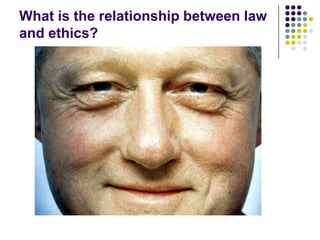
What is the relationship between law and ethics?
Is the law a litmus test for ethics?Can something be ethical yet be illegal…ok, stop thinking of medicinal marijuana…can something be illegal yet ethical for a PR practitioner?
General Ethical PrinciplesAct in the public interest.Find the greater good for the majority of the people. Use honesty and integrity as your guide. Ensure accuracy and truth.Do not disseminate false and misleading information.If you accidentally do, correct your error immediately with all audiences. Deal fairly with the public.Respect yourself, respect others.When you move to a new job, leave proprietary materials related to your old job behind.
Specific Ethical Principles Accurately define what public relations strategies and tactics can accomplish.Do not guarantee results for things beyond your control. Maintain the integrity of communication channels.Ensure transparency with all audiences, from employees to publics.Maintain ethical relationships with government, regulatory agencies, media, colleagues and allaudiences.Safeguard confidences.Build trust through protection of confidential information.Secure the privacy of organization and individuals. Do not damage the reputation of others.Be careful during agency pitches.Stick to the facts; avoid the gossip. Avoid conflicts of interest.Disclose interests of yourself and others.Get consent to represent conflicting views or competitors; maintain the related knowledge intwo different areas.Be ready to publicly identify your clients, sources of information, etc.
Ethical Decision Making GuideDefine issue/conflictIdentify factors that influenceIdentify key valuesIdentify parties affectedSelect principlesMake a decision
Case StudyYou are the communications director for a school district. A school board member who has been an outstanding advocate for the district is up for re-election. He calls to ask you if you would help with his re-election campaign.He says he values your communications expertise and needs help to defeat his opponent, who is very vocal about reducing administrative positions in the district. He considers them “fluff.” In fact, your job as communications director is at the top of his list and will likely be the first to go.You know you can’t work on the campaign during the workday but agree to work from home on the incumbent’s campaign. You don’t plan on telling anyone else you are helping him because what you do on your own time is your business.
Why is Accreditation Important?Public Relation Practitioners strive to be treated as professionals:Specialized education and body of knowledgeRecognized as essential serviceAutonomy and acceptance of personal responsibilityCodes of ethics and standards
lawII.
Legal Aspects of PRFirst Amendment“Congress shall make no law respecting an establishment of religion, or prohibiting the free exercise thereof; or abridging the freedom of speech, or of the press; or the right of the people peaceably to assemble, and to petition the Government for a redress of grievances.”
Dimension of the First AmendmentFree Speech vs. Commercial SpeechNike caseDepends on court – Conservative Supreme Court thinks Commercial Speech doesn’t existFreedom of the PressNYT vs. SullivanPublic Officials/Celebrities v. Private PersonsMust prove negligence
Legal SystemAdministrative Law (FCC Rulings)Common Law (based on precedent)Constitutional Law (government relationships)Criminal LawStatutory Law (UCC)Plaintiff, defendant, and tort
Freedom of Information ActAct allows for full or partial disclosure on information contained in U.S. Government documents9 exemptionsStates also legislate Open Records laws (how much does JoePa make???)
Examples of FOIA Exemptions…established by an Executive order to be kept secret in the interest of national defense or foreign policy … …related solely to the internal personnel rules and practices of an agency… specifically exempted from disclosure by statute ……trade secrets and commercial or financial information …
Libel and SlanderStatements or communication that diminish respect, goodwill, confidence, or esteem; or produce other adverse feelings about a person or institution.Sometimes referred to as defamation of characterSlander is “spoken” Libel is written
Libel/Slander ConditionsDefame someone’s reputationIdentify victimBe communicatedMalice or negligence or (prove injurious or damaging)
Libel/Slander DefenseTruthPrivilegeFair Comment
What is Privacy?Defined by Warren and Brandeis in Harvard law Review (1890) “as the right to be let alone." Privacy Act of 1974 recognizes this at the Supreme Court level.
Privacy and The Supreme CourtThe privacy issue reached the Supreme Court through the issues of abortion and contraception.Just a value-added tidbit that won’t be on the APR exam…that I’m aware of(!)
Prosser’s Categorization of PrivacyIn 1960 William Prosser, a legal scholar categorized four legal rights of privacy. Subsequently, many states and court systems have adopted his classification:1. Intrusion2. Disclosure of Private Facts3. False Light4. Misappropriation
ExamplesIntrusion - Galella vs. Onassis 1982Disclosure of private facts - 1975 case of surfer Mike Virgil v. Time (Sports Illustrated)False Light – Two cases of the GillsMisappropriation  - “Here’s Johnny” Portable Toilets
Lawsuits to the GillsSame photo of John and Shelia Gill appeared in 2 publications.  Two different captions appeared under the photo (which was taken without consent)Gill vs. Hearst (Harpers) 1953 (lost) Mentioned they were married…Gill vs. Curtis (LHJ) 1952 (won) “Love at First Sight…”
Privacy DefensesNewsworthinessConsent (age is an issue here)Public Record
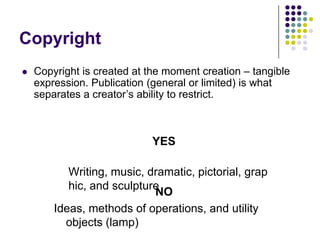
CopyrightCopyright is created at the moment creation – tangible expression. Publication (general or limited) is what separates a creator’s ability to restrict.YES Writing, music, dramatic, pictorial, graphic, and sculptureNOIdeas, methods of operations, and utility objects (lamp)
Common or Statutory ©?Two types of copyrights exist: common law copyright and statutory copyright Common exists from conception. No filing required. If the owner makes a General Publication, he/she loses the right to limit copyright. Limited Publication does not limit copyright.Statutory requires filing with the LOC. 28 years from date and another 28 years. Heirs can inherit.
Copyright Fair UseAbility of a critic, scholar, news reporter, or PR professional to quote briefly from copyrighted works while evaluating or commenting on them.PurposeNatureAmountEffect upon the market or value of copyrighted item
Trademark, Trade Name, Service MarkGeneral Electric“We bring good things to life”Trademark - words, names, or symbols used by companies to identify themselvesTrade name – identifies producerService mark – text that identifies a product, company, or service.
Financial PRRegulation Fair Disclosure (timing and positioning of news)Securities Trading (10-k, 10-Q reports)Fraud (insider info)Sarbanes Oxley
Sarbanes OxleySOX or SARBOXApplies only to public companiesHolds executives accountable by requiring them to sign financial statementsEnforced by the SECOutlines criminal penalties for corporate fraudHas XI titles, most of which are not germane to a financial PR practitioner (unless broken!)
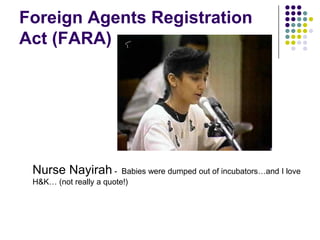
Foreign Agents Registration Act (FARA)Nurse Nayirah-  Babies were dumped out of incubators…and I love H&K… (not really a quote!)
FARA RequirementsEngages in political activities Acts in a public relations capacity for a foreign principal Solicits or dispenses any thing of value within the United States for a foreign principal Represents the interests of a foreign principal before any agency or official of the U.S. government.
More Legal Fun…Media AccessDue processSunshine ActPolitical Expression (corporate & union)LobbyingGrassroots Lobbying
Questions on Law & Ethics?
Information technologyIII.
Non-exhaustive list from Study GuideAddress/URL Anonymous Web surfingAudiocast Blog: BookmarkBreadcrumb trailCascading style sheetChannelChat roomChiclet (sp.) Content management systemCookieCounterCybersquattingDigitizationFAQFile transfer protocol ( FTP)ItemInternetNarrowcastNews feedPermission marketingPhishingPingPodcastPodcastingPodcatcherProxy serverPunchcastPush technologyRedirectionRSS aggregator/RSSL/RSS feedScrapingSpamSpoolSpywareStreaming mediaSyndication
IT on the ExamOnly 2% of questions come from ITSome IT questions arise from the business literacy areaPrevious exam had case studies – terminology is more appropriate for new exam
BlogsWeb logs – weblogs – blogsChronological musings of people posted to the web2 relevant aspects for PR: should we start one? Is the company receiving neg/pos publicity on a blog?Daypop is one of the few solid directories (but by no means exhaustive)
WebsitesWebpages are essential Basic contact informationArea tailored for media (or Online Newsroom)Clear Ownership of areas of the website should be employedContent Management issuesRichness vs. Reach
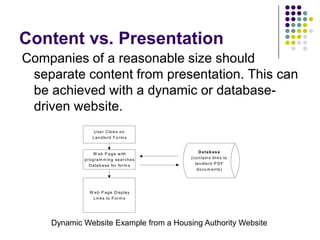
Content vs. PresentationCompanies of a reasonable size should separate content from presentation. This can be achieved with a dynamic or database-driven website.Dynamic Website Example from a Housing Authority Website
Other Website IssuesUse logs and statistics to track where people go on your siteHave a disclaimer and privacy statementReview any external link periodically for validityPay attention to usability…sometimes designers do notCreate consistency in message and distribution (all docs are PDFs for example)Have formal structures and policies for incoming information/contact us formsKnow/Identify/Segment your audience
EmailFind out whether a reporter likes email or notPermission marketing – do you know anyone who “opts in” for email from strangers? Me either!Email lists – different story. HersheyPark is one example. Achieve a balance.Run a successful removal program
News GroupsTechnical name is Usenet.Long History on the internet. Generally, groups are categorized by a common interest.Examples are rec., sci., alt., comp., Google Groups is best place to query. Google bought déjà news which was a pioneer in displaying groups in browser.Tile.net is a place to locate groups and listsChoose correct group & don’t post PR msgs.
List ServersDifferent than GroupsBasically, a broadcast email systemUseful for special events, practitioners, and people in a common industryCan lurk on a list (or chat room) that might say negative things about your company.
Section 508 complianceSection 508 requires that Federal agencies' electronic and information technology is accessible to people with disabilities.Not applicable to stateOften a good standard for all companies (and agencies)
Web 2.0 & Semantic WebExtensive amount of User Generated Content (UGC)Permits combination (mash up) of different sources of informationOften contains extensive interactive components (e.g. social networking, video, or applications)
Web 2.0 TechnologiesSocial Networking SitesBlogs (Weblogs)WikisVideoTwitterTaggingMashups
jkline@lvc.edu orjoel@joelkline.comContact Me At:

APR Ethics, Law &Technology

  • 1.
    Ethics, Law, &TechnologyAn APR Study Presentation by:Joel A. KlineAssociate Professor of Business and Digital CommunicationsLebanon Valley College
  • 2.
  • 3.
    What is therelationship between law and ethics?
  • 4.
    Is the lawa litmus test for ethics?Can something be ethical yet be illegal…ok, stop thinking of medicinal marijuana…can something be illegal yet ethical for a PR practitioner?
  • 5.
    General Ethical PrinciplesActin the public interest.Find the greater good for the majority of the people. Use honesty and integrity as your guide. Ensure accuracy and truth.Do not disseminate false and misleading information.If you accidentally do, correct your error immediately with all audiences. Deal fairly with the public.Respect yourself, respect others.When you move to a new job, leave proprietary materials related to your old job behind.
  • 6.
    Specific Ethical PrinciplesAccurately define what public relations strategies and tactics can accomplish.Do not guarantee results for things beyond your control. Maintain the integrity of communication channels.Ensure transparency with all audiences, from employees to publics.Maintain ethical relationships with government, regulatory agencies, media, colleagues and allaudiences.Safeguard confidences.Build trust through protection of confidential information.Secure the privacy of organization and individuals. Do not damage the reputation of others.Be careful during agency pitches.Stick to the facts; avoid the gossip. Avoid conflicts of interest.Disclose interests of yourself and others.Get consent to represent conflicting views or competitors; maintain the related knowledge intwo different areas.Be ready to publicly identify your clients, sources of information, etc.
  • 7.
    Ethical Decision MakingGuideDefine issue/conflictIdentify factors that influenceIdentify key valuesIdentify parties affectedSelect principlesMake a decision
  • 8.
    Case StudyYou arethe communications director for a school district. A school board member who has been an outstanding advocate for the district is up for re-election. He calls to ask you if you would help with his re-election campaign.He says he values your communications expertise and needs help to defeat his opponent, who is very vocal about reducing administrative positions in the district. He considers them “fluff.” In fact, your job as communications director is at the top of his list and will likely be the first to go.You know you can’t work on the campaign during the workday but agree to work from home on the incumbent’s campaign. You don’t plan on telling anyone else you are helping him because what you do on your own time is your business.
  • 9.
    Why is AccreditationImportant?Public Relation Practitioners strive to be treated as professionals:Specialized education and body of knowledgeRecognized as essential serviceAutonomy and acceptance of personal responsibilityCodes of ethics and standards
  • 10.
  • 11.
    Legal Aspects ofPRFirst Amendment“Congress shall make no law respecting an establishment of religion, or prohibiting the free exercise thereof; or abridging the freedom of speech, or of the press; or the right of the people peaceably to assemble, and to petition the Government for a redress of grievances.”
  • 12.
    Dimension of theFirst AmendmentFree Speech vs. Commercial SpeechNike caseDepends on court – Conservative Supreme Court thinks Commercial Speech doesn’t existFreedom of the PressNYT vs. SullivanPublic Officials/Celebrities v. Private PersonsMust prove negligence
  • 13.
    Legal SystemAdministrative Law(FCC Rulings)Common Law (based on precedent)Constitutional Law (government relationships)Criminal LawStatutory Law (UCC)Plaintiff, defendant, and tort
  • 14.
    Freedom of InformationActAct allows for full or partial disclosure on information contained in U.S. Government documents9 exemptionsStates also legislate Open Records laws (how much does JoePa make???)
  • 15.
    Examples of FOIAExemptions…established by an Executive order to be kept secret in the interest of national defense or foreign policy … …related solely to the internal personnel rules and practices of an agency… specifically exempted from disclosure by statute ……trade secrets and commercial or financial information …
  • 16.
    Libel and SlanderStatementsor communication that diminish respect, goodwill, confidence, or esteem; or produce other adverse feelings about a person or institution.Sometimes referred to as defamation of characterSlander is “spoken” Libel is written
  • 17.
    Libel/Slander ConditionsDefame someone’sreputationIdentify victimBe communicatedMalice or negligence or (prove injurious or damaging)
  • 18.
  • 19.
    What is Privacy?Definedby Warren and Brandeis in Harvard law Review (1890) “as the right to be let alone." Privacy Act of 1974 recognizes this at the Supreme Court level.
  • 20.
    Privacy and TheSupreme CourtThe privacy issue reached the Supreme Court through the issues of abortion and contraception.Just a value-added tidbit that won’t be on the APR exam…that I’m aware of(!)
  • 21.
    Prosser’s Categorization ofPrivacyIn 1960 William Prosser, a legal scholar categorized four legal rights of privacy. Subsequently, many states and court systems have adopted his classification:1. Intrusion2. Disclosure of Private Facts3. False Light4. Misappropriation
  • 22.
    ExamplesIntrusion - Galellavs. Onassis 1982Disclosure of private facts - 1975 case of surfer Mike Virgil v. Time (Sports Illustrated)False Light – Two cases of the GillsMisappropriation - “Here’s Johnny” Portable Toilets
  • 23.
    Lawsuits to theGillsSame photo of John and Shelia Gill appeared in 2 publications. Two different captions appeared under the photo (which was taken without consent)Gill vs. Hearst (Harpers) 1953 (lost) Mentioned they were married…Gill vs. Curtis (LHJ) 1952 (won) “Love at First Sight…”
  • 25.
    Privacy DefensesNewsworthinessConsent (ageis an issue here)Public Record
  • 26.
    CopyrightCopyright is createdat the moment creation – tangible expression. Publication (general or limited) is what separates a creator’s ability to restrict.YES Writing, music, dramatic, pictorial, graphic, and sculptureNOIdeas, methods of operations, and utility objects (lamp)
  • 27.
    Common or Statutory©?Two types of copyrights exist: common law copyright and statutory copyright Common exists from conception. No filing required. If the owner makes a General Publication, he/she loses the right to limit copyright. Limited Publication does not limit copyright.Statutory requires filing with the LOC. 28 years from date and another 28 years. Heirs can inherit.
  • 28.
    Copyright Fair UseAbilityof a critic, scholar, news reporter, or PR professional to quote briefly from copyrighted works while evaluating or commenting on them.PurposeNatureAmountEffect upon the market or value of copyrighted item
  • 29.
    Trademark, Trade Name,Service MarkGeneral Electric“We bring good things to life”Trademark - words, names, or symbols used by companies to identify themselvesTrade name – identifies producerService mark – text that identifies a product, company, or service.
  • 30.
    Financial PRRegulation FairDisclosure (timing and positioning of news)Securities Trading (10-k, 10-Q reports)Fraud (insider info)Sarbanes Oxley
  • 31.
    Sarbanes OxleySOX orSARBOXApplies only to public companiesHolds executives accountable by requiring them to sign financial statementsEnforced by the SECOutlines criminal penalties for corporate fraudHas XI titles, most of which are not germane to a financial PR practitioner (unless broken!)
  • 32.
    Foreign Agents RegistrationAct (FARA)Nurse Nayirah- Babies were dumped out of incubators…and I love H&K… (not really a quote!)
  • 33.
    FARA RequirementsEngages inpolitical activities Acts in a public relations capacity for a foreign principal Solicits or dispenses any thing of value within the United States for a foreign principal Represents the interests of a foreign principal before any agency or official of the U.S. government.
  • 34.
    More Legal Fun…MediaAccessDue processSunshine ActPolitical Expression (corporate & union)LobbyingGrassroots Lobbying
  • 35.
  • 36.
  • 37.
    Non-exhaustive list fromStudy GuideAddress/URL Anonymous Web surfingAudiocast Blog: BookmarkBreadcrumb trailCascading style sheetChannelChat roomChiclet (sp.) Content management systemCookieCounterCybersquattingDigitizationFAQFile transfer protocol ( FTP)ItemInternetNarrowcastNews feedPermission marketingPhishingPingPodcastPodcastingPodcatcherProxy serverPunchcastPush technologyRedirectionRSS aggregator/RSSL/RSS feedScrapingSpamSpoolSpywareStreaming mediaSyndication
  • 38.
    IT on theExamOnly 2% of questions come from ITSome IT questions arise from the business literacy areaPrevious exam had case studies – terminology is more appropriate for new exam
  • 39.
    BlogsWeb logs –weblogs – blogsChronological musings of people posted to the web2 relevant aspects for PR: should we start one? Is the company receiving neg/pos publicity on a blog?Daypop is one of the few solid directories (but by no means exhaustive)
  • 40.
    WebsitesWebpages are essentialBasic contact informationArea tailored for media (or Online Newsroom)Clear Ownership of areas of the website should be employedContent Management issuesRichness vs. Reach
  • 41.
    Content vs. PresentationCompaniesof a reasonable size should separate content from presentation. This can be achieved with a dynamic or database-driven website.Dynamic Website Example from a Housing Authority Website
  • 42.
    Other Website IssuesUselogs and statistics to track where people go on your siteHave a disclaimer and privacy statementReview any external link periodically for validityPay attention to usability…sometimes designers do notCreate consistency in message and distribution (all docs are PDFs for example)Have formal structures and policies for incoming information/contact us formsKnow/Identify/Segment your audience
  • 43.
    EmailFind out whethera reporter likes email or notPermission marketing – do you know anyone who “opts in” for email from strangers? Me either!Email lists – different story. HersheyPark is one example. Achieve a balance.Run a successful removal program
  • 44.
    News GroupsTechnical nameis Usenet.Long History on the internet. Generally, groups are categorized by a common interest.Examples are rec., sci., alt., comp., Google Groups is best place to query. Google bought déjà news which was a pioneer in displaying groups in browser.Tile.net is a place to locate groups and listsChoose correct group & don’t post PR msgs.
  • 45.
    List ServersDifferent thanGroupsBasically, a broadcast email systemUseful for special events, practitioners, and people in a common industryCan lurk on a list (or chat room) that might say negative things about your company.
  • 46.
    Section 508 complianceSection508 requires that Federal agencies' electronic and information technology is accessible to people with disabilities.Not applicable to stateOften a good standard for all companies (and agencies)
  • 47.
    Web 2.0 &Semantic WebExtensive amount of User Generated Content (UGC)Permits combination (mash up) of different sources of informationOften contains extensive interactive components (e.g. social networking, video, or applications)
  • 48.
    Web 2.0 TechnologiesSocialNetworking SitesBlogs (Weblogs)WikisVideoTwitterTaggingMashups
  • 49.