Chapter 4 –
Steps in Ethical
Decision Making
Here starts
the lesson!
01
Lesson 1 Ethical Reasoning
Lesson 2 Principle of
Beneficence
Lesson 3 Step Guide to Ethical
Decision
Lesson 1 Ethical Reasoning
REASON
– is the capacity for consciously making
sense of things, establishing and
verifying facts, applying logic and
changing or justifying practices,
institutions and beliefs based on new or
existing information (Kompridis, 2000).
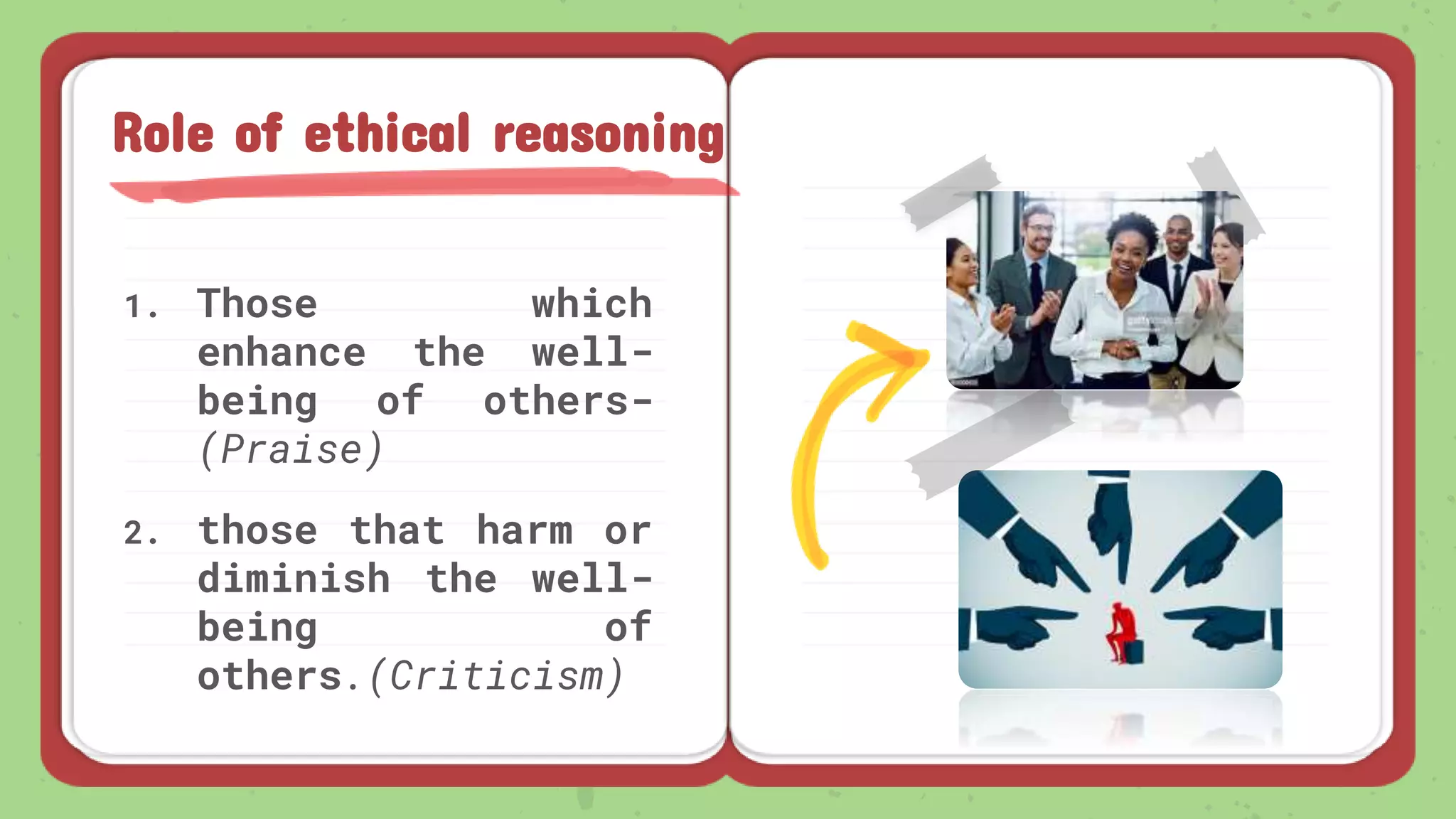
1. Those which
enhance the well-
being of others-
(Praise)
2. those that harm or
diminish the well-
being of
others.(Criticism)
Role of ethical reasoning
It’s quite scary to think that there are
people out there who are voting,
protesting, financing causes or running
campaigns without any clear idea of why
they are doing it. Each and every one of
us should be clear about our reasons for
our values, beliefs and behaviors and we
should be able to give a reasoned
account of them to others.
– also called even-handedness or fair-
mindedness is a principle of justice
holding that decisions should be based
on objective criteria, rather than on
the basis of bias, prejudice or
preferring the benefit to one person
over another for improper reasons.
IMPARTIALITY
- Impartiality makes no discrimination
as to nationality, race, religious
beliefs, class or political opinions.
IMPARTIALITY
 Cultural relativism is the
ability to understand
a culture on its own terms and
not to make judgments using
the standards of one's
own culture. The goal of this
is promote understanding
of cultural practices that are
not typically part of one's
own culture.
CULTURAL RELATIVISM
PREDICTING
CONSEQUENCES
Reason only informs you about what transpired
and how. So in assessing moral value of an
incident, will you based your moral
valuations solely on feelings? How do you
think can moral impartiality help in
resolving a societal issue such as racism and
sexism?
Relate to Practice
Lesson 2
Principle of Beneficence
- The generic definition of beneficence is
an act of charity, mercy, and kindness.
- An example of this is what has become
known as a random act of kindness.
BENEFICENCE
If one of your family members is about to be
put to jail for something, he had done wrong,
how will you react on this scenario? Unto
what extent would you take risk of saving
him/her? Will you let your feelings get the
best of you or will you let your sound moral
reasoning take part? Explain your answer.
Case Analysis: answer the following questions
after comprehending the case presented
below.
Lesson 3
Step Guide to Ethical
Decision
THE SEVEN (7) STEP
GUIDES TO ETHICAL
DECISION MAKING AND
MORAL REASONING
of Michael Davis
– Determine the possible moral dilemmas at
hand. Is there something about your judgment
and/or decision that make you uncomfortable?
Is there any conflict of interest present?
1. State the problem
– When we examine a scenario closely, what is
initially identified as a problem or dilemma
can surprisingly disappear. Some, on the
other hand, can be amplified or altered
radically due to new details that might come
to the light upon closer scrutiny.
2. Check the facts
– Who are the people involved? What laws or
professional codes can possibly apply? Are
there practical constraints? (For example:
You are a journalist and you were given 5000
php by a politician whom the article you are
currently writing is about. Will the money
create conflict of interest?)
3. Identify relevant factors
– Do you have a set of alternatives to the
action or decision (in relation to a given
scenario) in mind? Be creative and develop a
list of other choices. Avoid the binarism of
“yes/no” questions in making moral decisions
(such as “Should I do it or not?”). Identify
people you can potentially approach who may
provide fresh perspectives on the situation
you are confronted with.
4. Develop a list of options
– Michael Davis has included several test
that may prove to be useful where one is
weighing in on his/her choices and decisions:
5. Test the options
Harm Test – Would less harm be done on other
people when I favour this one decision over
the others?
Publicity Test – Would I be proud of this
decision if it makes the evening news? Would
I want my loved ones to know?
Defensibility Test – Would I be able to
defend this decision before the court or a
panel of reviewers without appearing self-
serving?
Test the options
Reversibility Test – Would I still prefer my option of
choice if it were to have some adverse effects on me
instead of others? Would I still want it despite the
implications?
Colleague Test – How would my profession’s ethics
committee see the option? What would they say?
Organization Test – What would my company’s (or
organization) ethics officials and/or legal counsel say
regarding the option?
Virtue Test – What kind of person would also choose such
an option? Is he/she who someone might consider as
“virtuous”? What would I become of me if I enact this
option all the time?
Test the options
6. Come with a choice or decision based on the
abovementioned steps.
7. Review Steps 1-6 - What can you do to prevent making
such a decision again? Are there precautions to take?
What changes should be affected on an organizational and
personal level (such as reviewing policy or being a more
discerning employee, among others)? Would it be possible
to get more support next time?
Before you make a major decision, think of
the following question again: Will these
leads me to the right path? Will I be able to
face the consequences justly? Will this help
me to become a better individual?
Relate to Practice
Directions: Analyze and comprehend the given
scenario below applying what you have learned from
the previous chapter. Answer the follow-up
questions after the case study presented.
Situation:
Romeo and Jerome are good friends. They are brothers not
by blood but by heart. Both of them are already a
graduate of the same program and together landed the
same job. One of the most important things to do
routinely is to report to your work place ahead of time.
One day Jerome appeared to work one and a half hour late
in his shift. Then he uttered “Andyan ka naman eh.”
signifying that you’ll cover his mistake his fault for
the day.
A week before the release of salary, the person
in-charge asked for all of your attendance manually due
loss of record. Jerome told him that he did not commit
any record of late and absence in his attendance. It was
noted by the person in-charge and turned to you to ask
the same question.
Questions:
1. If you are caught in this situation, how will you be
solving the problem? Present your ideas using the duty-
oriented and principled reasoning. Remember that in this
form of reasoning, it is not the consequences that are
considered but rather the principle involved.
2. If you are Jerome, what will you do?
3. If you are Romeo, how will you manage the situation?
Applying what you learned in this chapter, how does
ethical decision- making affect your daily living?
Chapter 4 – Steps in Ethical Decision Making.pptx

Chapter 4 – Steps in Ethical Decision Making.pptx

  • 1.
    Chapter 4 – Stepsin Ethical Decision Making Here starts the lesson!
  • 2.
    01 Lesson 1 EthicalReasoning Lesson 2 Principle of Beneficence Lesson 3 Step Guide to Ethical Decision
  • 3.
    Lesson 1 EthicalReasoning REASON – is the capacity for consciously making sense of things, establishing and verifying facts, applying logic and changing or justifying practices, institutions and beliefs based on new or existing information (Kompridis, 2000).
  • 4.
    1. Those which enhancethe well- being of others- (Praise) 2. those that harm or diminish the well- being of others.(Criticism) Role of ethical reasoning
  • 5.
    It’s quite scaryto think that there are people out there who are voting, protesting, financing causes or running campaigns without any clear idea of why they are doing it. Each and every one of us should be clear about our reasons for our values, beliefs and behaviors and we should be able to give a reasoned account of them to others.
  • 6.
    – also calledeven-handedness or fair- mindedness is a principle of justice holding that decisions should be based on objective criteria, rather than on the basis of bias, prejudice or preferring the benefit to one person over another for improper reasons. IMPARTIALITY
  • 7.
    - Impartiality makesno discrimination as to nationality, race, religious beliefs, class or political opinions. IMPARTIALITY
  • 9.
     Cultural relativismis the ability to understand a culture on its own terms and not to make judgments using the standards of one's own culture. The goal of this is promote understanding of cultural practices that are not typically part of one's own culture. CULTURAL RELATIVISM
  • 10.
  • 11.
    Reason only informsyou about what transpired and how. So in assessing moral value of an incident, will you based your moral valuations solely on feelings? How do you think can moral impartiality help in resolving a societal issue such as racism and sexism? Relate to Practice
  • 12.
  • 13.
    - The genericdefinition of beneficence is an act of charity, mercy, and kindness. - An example of this is what has become known as a random act of kindness. BENEFICENCE
  • 14.
    If one ofyour family members is about to be put to jail for something, he had done wrong, how will you react on this scenario? Unto what extent would you take risk of saving him/her? Will you let your feelings get the best of you or will you let your sound moral reasoning take part? Explain your answer. Case Analysis: answer the following questions after comprehending the case presented below.
  • 15.
    Lesson 3 Step Guideto Ethical Decision
  • 16.
    THE SEVEN (7)STEP GUIDES TO ETHICAL DECISION MAKING AND MORAL REASONING of Michael Davis
  • 17.
    – Determine thepossible moral dilemmas at hand. Is there something about your judgment and/or decision that make you uncomfortable? Is there any conflict of interest present? 1. State the problem
  • 18.
    – When weexamine a scenario closely, what is initially identified as a problem or dilemma can surprisingly disappear. Some, on the other hand, can be amplified or altered radically due to new details that might come to the light upon closer scrutiny. 2. Check the facts
  • 19.
    – Who arethe people involved? What laws or professional codes can possibly apply? Are there practical constraints? (For example: You are a journalist and you were given 5000 php by a politician whom the article you are currently writing is about. Will the money create conflict of interest?) 3. Identify relevant factors
  • 20.
    – Do youhave a set of alternatives to the action or decision (in relation to a given scenario) in mind? Be creative and develop a list of other choices. Avoid the binarism of “yes/no” questions in making moral decisions (such as “Should I do it or not?”). Identify people you can potentially approach who may provide fresh perspectives on the situation you are confronted with. 4. Develop a list of options
  • 21.
    – Michael Davishas included several test that may prove to be useful where one is weighing in on his/her choices and decisions: 5. Test the options
  • 22.
    Harm Test –Would less harm be done on other people when I favour this one decision over the others? Publicity Test – Would I be proud of this decision if it makes the evening news? Would I want my loved ones to know? Defensibility Test – Would I be able to defend this decision before the court or a panel of reviewers without appearing self- serving? Test the options
  • 23.
    Reversibility Test –Would I still prefer my option of choice if it were to have some adverse effects on me instead of others? Would I still want it despite the implications? Colleague Test – How would my profession’s ethics committee see the option? What would they say? Organization Test – What would my company’s (or organization) ethics officials and/or legal counsel say regarding the option? Virtue Test – What kind of person would also choose such an option? Is he/she who someone might consider as “virtuous”? What would I become of me if I enact this option all the time? Test the options
  • 24.
    6. Come witha choice or decision based on the abovementioned steps. 7. Review Steps 1-6 - What can you do to prevent making such a decision again? Are there precautions to take? What changes should be affected on an organizational and personal level (such as reviewing policy or being a more discerning employee, among others)? Would it be possible to get more support next time?
  • 25.
    Before you makea major decision, think of the following question again: Will these leads me to the right path? Will I be able to face the consequences justly? Will this help me to become a better individual? Relate to Practice
  • 26.
    Directions: Analyze andcomprehend the given scenario below applying what you have learned from the previous chapter. Answer the follow-up questions after the case study presented.
  • 27.
    Situation: Romeo and Jeromeare good friends. They are brothers not by blood but by heart. Both of them are already a graduate of the same program and together landed the same job. One of the most important things to do routinely is to report to your work place ahead of time. One day Jerome appeared to work one and a half hour late in his shift. Then he uttered “Andyan ka naman eh.” signifying that you’ll cover his mistake his fault for the day. A week before the release of salary, the person in-charge asked for all of your attendance manually due loss of record. Jerome told him that he did not commit any record of late and absence in his attendance. It was noted by the person in-charge and turned to you to ask the same question.
  • 28.
    Questions: 1. If youare caught in this situation, how will you be solving the problem? Present your ideas using the duty- oriented and principled reasoning. Remember that in this form of reasoning, it is not the consequences that are considered but rather the principle involved. 2. If you are Jerome, what will you do? 3. If you are Romeo, how will you manage the situation? Applying what you learned in this chapter, how does ethical decision- making affect your daily living?