Lesson 3.2
Four Subsystems
of Earth
Objective
describe each major
subsystem of Earth.
1
At the end
of the
lesson, you
should be
able to:
Learn about it!
The Earth has 4 major
subsystems, namely:
● The atmosphere,
● The geosphere,
● The hydrosphere, and
● The biosphere.
Each subsystem interacts with the other
subsystems.
The interaction between these subsystems makes
many processes on Earth possible.
Learn about it!
The Atmosphere
● The atmosphere makes up of
all the gases on Earth.
● The atmosphere has
different layers: troposphere,
stratosphere, mesosphere,
thermosphere, and
exosphere.
Layers of the atmosphere.
Learn about it!
The Geosphere
● Geosphere comes from
the Greek word geo
which means ground.
● It includes all the soil,
rocks, and minerals
present in the crust to
the core of Earth.
Internal structure of Earth
Learn about it!
This is the outermost
layer, and is solid.
Crust
This is the middle layer,
and is liquid.
Mantle
Layers of the Geosphere
This is the innermost
layer, and is solid.
Core
Learn about it!
The Hydrosphere
● It is composed of all water on
Earth in any form: water
vapor, liquid water, and ice.
● It is comprised of 97.5%
saltwater and 2.5%
freshwater.
The hydrosphere comprised of
97.5% saltwater.
Learn about it!
The Biosphere
● It includes all the
organisms on Earth.
Biosphere consists of all living things
including the microorganisms.
Key Points
The Atmosphere
includes the gases, and has 5 distinct layers.
The Geosphere
includes the ground, and has 3 distinct layers.
The Hydrosphere
includes all of the watery environments on the planet.
The Biosphere
includes all the planet’s organisms.
1
2
3
4
Check Your Understanding
A. Match the item to the sphere where it belongs by checking the box
under its field.
Lesson 3.4
The Biogeochemical
Cycles
Objectives
identify some of the
biogeochemical
processes that take place
on Earth; and
1
2
describe the movement
of matter such as water,
nitrogen, oxygen, and
carbon dioxide in their
respective cycles.
At the end
of the
lesson, you
should be
able to:
The Earth has multiple cycles of energy and matter
that affect many of its subsystems.
Some of these cycles even affect multiple
subsystems at the same time.
Learn about it!
The Hydrologic Cycle
● The movement of
water from the ocean
to the atmosphere to
land and back to the
ocean is called the
water or hydrologic
cycle.
The water cycle
Learn about it!
1
2
3
Steps of the Hydrologic Cycle
Evapotranspiration
liquid water to gas
Condensation
the formation of clouds
Precipitation
the release of water from clouds
Learn about it!
The Nitrogen Cycle
● It refers to the
transference and
conversion of nitrogen
across many forms.
Learn about it!
2
3
4
1
Steps of the Nitrogen Cycle
Nitrogen Fixation
atmospheric to usable nitrogen
Nitrification
ammonia/ammonium to
nitrite/nitrates
Ammonification
nitrogen releases as
ammonia after
decomposition
Denitrification
nitrogen returns to the
atmosphere
Learn about it!
Nitrogen Cycle
● Both organisms and
natural processes (like
lightning) play a role in
the nitrogen cycle.
Lightning plays a role in the
nitrogen cycle
Learn about it!
Carbon and Oxygen Cycle
● It includes the
photosynthesis and
respiration of
organisms, as well as
some natural
processes.
The carbon and oxygen cycle
Learn about it!
Carbon and Oxygen Cycle
● The most well-known among these are respiration in
animals and photosynthesis in plants.
● Respiration uses oxygen and releases carbon dioxide.
Photosynthesis uses carbon dioxide and releases
oxygen.
Key Points
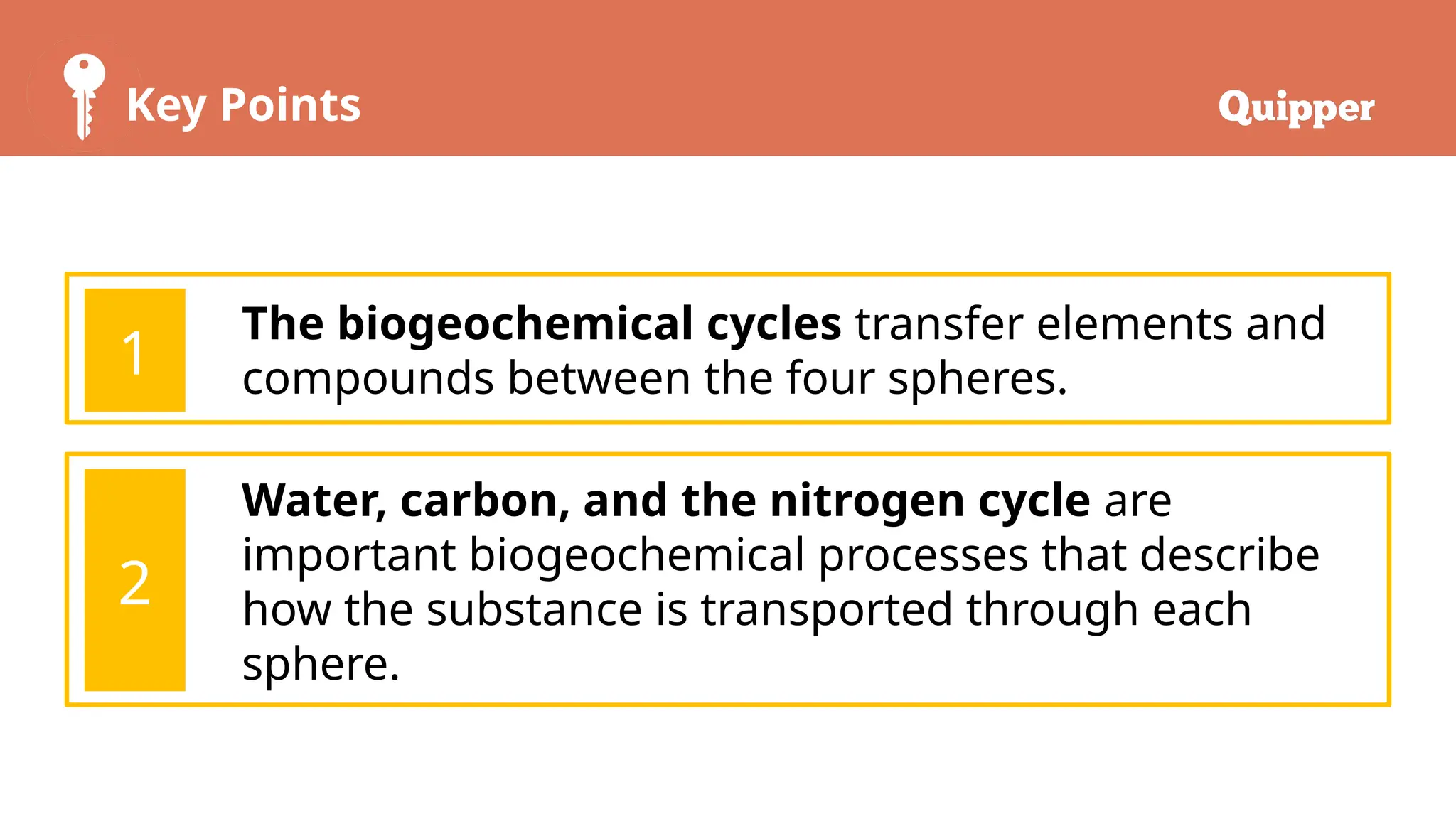
The biogeochemical cycles transfer elements and
compounds between the four spheres.
Water, carbon, and the nitrogen cycle are
important biogeochemical processes that describe
how the substance is transported through each
sphere.
1
2
Check Your Understanding
1. This is the path that an element takes across Earth’s
subsystems.
2. This is also known as the water cycle.
3. This is the transformation of water from liquid to gas.
4. This is the process that release water from the clouds.
5. This is the process that converts atmospheric nitrogen into
usable nitrogen by organisms.
Fill in the blanks with the correct answer.
Check Your Understanding
6. This is the conversion of ammonia and ammonium into nitrites
and nitrates.
7. This is the re-release of nitrogen back into the atmosphere.
8. This is the process done by plants to produce oxygen and
glucose.
9. Precipitation is the release of water from clouds in the form
of_____.
10. The condensation of water vapor results into the formation of
______.
Identify what was being described.
Check Your Understanding
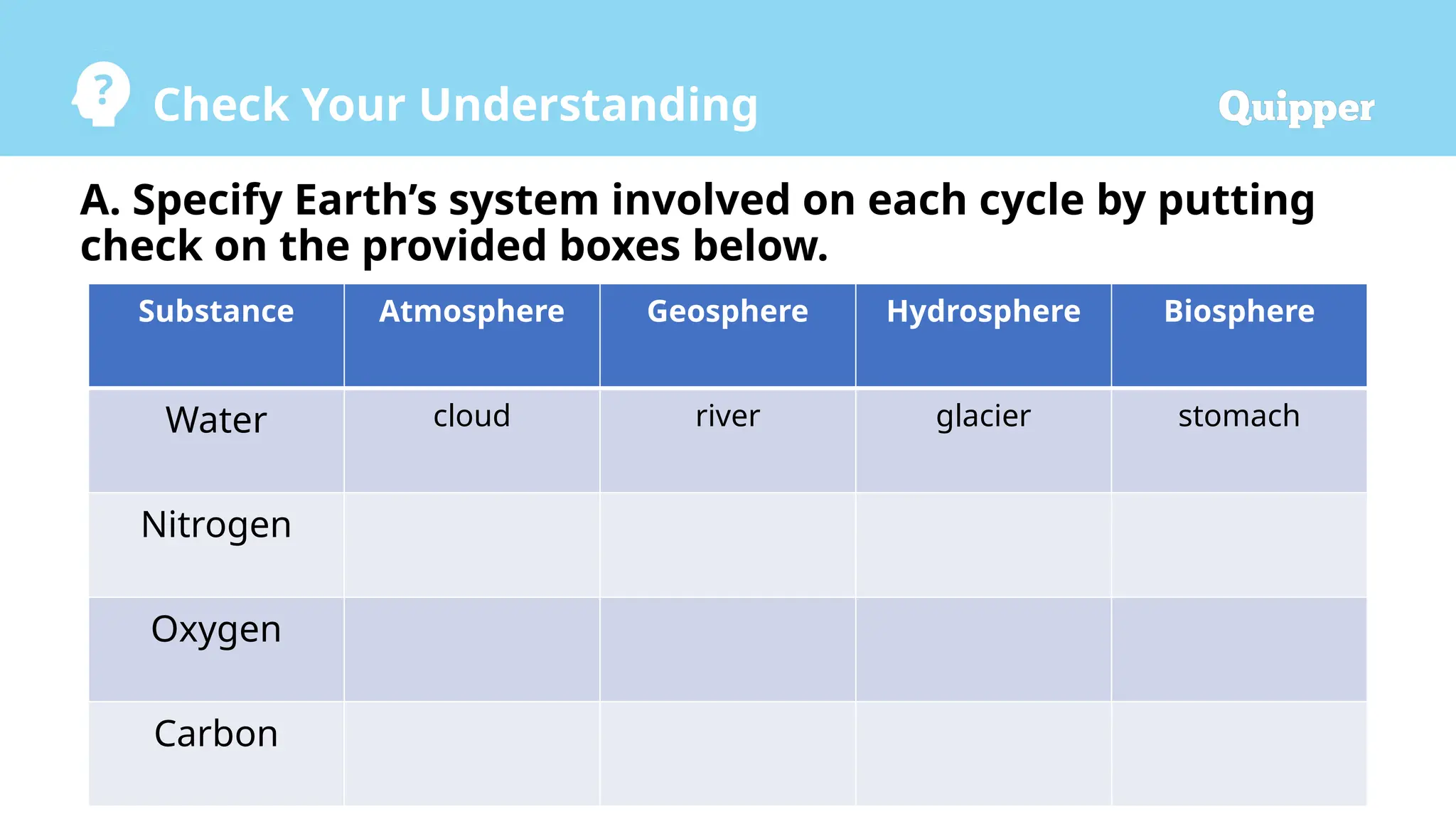
A. Specify Earth’s system involved on each cycle by putting
check on the provided boxes below.
Substance Atmosphere Geosphere Hydrosphere Biosphere
Water cloud river glacier stomach
Nitrogen
Oxygen
Carbon
Check Your Understanding
B. Label the sequences in the water cycle from A-C, starting from
evaporation:
1. ____ Evapotranspiration
2. ____ Precipitation
3. ____ Condensation
C. Label the sequences in the nitrogen cycle from A-D, starting from the
conversion of atmospheric nitrogen to biologically available nitrogen:
1. ____ Ammonification
2. ____ Denitrification
3. ____ Nitrification
4. ____ Nitrogen Fixation

Week 2 Unit 3 Introduction to Earth SS.pptx

  • 1.
  • 2.
    Objective describe each major subsystemof Earth. 1 At the end of the lesson, you should be able to:
  • 3.
    Learn about it! TheEarth has 4 major subsystems, namely: ● The atmosphere, ● The geosphere, ● The hydrosphere, and ● The biosphere.
  • 4.
    Each subsystem interactswith the other subsystems. The interaction between these subsystems makes many processes on Earth possible.
  • 5.
    Learn about it! TheAtmosphere ● The atmosphere makes up of all the gases on Earth. ● The atmosphere has different layers: troposphere, stratosphere, mesosphere, thermosphere, and exosphere. Layers of the atmosphere.
  • 6.
    Learn about it! TheGeosphere ● Geosphere comes from the Greek word geo which means ground. ● It includes all the soil, rocks, and minerals present in the crust to the core of Earth. Internal structure of Earth
  • 8.
    Learn about it! Thisis the outermost layer, and is solid. Crust This is the middle layer, and is liquid. Mantle Layers of the Geosphere This is the innermost layer, and is solid. Core
  • 9.
    Learn about it! TheHydrosphere ● It is composed of all water on Earth in any form: water vapor, liquid water, and ice. ● It is comprised of 97.5% saltwater and 2.5% freshwater. The hydrosphere comprised of 97.5% saltwater.
  • 10.
    Learn about it! TheBiosphere ● It includes all the organisms on Earth. Biosphere consists of all living things including the microorganisms.
  • 11.
    Key Points The Atmosphere includesthe gases, and has 5 distinct layers. The Geosphere includes the ground, and has 3 distinct layers. The Hydrosphere includes all of the watery environments on the planet. The Biosphere includes all the planet’s organisms. 1 2 3 4
  • 12.
    Check Your Understanding A.Match the item to the sphere where it belongs by checking the box under its field.
  • 13.
  • 14.
    Objectives identify some ofthe biogeochemical processes that take place on Earth; and 1 2 describe the movement of matter such as water, nitrogen, oxygen, and carbon dioxide in their respective cycles. At the end of the lesson, you should be able to:
  • 15.
    The Earth hasmultiple cycles of energy and matter that affect many of its subsystems. Some of these cycles even affect multiple subsystems at the same time.
  • 16.
    Learn about it! TheHydrologic Cycle ● The movement of water from the ocean to the atmosphere to land and back to the ocean is called the water or hydrologic cycle. The water cycle
  • 17.
    Learn about it! 1 2 3 Stepsof the Hydrologic Cycle Evapotranspiration liquid water to gas Condensation the formation of clouds Precipitation the release of water from clouds
  • 18.
    Learn about it! TheNitrogen Cycle ● It refers to the transference and conversion of nitrogen across many forms.
  • 19.
    Learn about it! 2 3 4 1 Stepsof the Nitrogen Cycle Nitrogen Fixation atmospheric to usable nitrogen Nitrification ammonia/ammonium to nitrite/nitrates Ammonification nitrogen releases as ammonia after decomposition Denitrification nitrogen returns to the atmosphere
  • 20.
    Learn about it! NitrogenCycle ● Both organisms and natural processes (like lightning) play a role in the nitrogen cycle. Lightning plays a role in the nitrogen cycle
  • 21.
    Learn about it! Carbonand Oxygen Cycle ● It includes the photosynthesis and respiration of organisms, as well as some natural processes. The carbon and oxygen cycle
  • 22.
    Learn about it! Carbonand Oxygen Cycle ● The most well-known among these are respiration in animals and photosynthesis in plants. ● Respiration uses oxygen and releases carbon dioxide. Photosynthesis uses carbon dioxide and releases oxygen.
  • 23.
    Key Points The biogeochemicalcycles transfer elements and compounds between the four spheres. Water, carbon, and the nitrogen cycle are important biogeochemical processes that describe how the substance is transported through each sphere. 1 2
  • 24.
    Check Your Understanding 1.This is the path that an element takes across Earth’s subsystems. 2. This is also known as the water cycle. 3. This is the transformation of water from liquid to gas. 4. This is the process that release water from the clouds. 5. This is the process that converts atmospheric nitrogen into usable nitrogen by organisms. Fill in the blanks with the correct answer.
  • 25.
    Check Your Understanding 6.This is the conversion of ammonia and ammonium into nitrites and nitrates. 7. This is the re-release of nitrogen back into the atmosphere. 8. This is the process done by plants to produce oxygen and glucose. 9. Precipitation is the release of water from clouds in the form of_____. 10. The condensation of water vapor results into the formation of ______. Identify what was being described.
  • 26.
    Check Your Understanding A.Specify Earth’s system involved on each cycle by putting check on the provided boxes below. Substance Atmosphere Geosphere Hydrosphere Biosphere Water cloud river glacier stomach Nitrogen Oxygen Carbon
  • 27.
    Check Your Understanding B.Label the sequences in the water cycle from A-C, starting from evaporation: 1. ____ Evapotranspiration 2. ____ Precipitation 3. ____ Condensation C. Label the sequences in the nitrogen cycle from A-D, starting from the conversion of atmospheric nitrogen to biologically available nitrogen: 1. ____ Ammonification 2. ____ Denitrification 3. ____ Nitrification 4. ____ Nitrogen Fixation

Editor's Notes

  • #3 How do the subsystems of Earth interact with one another? Each sphere is comprised of matter that are similar in nature, which is also the basis for their names. Each subsystem interacts with the other subsystems in maintaining balance and equilibrium in Earth’s system. The interaction between these subsystems makes many processes on Earth possible.
  • #5 The troposphere extends to about 14.5 km above the surface of Earth. It is the lowest layer where the weather disturbances occur. The stratosphere is found 14.5 to 50 km above Earth’s surface. The ozone layer that protects Earth from the sun’s harmful UV radiation is part of this layer. The mesosphere extends from 50 to 85 km above Earth’s surface. It protects Earth from the impact of space debris. The coldest temperatures on Earth, at -90°C are found near the top of this layer. The thermosphere is found 85 to 600 km above Earth’s surface. It has charged particles that are affected by Earth’s magnetic field. The particles create the Auroras or Northern and Southern lights. Many satellites also orbit Earth in this layer. The exosphere is the outermost layer. It extends to about 10 000 km above Earth’s surface, though there is no clear boundary where the exosphere ends, and space begins.
  • #7 Crust-Mantle (Mohorovicic Discontinuity) Mantle-Core (Gutenberg Discontinuity) Outer Core-Inner Core (Bullen Discontinuity)
  • #8 The crust is the outermost layer of the geosphere. It is made mostly of silicate materials. There are two different types of crust, the oceanic and continental crusts. The boundary between the crust and mantle is known as the Mohorovicic discontinuity or Moho. The mantle is a 2 900 km thick layer below the crust that is mostly made up of silicate rocks rich in magnesium and iron. Mantle’s temperature increases with its depth. The uppermost mantle is cold and brittle, and together with the crust forms the lithosphere. It is broken up into tectonic plates. The asthenosphere is the layer directly beneath the lithosphere is hot enough to flow and minimally melt, allowing the lithospheric or tectonic plates above to move. Outer and Inner core are separated by a boundary called Bullen discontinuity.
  • #12 NOT A QUIZ. FOR ORAL RECITATION ONLY 1. biosphere 2. atmosphere 3. hydrosphere 4. geosphere 5. biosphere 6. hydrosphere 7. atmosphere 8. geosphere 9. biosphere 10.atmosphere
  • #15 Earth’s subsystems are consists of several compounds like water, nitrogen, carbon, and oxygen that are essential to sustain life. Interactions between the subsystems and living organisms allow recycling of these materials to make Earth a self regulating system. A biogeochemical cycle is a complete path an element or a compound takes through the four subsystems of Earth—atmosphere, geosphere, hydrosphere, and biosphere. Biogeochemical cycles include water, nitrogen, carbon dioxide, and oxygen cycles
  • #17 Evapotranspiration. The sun heats up bodies of water, such as oceans and rivers, and also moisture from land and vegetation. Water undergoes evaporation​. It transforms from liquid to gas. Also, plants release water vapor through the pores under the leaves in the process known as transpiration​. These two processes are sometimes coined together to refer to the process that transfers water from land to the atmosphere called evapotranspiration. Condensation. Lighter water vapor cools as it reaches a certain altitude, and forms tiny floating droplets. As a result, clouds form. This process is called condensation​. Clouds are not the only manifestation of condensation. Ground-level fog and glasses fogging up in rooms also result from this process. Precipitation is the release of water from clouds in the form of rain, sleet, hail or snow. For this to happen, water droplets must collide with each other or condense on smaller dust, salt, or smoke particles which serve as the nucleus. Around 60% of precipitation on land evaporates back to the atmosphere each year while 40% returns to the ocean as ​runoff​.
  • #18 The nitrogen cycle is the movement of nitrogen between the four spheres. essential to life’s protein synthesis; Organisms can’t use molecular nitrogen directly that is why conversion of this element into other forms is vital.
  • #19 https://www.youtube.com/watch?v=K5EOZenSSB8 Nitrogen fixation is the process of converting atmospheric nitrogen into biologically available nitrogen (ammonium compounds). Molecular nitrogen (N​2 ) is a very stable compound due to the strong bond between the two nitrogen atoms. Hence, the bond requires a large amount of energy to break. Only a selected group of prokaryotes can carry out reactions that break such bond. These prokaryotes are called nitrogen-fixing bacteria. Ammonification is the process where fungi and prokaryotes decompose the dead tissue of organisms and release the inorganic nitrogen back into the ecosystem as ammonia. It is also known as nitrogen mineralization. Nitrification is a process that converts ammonia and ammonium compounds into nitrite and then to nitrate. Most nitrification process occurs aerobically (requires oxygen) and is carried out exclusively by prokaryotes. The nitrates and nitrites are utilized by land plants and algae in water bodies. Plants, algae, and bacteria then convert the inorganic forms of nitrogen compounds through different chemical reactions. Denitrification involves the process of releasing nitrogen back to the atmosphere. Through denitrifying bacteria, organic compounds from dead organisms are converted back to ammonia, nitrate, or molecular nitrogen.
  • #20 As lightning blasts through the atmosphere, it breaks apart nitrogen molecules. This allows them to combine with oxygen in the air to form nitrogen oxides. The rain dissolves these into nitrates, then carries them to Earth and into the soil. Lightning strikes can more than double some mushroom crops, according to ongoing experiments that are jolting fungi with electricity.
  • #21 Carbon is present in many forms ranging from compounds found in living organisms to fossil fuels. Carbon, in its gaseous state in the form of carbon dioxide (CO​2 ) and methane (CH​4 ), enters the atmosphere through respiration, combustion or burning of organic compounds, and diffusion from the ocean. This is the process done by plants to produce oxygen and glucose. Photosynthesis of plants and photosynthetic bacteria and diffusion into the oceans remove carbon from the atmosphere. Photosynthesis is the process by which organisms convert carbon dioxide and water from the environment into glucose and oxygen. Carbon is present in many forms ranging from compounds found in living organisms to fossil fuels. Carbon, in its gaseous state in the form of carbon dioxide (CO​2 ) and methane (CH​4 ), enters the atmosphere through respiration, combustion or burning of organic compounds, and diffusion from the ocean. This is the process done by plants to produce oxygen and glucose. Photosynthesis of plants and photosynthetic bacteria and diffusion into the oceans remove carbon from the atmosphere. Photosynthesis is the process by which organisms convert carbon dioxide and water from the environment into glucose and oxygen. Carbon is present in many forms ranging from compounds found in living organisms to fossil fuels. Carbon, in its gaseous state in the form of carbon dioxide (CO​2 ) and methane (CH​4 ), enters the atmosphere through respiration, combustion or burning of organic compounds, and diffusion from the ocean. This is the process done by plants to produce oxygen and glucose. Photosynthesis of plants and photosynthetic bacteria and diffusion into the oceans remove carbon from the atmosphere. Photosynthesis is the process by which organisms convert carbon dioxide and water from the environment into glucose and oxygen.
  • #24 Biogeochemical cycle Hydrologic cycle Evaporation Precipitation Nitrogen Fixation
  • #25 Nitrification Denitrification Photosynthesis Rain, snow, sleet or hail Clouds
  • #26 ½ crosswise: COPY AND ANSWER 3 PARTS. NEXT SLIDE