Poetry Elements for
Specific
Forms
LEARNING COMPETENCY:
●
Determine specific forms and
conventions of poetry
●
(HUMSS_CW/MP11/12c-f-7)
Types of Poetry
●
1. Traditional or Conventional
●
2. Modern or Contemporary
Types of Poetry
●
1. Traditional or Conventional
– follows standard rules of
grammar and syntax with a
regular rhythm and rhyme
scheme.
Types of Poetry
●
The sonnet, ode, blank verse,
ballad, dramatic monologue,
each have formal elements that
poets follow. For example, the
sonnet is a 14-line poem in a
iambic pentameter with a set
rhyme scheme.
On the Sea
●
It keeps eternal whispering around
●
Desolate shores, and with its mighty swell
●
Gluts twice ten thousand Caverns, till the spell
●
Of Hecate leaves them their old shadowy sound.
●
Often ‘tis in such gentle temper found,
●
That scarcely will the very smallest shell
●
Be mov’d for days from where it sometime fell,
●
When last the winds of Heaven were unbound.
●
Oh ye! Who have your eye-balls vex’d and tir’d,
●
Feast them upon the wideness of the Sea;
●
Oh ye! Whose ears are dinn’d with uproar rude.
●
Or fed too much with cloying melody—
●
Sit ye near some old Cavern’s Mouth, and brood
●
Until ye start, as if the sea-nymphs quir’d!
Analysis
●
This poem was written back in 1817 by a
popular romantic poet, John Keats. In this
sonnet, he addresses people who are
disturbed and irritated from the uproar of
life and suggests they should seek comfort
by the seaside. The sea’s mystery, power,
and vastness will not only comfort their
noisiest mind but also transport them to a
world of imagination.
Types of Poetry
●
2. Modern or Contemporary –
avoids rhyme and standard
grammatical organization and
seeks new ways of expression. It
is most common written in free
verse (unrhymed rhymes), and
the language is accessible to the
common reader.
The Peace of Wild Things
When despair for the world grows in me
and I wake in the night at the least sound
in fear of what my life and my children’s lives may be,
I go and lie down where the wood drake
rests in his beauty on the water, and the great heron feeds.
I come into the peace of wild things
who do not tax their lives with forethought of grief.
I come into the presence of still water,
And I feel above me the day blind stars waiting with their light.
For a time I rest in the grace of the world, and am free.
-Wendell Berry
Analysis
The poem was written by American poet and novelist Wendell
Berry.
The lines of the poem are quite easy to read. He used
clear language and syntax. The poem describes how the
speaker finds a solution to the anxieties he feels during a
sleepless night by going outside to a quiet, peaceful place in
nature, near a body of water. The poem attempts to find a
balance between humans and nature; it shows how the
natural world can play a vital role in healing the troubled
human spirit.
Conventional
Forms
01
There are several
commonly known
forms of conventional
poetry that have their
own rules regarding
stanza, length, any
meter, or rhyme
patterns.
1. SONNETS
 Is a fixed verse containing 14
lines in iambic pentameter (has
10 syllables per line).
 It is originated in Italy with the
earliest sonnets written by
Giacomo da Lentini who lived
from 1188 – 1240.
1. SONNETS
 Sonnet, from the Italian word
sonetto (little song) is a lyrical
poem that often has a theme
related to Love.
 This poem is a typical Italian or
Petrarchan style sonnet written in
iambic pentameter. (10 syllables per
line with five pairs of unstressed and
EXAMPLES
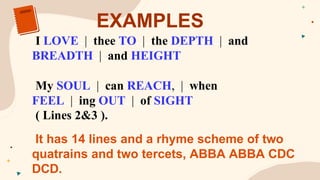
I LOVE..|..thee TO..|..the DEPTH..|..and
BREADTH..|..and HEIGHT
My SOUL..|..can REACH,..|..when
FEEL..|..ing OUT..|..of SIGHT
( Lines 2&3 ).
It has 14 lines and a rhyme scheme of two
quatrains and two tercets, ABBA ABBA CDC
DCD.
Sonnets have 2
variations:
A. Petrarchan Sonnet
• It contains 14 lines of iambic pentameter.
• These lines are divided into two: the first is
octave, and the final six lines or sestet.
• ABBA ABBA – octave involves two
rhymes scheme.
• Two or three rhyme patterns – CDECDE
& CDCDCD (Sestet)
• Example: Sonnet 23 (Elizabeth
Barrett Browning)
E
X
A
M
P
L
E
B. Shakesperean Sonnet
• Also known as “English Sonnet”
• 14 lines, these line are divided into
4 lines or quatrains and the final two
lines or couplet.
• The quatrains have a rhymes
scheme of ABAB CDCD EFEF with the
final couplet rhyming GG
• Example: Sonnet 98
E
X
A
M
P
L
E
2. HAIKU
 Traditional Japanese poetic
form with a three line poem
5 – 7 – 5 syllables count
 Frequently uses images in
nature and conveys in one
moment of time and illumination
2. HAIKU
 A Japanese poetic form that
consists of three lines, with
five syllables in the first line,
seven in the second, and five
in the third.
2. HAIKU
EXAMPLE
BASIC ELEMENTS
OF POETRY
Foot
A foot is a combination of
stressed and unstressed
syllables in a line of a poetry.
Foot
iamb – a foot with two syllables (1 stressed
and 1 unstressed)
spondee- a foot with two syllables (both
stressed)
anapest – a foot with three syllables (2
stressed syllables followed by 1 unstressed)
dactyl – a foot with three syllables (1 stressed
syllables followed by two unstressed)
Meter
It is the rhythmic structure
within a poem and is
dictated by the number of
syllables and the pattern in
which these syllables are
Meter
This is the number of
feet that is in the line a
line of poetry.
Meter
Monometer – a line with one foot
Trimeter- a line with 3 feet
Pentameter – a line with 5 feet
Heptameter – a line with 7 feet
Dimeter – a line with 2 feet
Tetrameter – a line with 4 feet
Hexameter – a line with 6 feet
Octameter – a line with 8 feet
Rhyme
Rhyme is created when the last
one or more syllables within
separate words match. A poem is
considered to rhyme when the
last words of the lines within the
verse share this relationship.
Scheme
It refers to the rhyming pattern within
a verse of poetry. The scheme could
contain words that rhyme at each of
every line throughout the stanza, or
alternating lines, or in couplets. We
often signify the rhyme scheme using
an arrangement of letters.
Verse (Taludtod)
The verse of the poem is
a way to describe the
relationship between
rhyme and meter in a
poem.
Stanza (saknong)
A stanza is a group of lines
within the verse of a poem.
They are separated from other
stanzas within the poem
through the use of a break or a
blank line.
Free Verse
01
What is a Free Verse Poem?
It has no defined meter, no consistent
rhyme scheme, and no specified length or
formal requirements. A free verse poem,
also known as a vers libre, is a poem that
lacks all of the above. It has no defined
meter, no consistent rhyme scheme, and
no specified length or formal
requirements.
Line Break
A line break is the termination of
the line of a poem and the
beginning of a new line. The
process of arranging words using
lines and line breaks is known as
lineation, and is one of the
Enjambments
The definition of “enjambment” in
French is “to step over.” In poetry, this
means that a thought “steps over” the
end of a line and into the beginning of
the next line, with no punctuation, so
that the reader must read through the
line break quickly to reach the
conclusion of the thought.
Enjambments
A poetic term for the continuation of
a sentence or phrase from one line of
poetry to the next. An enjambed line
typically lacks punctuation at its line
break, so the reader is carried
smoothly and swiftly—without
interruption—to the next line of the
Metaphor
Metaphor is a common poetic
device where an object in, or
the subject of, a poem is
described as being the same as
another otherwise unrelated
“This is a quote, words full
of wisdom that someone
important said and that can
inspire the
reader.”
—Someone Famous
Thanks!
CREDITS: This presentation template was created by Slidesgo,
and includes icons by Flaticon, and infographics & images by
Freepik
Please keep this slide for attribution
Do you have any
questions?
CW Poetry Elements for Specific Forms.pptx

CW Poetry Elements for Specific Forms.pptx

  • 1.
  • 2.
    LEARNING COMPETENCY: ● Determine specificforms and conventions of poetry ● (HUMSS_CW/MP11/12c-f-7)
  • 3.
    Types of Poetry ● 1.Traditional or Conventional ● 2. Modern or Contemporary
  • 4.
    Types of Poetry ● 1.Traditional or Conventional – follows standard rules of grammar and syntax with a regular rhythm and rhyme scheme.
  • 5.
    Types of Poetry ● Thesonnet, ode, blank verse, ballad, dramatic monologue, each have formal elements that poets follow. For example, the sonnet is a 14-line poem in a iambic pentameter with a set rhyme scheme.
  • 6.
    On the Sea ● Itkeeps eternal whispering around ● Desolate shores, and with its mighty swell ● Gluts twice ten thousand Caverns, till the spell ● Of Hecate leaves them their old shadowy sound. ● Often ‘tis in such gentle temper found, ● That scarcely will the very smallest shell ● Be mov’d for days from where it sometime fell, ● When last the winds of Heaven were unbound. ● Oh ye! Who have your eye-balls vex’d and tir’d, ● Feast them upon the wideness of the Sea; ● Oh ye! Whose ears are dinn’d with uproar rude. ● Or fed too much with cloying melody— ● Sit ye near some old Cavern’s Mouth, and brood ● Until ye start, as if the sea-nymphs quir’d!
  • 7.
    Analysis ● This poem waswritten back in 1817 by a popular romantic poet, John Keats. In this sonnet, he addresses people who are disturbed and irritated from the uproar of life and suggests they should seek comfort by the seaside. The sea’s mystery, power, and vastness will not only comfort their noisiest mind but also transport them to a world of imagination.
  • 8.
    Types of Poetry ● 2.Modern or Contemporary – avoids rhyme and standard grammatical organization and seeks new ways of expression. It is most common written in free verse (unrhymed rhymes), and the language is accessible to the common reader.
  • 9.
    The Peace ofWild Things When despair for the world grows in me and I wake in the night at the least sound in fear of what my life and my children’s lives may be, I go and lie down where the wood drake rests in his beauty on the water, and the great heron feeds. I come into the peace of wild things who do not tax their lives with forethought of grief. I come into the presence of still water, And I feel above me the day blind stars waiting with their light. For a time I rest in the grace of the world, and am free. -Wendell Berry
  • 10.
    Analysis The poem waswritten by American poet and novelist Wendell Berry. The lines of the poem are quite easy to read. He used clear language and syntax. The poem describes how the speaker finds a solution to the anxieties he feels during a sleepless night by going outside to a quiet, peaceful place in nature, near a body of water. The poem attempts to find a balance between humans and nature; it shows how the natural world can play a vital role in healing the troubled human spirit.
  • 11.
  • 12.
    There are several commonlyknown forms of conventional poetry that have their own rules regarding stanza, length, any meter, or rhyme patterns.
  • 13.
    1. SONNETS  Isa fixed verse containing 14 lines in iambic pentameter (has 10 syllables per line).  It is originated in Italy with the earliest sonnets written by Giacomo da Lentini who lived from 1188 – 1240.
  • 14.
    1. SONNETS  Sonnet,from the Italian word sonetto (little song) is a lyrical poem that often has a theme related to Love.  This poem is a typical Italian or Petrarchan style sonnet written in iambic pentameter. (10 syllables per line with five pairs of unstressed and
  • 15.
    EXAMPLES I LOVE..|..thee TO..|..theDEPTH..|..and BREADTH..|..and HEIGHT My SOUL..|..can REACH,..|..when FEEL..|..ing OUT..|..of SIGHT ( Lines 2&3 ). It has 14 lines and a rhyme scheme of two quatrains and two tercets, ABBA ABBA CDC DCD.
  • 16.
  • 17.
    A. Petrarchan Sonnet •It contains 14 lines of iambic pentameter. • These lines are divided into two: the first is octave, and the final six lines or sestet. • ABBA ABBA – octave involves two rhymes scheme. • Two or three rhyme patterns – CDECDE & CDCDCD (Sestet) • Example: Sonnet 23 (Elizabeth Barrett Browning)
  • 18.
  • 19.
    B. Shakesperean Sonnet •Also known as “English Sonnet” • 14 lines, these line are divided into 4 lines or quatrains and the final two lines or couplet. • The quatrains have a rhymes scheme of ABAB CDCD EFEF with the final couplet rhyming GG • Example: Sonnet 98
  • 20.
  • 21.
    2. HAIKU  TraditionalJapanese poetic form with a three line poem 5 – 7 – 5 syllables count  Frequently uses images in nature and conveys in one moment of time and illumination
  • 22.
    2. HAIKU  AJapanese poetic form that consists of three lines, with five syllables in the first line, seven in the second, and five in the third.
  • 23.
  • 24.
  • 25.
  • 26.
    Foot A foot isa combination of stressed and unstressed syllables in a line of a poetry.
  • 27.
    Foot iamb – afoot with two syllables (1 stressed and 1 unstressed) spondee- a foot with two syllables (both stressed) anapest – a foot with three syllables (2 stressed syllables followed by 1 unstressed) dactyl – a foot with three syllables (1 stressed syllables followed by two unstressed)
  • 28.
    Meter It is therhythmic structure within a poem and is dictated by the number of syllables and the pattern in which these syllables are
  • 30.
    Meter This is thenumber of feet that is in the line a line of poetry.
  • 31.
    Meter Monometer – aline with one foot Trimeter- a line with 3 feet Pentameter – a line with 5 feet Heptameter – a line with 7 feet Dimeter – a line with 2 feet Tetrameter – a line with 4 feet Hexameter – a line with 6 feet Octameter – a line with 8 feet
  • 32.
    Rhyme Rhyme is createdwhen the last one or more syllables within separate words match. A poem is considered to rhyme when the last words of the lines within the verse share this relationship.
  • 34.
    Scheme It refers tothe rhyming pattern within a verse of poetry. The scheme could contain words that rhyme at each of every line throughout the stanza, or alternating lines, or in couplets. We often signify the rhyme scheme using an arrangement of letters.
  • 36.
    Verse (Taludtod) The verseof the poem is a way to describe the relationship between rhyme and meter in a poem.
  • 37.
    Stanza (saknong) A stanzais a group of lines within the verse of a poem. They are separated from other stanzas within the poem through the use of a break or a blank line.
  • 39.
  • 40.
    What is aFree Verse Poem? It has no defined meter, no consistent rhyme scheme, and no specified length or formal requirements. A free verse poem, also known as a vers libre, is a poem that lacks all of the above. It has no defined meter, no consistent rhyme scheme, and no specified length or formal requirements.
  • 41.
    Line Break A linebreak is the termination of the line of a poem and the beginning of a new line. The process of arranging words using lines and line breaks is known as lineation, and is one of the
  • 43.
    Enjambments The definition of“enjambment” in French is “to step over.” In poetry, this means that a thought “steps over” the end of a line and into the beginning of the next line, with no punctuation, so that the reader must read through the line break quickly to reach the conclusion of the thought.
  • 44.
    Enjambments A poetic termfor the continuation of a sentence or phrase from one line of poetry to the next. An enjambed line typically lacks punctuation at its line break, so the reader is carried smoothly and swiftly—without interruption—to the next line of the
  • 46.
    Metaphor Metaphor is acommon poetic device where an object in, or the subject of, a poem is described as being the same as another otherwise unrelated
  • 50.
    “This is aquote, words full of wisdom that someone important said and that can inspire the reader.” —Someone Famous
  • 51.
    Thanks! CREDITS: This presentationtemplate was created by Slidesgo, and includes icons by Flaticon, and infographics & images by Freepik Please keep this slide for attribution Do you have any questions?