Lesson 2
Discrete and
Continuous Random
Variables
Learn about It!
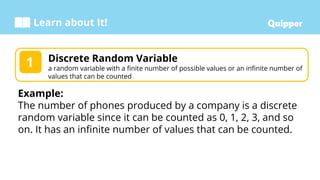
Discrete Random Variable
a random variable with a finite number of possible values or an infinite number of
values that can be counted
1
Example:
The number of phones produced by a company is a discrete
random variable since it can be counted as 0, 1, 2, 3, and so
on. It has an infinite number of values that can be counted.
Learn about It!
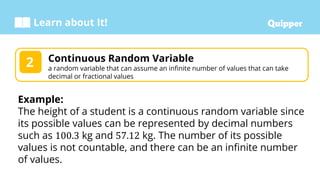
Continuous Random Variable
a random variable that can assume an infinite number of values that can take
decimal or fractional values
2
Example:
The height of a student is a continuous random variable since
its possible values can be represented by decimal numbers
such as 100.3 kg and 57.12 kg. The number of its possible
values is not countable, and there can be an infinite number
of values.
Try It!
Example 1: A random variable has the following value: 7, 8,
10, 13, or 21. Is the random variable discrete or continuous?
Try It!
Solution:
Based on the given, we see that the number of possible
values of the random variable is finite. Thus, the random
variable is discrete.
Example 1: A random variable has the following value: 7, 8,
10, 13, or 21. Is the random variable discrete or continuous?
Try It!
Example 2: Determine whether the recorded body
temperature of a patient in a hospital is a discrete or
continuous random variable.
Try It!
Solution:
The body temperature of a patient may take infinitely many
possible decimal values such as 37.8℃, 41.1℃, and 34.51℃.
Thus, the body temperature of a patient is a continuous
random variable.
Example 2: Determine whether the recorded body
temperature of a patient in a hospital is a discrete or
continuous random variable.
Let’s Practice!
Individual Practice:
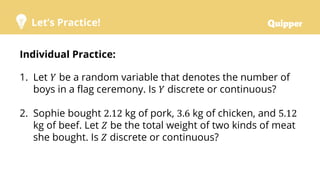
1. Let 𝑌 be a random variable that denotes the number of
boys in a flag ceremony. Is 𝑌 discrete or continuous?
2. Sophie bought 2.12 kg of pork, 3.6 kg of chicken, and 5.12
kg of beef. Let 𝑍 be the total weight of two kinds of meat
she bought. Is 𝑍 discrete or continuous?
Let’s Practice!
Individual Practice:
WRITE DISCRETE OR CONTINUOUS
Let’s Practice!
Individual Practice:
Number of students in the canteen during lunch break.
Let’s Practice!
Individual Practice:
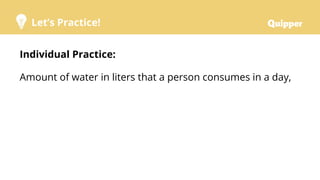
Amount of water in liters that a person consumes in a day,
Let’s Practice!
Individual Practice:
Weight of a baby
Let’s Practice!
Individual Practice:
Amount of money spent on buying medicines,
Let’s Practice!
Individual Practice:
Number of passengers in a bus.
Let’s Practice!
Individual Practice:
Number of patients in a hospital.
Let’s Practice!
Individual Practice:
Speed of a car,
Let’s Practice!
Individual Practice:
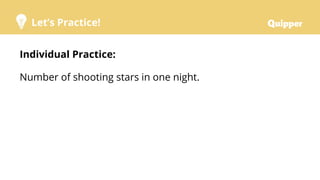
Number of shooting stars in one night.
Let’s Practice!
Individual Practice:
Number of shooting stars in one night.
Let’s Practice!
Individual Practice:
Number of action figures of a kid.
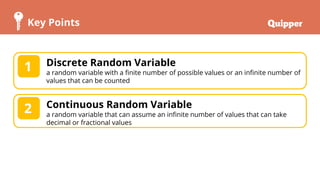
Key Points
Discrete Random Variable
a random variable with a finite number of possible values or an infinite number of
values that can be counted
1
Continuous Random Variable
a random variable that can assume an infinite number of values that can take
decimal or fractional values
2
Synthesis
 What is the difference between discrete and continuous
random variables?
 How can you use discrete and continuous random
variables in describing data?
 How would you determine the probability that a certain
value of a random variable will appear?

MATH211-WEEK-1-PT-2.pptx