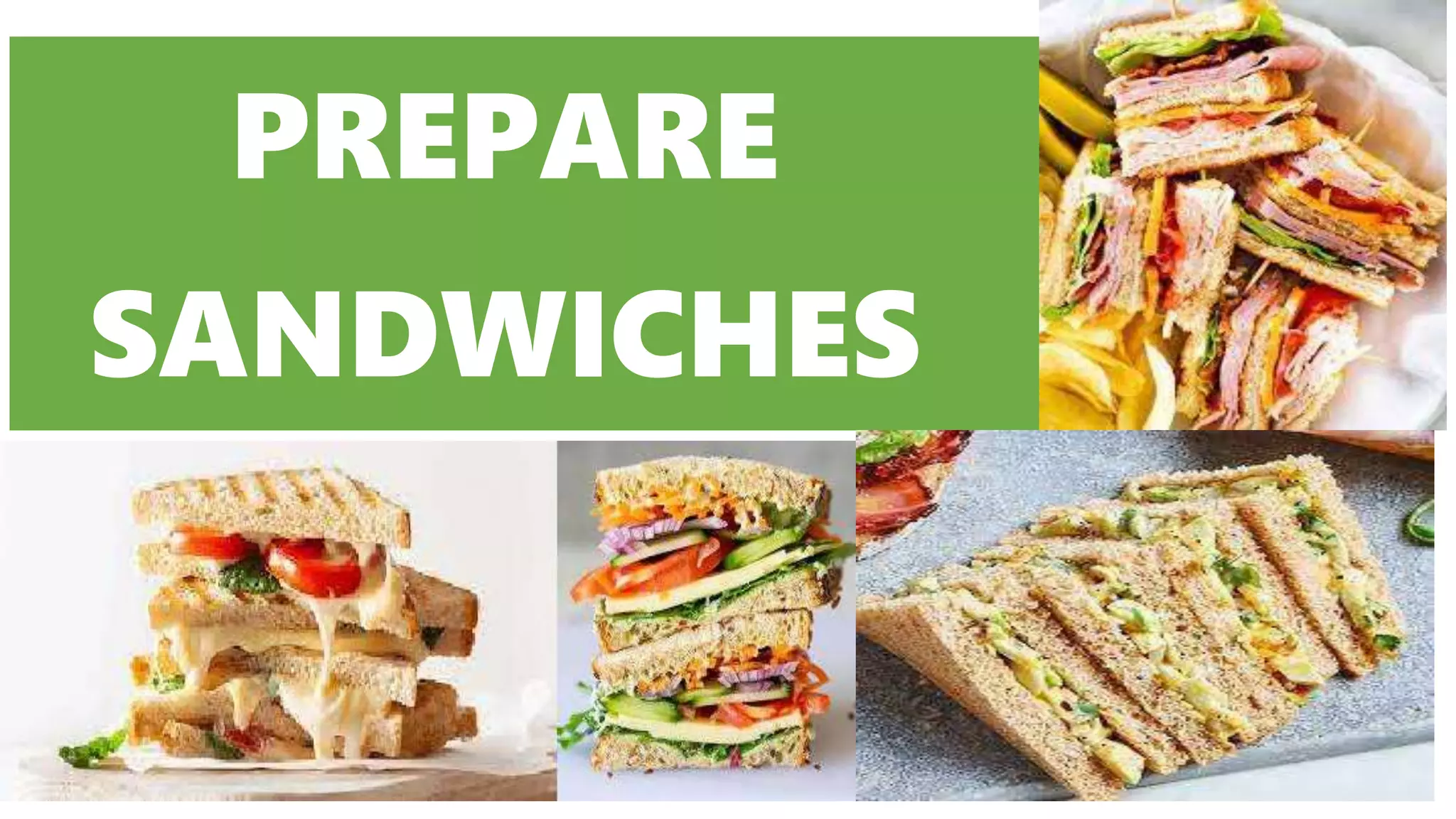
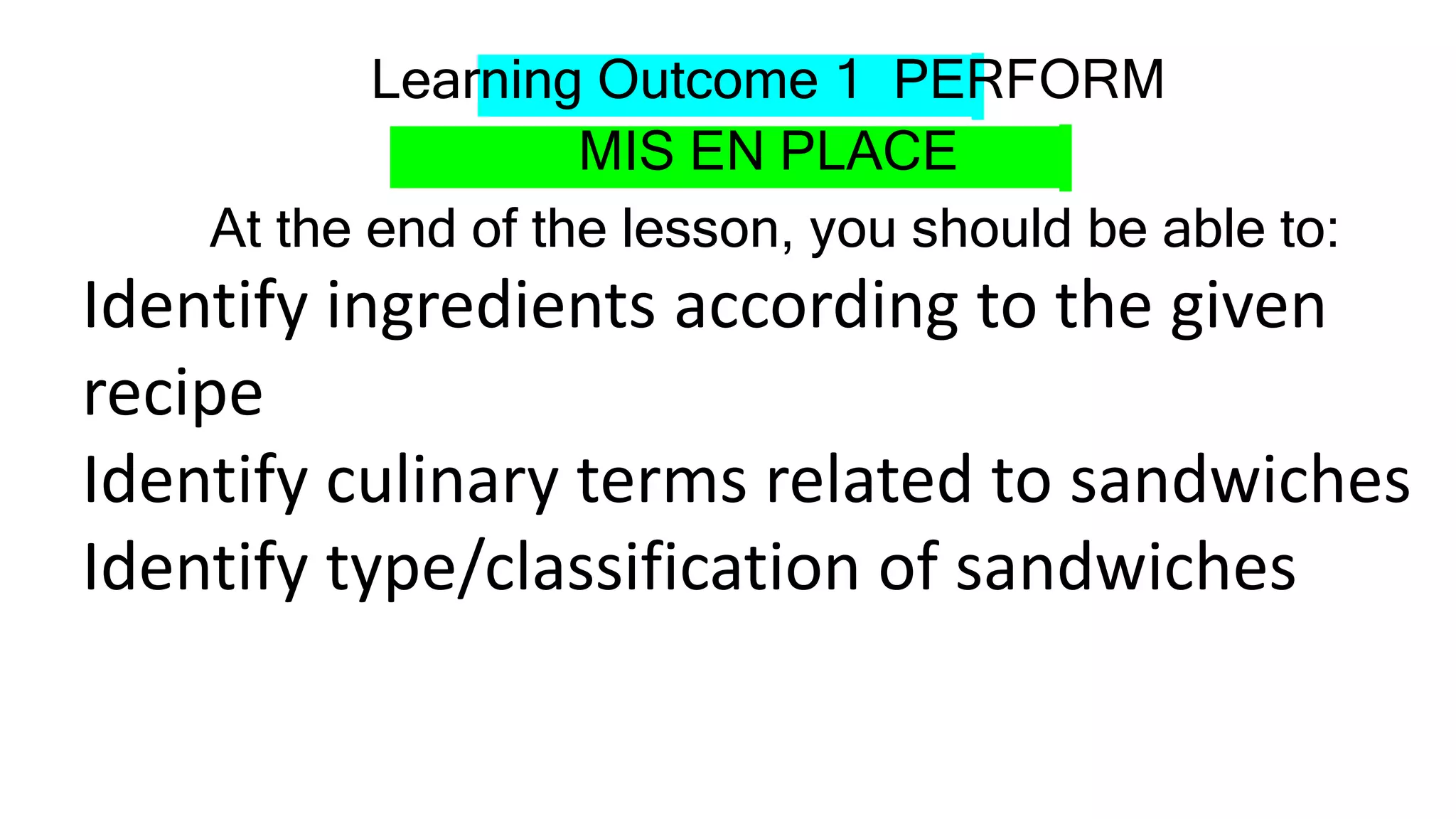
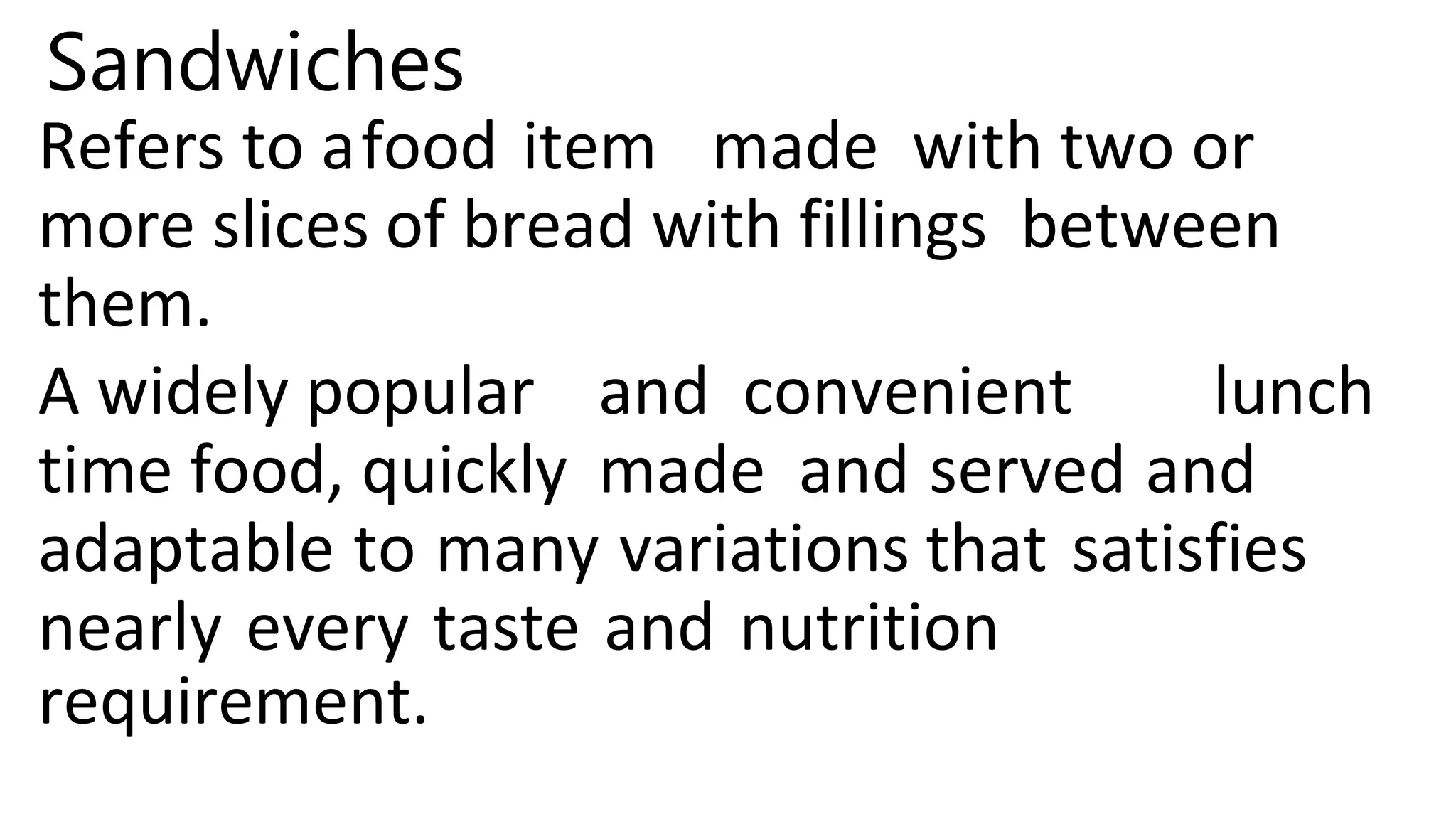
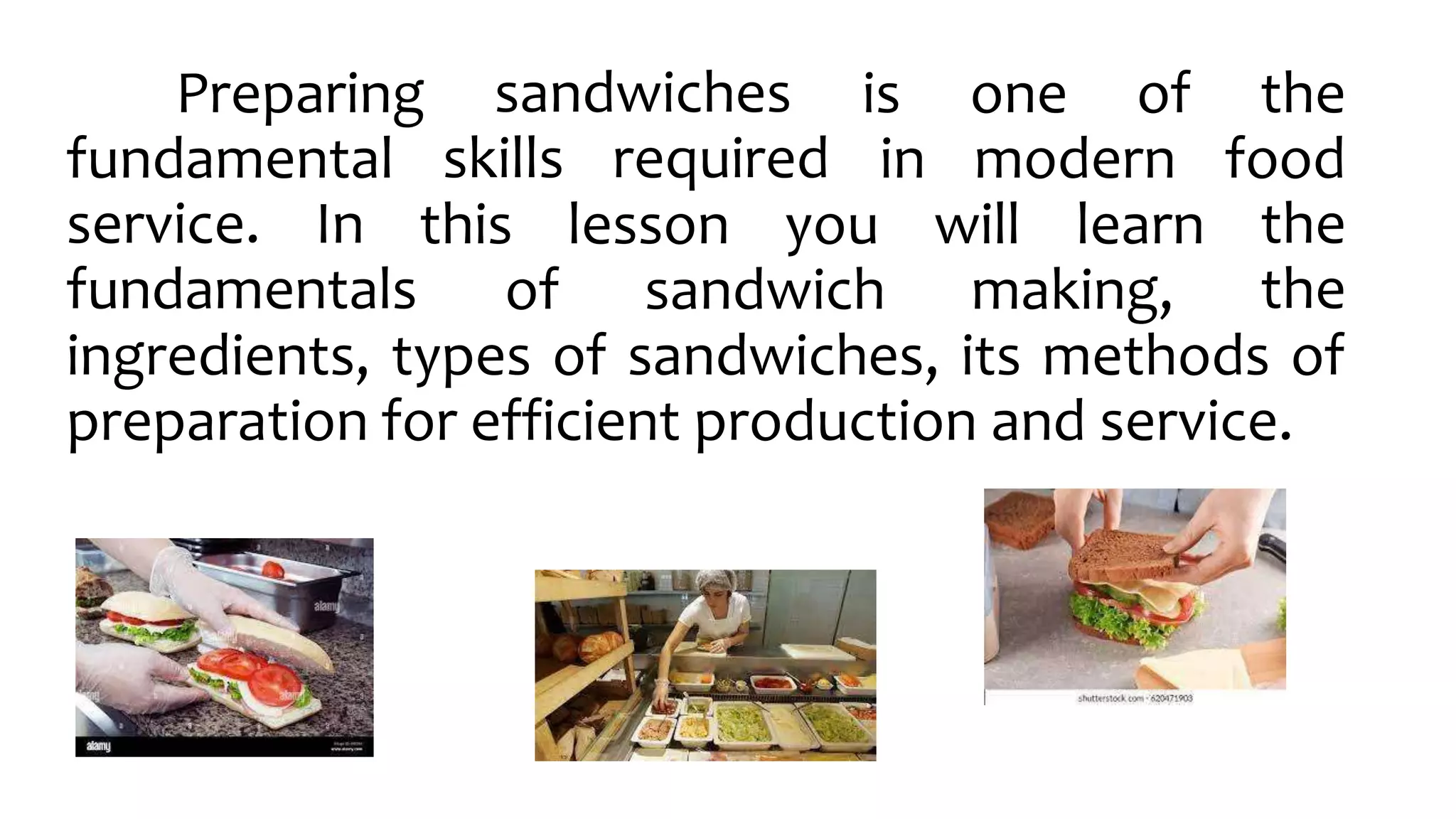
PREPARE
SANDWICHES
Learning Outcome 1 PERFORM
MIS EN PLACE
At the end of the lesson, you should be able to:
Identify ingredients according to the given
recipe
Identify culinary terms related to sandwiches
Identify type/classification of sandwiches
Sandwiches
Refers to afood item made with two or
more slices of bread with fillings between
them.
A widely popular and convenient lunch
time food, quickly made and served and
adaptable to many variations that satisfies
nearly every taste and nutrition
requirement.
sandwiches
Preparing
fundamental skills required
service. In
fundamentals
this lesson you will learn
of sandwich making,
is one of the
in modern food
the
the
ingredients, types of sandwiches, its methods of
preparation for efficient production and service.
TOOLS,UTENSILS
ANDEQUIPMENTIN
PREPARINGSANDWICHES
A. TOOLS AND UTENSILS
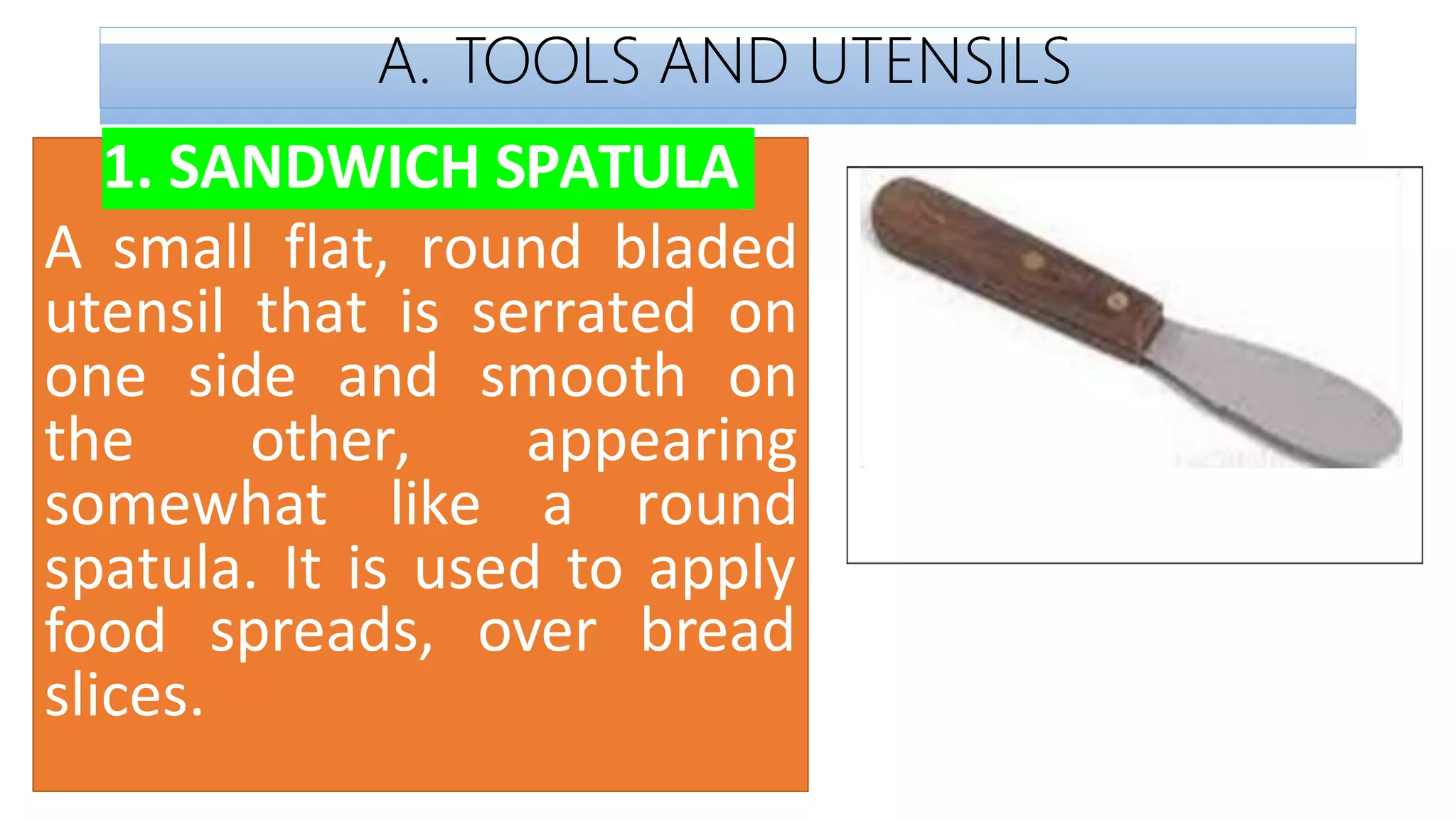
1. SANDWICH SPATULA
A small flat, round bladed
utensil that is serrated on
one side and smooth on
the other, appearing
somewhat like a round
spatula. It is used to apply
spreads, over bread
food
slices.
A. TOOLS AND UTENSILS
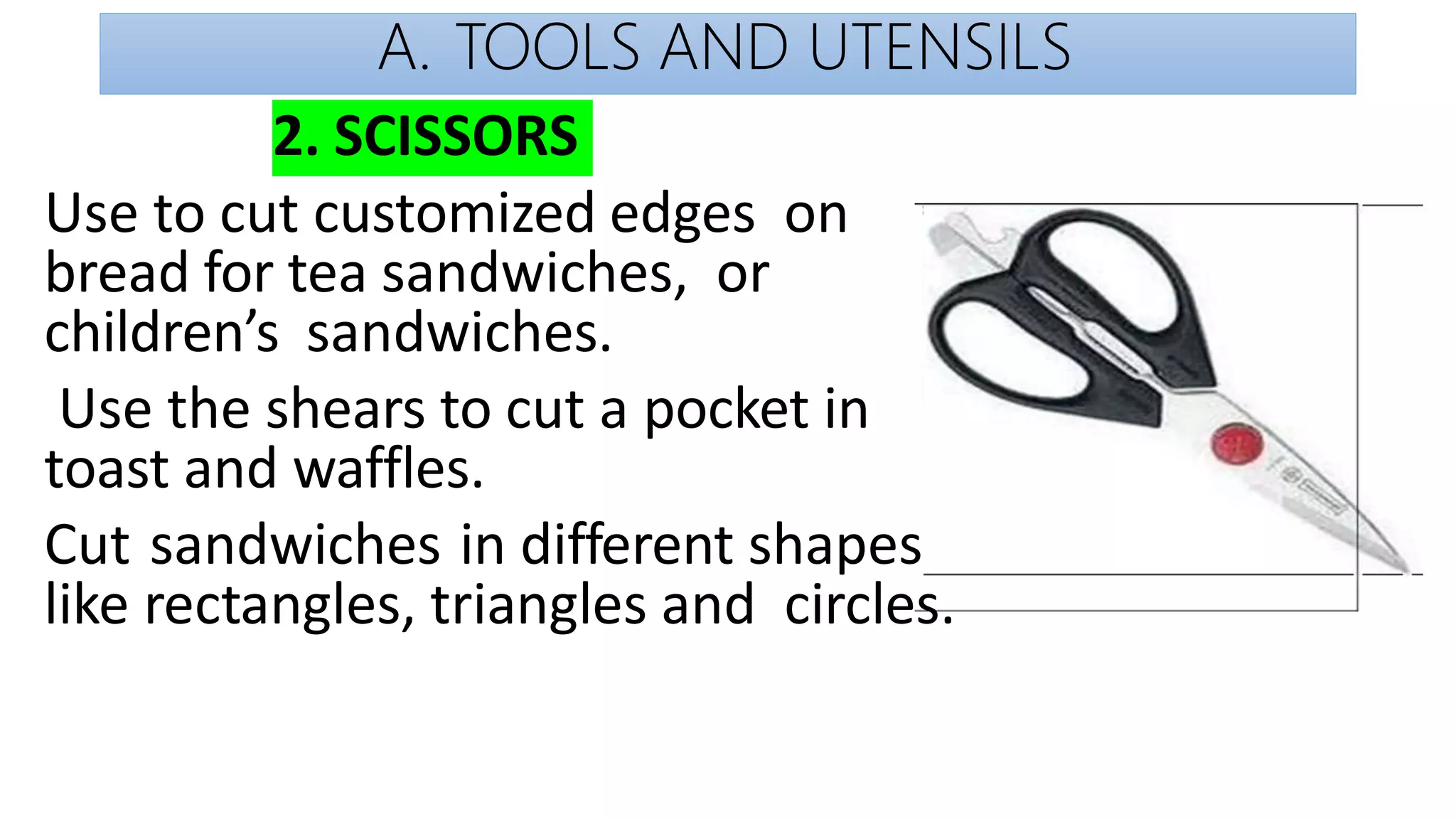
2. SCISSORS
Use to cut customized edges on
bread for tea sandwiches, or
children’s sandwiches.
Use the shears to cut a pocket in
toast and waffles.
Cut sandwiches in different shapes
like rectangles, triangles and circles.
A. TOOLS AND UTENSILS
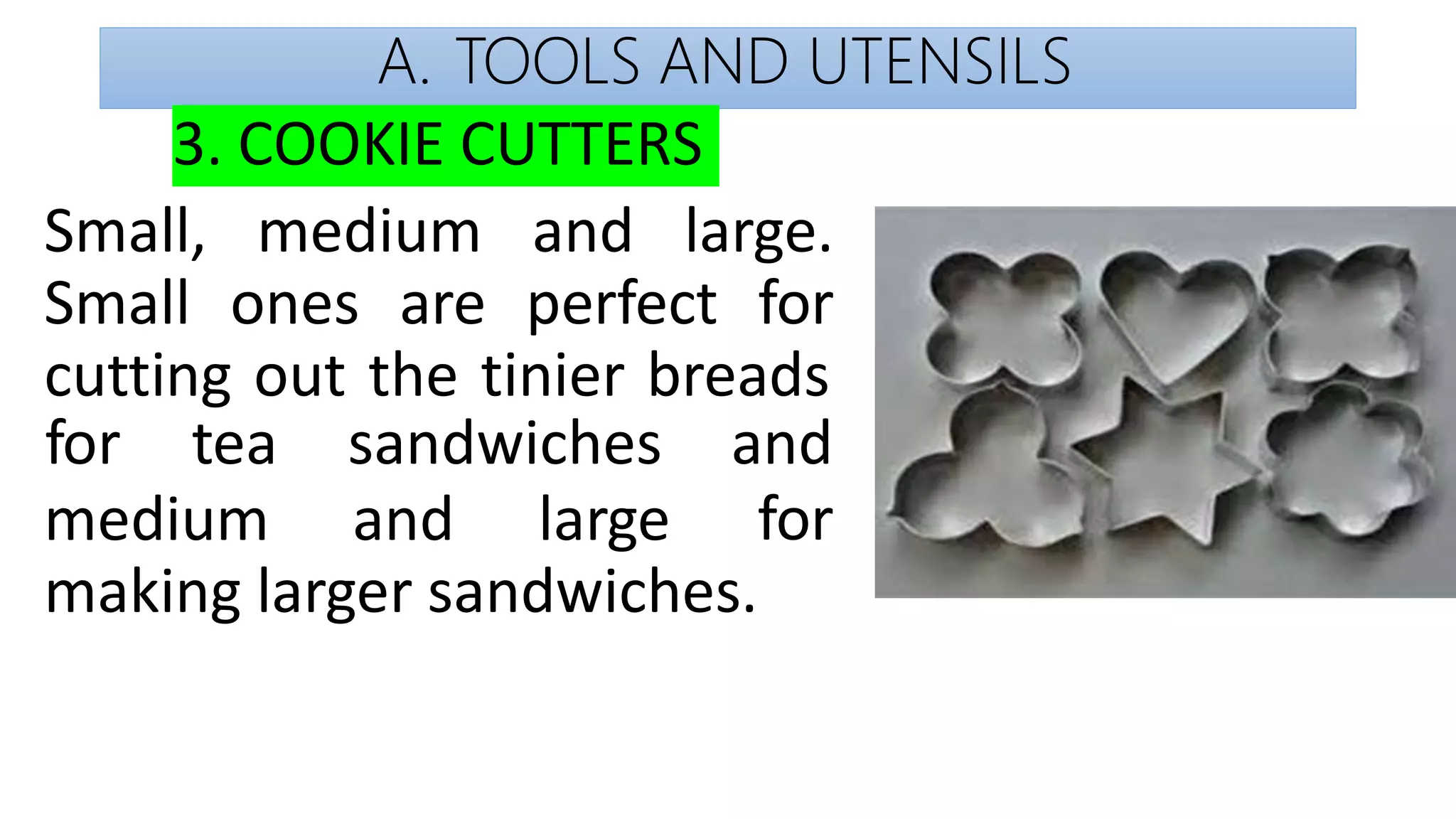
3. COOKIE CUTTERS
Small, medium and large.
Small ones are perfect for
cutting out the tinier breads
medium and large
for tea sandwiches and
for
making larger sandwiches.
A. TOOLS AND UTENSILS
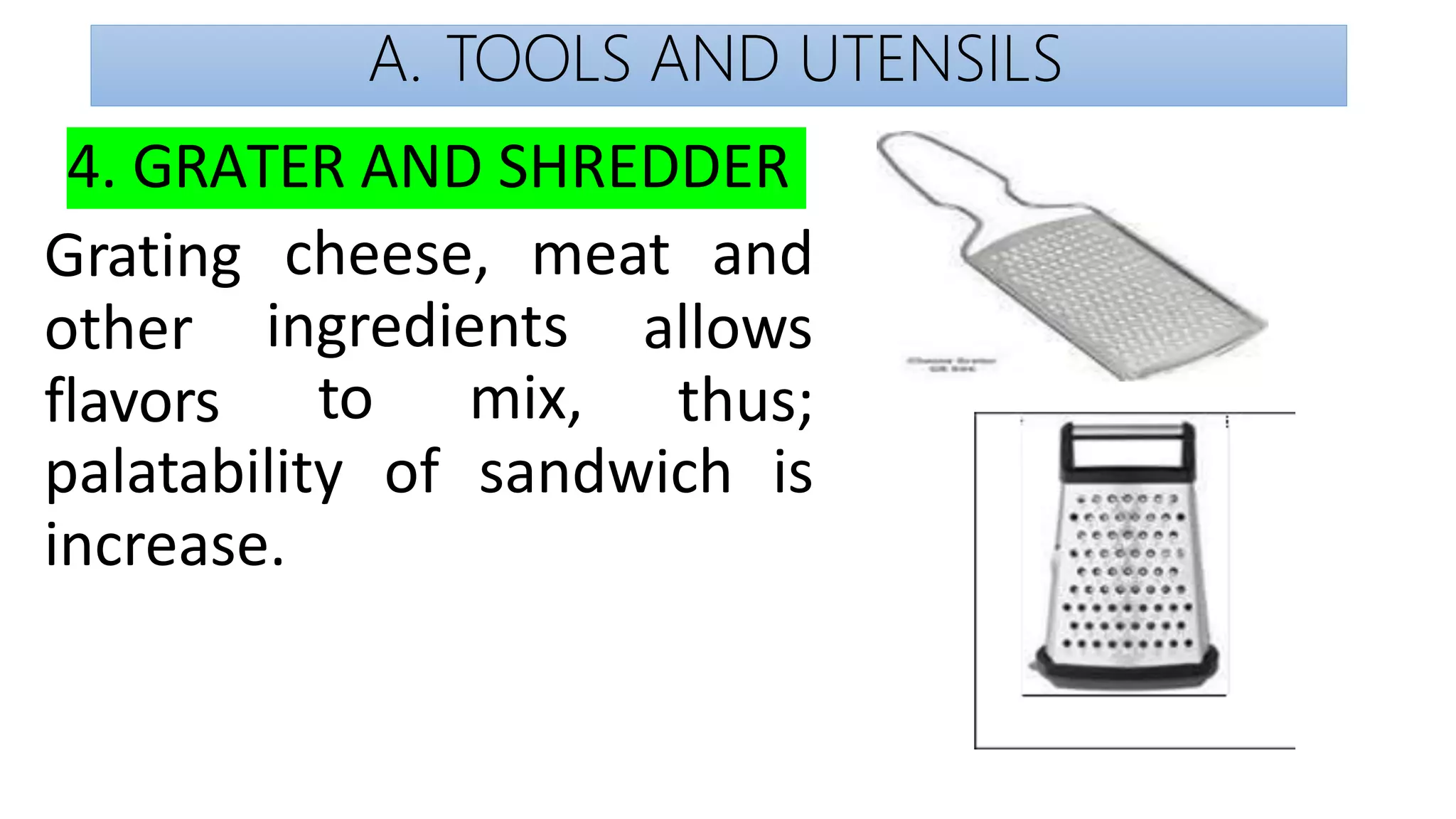
4. GRATER AND SHREDDER
cheese, meat and
ingredients
Grating
other
flavors to mix,
allows
thus;
palatability of sandwich is
increase.
A. TOOLS AND UTENSILS
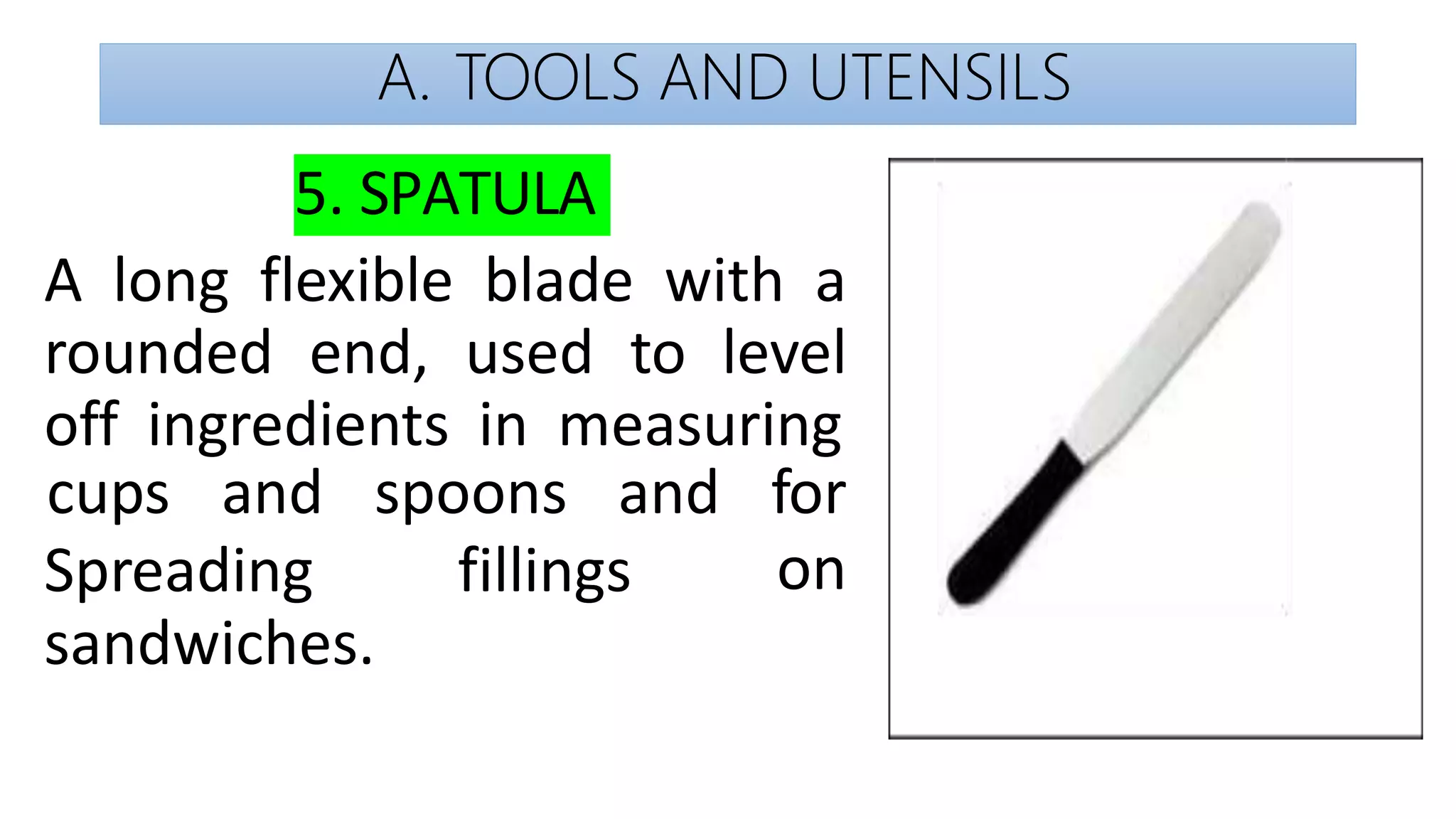
5. SPATULA
A long flexible blade with a
rounded end, used to level
off ingredients in measuring
cups and spoons and for
on
Spreading fillings
sandwiches.
A. TOOLS AND UTENSILS
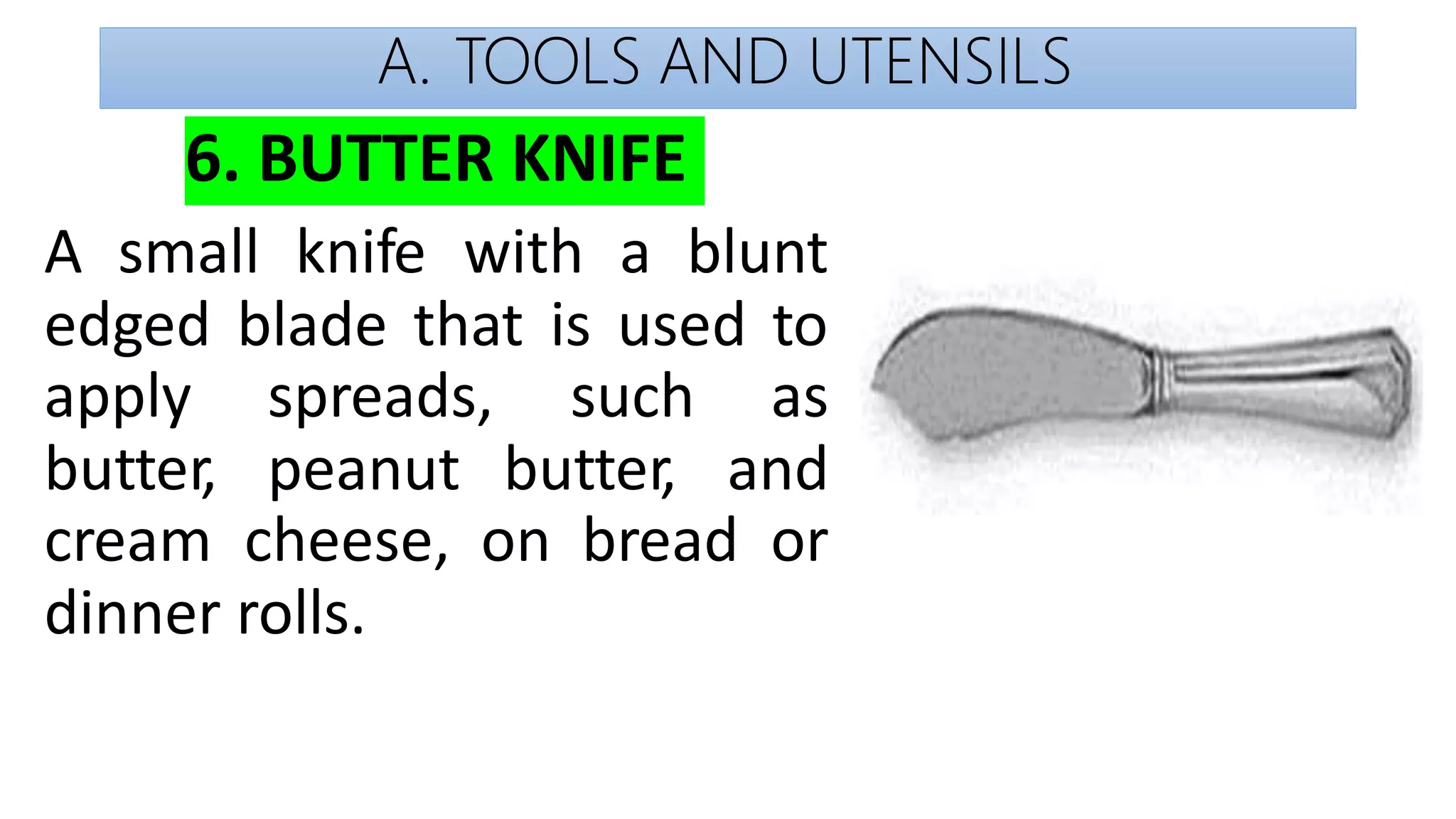
6. BUTTER KNIFE
A small knife with a blunt
edged blade that is used to
apply
butter,
spreads,
peanut
such as
butter, and
cream cheese, on bread or
dinner rolls.
A. TOOLS AND UTENSILS
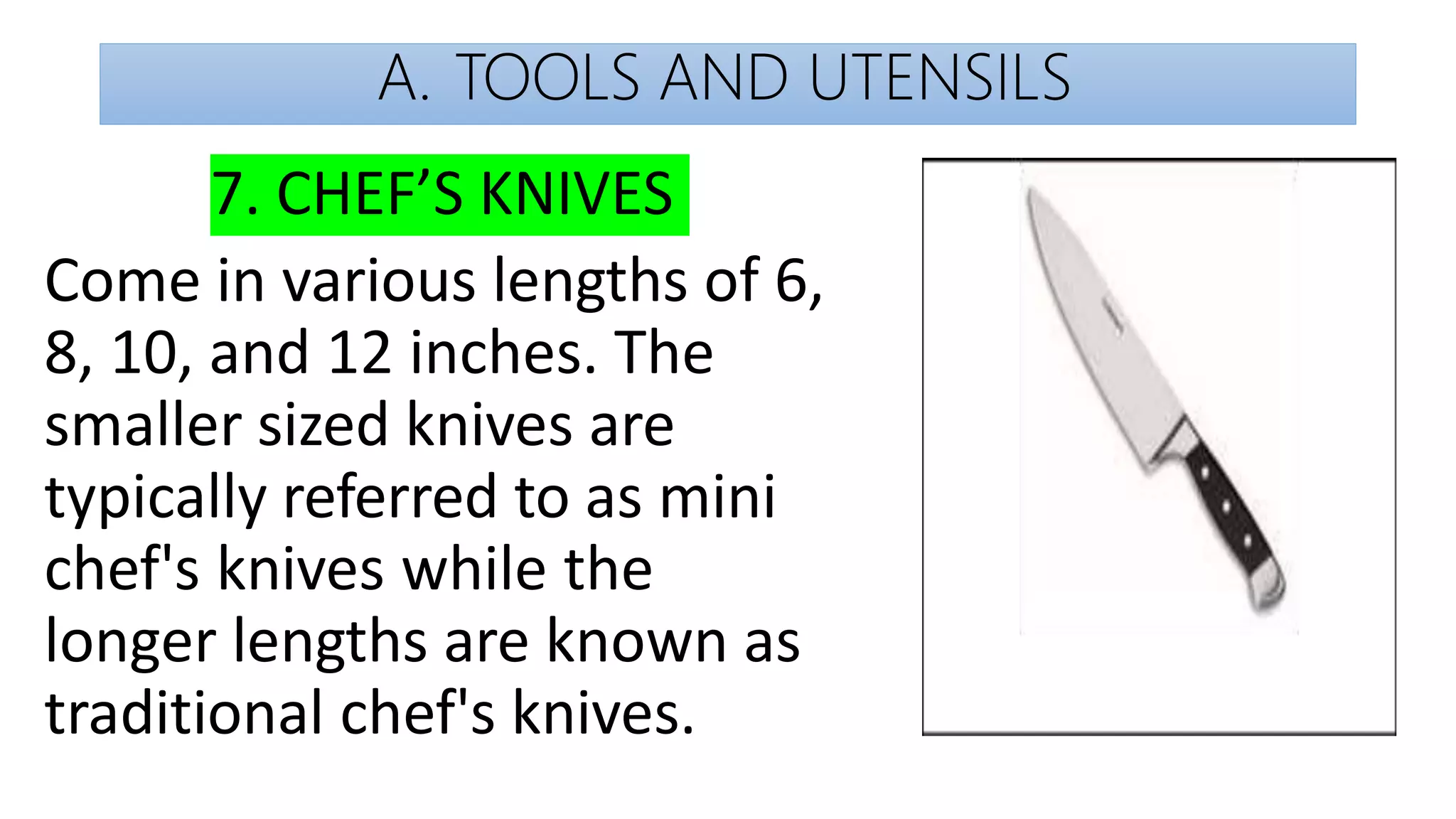
7. CHEF’S KNIVES
Come in various lengths of 6,
8, 10, and 12 inches. The
smaller sized knives are
typically referred to as mini
chef's knives while the
longer lengths are known as
traditional chef's knives.
A. TOOLS AND UTENSILS
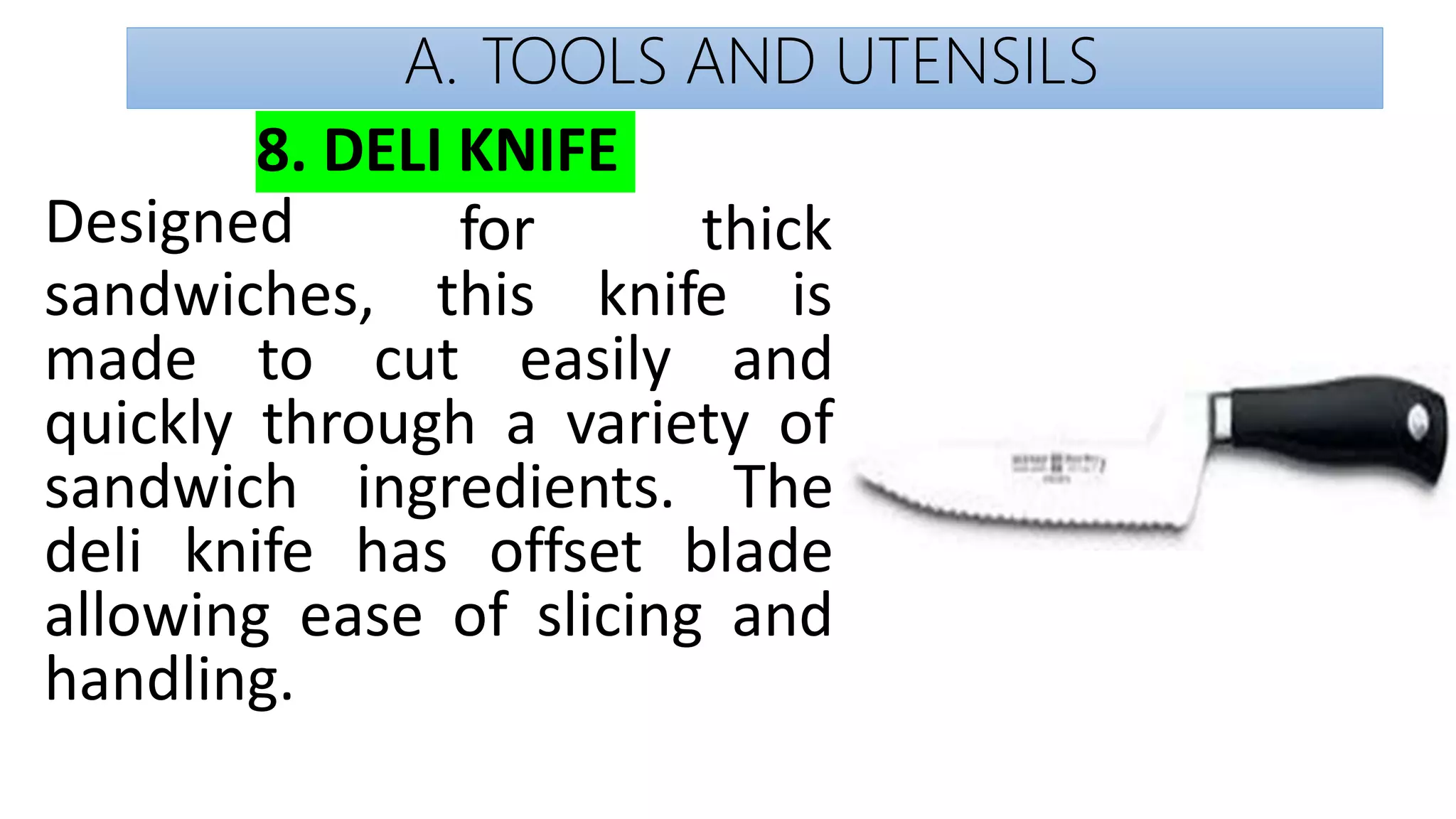
8. DELI KNIFE
for thick
Designed
sandwiches, this knife is
made to cut easily and
quickly through a variety of
sandwich ingredients. The
deli knife has offset blade
allowing ease of slicing and
handling.
A. TOOLS AND UTENSILS
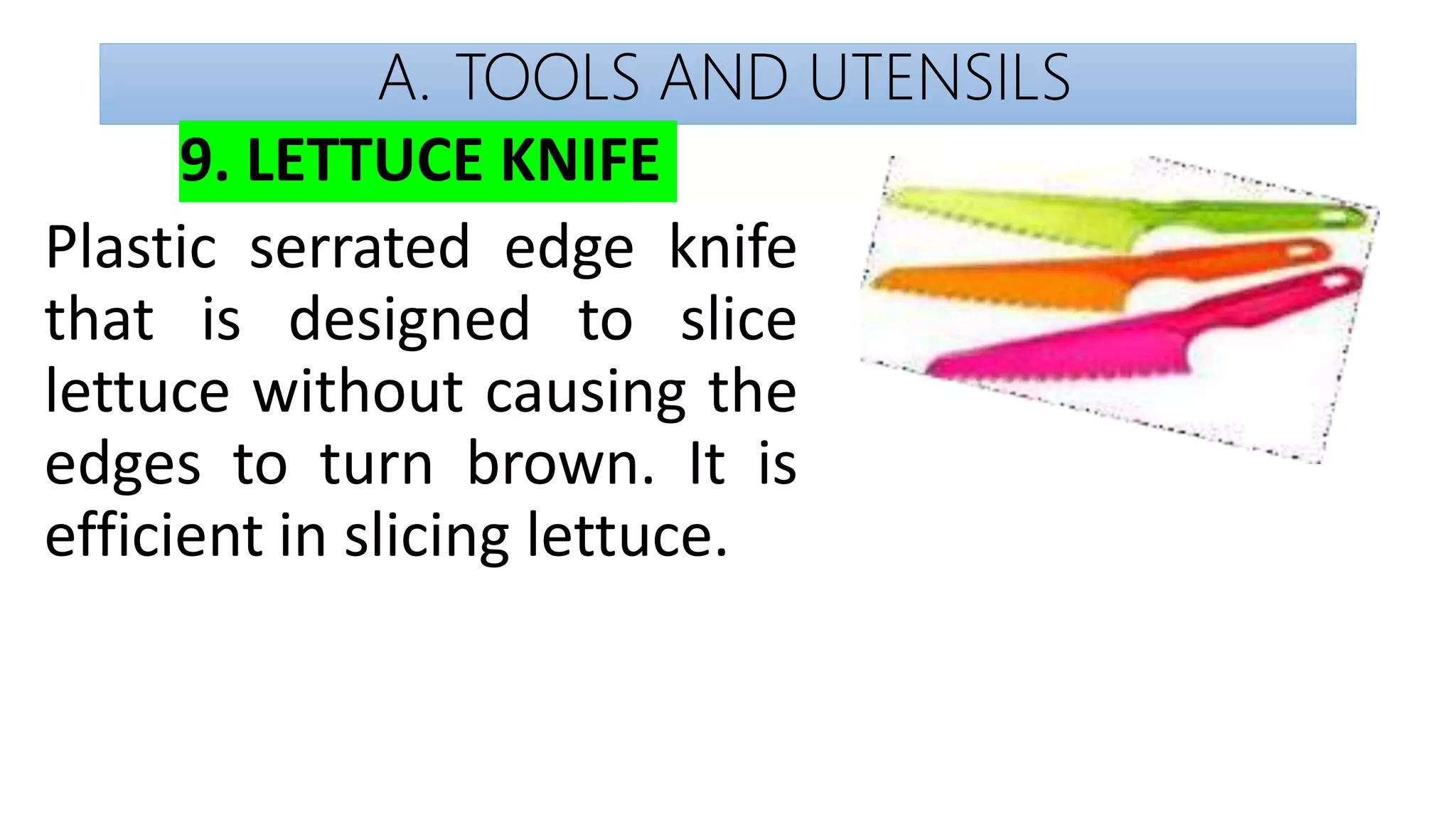
9. LETTUCE KNIFE
Plastic serrated edge knife
that is designed to slice
lettuce without causing the
edges to turn brown. It is
efficient in slicing lettuce.
A. TOOLS AND UTENSILS
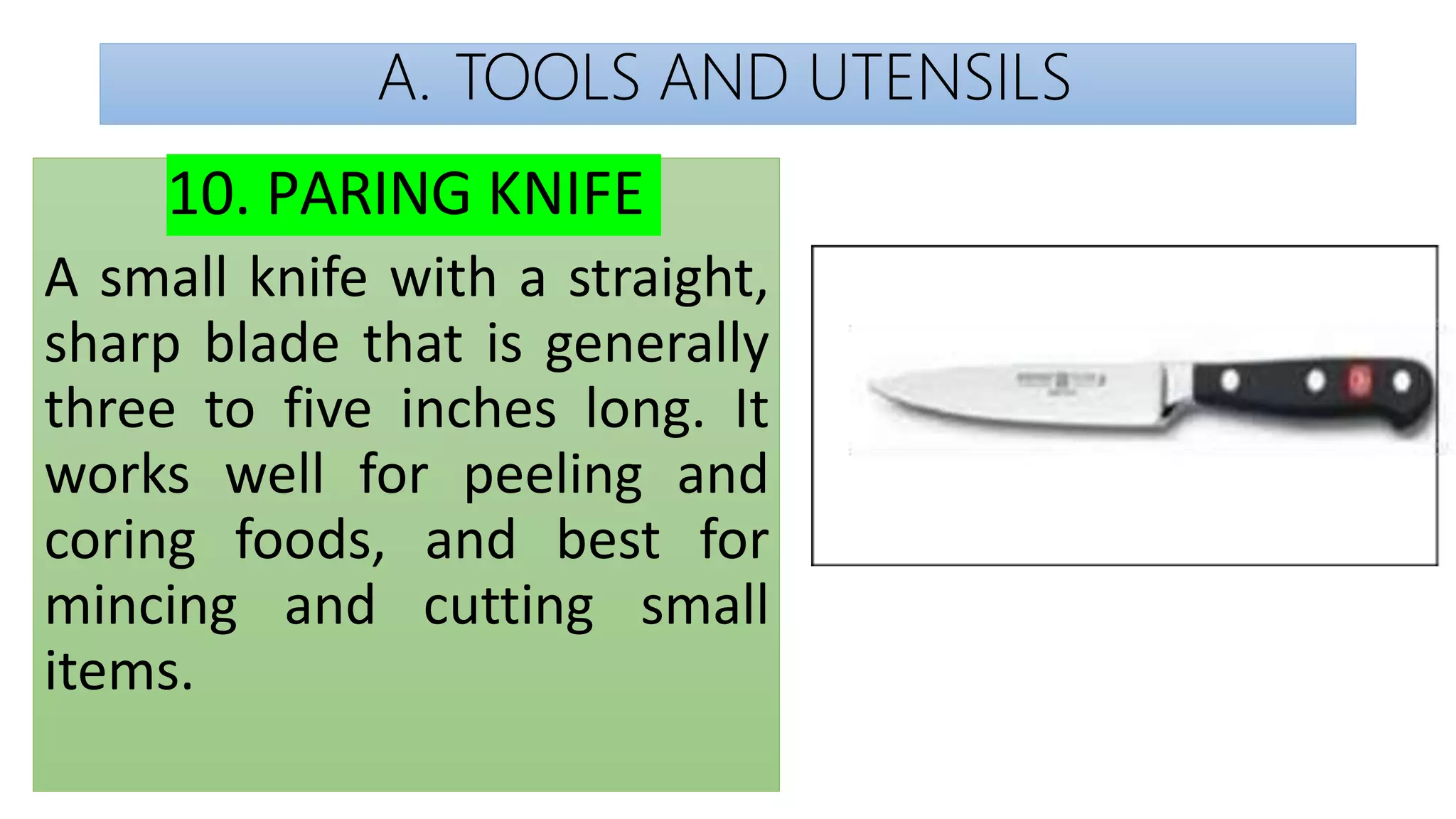
10. PARING KNIFE
A small knife with a straight,
sharp blade that is generally
three to five inches long. It
works well for peeling and
coring foods, and best for
mincing and cutting small
items.
A. TOOLS AND UTENSILS
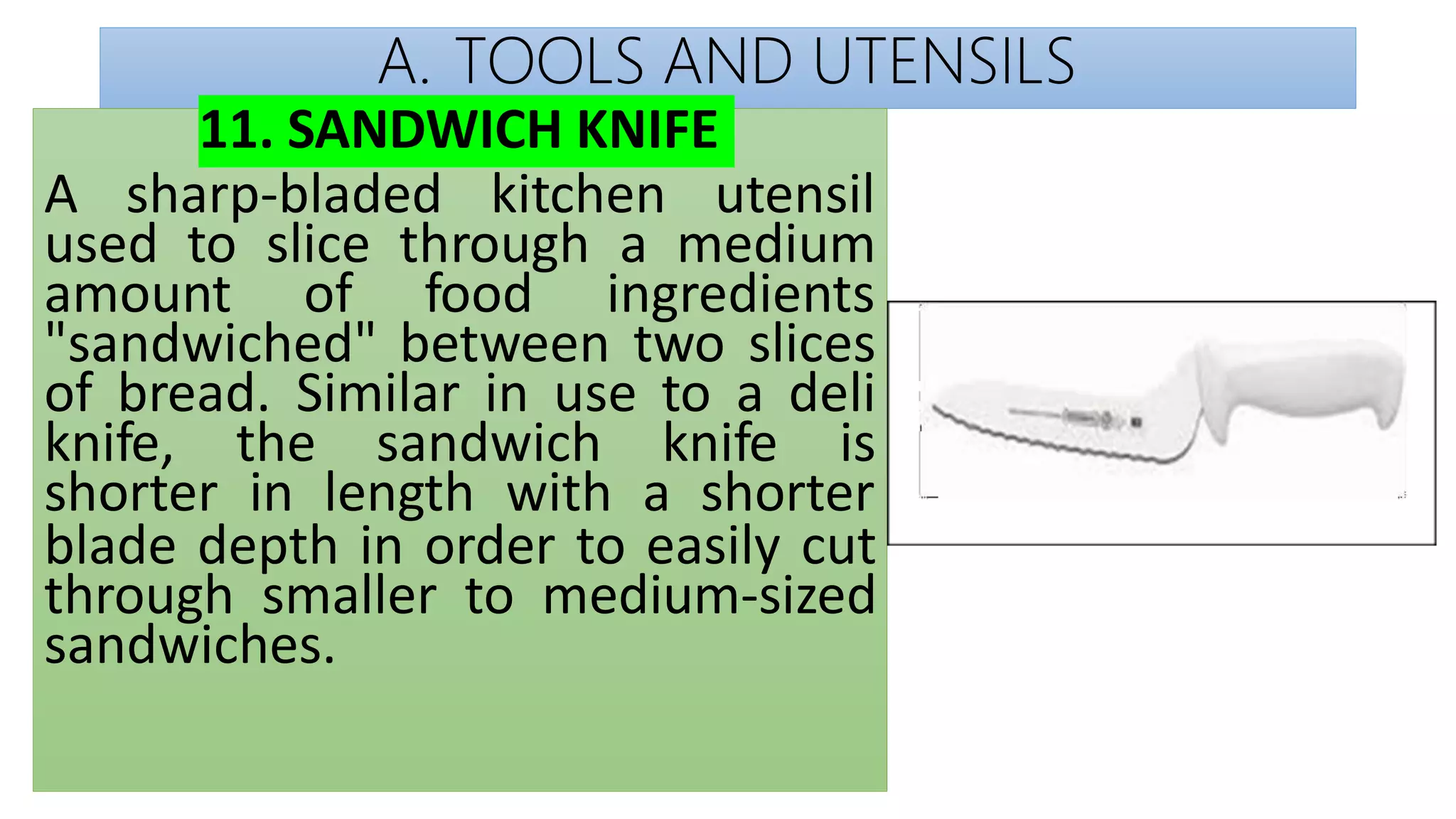
11. SANDWICH KNIFE
A sharp-bladed kitchen utensil
used to slice through a medium
amount of food ingredients
"sandwiched" between two slices
of bread. Similar in use to a deli
knife, the sandwich knife is
shorter in length with a shorter
blade depth in order to easily cut
through smaller to medium-sized
sandwiches.
A. TOOLS AND UTENSILS
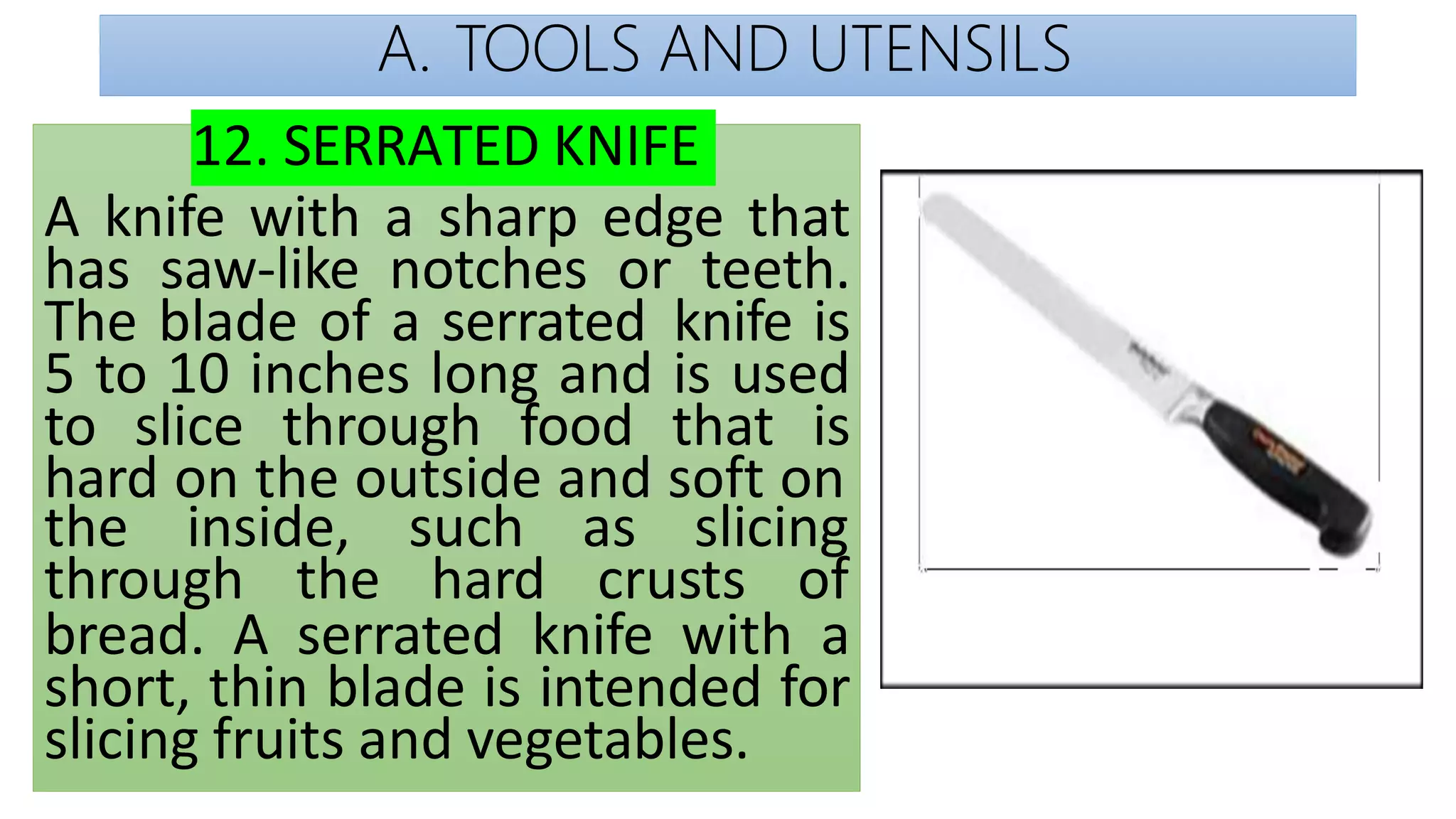
12. SERRATED KNIFE
A knife with a sharp edge that
has saw-like notches or teeth.
The blade of a serrated knife is
5 to 10 inches long and is used
to slice through food that is
hard on the outside and soft on
the inside, such as slicing
through the hard crusts of
bread. A serrated knife with a
short, thin blade is intended for
slicing fruits and vegetables.
A. TOOLS AND UTENSILS
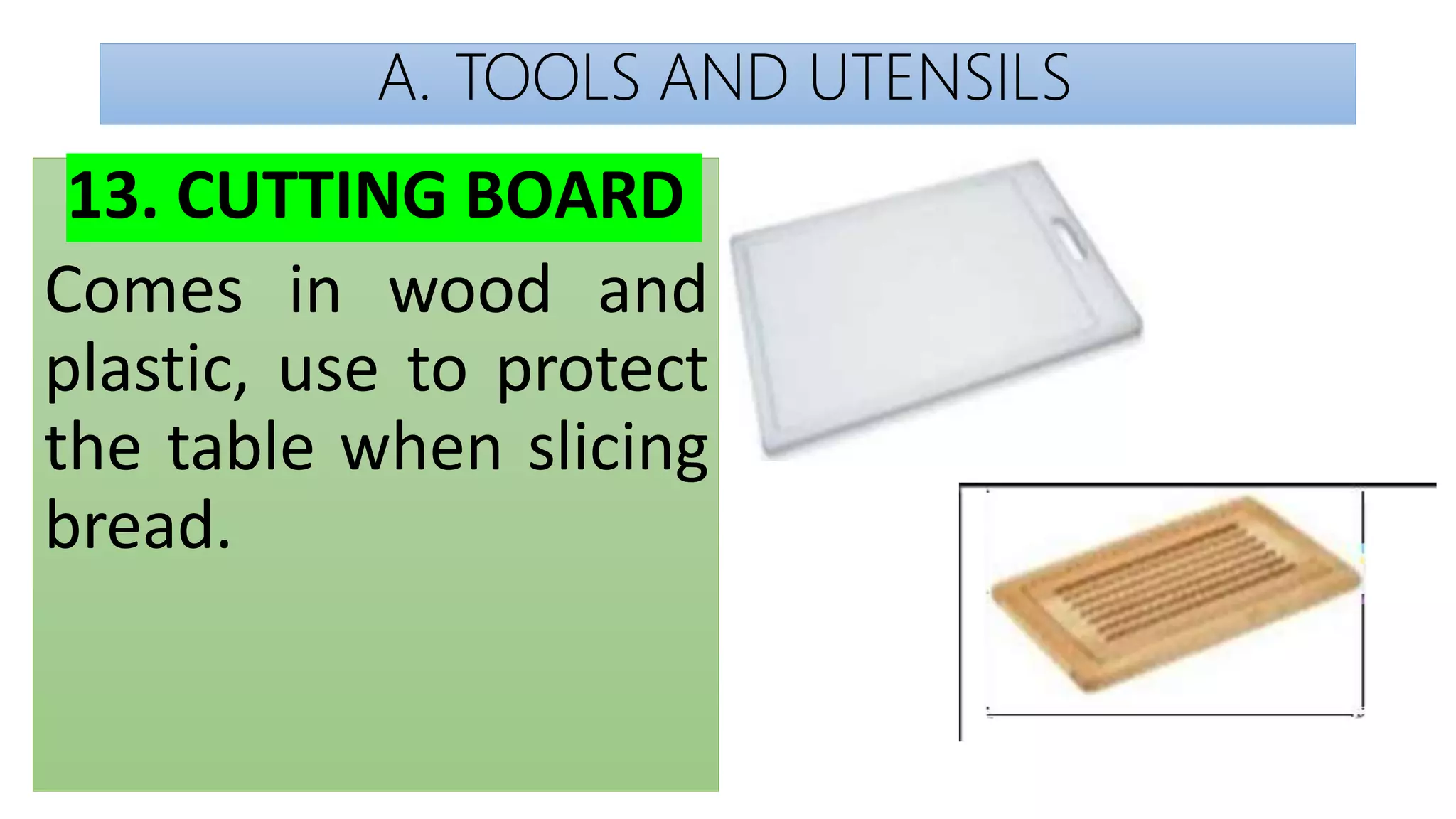
13. CUTTING BOARD
Comes in wood and
plastic, use to protect
the table when slicing
bread.
A. TOOLS AND UTENSILS
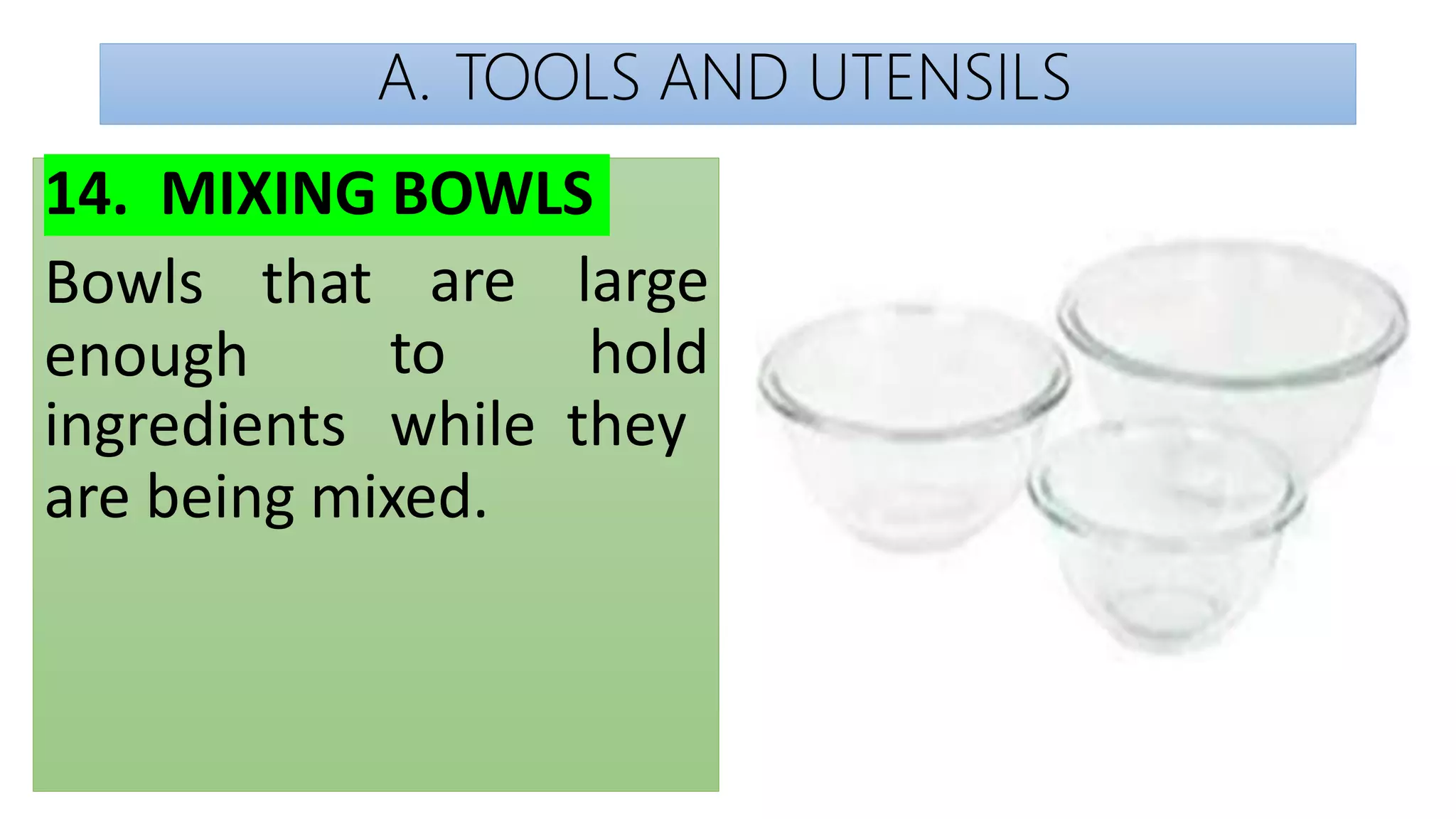
14. MIXING BOWLS
Bowls that
enough
ingredients
are large
to hold
while they
are being mixed.
A. TOOLS AND UTENSILS
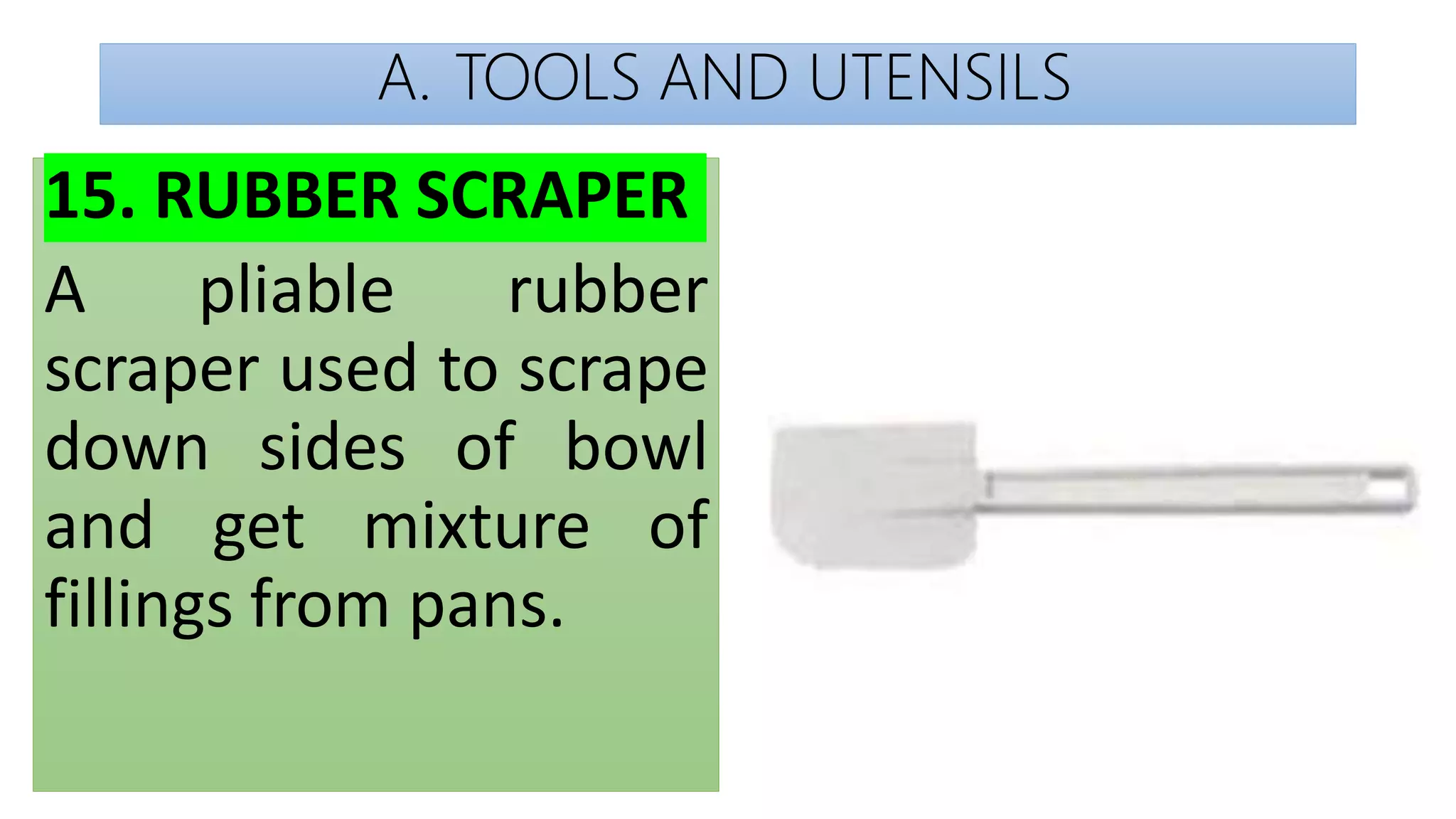
15. RUBBER SCRAPER
A pliable rubber
scraper used to scrape
down sides of bowl
and get mixture of
fillings from pans.
A. TOOLS AND UTENSILS
16. MEASURING CUPS
Graduated Measuring
Glass - a transparent
glass with fractions [1,
3/4, 2/3,1/2, 1/3, ¼ ]. Is
used for measuring
liquids.
A. TOOLS AND UTENSILS
•Individual Cups -
with fractional parts
[1, 3/4, 1/2, 1/4, ] is
used for solids or
dry ingredients.
A. TOOLS AND UTENSILS
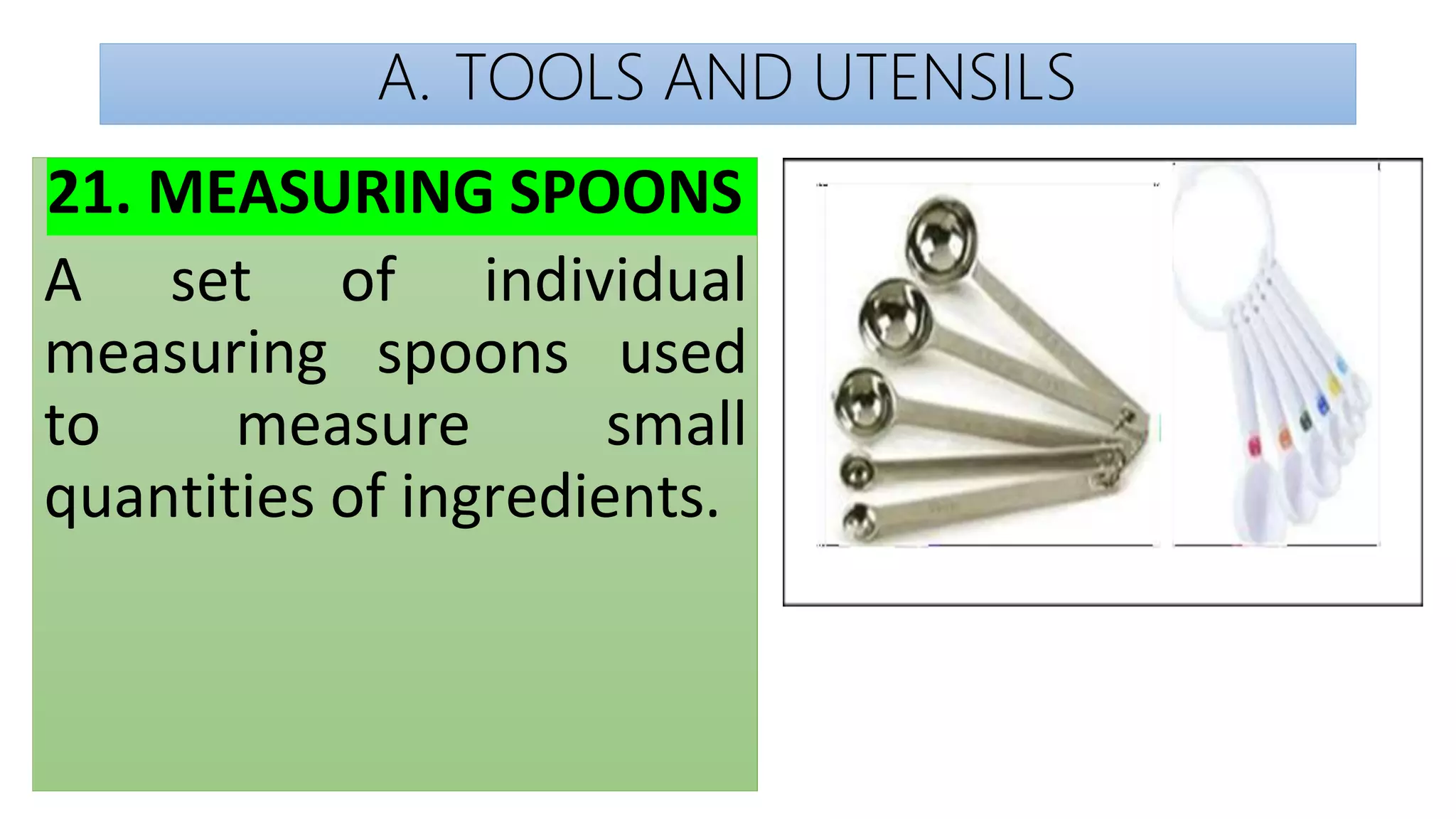
21. MEASURING SPOONS
A set of individual
measuring spoons used
to measure small
quantities of ingredients.
A. TOOLS AND UTENSILS
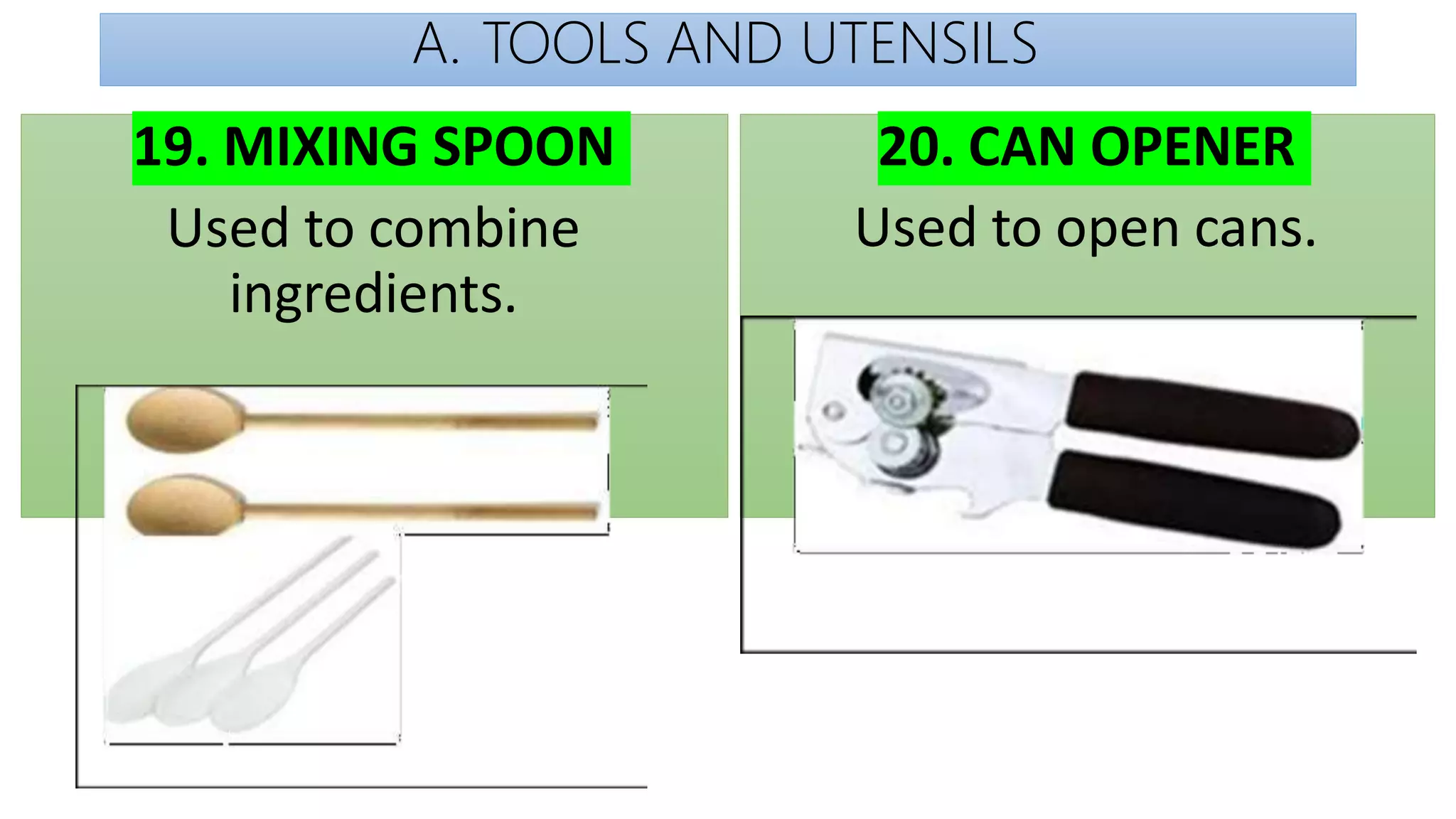
19. MIXING SPOON
Used to combine
ingredients.
20. CAN OPENER
Used to open cans.
A. TOOLS AND UTENSILS
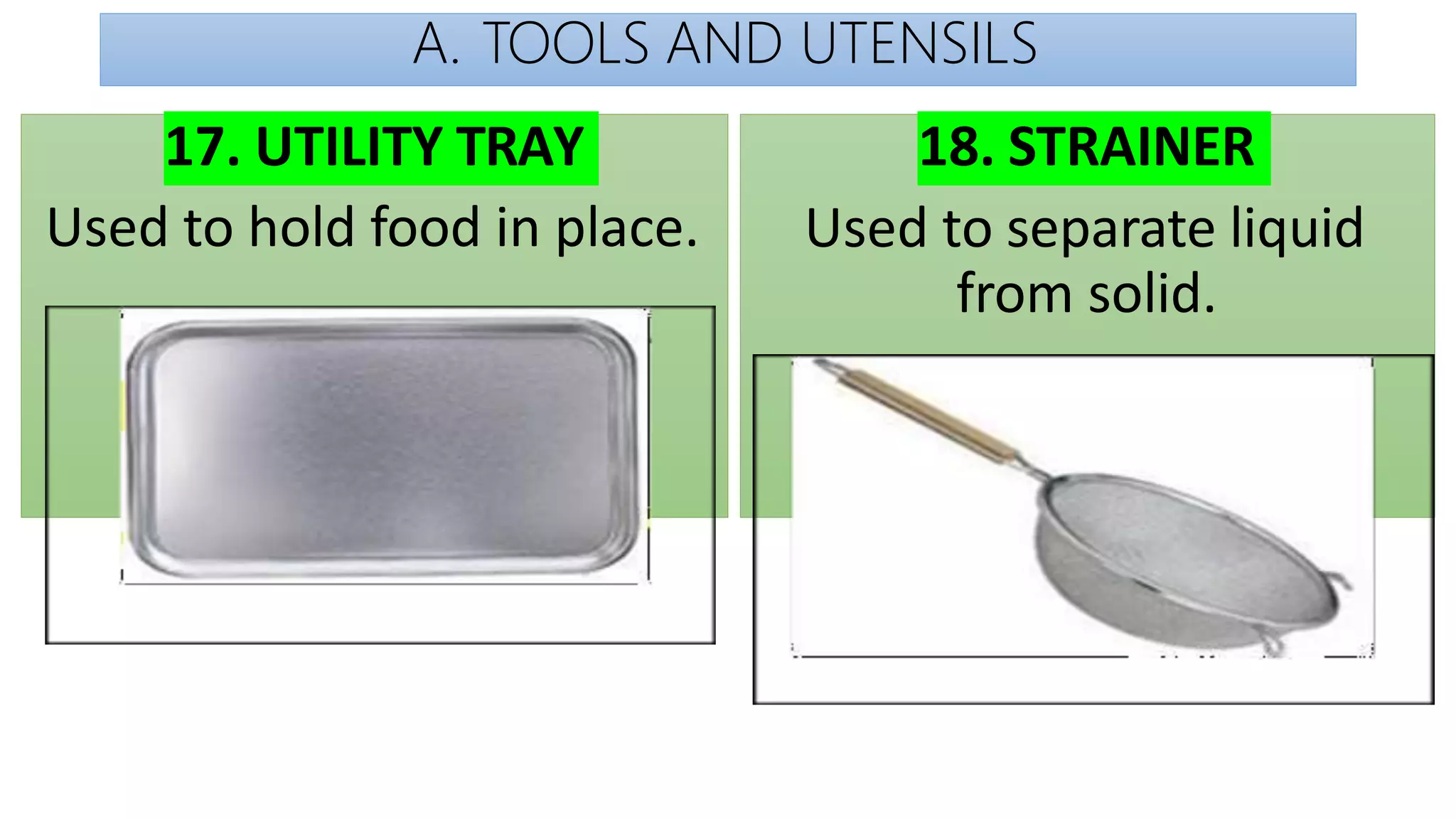
17. UTILITY TRAY
Used to hold food in place.
18. STRAINER
Used to separate liquid
from solid.
EQUIPMENT FOR SANDWICH MAKING
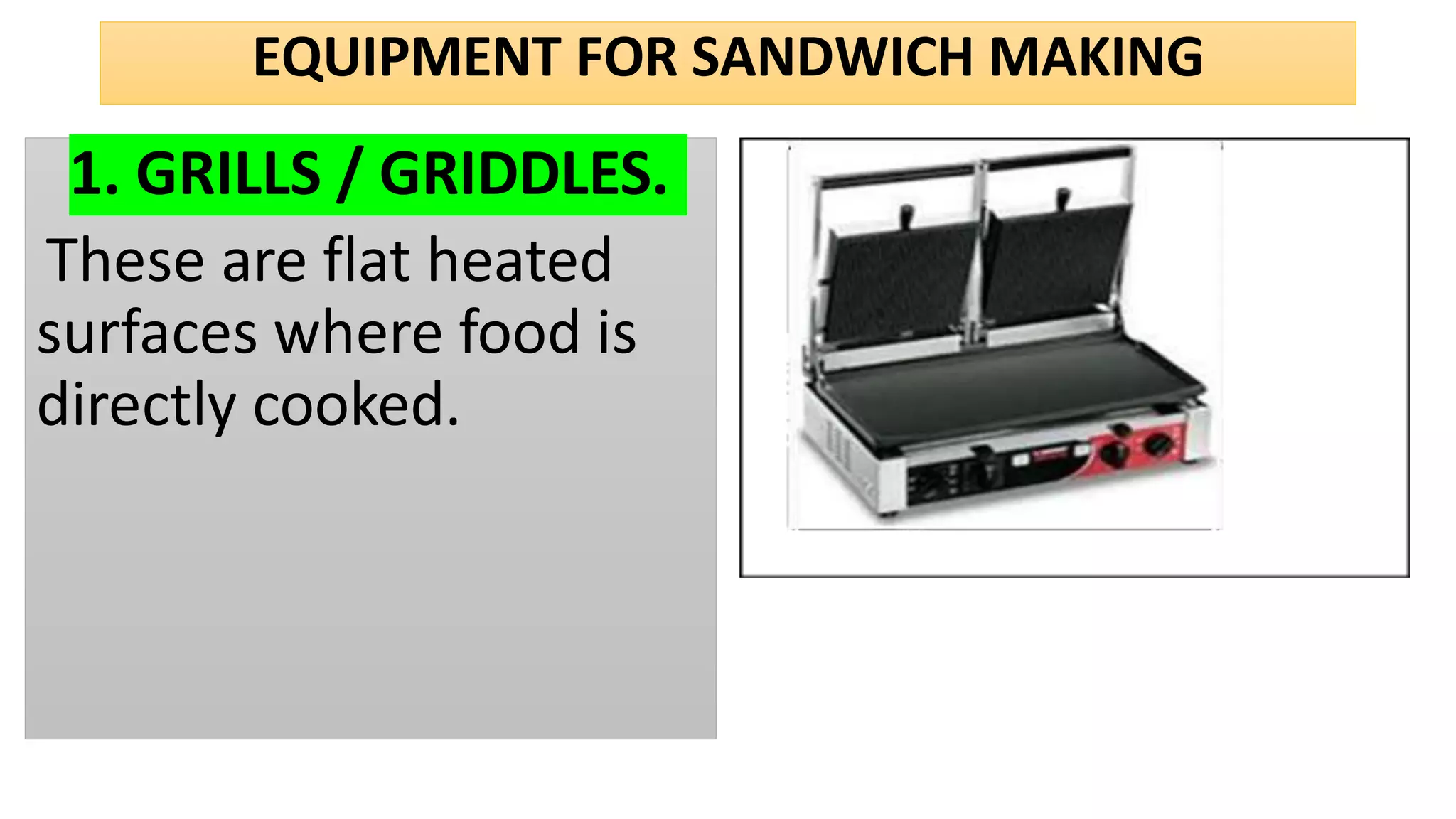
1. GRILLS / GRIDDLES.
These are flat heated
surfaces where food is
directly cooked.
EQUIPMENT FOR SANDWICH MAKING
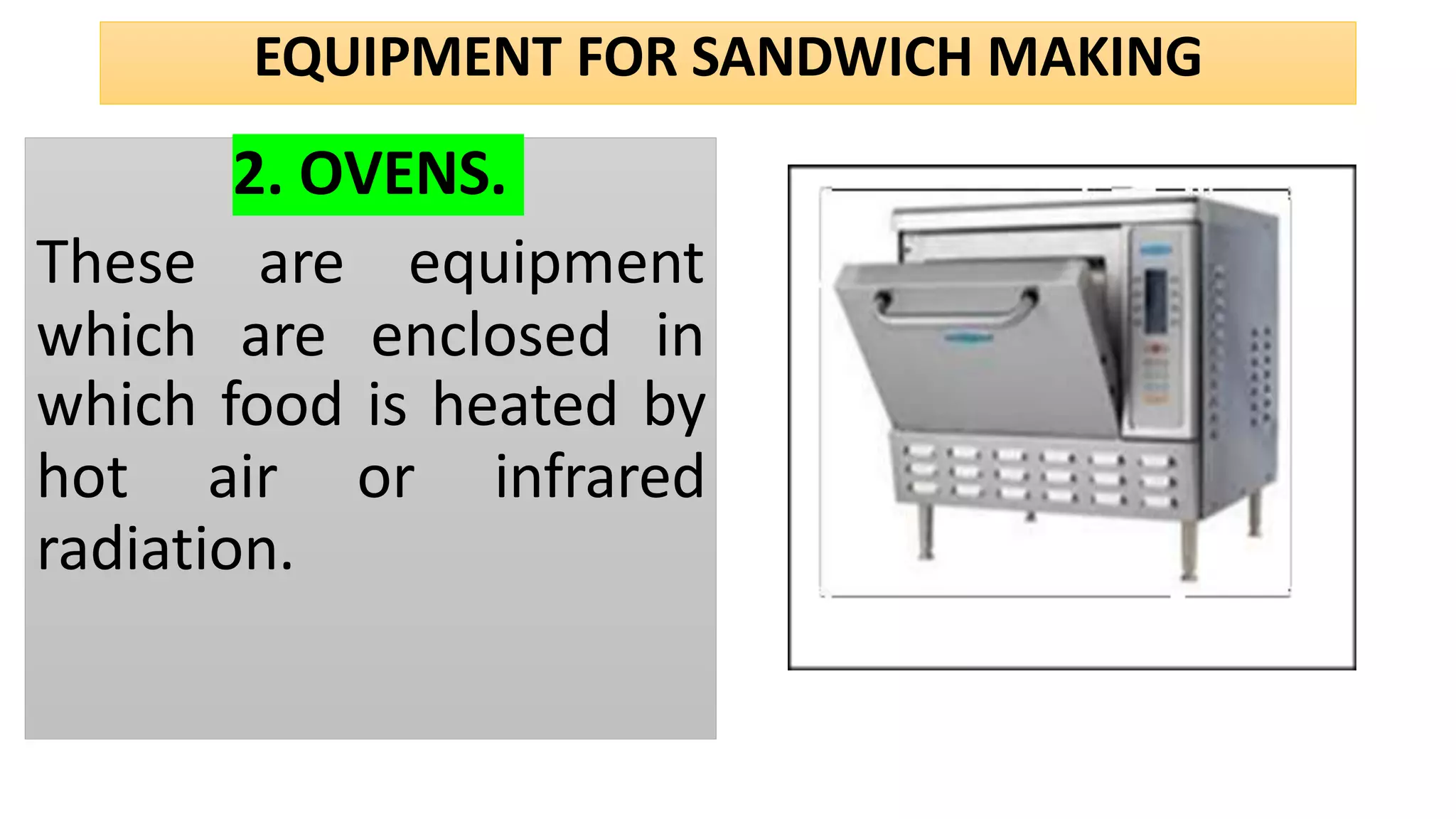
2. OVENS.
These
which
are equipment
are enclosed in
which food is heated by
hot air or infrared
radiation.
EQUIPMENT FOR SANDWICH MAKING
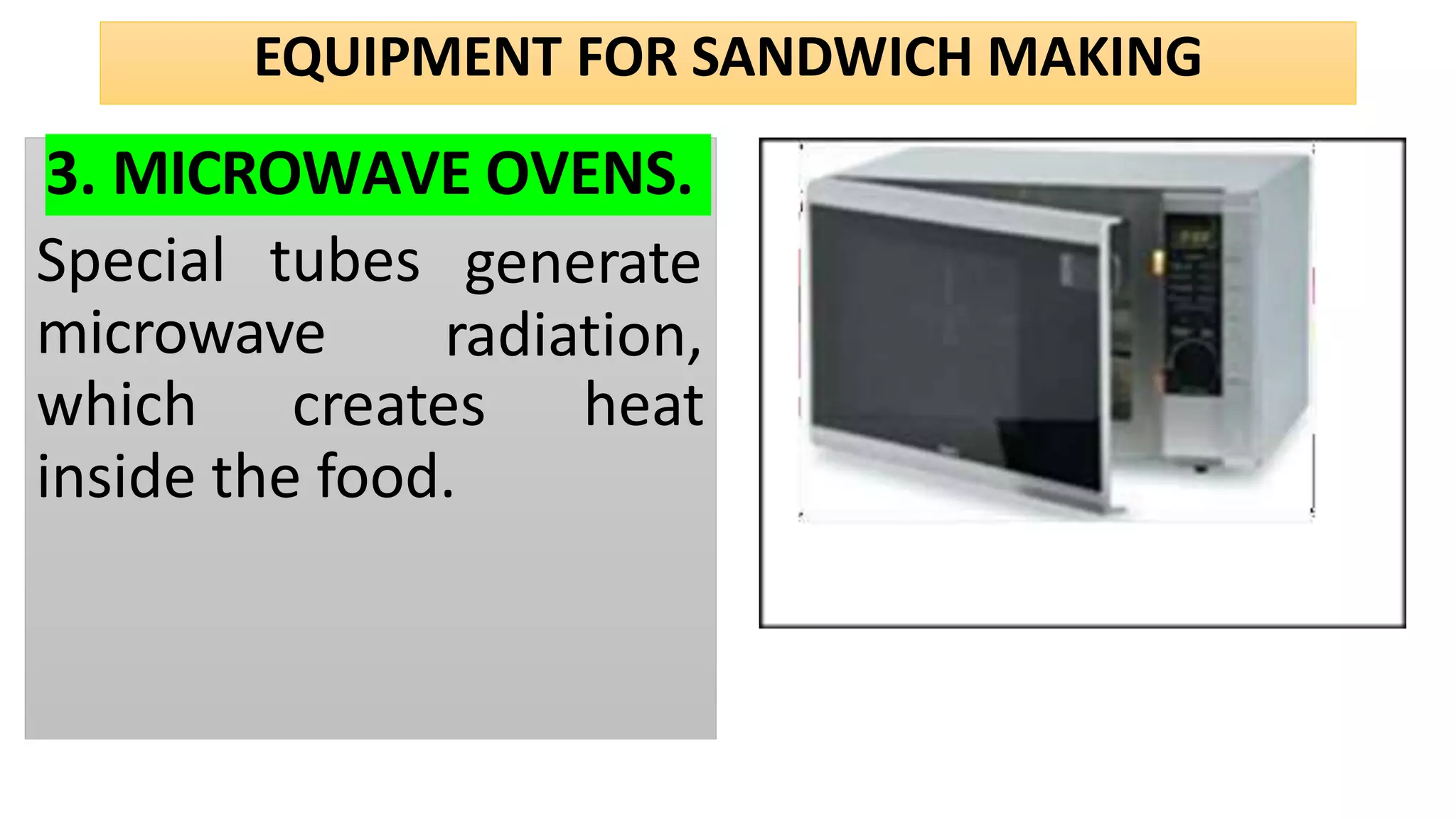
3. MICROWAVE OVENS.
Special tubes
microwave
generate
radiation,
which creates heat
inside the food.
EQUIPMENT FOR SANDWICH MAKING
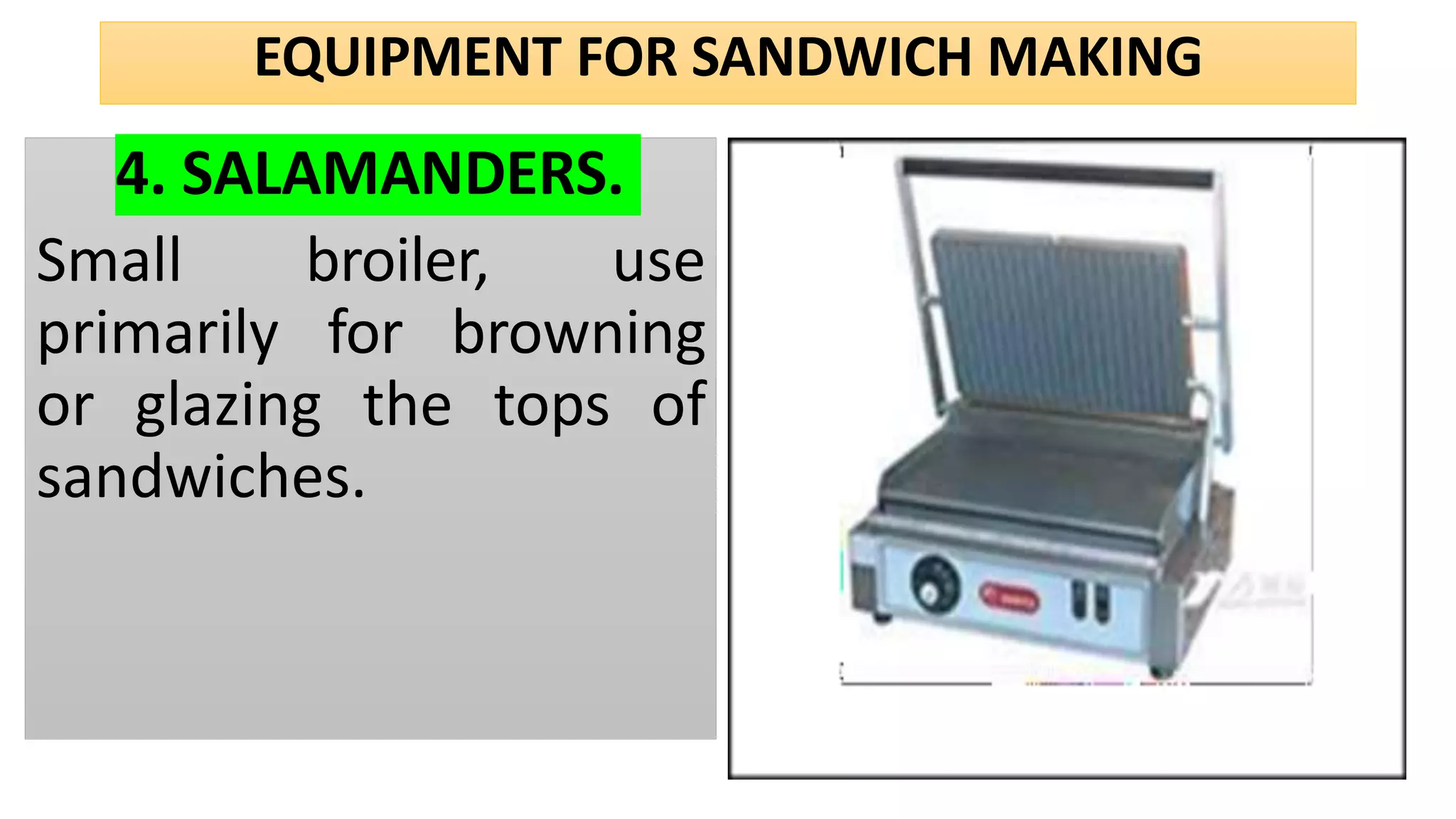
4. SALAMANDERS.
Small broiler, use
primarily for browning
or glazing the tops of
sandwiches.
EQUIPMENT FOR SANDWICH MAKING
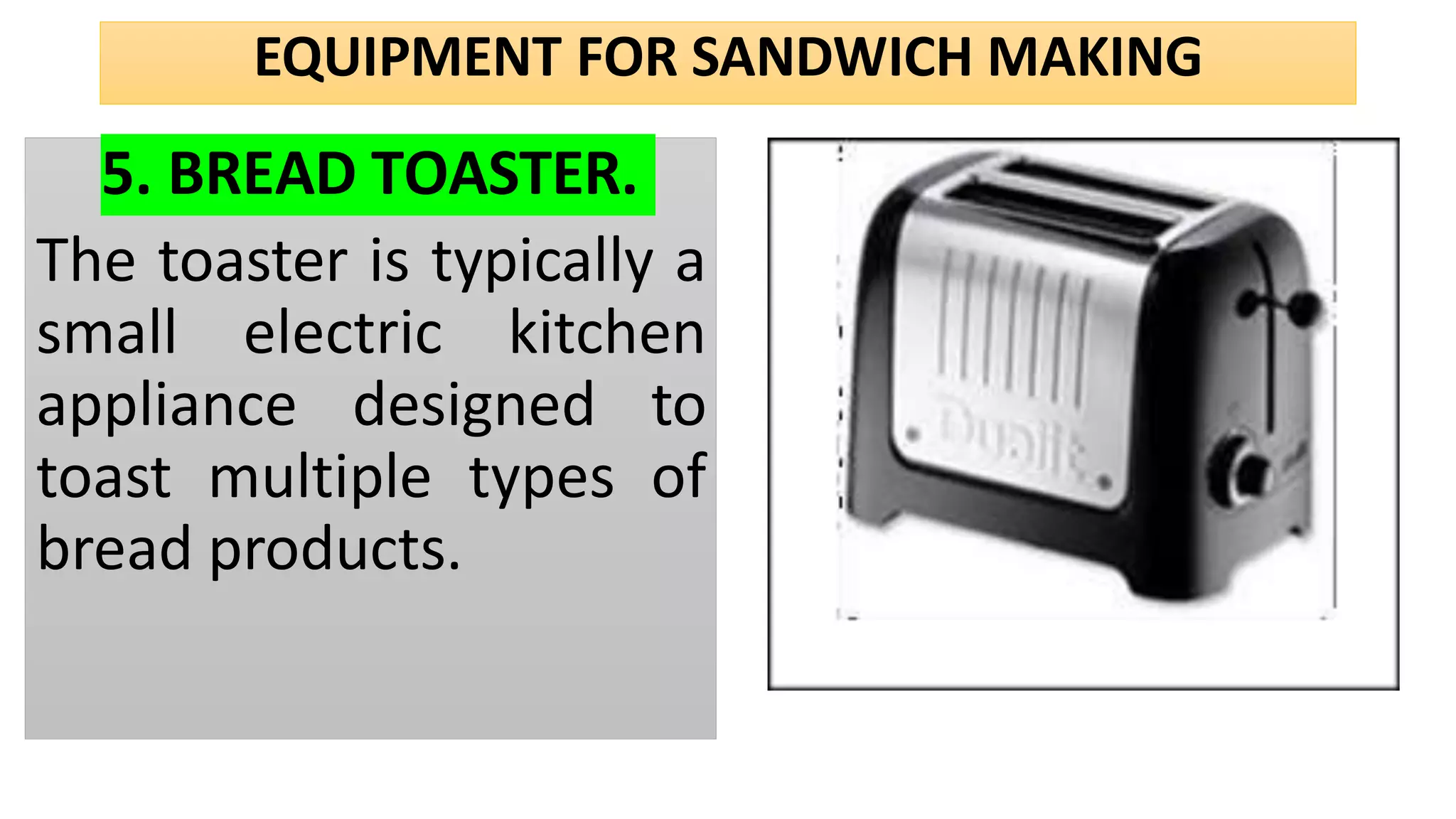
5. BREAD TOASTER.
The toaster is typically a
small electric kitchen
appliance designed to
toast multiple types of
bread products.
EQUIPMENT FOR SANDWICH MAKING
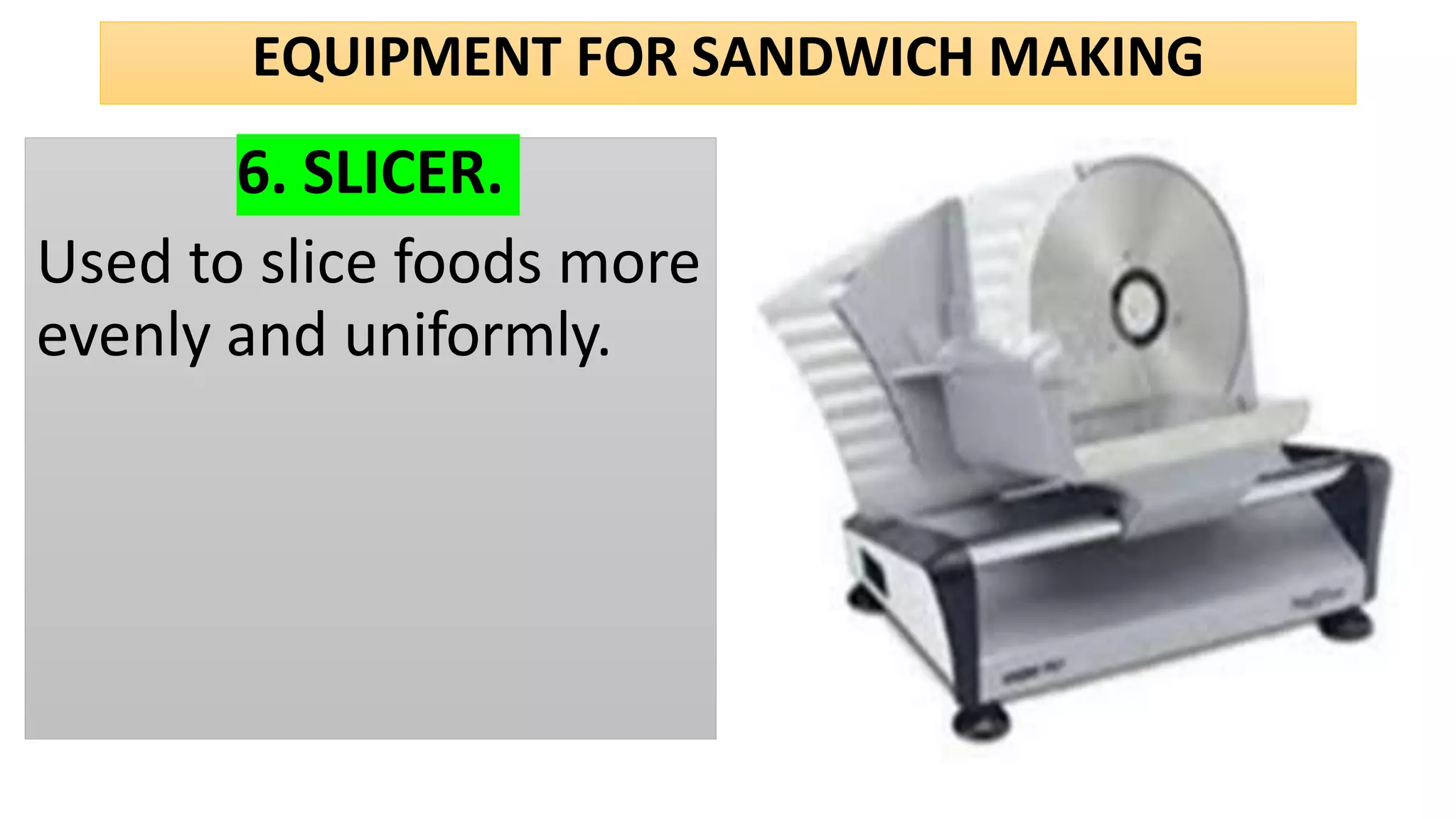
6. SLICER.
Used to slice foods more
evenly and uniformly.
EQUIPMENT FOR SANDWICH MAKING
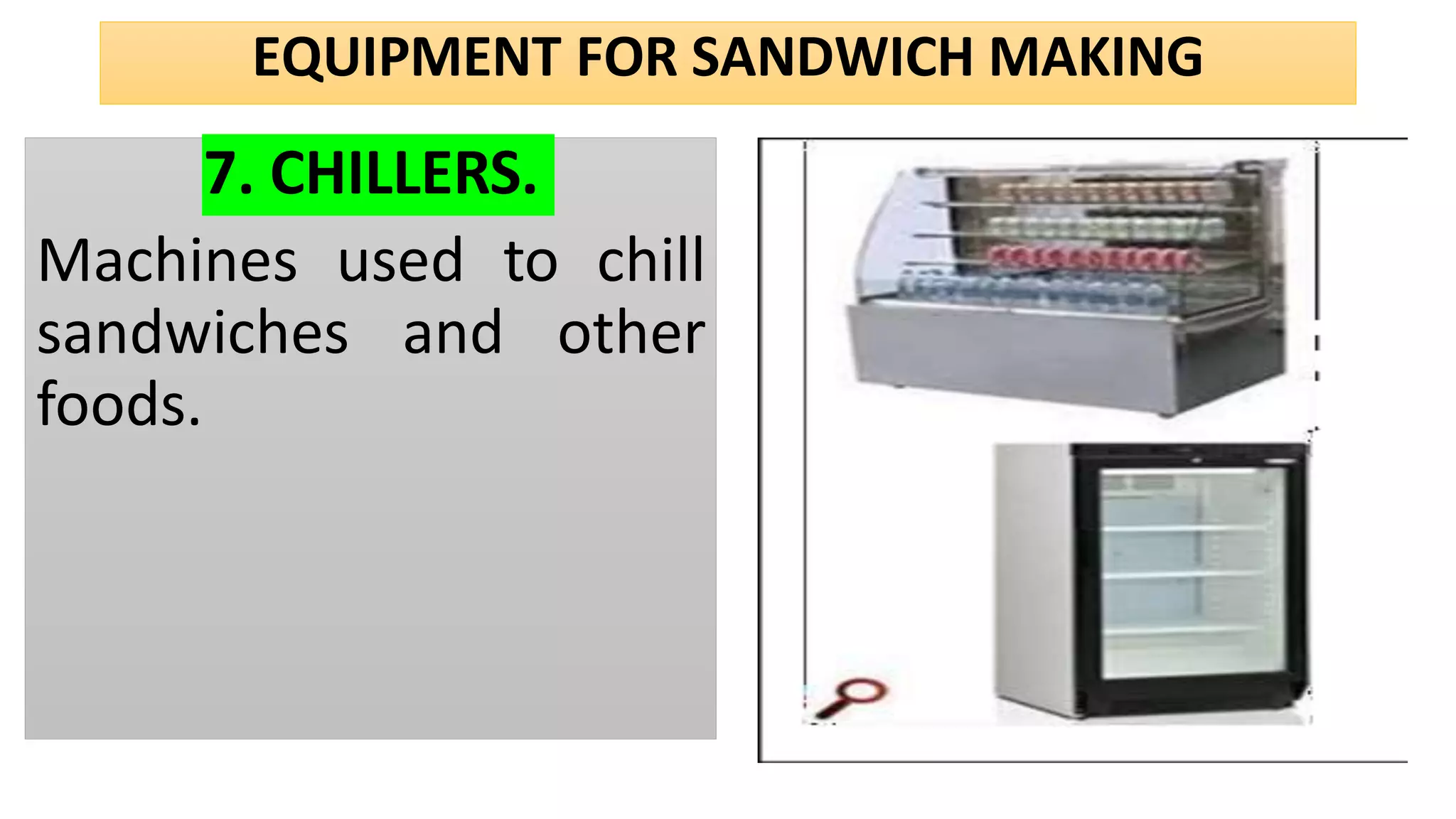
7. CHILLERS.
Machines used to chill
sandwiches and other
foods.
EQUIPMENT FOR SANDWICH MAKING
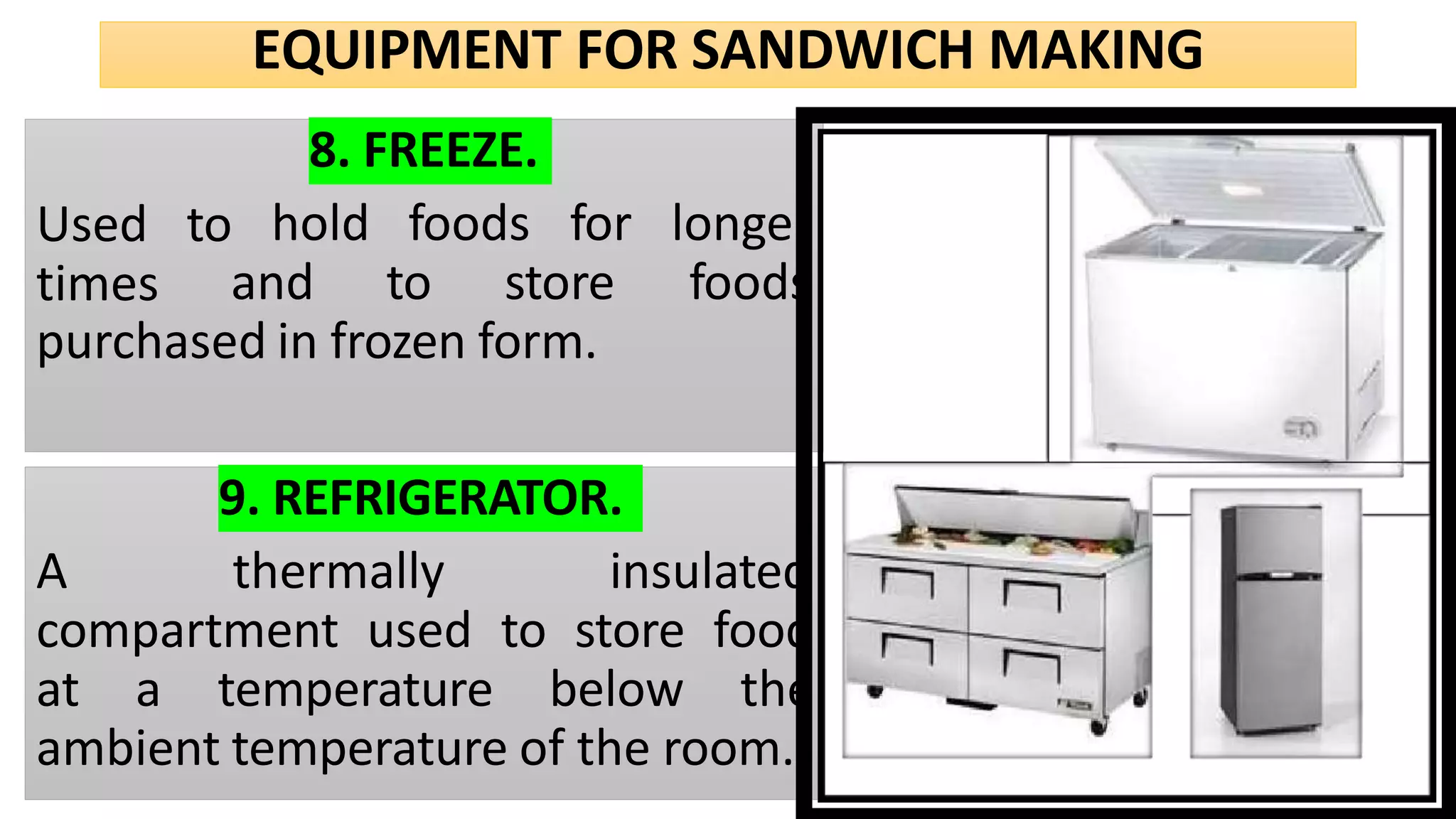
8. FREEZE.
hold foods for longer
Used to
times and to store foods
purchased in frozen form.
9. REFRIGERATOR.
A thermally insulated
compartment used to store food
at a temperature below the
ambient temperature of the room.
Direction: Read each item carefully and choose the answer that
best describes the statement.
1. A salad tool used to remove excess water from
the salad greens.
a) cutting boards c) salad serve
b) mixing bowl d) salad spinner
2. Used to hold salad ingredients for mixing, or for
tossing.
a) cutting boards c)mixing bowls
b) knives d)salad server
3. Salads that can be served as a full meal because
it contains substantial portion of meat, poultry,
seafood’s, fruits and vegetables.
a) accompaniment salad c)dessert salad
b)appetizer salad d)main course salad
4. Salads made of mixtures of ingredients that are
held together usually with a thick dressing like
mayonnaise.
a) bound salads b) composed salads
c) green salads d) vegetable salads
5. Salad ingredients are arranged on plate rather
than being mixed together
a) bound salad c) fruit salad
b) composed salad d) vegetable salad
6. Which of the following considerations are
essential in choosing ingredients for high quality
salads?
a) crispiness and taste c) quality and quantity
b) freshness and variety d) texture and color
7. Which of the following guidelines is not included in making
vegetable salad?
a) Cooked to a firm, crisp texture and good color
b) Cooked until completely tender and overcooked
c) Marinated or soaked in a seasoned liquid
d) Thoroughly drained and chilled before using
8. Which of the following is not a factor to consider in salad
preparation?
a) arrangement of food
b) contrast and harmony of colors
c) proper food combinations
d) quality of ingredients 3
9. Which of the following procedures for quantity
green salad production is the last step to do?
a) add dressing before serving
b) arrange salad plates on worktables
c) prepare all ingredients
d) refrigerate until serving
10. Which of the following ingredients is not used in
making French dressing?
a) Egg yolk b) Oil c) sugar d) vinegar

week 1.pptx

  • 1.
  • 2.
    Learning Outcome 1PERFORM MIS EN PLACE At the end of the lesson, you should be able to: Identify ingredients according to the given recipe Identify culinary terms related to sandwiches Identify type/classification of sandwiches
  • 3.
    Sandwiches Refers to afooditem made with two or more slices of bread with fillings between them. A widely popular and convenient lunch time food, quickly made and served and adaptable to many variations that satisfies nearly every taste and nutrition requirement.
  • 4.
    sandwiches Preparing fundamental skills required service.In fundamentals this lesson you will learn of sandwich making, is one of the in modern food the the ingredients, types of sandwiches, its methods of preparation for efficient production and service.
  • 5.
  • 6.
    A. TOOLS ANDUTENSILS 1. SANDWICH SPATULA A small flat, round bladed utensil that is serrated on one side and smooth on the other, appearing somewhat like a round spatula. It is used to apply spreads, over bread food slices.
  • 7.
    A. TOOLS ANDUTENSILS 2. SCISSORS Use to cut customized edges on bread for tea sandwiches, or children’s sandwiches. Use the shears to cut a pocket in toast and waffles. Cut sandwiches in different shapes like rectangles, triangles and circles.
  • 8.
    A. TOOLS ANDUTENSILS 3. COOKIE CUTTERS Small, medium and large. Small ones are perfect for cutting out the tinier breads medium and large for tea sandwiches and for making larger sandwiches.
  • 9.
    A. TOOLS ANDUTENSILS 4. GRATER AND SHREDDER cheese, meat and ingredients Grating other flavors to mix, allows thus; palatability of sandwich is increase.
  • 10.
    A. TOOLS ANDUTENSILS 5. SPATULA A long flexible blade with a rounded end, used to level off ingredients in measuring cups and spoons and for on Spreading fillings sandwiches.
  • 11.
    A. TOOLS ANDUTENSILS 6. BUTTER KNIFE A small knife with a blunt edged blade that is used to apply butter, spreads, peanut such as butter, and cream cheese, on bread or dinner rolls.
  • 12.
    A. TOOLS ANDUTENSILS 7. CHEF’S KNIVES Come in various lengths of 6, 8, 10, and 12 inches. The smaller sized knives are typically referred to as mini chef's knives while the longer lengths are known as traditional chef's knives.
  • 13.
    A. TOOLS ANDUTENSILS 8. DELI KNIFE for thick Designed sandwiches, this knife is made to cut easily and quickly through a variety of sandwich ingredients. The deli knife has offset blade allowing ease of slicing and handling.
  • 14.
    A. TOOLS ANDUTENSILS 9. LETTUCE KNIFE Plastic serrated edge knife that is designed to slice lettuce without causing the edges to turn brown. It is efficient in slicing lettuce.
  • 15.
    A. TOOLS ANDUTENSILS 10. PARING KNIFE A small knife with a straight, sharp blade that is generally three to five inches long. It works well for peeling and coring foods, and best for mincing and cutting small items.
  • 16.
    A. TOOLS ANDUTENSILS 11. SANDWICH KNIFE A sharp-bladed kitchen utensil used to slice through a medium amount of food ingredients "sandwiched" between two slices of bread. Similar in use to a deli knife, the sandwich knife is shorter in length with a shorter blade depth in order to easily cut through smaller to medium-sized sandwiches.
  • 17.
    A. TOOLS ANDUTENSILS 12. SERRATED KNIFE A knife with a sharp edge that has saw-like notches or teeth. The blade of a serrated knife is 5 to 10 inches long and is used to slice through food that is hard on the outside and soft on the inside, such as slicing through the hard crusts of bread. A serrated knife with a short, thin blade is intended for slicing fruits and vegetables.
  • 18.
    A. TOOLS ANDUTENSILS 13. CUTTING BOARD Comes in wood and plastic, use to protect the table when slicing bread.
  • 19.
    A. TOOLS ANDUTENSILS 14. MIXING BOWLS Bowls that enough ingredients are large to hold while they are being mixed.
  • 20.
    A. TOOLS ANDUTENSILS 15. RUBBER SCRAPER A pliable rubber scraper used to scrape down sides of bowl and get mixture of fillings from pans.
  • 21.
    A. TOOLS ANDUTENSILS 16. MEASURING CUPS Graduated Measuring Glass - a transparent glass with fractions [1, 3/4, 2/3,1/2, 1/3, ¼ ]. Is used for measuring liquids.
  • 22.
    A. TOOLS ANDUTENSILS •Individual Cups - with fractional parts [1, 3/4, 1/2, 1/4, ] is used for solids or dry ingredients.
  • 23.
    A. TOOLS ANDUTENSILS 21. MEASURING SPOONS A set of individual measuring spoons used to measure small quantities of ingredients.
  • 24.
    A. TOOLS ANDUTENSILS 19. MIXING SPOON Used to combine ingredients. 20. CAN OPENER Used to open cans.
  • 25.
    A. TOOLS ANDUTENSILS 17. UTILITY TRAY Used to hold food in place. 18. STRAINER Used to separate liquid from solid.
  • 26.
    EQUIPMENT FOR SANDWICHMAKING 1. GRILLS / GRIDDLES. These are flat heated surfaces where food is directly cooked.
  • 27.
    EQUIPMENT FOR SANDWICHMAKING 2. OVENS. These which are equipment are enclosed in which food is heated by hot air or infrared radiation.
  • 28.
    EQUIPMENT FOR SANDWICHMAKING 3. MICROWAVE OVENS. Special tubes microwave generate radiation, which creates heat inside the food.
  • 29.
    EQUIPMENT FOR SANDWICHMAKING 4. SALAMANDERS. Small broiler, use primarily for browning or glazing the tops of sandwiches.
  • 30.
    EQUIPMENT FOR SANDWICHMAKING 5. BREAD TOASTER. The toaster is typically a small electric kitchen appliance designed to toast multiple types of bread products.
  • 31.
    EQUIPMENT FOR SANDWICHMAKING 6. SLICER. Used to slice foods more evenly and uniformly.
  • 32.
    EQUIPMENT FOR SANDWICHMAKING 7. CHILLERS. Machines used to chill sandwiches and other foods.
  • 33.
    EQUIPMENT FOR SANDWICHMAKING 8. FREEZE. hold foods for longer Used to times and to store foods purchased in frozen form. 9. REFRIGERATOR. A thermally insulated compartment used to store food at a temperature below the ambient temperature of the room.
  • 35.
    Direction: Read eachitem carefully and choose the answer that best describes the statement. 1. A salad tool used to remove excess water from the salad greens. a) cutting boards c) salad serve b) mixing bowl d) salad spinner 2. Used to hold salad ingredients for mixing, or for tossing. a) cutting boards c)mixing bowls b) knives d)salad server
  • 36.
    3. Salads thatcan be served as a full meal because it contains substantial portion of meat, poultry, seafood’s, fruits and vegetables. a) accompaniment salad c)dessert salad b)appetizer salad d)main course salad 4. Salads made of mixtures of ingredients that are held together usually with a thick dressing like mayonnaise. a) bound salads b) composed salads c) green salads d) vegetable salads
  • 37.
    5. Salad ingredientsare arranged on plate rather than being mixed together a) bound salad c) fruit salad b) composed salad d) vegetable salad 6. Which of the following considerations are essential in choosing ingredients for high quality salads? a) crispiness and taste c) quality and quantity b) freshness and variety d) texture and color
  • 38.
    7. Which ofthe following guidelines is not included in making vegetable salad? a) Cooked to a firm, crisp texture and good color b) Cooked until completely tender and overcooked c) Marinated or soaked in a seasoned liquid d) Thoroughly drained and chilled before using 8. Which of the following is not a factor to consider in salad preparation? a) arrangement of food b) contrast and harmony of colors c) proper food combinations d) quality of ingredients 3
  • 39.
    9. Which ofthe following procedures for quantity green salad production is the last step to do? a) add dressing before serving b) arrange salad plates on worktables c) prepare all ingredients d) refrigerate until serving 10. Which of the following ingredients is not used in making French dressing? a) Egg yolk b) Oil c) sugar d) vinegar