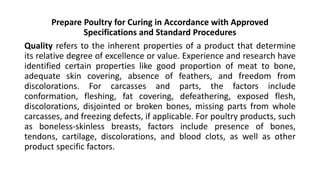
Prepare Poultry for Curing in Accordance with Approved
Specifications and Standard Procedures
Quality refers to the inherent properties of a product that determine
its relative degree of excellence or value. Experience and research have
identified certain properties like good proportion of meat to bone,
adequate skin covering, absence of feathers, and freedom from
discolorations. For carcasses and parts, the factors include
conformation, fleshing, fat covering, defeathering, exposed flesh,
discolorations, disjointed or broken bones, missing parts from whole
carcasses, and freezing defects, if applicable. For poultry products, such
as boneless-skinless breasts, factors include presence of bones,
tendons, cartilage, discolorations, and blood clots, as well as other
product specific factors.
Grading involves evaluating poultry in terms of
the standards to determine the grade. A quality
young chicken, turkey, duck, and goose. A given
lot of poultry may contain a small percentage of a
quality lower than the grade specified because
some defects are permitted. This is an
unavoidable necessity due to today’s production-
type processing methods. The following factors
must be considered when determining the quality
of an individual ready-to-cook carcass or part.
Conformation
The structure or shape of the bird may affect the
distribution and amount of meat, while certain defects
detract from its appearance. Some of the defects that
should be noted are breasts that are dented, crooked,
knobby, or V-shaped; backs that are crooked or
hunched; legs and wings that are deformed; and bodies
that are definitely wedge-shaped.
Fleshing
The drumsticks, thighs, and breast carry the bulk of the meat.
There is, however, a definite correlation between the covering of
the flesh over the back and the amount of flesh on the rest of the
carcass. Females almost invariably carry more flesh over the back
and will generally have a more rounded appearance to the breast,
thighs, and legs. The common defects in fleshing are breasts that
are V-shape or concave, rather than full and rounded; breasts that
are full near the wishbone, but taper sharply to the rear; legs and
drumsticks that are thin; and backs that have insufficient flesh to
cover the vertebrae and hip bones.
Fat Covering
Fat in poultry is judged entirely by accumulation under the skin. This is true
even for chicken parts. Accumulations occur first around the feather follicles
in the heavy feather tracts. Poorly fattened birds may have some
accumulation of fat in the skin along the heavy feather tracts on the breast.
Then, accumulations will be noted at the juncture of the wishbone and keel
and where the thigh skin joins the breast skin. At the same time,
accumulations will be noted around the feather follicles between the heavy
feather tracts and over the back and hips. Well -finished older birds will have
sufficient fat in these areas and over the drumsticks and thighs so that the
flesh is difficult to see. Fowl which have stopped laying have a tendency to
take on excessive fat in the abdominal area. Younger birds will generally have
less fat under the skin between the heavy feather tracts on the breast and
over the drumsticks and thighs than mature birds.
Feathers
Before a quality designation can be assigned, ready to cook poultry
must be free of protruding feathers that are visible to a grader during
examination of the carcass at normal operating speeds. However, a
carcass may be considered as being free from protruding feathers if it
has a generally clean appearance (especially on the breast and legs)
and if not more than an occasional protruding feather is in evidence
during a more careful examination of the carcass. Hair on chickens,
turkeys, guineas, and pigeons; and down on ducks and geese must also
be considered. Exposed Flesh, Cuts, Tears, and Broken Bones Exposed
flesh can result from cuts, tears, missing skin, or broken or disjointed
bones.
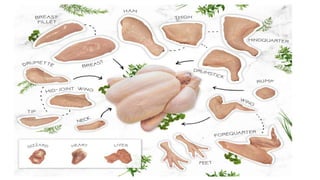
Cutting Poultry Parts
The USDA standards of quality apply to poultry parts cut
in the manner described below. While most descriptions
were developed when parts were cut from a carcass by
hand, most processors today disjoint whole carcasses by
machine. Machine-cut parts may be graded provided
they are not misshapen and have nearly the same
appearance as they had prior to cutting from the carcass.
Under certain conditions, parts cut in other ways may
also be officially identified when properly labeled. Only
skin or fat normally associated with a part maybe
included unless stated on the label.
Poultry halves are
prepared by making a full-
length back and breast split
of the carcass to produce
approximately equal right
and left sides. Portions of
the backbone must remain
on both halves. The cut
may be no more than one-
fourth inch from the outer
edge of the sternum
(breastbone).
Front poultry halves
include the full
breast with
corresponding back
portion, and may or
may not include
wings, wing meat or
portions of wing.
Rear poultry
halves include
both legs and
adjoining
portion of the
back.
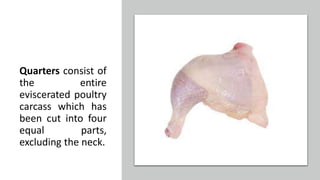
Quarters consist of
the entire
eviscerated poultry
carcass which has
been cut into four
equal parts,
excluding the neck.
Breast quarters
consist of half a
breast with the
wing and a
portion of the
back attached.
Leg quarters consist of a thigh
and drumstick, with a portion
of the back attached. It may
also include attached
abdominal fat and a maximum
of two ribs. A leg with a
complete or entire rear back
portion attached may also be
grade identified if certain
criteria are met.
Breasts are separated from the back
at the shoulder joint and by a cut
running backward and downward
from that point along the junction of
the vertebral and sternal ribs. The
ribs may be removed from the
breasts, and the breasts may be cut
along the breastbone to make two
approximately equal halves; or the
wishbone portion may be removed
before cutting the remainder along
the breastbone to make three parts.
Breasts with ribs are separated
from the back at the junction of
the vertebral ribs and back.
Breasts with ribs maybe cut
along the breastbone to make
two approximately equal
halves; or the wishbone portion
may be removed before cutting
the remainder along the
breastbone to make three
parts.
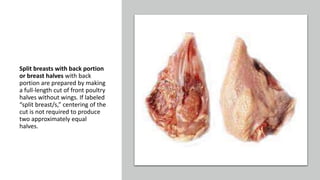
Split breasts with back portion
or breast halves with back
portion are prepared by making
a full-length cut of front poultry
halves without wings. If labeled
“split breast/s,” centering of the
cut is not required to produce
two approximately equal
halves.
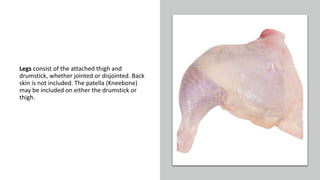
Legs consist of the attached thigh and
drumstick, whether jointed or disjointed. Back
skin is not included. The patella (Kneebone)
may be included on either the drumstick or
thigh.
Thighs are disjointed at the hip
joint and may include the pelvic
meat, but not the pelvic bones.
Back skin is not included. Thighs
may also include abdominal meat
(flank meat), but not rib bones.
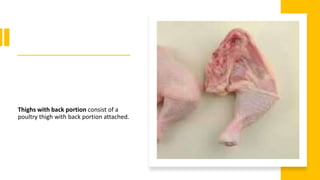
Thighs with back portion consist of a
poultry thigh with back portion attached.
Drumsticks are separated from the
thigh and hock by cuts through the
knee joint (femorotibial and
patellar joint) and the hock joint
(tarsal joint), respectively.
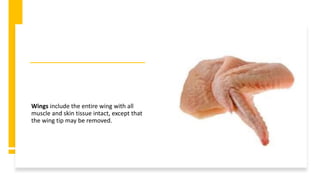
Wings include the entire wing with all
muscle and skin tissue intact, except that
the wing tip may be removed.
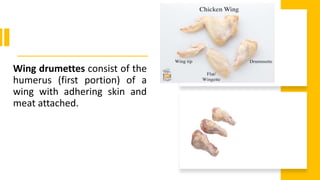
Wing drumettes consist of the
humerus (first portion) of a
wing with adhering skin and
meat attached.
Boneless-skinless poultry, except as
noted, is free of tendons, cartilage, bone
pieces, blood clots, discolorations, and
muscle mutilation.
Boneless-skinless breasts or breasts with
rib meat are prepared from breasts cut as
described for “breasts” and for “breasts
with ribs.”
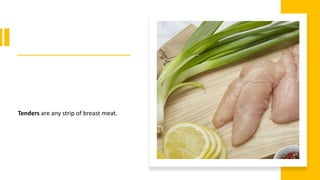
Tenders are any strip of breast meat.
Tenderloins are the inner pectoral muscle
which lies alongside the sternum
(breastbone). Tendons may be present.
Boneless-skinless thighs are prepared from
thighs cut as described for “thighs.”
Boneless-skinless drums are prepared
from drums cut as described for
“drumsticks.”
Prepare Salting and Curing Solutions and
Mixtures
Salt as a Preservative Salt has been used as a preservative for ages, and
works to preserve food in two ways:
1. Salt dries food. Salt draws water out of food and dehydrates it. It is used
to preserve beef jerky by keeping it dry, and it prevents butter from
spoiling by draw.
2. Salt kills microbes. High salt is toxic to most (not all) microbes because of
the effect of osmolarity, or water pressure. In very high salt solutions,
many microbes will rupture due to the difference in pressure between
the outside and inside of the organism. High salt can also be toxic to
internal processes of microbes, affecting DNA and enzymes. Solutions
high in sugar also have the same effects on microbes, which is why it is
used as a preservative of foods, such as jams and jellies.
chicken.pptx
chicken.pptx

chicken.pptx

  • 19.
    Prepare Poultry forCuring in Accordance with Approved Specifications and Standard Procedures Quality refers to the inherent properties of a product that determine its relative degree of excellence or value. Experience and research have identified certain properties like good proportion of meat to bone, adequate skin covering, absence of feathers, and freedom from discolorations. For carcasses and parts, the factors include conformation, fleshing, fat covering, defeathering, exposed flesh, discolorations, disjointed or broken bones, missing parts from whole carcasses, and freezing defects, if applicable. For poultry products, such as boneless-skinless breasts, factors include presence of bones, tendons, cartilage, discolorations, and blood clots, as well as other product specific factors.
  • 20.
    Grading involves evaluatingpoultry in terms of the standards to determine the grade. A quality young chicken, turkey, duck, and goose. A given lot of poultry may contain a small percentage of a quality lower than the grade specified because some defects are permitted. This is an unavoidable necessity due to today’s production- type processing methods. The following factors must be considered when determining the quality of an individual ready-to-cook carcass or part.
  • 21.
    Conformation The structure orshape of the bird may affect the distribution and amount of meat, while certain defects detract from its appearance. Some of the defects that should be noted are breasts that are dented, crooked, knobby, or V-shaped; backs that are crooked or hunched; legs and wings that are deformed; and bodies that are definitely wedge-shaped.
  • 22.
    Fleshing The drumsticks, thighs,and breast carry the bulk of the meat. There is, however, a definite correlation between the covering of the flesh over the back and the amount of flesh on the rest of the carcass. Females almost invariably carry more flesh over the back and will generally have a more rounded appearance to the breast, thighs, and legs. The common defects in fleshing are breasts that are V-shape or concave, rather than full and rounded; breasts that are full near the wishbone, but taper sharply to the rear; legs and drumsticks that are thin; and backs that have insufficient flesh to cover the vertebrae and hip bones.
  • 23.
    Fat Covering Fat inpoultry is judged entirely by accumulation under the skin. This is true even for chicken parts. Accumulations occur first around the feather follicles in the heavy feather tracts. Poorly fattened birds may have some accumulation of fat in the skin along the heavy feather tracts on the breast. Then, accumulations will be noted at the juncture of the wishbone and keel and where the thigh skin joins the breast skin. At the same time, accumulations will be noted around the feather follicles between the heavy feather tracts and over the back and hips. Well -finished older birds will have sufficient fat in these areas and over the drumsticks and thighs so that the flesh is difficult to see. Fowl which have stopped laying have a tendency to take on excessive fat in the abdominal area. Younger birds will generally have less fat under the skin between the heavy feather tracts on the breast and over the drumsticks and thighs than mature birds.
  • 24.
    Feathers Before a qualitydesignation can be assigned, ready to cook poultry must be free of protruding feathers that are visible to a grader during examination of the carcass at normal operating speeds. However, a carcass may be considered as being free from protruding feathers if it has a generally clean appearance (especially on the breast and legs) and if not more than an occasional protruding feather is in evidence during a more careful examination of the carcass. Hair on chickens, turkeys, guineas, and pigeons; and down on ducks and geese must also be considered. Exposed Flesh, Cuts, Tears, and Broken Bones Exposed flesh can result from cuts, tears, missing skin, or broken or disjointed bones.
  • 25.
    Cutting Poultry Parts TheUSDA standards of quality apply to poultry parts cut in the manner described below. While most descriptions were developed when parts were cut from a carcass by hand, most processors today disjoint whole carcasses by machine. Machine-cut parts may be graded provided they are not misshapen and have nearly the same appearance as they had prior to cutting from the carcass. Under certain conditions, parts cut in other ways may also be officially identified when properly labeled. Only skin or fat normally associated with a part maybe included unless stated on the label.
  • 26.
    Poultry halves are preparedby making a full- length back and breast split of the carcass to produce approximately equal right and left sides. Portions of the backbone must remain on both halves. The cut may be no more than one- fourth inch from the outer edge of the sternum (breastbone).
  • 27.
    Front poultry halves includethe full breast with corresponding back portion, and may or may not include wings, wing meat or portions of wing.
  • 28.
    Rear poultry halves include bothlegs and adjoining portion of the back.
  • 29.
    Quarters consist of theentire eviscerated poultry carcass which has been cut into four equal parts, excluding the neck.
  • 30.
    Breast quarters consist ofhalf a breast with the wing and a portion of the back attached.
  • 31.
    Leg quarters consistof a thigh and drumstick, with a portion of the back attached. It may also include attached abdominal fat and a maximum of two ribs. A leg with a complete or entire rear back portion attached may also be grade identified if certain criteria are met.
  • 32.
    Breasts are separatedfrom the back at the shoulder joint and by a cut running backward and downward from that point along the junction of the vertebral and sternal ribs. The ribs may be removed from the breasts, and the breasts may be cut along the breastbone to make two approximately equal halves; or the wishbone portion may be removed before cutting the remainder along the breastbone to make three parts.
  • 33.
    Breasts with ribsare separated from the back at the junction of the vertebral ribs and back. Breasts with ribs maybe cut along the breastbone to make two approximately equal halves; or the wishbone portion may be removed before cutting the remainder along the breastbone to make three parts.
  • 34.
    Split breasts withback portion or breast halves with back portion are prepared by making a full-length cut of front poultry halves without wings. If labeled “split breast/s,” centering of the cut is not required to produce two approximately equal halves.
  • 35.
    Legs consist ofthe attached thigh and drumstick, whether jointed or disjointed. Back skin is not included. The patella (Kneebone) may be included on either the drumstick or thigh.
  • 36.
    Thighs are disjointedat the hip joint and may include the pelvic meat, but not the pelvic bones. Back skin is not included. Thighs may also include abdominal meat (flank meat), but not rib bones.
  • 37.
    Thighs with backportion consist of a poultry thigh with back portion attached.
  • 38.
    Drumsticks are separatedfrom the thigh and hock by cuts through the knee joint (femorotibial and patellar joint) and the hock joint (tarsal joint), respectively.
  • 39.
    Wings include theentire wing with all muscle and skin tissue intact, except that the wing tip may be removed.
  • 40.
    Wing drumettes consistof the humerus (first portion) of a wing with adhering skin and meat attached.
  • 41.
    Boneless-skinless poultry, exceptas noted, is free of tendons, cartilage, bone pieces, blood clots, discolorations, and muscle mutilation.
  • 42.
    Boneless-skinless breasts orbreasts with rib meat are prepared from breasts cut as described for “breasts” and for “breasts with ribs.”
  • 43.
    Tenders are anystrip of breast meat.
  • 44.
    Tenderloins are theinner pectoral muscle which lies alongside the sternum (breastbone). Tendons may be present.
  • 45.
    Boneless-skinless thighs areprepared from thighs cut as described for “thighs.”
  • 46.
    Boneless-skinless drums areprepared from drums cut as described for “drumsticks.”
  • 49.
    Prepare Salting andCuring Solutions and Mixtures Salt as a Preservative Salt has been used as a preservative for ages, and works to preserve food in two ways: 1. Salt dries food. Salt draws water out of food and dehydrates it. It is used to preserve beef jerky by keeping it dry, and it prevents butter from spoiling by draw. 2. Salt kills microbes. High salt is toxic to most (not all) microbes because of the effect of osmolarity, or water pressure. In very high salt solutions, many microbes will rupture due to the difference in pressure between the outside and inside of the organism. High salt can also be toxic to internal processes of microbes, affecting DNA and enzymes. Solutions high in sugar also have the same effects on microbes, which is why it is used as a preservative of foods, such as jams and jellies.