Farm Tools- are the equipment that is used in the processes of land preparation.
Hand farming tools- are usually light, one can use them manually, without the help of machinery or
animals. Commonly they are used for cultivating small areas or backyard-garden farming.
► Bolo- this tool is used to cut tall weeds
and grasses or chopping branches of trees.
 Crowbar - one can dig holes, with the help
of this tool, or dig out stones or stumps. It can
also be used as a lever arm.
► Pick-mattock
- Is a handy tool to dig and break stones.
 Spade
- this tool is used for removing soil
or trash, dig canals and so on.
► Shovel
- with the help of shovel, one can
quickly remove trash, dig, move and mix the soil.
 Spading fork
- is used for digging out roots,
loosening the soil or turning the materials in
the compost heap.
 Light hoe
- is used for leveling and loosening soil
or digging the furrows for planting.
 Hand cultivator
- is used for cultivating
garden plot and removing the weeds.
 Pruning shears
- it is a great tool to cut
branches of trees and brushes.
 Axe
- it helps in cutting big size branches and trees.
► Knife
- is a universal tool for cutting.
► Sprayers
- this one is used for spraying insecticides.
► Wheelbarrow
- it is used to remove the trash, haul fertilizers,
manures, planting materials, and other things.
► Sickle
- A tool with a curved metal blade attached to
a short handle that is used for cutting grass, grain, etc.
Farm Inputs- resources that are used in farm production, such as:
 Chemicals
 Equipment
 Seed
 Energy
Examples are fertilizer, seeds, seedlings, insecticides and labors.
 Fertilizers- chemical or natural substance added to soil or land to
increase its fertility.
 Seeds- a flowering plant’s unit of reproduction, capable of
developing into another such plant.
 Seedlings- is a young plant, already grown from a seed.
 Insecticides- a chemical substance used for killing insects
 Labor- the body of persons engaged in such activity, especially
those working for wages.
Labor requirement in planting Labor requirement for land
preparation
Labor requirement for plant care
• Production of seedlings
• Transplanting
• Plowing using tractor
• Clearing of the land using hoe
• Plowing using animal
• Harrowing using hand tractor
• Digging holes(for orchard)
• Preparation of furrow
• Fertilizer application
• Pesticides application
• Irrigation
• Weeding
• Harvesting
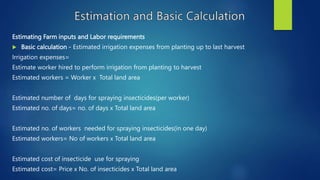
Estimating Farm inputs and Labor requirements
 Basic calculation - Estimated irrigation expenses from planting up to last harvest
Irrigation expenses=
Estimate worker hired to perform irrigation from planting to harvest
Estimated workers = Worker x Total land area
Estimated number of days for spraying insecticides(per worker)
Estimated no. of days= no. of days x Total land area
Estimated no. of workers needed for spraying insecticides(in one day)
Estimated workers= No of workers x Total land area
Estimated cost of insecticide use for spraying
Estimated cost= Price x No. of insecticides x Total land area
► Refers to the compiling of physical structures such as homesteads, outbuildings,
waterways, contours, camps, water supply roads and the layout of orchards,
vineyards or lands.
► involves the location of the fields with respect to the farmstead and public
highways, the size, shape and number of fields, and the location of hog-lots ,
feed-yards, etc. In arranging or re-arranging a farm layout the most important
considerations are convenience and economy of operation.
Selecting farming is an occupation : There are two reasons for selecting
farming as an occupation , namely ,
( 1 ) farming is stable and subject to less serious interruption in the
course of its existence , and
( 2 ) farm is considered by many as a good place for a home .
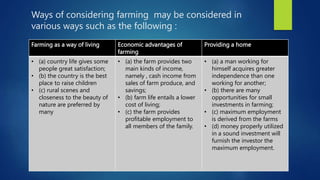
Ways of considering farming may be considered in
various ways such as the following :
Farming as a way of living Economic advantages of
farming
Providing a home
• (a) country life gives some
people great satisfaction;
• (b) the country is the best
place to raise children
• (c) rural scenes and
closeness to the beauty of
nature are preferred by
many
• (a) the farm provides two
main kinds of income,
namely , cash income from
sales of farm produce, and
savings;
• (b) farm life entails a lower
cost of living;
• (c) the farm provides
profitable employment to
all members of the family.
• (a) a man working for
himself acquires greater
independence than one
working for another;
• (b) there are many
opportunities for small
investments in farming;
• (c) maximum employment
is derived from the farms
• (d) money properly utilized
in a sound investment will
furnish the investor the
maximum employment.
“Good Working Equipment + Capable and Attentive Operators = Safety”
10 Tips to Remember About Farm Equipment and their Uses:
 Read and comply with the manual.
 Follow and keep up with federal and state laws.
 Always keep your slow-moving-emblem (SMV) clean visible and properly mounted.
 Dress Appropriately.
 Ensure you’re well rested.
 Avoid alcohol.
 Maintain Awareness.
 Adjust equipment accordingly.
 Keep children and animals away from working areas.
 Read up about planter equipment safety.
Farm waste-is a mixture of animal feces and urine, plus milk and chemicals such as pesticides.
Farm Manure
Kinds of farm manure : Farm manure is classified into :
( 1 ) Stace manure , which includes all solid and liquid animal excreta and absorbents which
have not suffered any loss yet ;
( 2 ) barnyard manure , which refers to manure which accumulates around the bar in the
farmyard and is exposed to rain and the drying action of the sun ; and
( 3 ) humus or decayed compost , which is made up of materials resulting from decom
position of plants.
 Covers the creation and maintenance of plant farms, including planting seeds,
fertilizing seedlings and harvesting all types of plants.
 Graduates of plant nursery operations programs may be employed in retail and
wholesale nurseries or greenhouse businesses as propagators, growers, seed
workers or salespeople.
 They may also find jobs analyzing weed seeds, inspecting horticulture
businesses or supervising spray-control operators.
Nursery work provides wholesome experiences for young people to develop life-
long interest in the growth and care of young plants and how they could be
multiplied for the benefit of the people. The nursery is a place for training,
educating, or the like.
Plant propagation is a means to continue and increase the production of
vegetables, root and fruit crops, and fruits and ornament- al plants. A school or
home nursery provides the facilities for the preparation of seedlings, cuttings,
marcottages, etc., which could be propagated and planted by those who want to
engage in food production.
Selecting the nursery site is like selecting a suitable garden site. In
many schools, the nursery site is a part of the garden site. In case the
nursery is not a part of the school garden site, it must meet the
following factors:
 Appropriate kind of soil
 Good drainage
 Near a water supply.
 A seed bed is like a seed box. Instead of using a box, the ground is prepared
into a plot or plots for germinating seeds.
 A common size of seed bed is 3 1/2 to 4 ft. wide with a walk-away between
seed beds, the length varying with the size of the project.
 The soil is prepared in the same way as the soil in the seed box is prepared.
 Pots, sand boxes, and bamboo tubes, are other receptacles that should be
prepared for the nursery.
 Propagation from Seeds
• Seeds are first planted in seed boxes. Forest tree seeds and other seeds with hard
coverings should be soaked one to three hours in warm water.
• Tree seeds are planted singly three cm. apart, rows four cm. apart. When the young plants
have four leaves, they are transferred to bamboo tubes or to nursery plots.
• One seedling is placed in each bamboo pot and the pots are kept under the slat arbor.
When trans- planted to nursery plots, the seedlings should be set 15 cm. apart, in rows 30
cm. apart.
 Cuttings
• Sand boxes are used for starting cuttings. Wood of at least year's growth must be
selected for the cutting. A clean slanting is made with a sharp knife at both ends of the
branch selected for cutting.
• The cutting should be long enough to contain four or five buds. All leaves and all small
branches should be trimmed off with sharp knife.
• The cutting is placed in a slanting position in a sand box so that one bud will be just at
the surface.
 Marcotting
- A limb or a branch with wood two or more years old is selected. A ring of bark is
removed (with a sharp knife) completely or almost completely around the limb.
 Grafting
- Is the art of joining parts of plants together in such a manner that they will unite and
continue their growth as one plant. The part of the graft combination which is to
become the upper portion or top of the new plant is called the scion, and the part which
is to become the lower portion or root is called the stock.
 Layering
- is the development of the roots on a stem while it is still attached to the parent
plant. The rooted system is then detached to become a new plant growing on its
roots. A layered stem is known as a layer. This may be a natural means of
reproduction , such as in ornamental plants and vines.
 Inarching
- considered to be a form of repair grafting, is used in cases where the roots of an
established tree have been damaged by such things as cultivation implements,
rodents and disease. It can be used to advantage in saving a valuable tree.
Land preparation is important to ensure that the rice field is ready for planting. A well-prepared
field controls weeds, recycles plant nutrients, and provides a soft soil mass for transplanting and a
suitable soil surface for direct seeding.
It typically involves :
(1) plowing to “till” or dig-up, mix and overturn the soil;
(2) harrowing to break the soil clods into smaller mass and incorporate plant residue
(3) leveling the field. Initial land preparation begins after your last harvest.
In general, a farmer who intends to raise a crop has to choose between
these two methods of planting: direct seeding and transplanting.
• Direct seeding- means planting at the crop area with the use of
seeds.
• Transplanting- is planting with the use of pre-grown seedlings or
plants that have been propagated from seeds.
- this competency standard covers the process of implementing a plant nutrition in the horticultural
industry.
Elements of competency
 Prepare for implementation of the plant nutrition program
• Target site for implementation of the plan nutrition program including soils , plant species and
varieties are identified according to enterprise work procedures .
• Materials for soil and plant treatments available to the enterprise are identified and the storage
site or supplier details located.
• Services are located using site plans and in consultation with the supervisor.
• OHS hazards are identified, risks assessed, controls implemented and reported to the supervisor.
• Suitable personal protective equipment (PPE) is selected, used and maintained.
 Monitor soil pH
• Soil pH in the implementation site is monitored in relation to plant nutrition and according to
enterprise work procedure.
• Products useful in changing soil pH are identified, compared, selected and sourced according to
enterprise work procedures.
• Product application methods are assessed according to product type , soils , enterprise work
procedures and in due consideration of the environmental implications .
 Determine nutritional problems in plants
• Common nutrient deficiency and toxicity problems in plants are identified using visual inspection.
inspection.
• The supervisor and / or nutritional specialist are consulted as required to determine causes of
nutritional or toxicity problem.
• Soil ameliorants to improve soil fertility are identified, compare, selected and sourced according
to enterprise work procedures .
 Prepare to use fertilizers
• The fertilizer to be used is selected according to fertilizer type , soils , enterprise work procedures
and in due consideration of the environmental implications .
• Fertilizer application methods are assessed according to fertilizer type , soils , enterprise work
procedures and in due consideration of the environmental implications .
• Fertilizers are applied according to the plant growing cycle and the enterprise fertilizer calendar .
• Fertilizers are handled and stored safely in a manner that minimizes detrimental environmental
impact and according to enterprise work procedures .
 Prepare application equipment
• Tools ,equipment and machinery are selected according to enterprise work procedures .
• Pre - operational and safety checks are carried out on tools , equipment and machinery according
to manufacturers specifications and enterprise work procedures .
• Tools , equipment and machinery are calibrated and adjusted according to manufacturers
guidelines and enterprise work procedures .
 Apply specific products at appropriate rates
• Specific products are selected based on their analysis to meet plant needs according to
enterprise work procedures .
• Product application rates are calculated to optimize plant benefit and minimize
environmental impact according to manufacturers specifications and enterprise work
procedures .
• Specific products are applied at the correct rate , timing and method according to the
product type and analysis , manufacturers specifications , enterprise work procedures and
in due consideration of the environmental implications .
• Product applications are recorded according to enterprise work procedure .
• Target plant response to the plant nutrition program, as well as any non - target effects
, such as environmental impact or pest responses , are monitored , documented and
reported to the supervisor according to enterprise work procedures .
 Weeds are wild plants growing in cultivated land and are harmful
to the planted crops .
 Weeds may be destroyed by pulling them including their roots or
by the use of pointed bamboo stick about 30 centimeters long .
 Weeding should be done daily because weeds grow fast .
 By cultivation we mean the job of keeping the soil around the
plants free from weeds ,
 Let sleeping weeds lie . Kill weeds at their roots but leave the soil - and dormant weed
seeds largely undisturbed
 Mulch , mulch , mulch. Don 't give weeds the chance to see the light . Whether you choose
wood chips , bark nuggets , straw , or even pine needles , keep the mulch coming to
smother out weeds .
 Weed when the weeding ' s good. Young weeds go down much easier than older ones , so
make the most of good weeding conditions .
 Lop off their heads . Chopping off weed heads feels good and you’ll reap short - and long -
term benefits
 Mind the gaps between plants. Tightly planted beds leave no room for unwanted visitors.
 Water the plants you want , not the weeds you’ve got . Drip irrigations is the way to go for a
quick way to water your plants and not your weeds.
Using Pesticides Safely and correctly :
 Read the Label thoroughly !
 Be familiar with all precautions .
 Be familiar with First Aid information .
 Put on the proper Personal Protective Equipment ( PPE ).
When Mixing or Applying a Pesticide
•Never smoke or eat while mixing or applying pesticides . You could easily carry traces of the
the pesticide from your hands to your mouth . Also , some pesticide products are flammable .
• Always mix or dilute the pesticide outdoors or in a well -
ventilated area . Only use the amount listed on the label and measure
the pesticide carefully . ( Never use the same measuring cups or spoons
that you use in the kitchen . )
• Mix only the amount that you need for each application. Do not
prepare larger amounts to store for possible future use. The pesticide
will degrade and become ineffective over time.
 Harvesting
- removing products from the forest to make room for a new crop.
 Postharvest
- is the stage of crop production immediately following harvest , including cooling ,
cleaning , sorting and packing. The instant a crop is removed from the ground, or
separated from its parent plant, it begins to deteriorate . Postharvest treatment largely
determines final quality, whether a crop is sold for fresh consumption, or used as an
ingredient in a processed food product.

Agricultural_Crop_Production_1.pptx

  • 2.
    Farm Tools- arethe equipment that is used in the processes of land preparation. Hand farming tools- are usually light, one can use them manually, without the help of machinery or animals. Commonly they are used for cultivating small areas or backyard-garden farming. ► Bolo- this tool is used to cut tall weeds and grasses or chopping branches of trees.  Crowbar - one can dig holes, with the help of this tool, or dig out stones or stumps. It can also be used as a lever arm.
  • 3.
    ► Pick-mattock - Isa handy tool to dig and break stones.  Spade - this tool is used for removing soil or trash, dig canals and so on. ► Shovel - with the help of shovel, one can quickly remove trash, dig, move and mix the soil.  Spading fork - is used for digging out roots, loosening the soil or turning the materials in the compost heap.
  • 4.
     Light hoe -is used for leveling and loosening soil or digging the furrows for planting.  Hand cultivator - is used for cultivating garden plot and removing the weeds.  Pruning shears - it is a great tool to cut branches of trees and brushes.  Axe - it helps in cutting big size branches and trees.
  • 5.
    ► Knife - isa universal tool for cutting. ► Sprayers - this one is used for spraying insecticides. ► Wheelbarrow - it is used to remove the trash, haul fertilizers, manures, planting materials, and other things. ► Sickle - A tool with a curved metal blade attached to a short handle that is used for cutting grass, grain, etc.
  • 6.
    Farm Inputs- resourcesthat are used in farm production, such as:  Chemicals  Equipment  Seed  Energy Examples are fertilizer, seeds, seedlings, insecticides and labors.
  • 7.
     Fertilizers- chemicalor natural substance added to soil or land to increase its fertility.  Seeds- a flowering plant’s unit of reproduction, capable of developing into another such plant.  Seedlings- is a young plant, already grown from a seed.  Insecticides- a chemical substance used for killing insects  Labor- the body of persons engaged in such activity, especially those working for wages.
  • 8.
    Labor requirement inplanting Labor requirement for land preparation Labor requirement for plant care • Production of seedlings • Transplanting • Plowing using tractor • Clearing of the land using hoe • Plowing using animal • Harrowing using hand tractor • Digging holes(for orchard) • Preparation of furrow • Fertilizer application • Pesticides application • Irrigation • Weeding • Harvesting
  • 9.
    Estimating Farm inputsand Labor requirements  Basic calculation - Estimated irrigation expenses from planting up to last harvest Irrigation expenses= Estimate worker hired to perform irrigation from planting to harvest Estimated workers = Worker x Total land area Estimated number of days for spraying insecticides(per worker) Estimated no. of days= no. of days x Total land area Estimated no. of workers needed for spraying insecticides(in one day) Estimated workers= No of workers x Total land area Estimated cost of insecticide use for spraying Estimated cost= Price x No. of insecticides x Total land area
  • 10.
    ► Refers tothe compiling of physical structures such as homesteads, outbuildings, waterways, contours, camps, water supply roads and the layout of orchards, vineyards or lands. ► involves the location of the fields with respect to the farmstead and public highways, the size, shape and number of fields, and the location of hog-lots , feed-yards, etc. In arranging or re-arranging a farm layout the most important considerations are convenience and economy of operation.
  • 11.
    Selecting farming isan occupation : There are two reasons for selecting farming as an occupation , namely , ( 1 ) farming is stable and subject to less serious interruption in the course of its existence , and ( 2 ) farm is considered by many as a good place for a home .
  • 12.
    Ways of consideringfarming may be considered in various ways such as the following : Farming as a way of living Economic advantages of farming Providing a home • (a) country life gives some people great satisfaction; • (b) the country is the best place to raise children • (c) rural scenes and closeness to the beauty of nature are preferred by many • (a) the farm provides two main kinds of income, namely , cash income from sales of farm produce, and savings; • (b) farm life entails a lower cost of living; • (c) the farm provides profitable employment to all members of the family. • (a) a man working for himself acquires greater independence than one working for another; • (b) there are many opportunities for small investments in farming; • (c) maximum employment is derived from the farms • (d) money properly utilized in a sound investment will furnish the investor the maximum employment.
  • 13.
    “Good Working Equipment+ Capable and Attentive Operators = Safety” 10 Tips to Remember About Farm Equipment and their Uses:  Read and comply with the manual.  Follow and keep up with federal and state laws.  Always keep your slow-moving-emblem (SMV) clean visible and properly mounted.  Dress Appropriately.  Ensure you’re well rested.  Avoid alcohol.  Maintain Awareness.  Adjust equipment accordingly.  Keep children and animals away from working areas.  Read up about planter equipment safety.
  • 14.
    Farm waste-is amixture of animal feces and urine, plus milk and chemicals such as pesticides. Farm Manure Kinds of farm manure : Farm manure is classified into : ( 1 ) Stace manure , which includes all solid and liquid animal excreta and absorbents which have not suffered any loss yet ; ( 2 ) barnyard manure , which refers to manure which accumulates around the bar in the farmyard and is exposed to rain and the drying action of the sun ; and ( 3 ) humus or decayed compost , which is made up of materials resulting from decom position of plants.
  • 15.
     Covers thecreation and maintenance of plant farms, including planting seeds, fertilizing seedlings and harvesting all types of plants.  Graduates of plant nursery operations programs may be employed in retail and wholesale nurseries or greenhouse businesses as propagators, growers, seed workers or salespeople.  They may also find jobs analyzing weed seeds, inspecting horticulture businesses or supervising spray-control operators.
  • 16.
    Nursery work provideswholesome experiences for young people to develop life- long interest in the growth and care of young plants and how they could be multiplied for the benefit of the people. The nursery is a place for training, educating, or the like. Plant propagation is a means to continue and increase the production of vegetables, root and fruit crops, and fruits and ornament- al plants. A school or home nursery provides the facilities for the preparation of seedlings, cuttings, marcottages, etc., which could be propagated and planted by those who want to engage in food production.
  • 17.
    Selecting the nurserysite is like selecting a suitable garden site. In many schools, the nursery site is a part of the garden site. In case the nursery is not a part of the school garden site, it must meet the following factors:  Appropriate kind of soil  Good drainage  Near a water supply.
  • 18.
     A seedbed is like a seed box. Instead of using a box, the ground is prepared into a plot or plots for germinating seeds.  A common size of seed bed is 3 1/2 to 4 ft. wide with a walk-away between seed beds, the length varying with the size of the project.  The soil is prepared in the same way as the soil in the seed box is prepared.  Pots, sand boxes, and bamboo tubes, are other receptacles that should be prepared for the nursery.
  • 19.
     Propagation fromSeeds • Seeds are first planted in seed boxes. Forest tree seeds and other seeds with hard coverings should be soaked one to three hours in warm water. • Tree seeds are planted singly three cm. apart, rows four cm. apart. When the young plants have four leaves, they are transferred to bamboo tubes or to nursery plots. • One seedling is placed in each bamboo pot and the pots are kept under the slat arbor. When trans- planted to nursery plots, the seedlings should be set 15 cm. apart, in rows 30 cm. apart.  Cuttings • Sand boxes are used for starting cuttings. Wood of at least year's growth must be selected for the cutting. A clean slanting is made with a sharp knife at both ends of the branch selected for cutting. • The cutting should be long enough to contain four or five buds. All leaves and all small branches should be trimmed off with sharp knife. • The cutting is placed in a slanting position in a sand box so that one bud will be just at the surface.
  • 20.
     Marcotting - Alimb or a branch with wood two or more years old is selected. A ring of bark is removed (with a sharp knife) completely or almost completely around the limb.  Grafting - Is the art of joining parts of plants together in such a manner that they will unite and continue their growth as one plant. The part of the graft combination which is to become the upper portion or top of the new plant is called the scion, and the part which is to become the lower portion or root is called the stock.
  • 21.
     Layering - isthe development of the roots on a stem while it is still attached to the parent plant. The rooted system is then detached to become a new plant growing on its roots. A layered stem is known as a layer. This may be a natural means of reproduction , such as in ornamental plants and vines.  Inarching - considered to be a form of repair grafting, is used in cases where the roots of an established tree have been damaged by such things as cultivation implements, rodents and disease. It can be used to advantage in saving a valuable tree.
  • 22.
    Land preparation isimportant to ensure that the rice field is ready for planting. A well-prepared field controls weeds, recycles plant nutrients, and provides a soft soil mass for transplanting and a suitable soil surface for direct seeding. It typically involves : (1) plowing to “till” or dig-up, mix and overturn the soil; (2) harrowing to break the soil clods into smaller mass and incorporate plant residue (3) leveling the field. Initial land preparation begins after your last harvest.
  • 23.
    In general, afarmer who intends to raise a crop has to choose between these two methods of planting: direct seeding and transplanting. • Direct seeding- means planting at the crop area with the use of seeds. • Transplanting- is planting with the use of pre-grown seedlings or plants that have been propagated from seeds.
  • 24.
    - this competencystandard covers the process of implementing a plant nutrition in the horticultural industry. Elements of competency  Prepare for implementation of the plant nutrition program • Target site for implementation of the plan nutrition program including soils , plant species and varieties are identified according to enterprise work procedures . • Materials for soil and plant treatments available to the enterprise are identified and the storage site or supplier details located. • Services are located using site plans and in consultation with the supervisor. • OHS hazards are identified, risks assessed, controls implemented and reported to the supervisor. • Suitable personal protective equipment (PPE) is selected, used and maintained.
  • 25.
     Monitor soilpH • Soil pH in the implementation site is monitored in relation to plant nutrition and according to enterprise work procedure. • Products useful in changing soil pH are identified, compared, selected and sourced according to enterprise work procedures. • Product application methods are assessed according to product type , soils , enterprise work procedures and in due consideration of the environmental implications .  Determine nutritional problems in plants • Common nutrient deficiency and toxicity problems in plants are identified using visual inspection. inspection. • The supervisor and / or nutritional specialist are consulted as required to determine causes of nutritional or toxicity problem. • Soil ameliorants to improve soil fertility are identified, compare, selected and sourced according to enterprise work procedures .
  • 26.
     Prepare touse fertilizers • The fertilizer to be used is selected according to fertilizer type , soils , enterprise work procedures and in due consideration of the environmental implications . • Fertilizer application methods are assessed according to fertilizer type , soils , enterprise work procedures and in due consideration of the environmental implications . • Fertilizers are applied according to the plant growing cycle and the enterprise fertilizer calendar . • Fertilizers are handled and stored safely in a manner that minimizes detrimental environmental impact and according to enterprise work procedures .  Prepare application equipment • Tools ,equipment and machinery are selected according to enterprise work procedures . • Pre - operational and safety checks are carried out on tools , equipment and machinery according to manufacturers specifications and enterprise work procedures . • Tools , equipment and machinery are calibrated and adjusted according to manufacturers guidelines and enterprise work procedures .
  • 27.
     Apply specificproducts at appropriate rates • Specific products are selected based on their analysis to meet plant needs according to enterprise work procedures . • Product application rates are calculated to optimize plant benefit and minimize environmental impact according to manufacturers specifications and enterprise work procedures . • Specific products are applied at the correct rate , timing and method according to the product type and analysis , manufacturers specifications , enterprise work procedures and in due consideration of the environmental implications . • Product applications are recorded according to enterprise work procedure . • Target plant response to the plant nutrition program, as well as any non - target effects , such as environmental impact or pest responses , are monitored , documented and reported to the supervisor according to enterprise work procedures .
  • 28.
     Weeds arewild plants growing in cultivated land and are harmful to the planted crops .  Weeds may be destroyed by pulling them including their roots or by the use of pointed bamboo stick about 30 centimeters long .  Weeding should be done daily because weeds grow fast .  By cultivation we mean the job of keeping the soil around the plants free from weeds ,
  • 29.
     Let sleepingweeds lie . Kill weeds at their roots but leave the soil - and dormant weed seeds largely undisturbed  Mulch , mulch , mulch. Don 't give weeds the chance to see the light . Whether you choose wood chips , bark nuggets , straw , or even pine needles , keep the mulch coming to smother out weeds .  Weed when the weeding ' s good. Young weeds go down much easier than older ones , so make the most of good weeding conditions .  Lop off their heads . Chopping off weed heads feels good and you’ll reap short - and long - term benefits  Mind the gaps between plants. Tightly planted beds leave no room for unwanted visitors.  Water the plants you want , not the weeds you’ve got . Drip irrigations is the way to go for a quick way to water your plants and not your weeds.
  • 30.
    Using Pesticides Safelyand correctly :  Read the Label thoroughly !  Be familiar with all precautions .  Be familiar with First Aid information .  Put on the proper Personal Protective Equipment ( PPE ).
  • 31.
    When Mixing orApplying a Pesticide •Never smoke or eat while mixing or applying pesticides . You could easily carry traces of the the pesticide from your hands to your mouth . Also , some pesticide products are flammable .
  • 32.
    • Always mixor dilute the pesticide outdoors or in a well - ventilated area . Only use the amount listed on the label and measure the pesticide carefully . ( Never use the same measuring cups or spoons that you use in the kitchen . ) • Mix only the amount that you need for each application. Do not prepare larger amounts to store for possible future use. The pesticide will degrade and become ineffective over time.
  • 33.
     Harvesting - removingproducts from the forest to make room for a new crop.  Postharvest - is the stage of crop production immediately following harvest , including cooling , cleaning , sorting and packing. The instant a crop is removed from the ground, or separated from its parent plant, it begins to deteriorate . Postharvest treatment largely determines final quality, whether a crop is sold for fresh consumption, or used as an ingredient in a processed food product.