Website Governance Document
Purpose

Use this template to create a website governance document to help you govern the
“COMPANY XYZ” corporate website.


At the highest level, this document is intended to address the following:

      1.   Governance Goals
      2.   Governance Structure
      3.   Governance Process
      4.   Website Roles & Responsibilities
      5.   Implementation Timeline
      6.   Website Training
      7.   Website Funding Model
      8.   Website Metrics
      9.   Continuous Improvement

Scope

This document is limited to the “COMPANY XYZ” corporate website, and does not include
information pertaining to intranets, extranets, portals, micro-sites, landing pages, and/or
“Company XYZ” subsites.


This document describes the “COMPANY XYZ” Website Governance Framework (the
Framework). The Framework is to be used by all “COMPANY XYZ” employees & contractors
to introduce consistency in the way “COMPANY XYZ” websites are created, managed, and
maintained. Senior Management as well as the Governance Committee endorsed
development and implementation of the Website Governance Framework.


This document is subject to modifications and amendments from time to time as required.
Please be sure to check back frequently for updates.


Background & Site Architecture

This section is not required but it will provide the reader with a better understanding of why
this document exists. An example of some good background information is below:


   •   The “COMPANY XYZ” corporate website is now a mainstream channel through which
       information and services are being delivered. This website should project a unified,
       positive image of “COMPANY XYZ” locally, nationally and globally in order to better
       support our customers/clients.


   •   On “Enter Date Here” we undertook an internal audit of “COMPANY XYZ” corporate
       website to gain a comprehensive understanding of our current infrastructure and
       quality of products/services delivered.


   •   The Review revealed that “COMPANY XYZ” corporate website is inconsistent, difficult
       to use, and fragmented.


   •   In response to the findings of this review, the outdated Content Management System
       (CMS) was upgraded to the latest version of an open source software platform and all
       other software being used by “COMPANY XYZ” was integrated successfully.


   •   This Website Governance Document will assist “COMPANY XYZ” employees and
       contractors to focus on delivering information and services that are aligned to the
       needs of our clients/customers and will lay the path for clear ownership and
       responsibility over website development and maintenance activities.


1. Governance Goals

The main goals of this governance document include:


       1. Facilitating communication & collaboration across the organization
       2. Creating a better managed and maintained website
       3. Decreasing the amount of time it takes to train new employees
4. Building a more “Customer Centric” website
       5. Increasing the speed at which decisions can be made
       6. Controlling the quantity & quality of content for the Website


2. Governance Structure

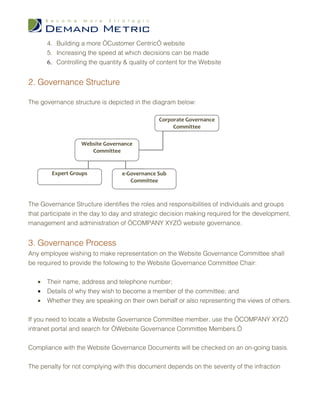
The governance structure is depicted in the diagram below:

                                                Corporate Governance
                                                     Committee

                   Website Governance
                      Committee


        Expert Groups             e-Governance Sub
                                     Committee


The Governance Structure identifies the roles and responsibilities of individuals and groups
that participate in the day to day and strategic decision making required for the development,
management and administration of “COMPANY XYZ” website governance.


3. Governance Process
Any employee wishing to make representation on the Website Governance Committee shall
be required to provide the following to the Website Governance Committee Chair:


   •   Their name, address and telephone number;
   •   Details of why they wish to become a member of the committee; and
   •   Whether they are speaking on their own behalf or also representing the views of others.


If you need to locate a Website Governance Committee member, use the “COMPANY XYZ”
intranet portal and search for “Website Governance Committee Members.”


Compliance with the Website Governance Documents will be checked on an on-going basis.


The penalty for not complying with this document depends on the severity of the infraction
and will be judged on a case-by-case basis by the Website Governance Committee.

Responsibilities of e- Governance Sub- Committee:

   •   Provide policy directions for the Framework (current and future) through collaboration
       with representatives, for example the Website Governance Committee and Expert
       Groups (when required).
   •   Provide clarity and assistance to “COMPANY XYZ” departments on the policies and
       standards in the form of tools and implementation guides.

Responsibilities of Expert Group:
Contribute to and assist in the development of best practice standards as required.


Responsibilities of Website Governance Committee:

   •   Administration of the Framework policies and standards.
   •   Communication, marketing, awareness raising and promotion of the Website
       Governance Framework.
   •   Manage and maintain relevant policies.
   •   The Website Governance Committee will meet Monthly to discuss revisions to policies,
       change requests, and to update the Website Governance Document when necessary.

Responsibilities of Corporate Governance Committee:

   •   Provide strategic direction setting for all strategic matters concerning the development
       of the Website Governance Framework.
   •   Approval authority for policies where there is significant policy impact to the
       organization as a whole.
   •   The Corporate Governance Committee will continue to meet Quarterly.


4. Roles & Responsibilities

Executive Sponsor

Insert Name Here
Responsibilities Include: Advocate & champion the website project internally & externally,
obtain budgets, accept responsibility for the website project, and support the project, etc.


Governance Committee Chair


Insert Name Here


Responsibilities Include: Guides the committee in accomplishing its objectives, keep the
committee focused, ensure new members are well oriented, develop meeting agendas,
assign tasks as required, work with executive sponsor to ensure objectives are met, develop
final reports, proposal, create supporting documentation, etc.


Term: Appointed, 2 years renewable.


Governance Committee Members


Membership composition of the Website Governance Committee shall consist of a minimum
of four members, including the Chair of the Corporate Governance Committee.


Current Members of the Website Governance Committee are:


      •   Insert Name Here

      •   Insert Name Here

      •   Insert Name Here
•   Insert Name Here


Responsibilities Include: Develop, review and monitor the Website Governance Document,
benchmark best practices with regard to website governance, retain outside experts and
specialists to advise the Website Governance Committee, respond to any matter that may be
referred to the Website Governance Committee Chair, review the Website Governance
Committee's annual agenda of activities, etc.


Term: Appointed, 2 years renewable


Chief Information Officer (Technology Owner)


Insert Name Here


Responsibilities Include: Align IT objectives and programs to enterprise objectives and
strategies, define metrics based on overall business objectives, maximize the mix of in house
versus out sourced services, establish strategic service provider partnerships, align IT risk
management with enterprise-wide risk management, optimize and design enterprise
processes via IT, optimize costs of services through a mix of internal and external resources,
etc.


Website Project Owner


Insert Name Here


Responsibilities Include: Oversee website project, set goals, objectives, and targets, monitor
traffic, report to key stakeholders, manage integration, SEO strategy, etc.
Website Author & Content Owner

Insert Name Here


Responsibilities Include: creating content, overseeing and managing publishing model. See
below.


This section is broken down into 3 key publishing models depending (dependent on
“COMPANY XYZ” website goals.


      •   Enterprise Generated Media: Internal docs.

      •   Consumer Generated Media: Self-publishing on your site via blogs, podcasts,
          social media, videos, etc.

      •   Partner Generated Media: Have contributors publish on your behalf.


Website Designer

Insert Name Here


Responsibilities Include: Design look and feel, work with HTML templates and style sheets,
outline page design, document and implement Meta-tagging procedures, taxonomy changes,
feeds to and from other systems, etc.


Website Developer

Insert Name Here
Responsibilities Include: Work with any code used to add functionality to the website (for
example, java script).


Website Administrator

Insert Name Here


Responsibilities Include: Create experiences from the elements provided by the designer,
developer, and author. Content is reviewed and made live. The Webmaster can assume this
role. Responsibility and knowledge necessary for maintaining and updating the content on
the website.


Departmental Liaisons

Marketing : Insert Name Here

Responsibilities Include: Designing landing pages, marketing automation system owner,
promotions, discounts, press releases, communications, events, etc.


Sales: Insert Name Here

Responsibilities Include: Owns sales leads, manages sales funnel, etc.


Product: Insert Name Here

Responsibilities Include: Client feedback, product reviews, etc.


Human Resources : Insert Name Here

Responsibilities Include: Internal communications, etc.
IT : Insert Name Here

Responsibilities Include: Support & maintenance, etc.


5. Timeline

“COMPANY XYZ” corporate website will be developed and maintained in a 2 part
approach. Some functionality will be phased in and other recurring activities will be
happening in unison.

      •   New Roles: Phased in as needed

      •   Launch: On-Going

      •   Maintenance: Monthly

      •   Publication: On-Going

      •   Integration: Complete


6. Website Training

Consult CMS Training Manual. Items you will want to include in your training manual are the
following


      •   System Requirements

      •   Login Information

      •   Interface Overview

      •   Site Navigation

      •   Permissions

      •   General Workflow of the CMS
•   How to Edit an Existing Page

      •   How to Create a New Page

      •   Adding Images

      •   Page Types

      •   Copying and Moving Pages

      •   How to Preview Site

      •   Adding Downloads

      •   Updating and Managing Files


7. Website Funding Model

Funding for “COMPANY XYZ” corporate website will continue to be the responsibility of
“Enter Current Owner Here.”


If the situation arises whereby “COMPANY XYZ” corporate website requires funding for
development or redesign, you will be required to ensure the request for funds complies with
this governance document. This will require signoff from the Governance Committee that the
proposed website reflects the business priorities of “COMPANY XYZ” and that sufficient
funding will be available to maintain the site throughout its lifecycle.


8. Website Metrics

Measurement should be a key component of your website project. Demand Metric’s Website
Program Metrics Dashboard can be used to define, track, and report on your key website
program metrics and key performance indicators. All the metrics can be easily customized to
suit your organization's needs. Some examples include: Traffic Sources, Top Pages, Unique
Visitors, Pages per Visit, Bounce Rate, etc.


9. Continuous Improvement

In addition to the KPIs outlined in your website program metrics dashboard, the following best
practices for continuous improvement on your website should be followed and administered
accordingly:

Evaluate End User Value
Does each part of your website provide value to the end user?

Conduct Testing & Obtain Feedback
Survey customers & users to obtain feedback
Also check for invalid style sheets and document downloads

Perform Content Maintenance
Is older content still relevant?

Proofreading
Copyediting

Link & Load Time Checks
Speed means good site design
Automate the process of checking all links monthly

Testing
A/B testing on all pages

Website Governance Document

  • 1.
    Website Governance Document Purpose Usethis template to create a website governance document to help you govern the “COMPANY XYZ” corporate website. At the highest level, this document is intended to address the following: 1. Governance Goals 2. Governance Structure 3. Governance Process 4. Website Roles & Responsibilities 5. Implementation Timeline 6. Website Training 7. Website Funding Model 8. Website Metrics 9. Continuous Improvement Scope This document is limited to the “COMPANY XYZ” corporate website, and does not include information pertaining to intranets, extranets, portals, micro-sites, landing pages, and/or “Company XYZ” subsites. This document describes the “COMPANY XYZ” Website Governance Framework (the Framework). The Framework is to be used by all “COMPANY XYZ” employees & contractors to introduce consistency in the way “COMPANY XYZ” websites are created, managed, and maintained. Senior Management as well as the Governance Committee endorsed development and implementation of the Website Governance Framework. This document is subject to modifications and amendments from time to time as required.
  • 2.
    Please be sureto check back frequently for updates. Background & Site Architecture This section is not required but it will provide the reader with a better understanding of why this document exists. An example of some good background information is below: • The “COMPANY XYZ” corporate website is now a mainstream channel through which information and services are being delivered. This website should project a unified, positive image of “COMPANY XYZ” locally, nationally and globally in order to better support our customers/clients. • On “Enter Date Here” we undertook an internal audit of “COMPANY XYZ” corporate website to gain a comprehensive understanding of our current infrastructure and quality of products/services delivered. • The Review revealed that “COMPANY XYZ” corporate website is inconsistent, difficult to use, and fragmented. • In response to the findings of this review, the outdated Content Management System (CMS) was upgraded to the latest version of an open source software platform and all other software being used by “COMPANY XYZ” was integrated successfully. • This Website Governance Document will assist “COMPANY XYZ” employees and contractors to focus on delivering information and services that are aligned to the needs of our clients/customers and will lay the path for clear ownership and responsibility over website development and maintenance activities. 1. Governance Goals The main goals of this governance document include: 1. Facilitating communication & collaboration across the organization 2. Creating a better managed and maintained website 3. Decreasing the amount of time it takes to train new employees
  • 3.
    4. Building amore “Customer Centric” website 5. Increasing the speed at which decisions can be made 6. Controlling the quantity & quality of content for the Website 2. Governance Structure The governance structure is depicted in the diagram below: Corporate Governance Committee Website Governance Committee Expert Groups e-Governance Sub Committee The Governance Structure identifies the roles and responsibilities of individuals and groups that participate in the day to day and strategic decision making required for the development, management and administration of “COMPANY XYZ” website governance. 3. Governance Process Any employee wishing to make representation on the Website Governance Committee shall be required to provide the following to the Website Governance Committee Chair: • Their name, address and telephone number; • Details of why they wish to become a member of the committee; and • Whether they are speaking on their own behalf or also representing the views of others. If you need to locate a Website Governance Committee member, use the “COMPANY XYZ” intranet portal and search for “Website Governance Committee Members.” Compliance with the Website Governance Documents will be checked on an on-going basis. The penalty for not complying with this document depends on the severity of the infraction
  • 4.
    and will bejudged on a case-by-case basis by the Website Governance Committee. Responsibilities of e- Governance Sub- Committee: • Provide policy directions for the Framework (current and future) through collaboration with representatives, for example the Website Governance Committee and Expert Groups (when required). • Provide clarity and assistance to “COMPANY XYZ” departments on the policies and standards in the form of tools and implementation guides. Responsibilities of Expert Group: Contribute to and assist in the development of best practice standards as required. Responsibilities of Website Governance Committee: • Administration of the Framework policies and standards. • Communication, marketing, awareness raising and promotion of the Website Governance Framework. • Manage and maintain relevant policies. • The Website Governance Committee will meet Monthly to discuss revisions to policies, change requests, and to update the Website Governance Document when necessary. Responsibilities of Corporate Governance Committee: • Provide strategic direction setting for all strategic matters concerning the development of the Website Governance Framework. • Approval authority for policies where there is significant policy impact to the organization as a whole. • The Corporate Governance Committee will continue to meet Quarterly. 4. Roles & Responsibilities Executive Sponsor Insert Name Here
  • 5.
    Responsibilities Include: Advocate& champion the website project internally & externally, obtain budgets, accept responsibility for the website project, and support the project, etc. Governance Committee Chair Insert Name Here Responsibilities Include: Guides the committee in accomplishing its objectives, keep the committee focused, ensure new members are well oriented, develop meeting agendas, assign tasks as required, work with executive sponsor to ensure objectives are met, develop final reports, proposal, create supporting documentation, etc. Term: Appointed, 2 years renewable. Governance Committee Members Membership composition of the Website Governance Committee shall consist of a minimum of four members, including the Chair of the Corporate Governance Committee. Current Members of the Website Governance Committee are: • Insert Name Here • Insert Name Here • Insert Name Here
  • 6.
    Insert Name Here Responsibilities Include: Develop, review and monitor the Website Governance Document, benchmark best practices with regard to website governance, retain outside experts and specialists to advise the Website Governance Committee, respond to any matter that may be referred to the Website Governance Committee Chair, review the Website Governance Committee's annual agenda of activities, etc. Term: Appointed, 2 years renewable Chief Information Officer (Technology Owner) Insert Name Here Responsibilities Include: Align IT objectives and programs to enterprise objectives and strategies, define metrics based on overall business objectives, maximize the mix of in house versus out sourced services, establish strategic service provider partnerships, align IT risk management with enterprise-wide risk management, optimize and design enterprise processes via IT, optimize costs of services through a mix of internal and external resources, etc. Website Project Owner Insert Name Here Responsibilities Include: Oversee website project, set goals, objectives, and targets, monitor traffic, report to key stakeholders, manage integration, SEO strategy, etc.
  • 7.
    Website Author &Content Owner Insert Name Here Responsibilities Include: creating content, overseeing and managing publishing model. See below. This section is broken down into 3 key publishing models depending (dependent on “COMPANY XYZ” website goals. • Enterprise Generated Media: Internal docs. • Consumer Generated Media: Self-publishing on your site via blogs, podcasts, social media, videos, etc. • Partner Generated Media: Have contributors publish on your behalf. Website Designer Insert Name Here Responsibilities Include: Design look and feel, work with HTML templates and style sheets, outline page design, document and implement Meta-tagging procedures, taxonomy changes, feeds to and from other systems, etc. Website Developer Insert Name Here
  • 8.
    Responsibilities Include: Workwith any code used to add functionality to the website (for example, java script). Website Administrator Insert Name Here Responsibilities Include: Create experiences from the elements provided by the designer, developer, and author. Content is reviewed and made live. The Webmaster can assume this role. Responsibility and knowledge necessary for maintaining and updating the content on the website. Departmental Liaisons Marketing : Insert Name Here Responsibilities Include: Designing landing pages, marketing automation system owner, promotions, discounts, press releases, communications, events, etc. Sales: Insert Name Here Responsibilities Include: Owns sales leads, manages sales funnel, etc. Product: Insert Name Here Responsibilities Include: Client feedback, product reviews, etc. Human Resources : Insert Name Here Responsibilities Include: Internal communications, etc.
  • 9.
    IT : InsertName Here Responsibilities Include: Support & maintenance, etc. 5. Timeline “COMPANY XYZ” corporate website will be developed and maintained in a 2 part approach. Some functionality will be phased in and other recurring activities will be happening in unison. • New Roles: Phased in as needed • Launch: On-Going • Maintenance: Monthly • Publication: On-Going • Integration: Complete 6. Website Training Consult CMS Training Manual. Items you will want to include in your training manual are the following • System Requirements • Login Information • Interface Overview • Site Navigation • Permissions • General Workflow of the CMS
  • 10.
    How to Edit an Existing Page • How to Create a New Page • Adding Images • Page Types • Copying and Moving Pages • How to Preview Site • Adding Downloads • Updating and Managing Files 7. Website Funding Model Funding for “COMPANY XYZ” corporate website will continue to be the responsibility of “Enter Current Owner Here.” If the situation arises whereby “COMPANY XYZ” corporate website requires funding for development or redesign, you will be required to ensure the request for funds complies with this governance document. This will require signoff from the Governance Committee that the proposed website reflects the business priorities of “COMPANY XYZ” and that sufficient funding will be available to maintain the site throughout its lifecycle. 8. Website Metrics Measurement should be a key component of your website project. Demand Metric’s Website Program Metrics Dashboard can be used to define, track, and report on your key website program metrics and key performance indicators. All the metrics can be easily customized to suit your organization's needs. Some examples include: Traffic Sources, Top Pages, Unique Visitors, Pages per Visit, Bounce Rate, etc. 9. Continuous Improvement In addition to the KPIs outlined in your website program metrics dashboard, the following best
  • 11.
    practices for continuousimprovement on your website should be followed and administered accordingly: Evaluate End User Value Does each part of your website provide value to the end user? Conduct Testing & Obtain Feedback Survey customers & users to obtain feedback Also check for invalid style sheets and document downloads Perform Content Maintenance Is older content still relevant? Proofreading Copyediting Link & Load Time Checks Speed means good site design Automate the process of checking all links monthly Testing A/B testing on all pages