DIGITAL
PROCESS
ACCELERATION
SURVEY RESULTS
To assess the current state of digital process
automation within the federal government, Accenture
engaged Market Connections to survey 200 federal
government executives across both defense and
civilian agencies. The survey was fielded in February-
March 2018. These were program leaders with mission,
business or operational responsibilities for business
processes and service delivery within their agency.
Where do agencies
currently stand in
their digital
modernization
efforts for these
key functions?
What are the
key barriers to
modernization?
What functional
areas will be
impacted, and
what technologies
will be deployed?
OUR GOAL WAS
TO UNDERSTAND:
Copyright © 2019 Accenture. All rights reserved.
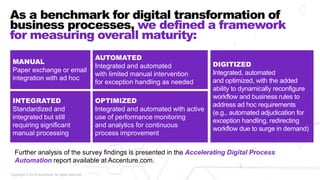
DIGITIZED
Integrated, automated
and optimized, with the added
ability to dynamically reconfigure
workflow and business rules to
address ad hoc requirements
(e.g., automated adjudication for
exception handling, redirecting
workflow due to surge in demand)
As a benchmark for digital transformation of
business processes, we defined a framework
for measuring overall maturity:
Copyright © 2019 Accenture. All rights reserved.
Further analysis of the survey findings is presented in the Accelerating Digital Process
Automation report available at Accenture.com.
MANUAL
Paper exchange or email
integration with ad hoc
INTEGRATED
Standardized and
integrated but still
requiring significant
manual processing
AUTOMATED
Integrated and automated
with limited manual intervention
for exception handling as needed
OPTIMIZED
Integrated and automated with active
use of performance monitoring
and analytics for continuous
process improvement
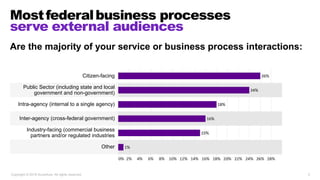
Mostfederalbusiness processes
serve external audiences
Copyright © 2019 Accenture. All rights reserved. 5
Are the majority of your service or business process interactions:
Citizen-facing
Public Sector (including state and local
government and non-government)
Intra-agency (internal to a single agency)
Inter-agency (cross-federal government)
Industry-facing (commercial business
partners and/or regulated industries
Other
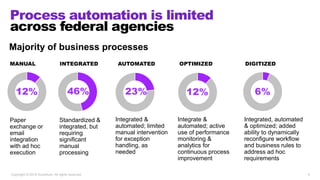
Process automation is limited
across federal agencies
Copyright © 2019 Accenture. All rights reserved. 6
Paper
exchange or
email
integration
with ad hoc
execution
MANUAL
12%
Standardized &
integrated, but
requiring
significant
manual
processing
INTEGRATED
46%
Integrated &
automated; limited
manual intervention
for exception
handling, as
needed
AUTOMATED
23%
Integrate &
automated; active
use of performance
monitoring &
analytics for
continuous process
improvement
OPTIMIZED
12%
Integrated, automated
& optimized; added
ability to dynamically
reconfigure workflow
and business rules to
address ad hoc
requirements
DIGITIZED
6%
Majority of business processes
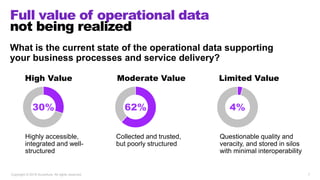
Full value of operational data
not being realized
Copyright © 2019 Accenture. All rights reserved. 7
What is the current state of the operational data supporting
your business processes and service delivery?
Highly accessible,
integrated and well-
structured
High Value
30%
Collected and trusted,
but poorly structured
Moderate Value
62%
Questionable quality and
veracity, and stored in silos
with minimal interoperability
Limited Value
4%
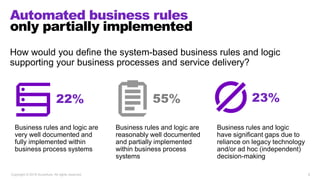
Automated business rules
only partially implemented
Copyright © 2019 Accenture. All rights reserved. 8
How would you define the system-based business rules and logic
supporting your business processes and service delivery?
Business rules and logic are
very well documented and
fully implemented within
business process systems
Business rules and logic are
reasonably well documented
and partially implemented
within business process
systems
Business rules and logic
have significant gaps due to
reliance on legacy technology
and/or ad hoc (independent)
decision-making
22% 23%55%
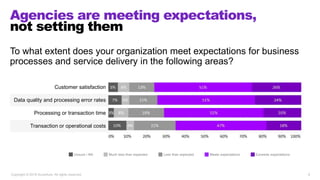
Agencies are meeting expectations,
not setting them
Copyright © 2019 Accenture. All rights reserved. 9
Unsure / NA Much less than expected Less than expected Meets expectations Exceeds expectations
To what extent does your organization meet expectations for business
processes and service delivery in the following areas?
Customer satisfaction
Data quality and processing error rates
Processing or transaction time
Transaction or operational costs
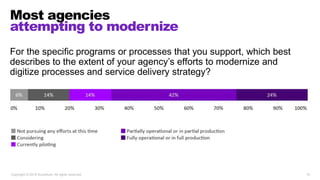
Most agencies
attempting to modernize
Copyright © 2019 Accenture. All rights reserved. 10
For the specific programs or processes that you support, which best
describes to the extent of your agency’s efforts to modernize and
digitize processes and service delivery strategy?
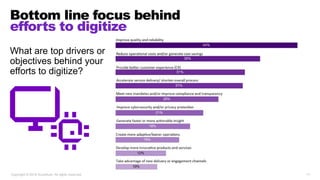
Bottom line focus behind
efforts to digitize
Copyright © 2019 Accenture. All rights reserved. 11
What are top drivers or
objectives behind your
efforts to digitize?
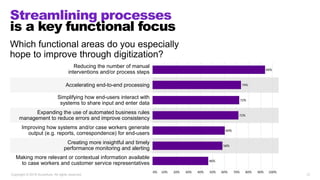
Reducing the number of manual
interventions and/or process steps
Accelerating end-to-end processing
Simplifying how end-users interact with
systems to share input and enter data
Expanding the use of automated business rules
management to reduce errors and improve consistency
Improving how systems and/or case workers generate
output (e.g. reports, correspondence) for end-users
Creating more insightful and timely
performance monitoring and alerting
Making more relevant or contextual information available
to case workers and customer service representatives
Streamlining processes
is a key functional focus
Copyright © 2019 Accenture. All rights reserved. 12
Which functional areas do you especially
hope to improve through digitization?
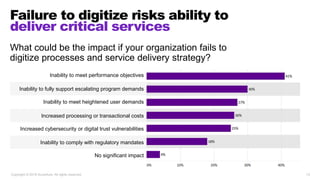
Failure to digitize risks ability to
deliver critical services
Copyright © 2019 Accenture. All rights reserved. 13
What could be the impact if your organization fails to
digitize processes and service delivery strategy?
Increased cybersecurity or digital trust vulnerabilities
Inability to comply with regulatory mandates
No significant impact
Increased processing or transactional costs
Inability to meet performance objectives
Inability to fully support escalating program demands
Inability to meet heightened user demands
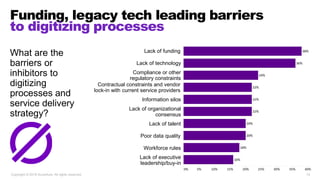
Lack of funding
Compliance or other
regulatory constraints
Lack of technology
Contractual constraints and vendor
lock-in with current service providers
Lack of organizational
consensus
Information silos
Lack of talent
Poor data quality
Lack of executive
leadership/buy-in
Workforce rules
Funding, legacy tech leading barriers
to digitizing processes
Copyright © 2019 Accenture. All rights reserved. 14
What are the
barriers or
inhibitors to
digitizing
processes and
service delivery
strategy?
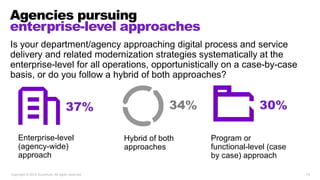
Agencies pursuing
enterprise-level approaches
Copyright © 2019 Accenture. All rights reserved. 15
Is your department/agency approaching digital process and service
delivery and related modernization strategies systematically at the
enterprise-level for all operations, opportunistically on a case-by-case
basis, or do you follow a hybrid of both approaches?
Enterprise-level
(agency-wide)
approach
Hybrid of both
approaches
Program or
functional-level (case
by case) approach
37% 30%34%
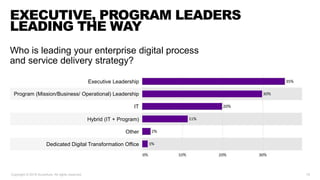
EXECUTIVE, PROGRAM LEADERS
LEADING THE WAY
Copyright © 2019 Accenture. All rights reserved. 16
Who is leading your enterprise digital process
and service delivery strategy?
Executive Leadership
Program (Mission/Business/ Operational) Leadership
IT
Hybrid (IT + Program)
Other
Dedicated Digital Transformation Office
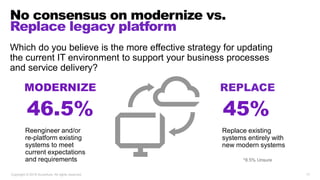
No consensus on modernize vs.
Replace legacy platform
Copyright © 2019 Accenture. All rights reserved. 17
Which do you believe is the more effective strategy for updating
the current IT environment to support your business processes
and service delivery?
Reengineer and/or
re-platform existing
systems to meet
current expectations
and requirements
46.5%
MODERNIZE
Replace existing
systems entirely with
new modern systems
45%
REPLACE
*8.5% Unsure
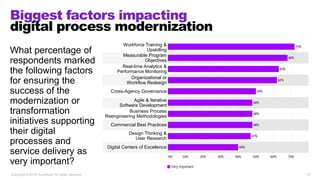
Biggest factors impacting
digital process modernization
Copyright © 2019 Accenture. All rights reserved. 18
What percentage of
respondents marked
the following factors
for ensuring the
success of the
modernization or
transformation
initiatives supporting
their digital
processes and
service delivery as
very important?
Workforce Training &
Upskilling
Measurable Program
Objectives
Real-time Analytics &
Performance Monitoring
Organizational or
Workflow Redesign
Cross-Agency Governance
Agile & Iterative
Software Development
Business Process
Reengineering Methodologies
Commercial Best Practices
Design Thinking &
User Research
Digital Centers of Excellence
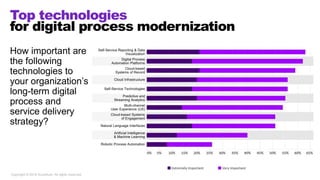
Top technologies
for digital process modernization
Copyright © 2019 Accenture. All rights reserved. 19
How important are
the following
technologies to
your organization’s
long-term digital
process and
service delivery
strategy?
Self-Service Reporting & Data
Visualization
Digital Process
Automation Platforms
Cloud-based
Systems of Record
Cloud Infrastructure
Self-Service Technologies
Predictive and
Streaming Analytics
Multi-channel
User Experience (UX)
Cloud-based Systems
of Engagement
Natural Language Interfaces
Artificial Intelligence
& Machine Learning
Robotic Process Automation
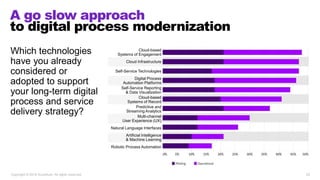
A go slow approach
to digital process modernization
Copyright © 2019 Accenture. All rights reserved. 20
Which technologies
have you already
considered or
adopted to support
your long-term digital
process and service
delivery strategy?
Cloud-based
Systems of Engagement
Cloud Infrastructure
Self-Service Technologies
Digital Process
Automation Platforms
Self-Service Reporting
& Data Visualization
Cloud-based
Systems of Record
Predictive and
Streaming Analytics
Multi-channel
User Experience (UX)
Natural Language Interfaces
Artificial Intelligence
& Machine Learning
Robotic Process Automation
THANK YOU

Accelerating Digital Process Automation

  • 1.
  • 2.
    To assess thecurrent state of digital process automation within the federal government, Accenture engaged Market Connections to survey 200 federal government executives across both defense and civilian agencies. The survey was fielded in February- March 2018. These were program leaders with mission, business or operational responsibilities for business processes and service delivery within their agency.
  • 3.
    Where do agencies currentlystand in their digital modernization efforts for these key functions? What are the key barriers to modernization? What functional areas will be impacted, and what technologies will be deployed? OUR GOAL WAS TO UNDERSTAND: Copyright © 2019 Accenture. All rights reserved.
  • 4.
    DIGITIZED Integrated, automated and optimized,with the added ability to dynamically reconfigure workflow and business rules to address ad hoc requirements (e.g., automated adjudication for exception handling, redirecting workflow due to surge in demand) As a benchmark for digital transformation of business processes, we defined a framework for measuring overall maturity: Copyright © 2019 Accenture. All rights reserved. Further analysis of the survey findings is presented in the Accelerating Digital Process Automation report available at Accenture.com. MANUAL Paper exchange or email integration with ad hoc INTEGRATED Standardized and integrated but still requiring significant manual processing AUTOMATED Integrated and automated with limited manual intervention for exception handling as needed OPTIMIZED Integrated and automated with active use of performance monitoring and analytics for continuous process improvement
  • 5.
    Mostfederalbusiness processes serve externalaudiences Copyright © 2019 Accenture. All rights reserved. 5 Are the majority of your service or business process interactions: Citizen-facing Public Sector (including state and local government and non-government) Intra-agency (internal to a single agency) Inter-agency (cross-federal government) Industry-facing (commercial business partners and/or regulated industries Other
  • 6.
    Process automation islimited across federal agencies Copyright © 2019 Accenture. All rights reserved. 6 Paper exchange or email integration with ad hoc execution MANUAL 12% Standardized & integrated, but requiring significant manual processing INTEGRATED 46% Integrated & automated; limited manual intervention for exception handling, as needed AUTOMATED 23% Integrate & automated; active use of performance monitoring & analytics for continuous process improvement OPTIMIZED 12% Integrated, automated & optimized; added ability to dynamically reconfigure workflow and business rules to address ad hoc requirements DIGITIZED 6% Majority of business processes
  • 7.
    Full value ofoperational data not being realized Copyright © 2019 Accenture. All rights reserved. 7 What is the current state of the operational data supporting your business processes and service delivery? Highly accessible, integrated and well- structured High Value 30% Collected and trusted, but poorly structured Moderate Value 62% Questionable quality and veracity, and stored in silos with minimal interoperability Limited Value 4%
  • 8.
    Automated business rules onlypartially implemented Copyright © 2019 Accenture. All rights reserved. 8 How would you define the system-based business rules and logic supporting your business processes and service delivery? Business rules and logic are very well documented and fully implemented within business process systems Business rules and logic are reasonably well documented and partially implemented within business process systems Business rules and logic have significant gaps due to reliance on legacy technology and/or ad hoc (independent) decision-making 22% 23%55%
  • 9.
    Agencies are meetingexpectations, not setting them Copyright © 2019 Accenture. All rights reserved. 9 Unsure / NA Much less than expected Less than expected Meets expectations Exceeds expectations To what extent does your organization meet expectations for business processes and service delivery in the following areas? Customer satisfaction Data quality and processing error rates Processing or transaction time Transaction or operational costs
  • 10.
    Most agencies attempting tomodernize Copyright © 2019 Accenture. All rights reserved. 10 For the specific programs or processes that you support, which best describes to the extent of your agency’s efforts to modernize and digitize processes and service delivery strategy?
  • 11.
    Bottom line focusbehind efforts to digitize Copyright © 2019 Accenture. All rights reserved. 11 What are top drivers or objectives behind your efforts to digitize?
  • 12.
    Reducing the numberof manual interventions and/or process steps Accelerating end-to-end processing Simplifying how end-users interact with systems to share input and enter data Expanding the use of automated business rules management to reduce errors and improve consistency Improving how systems and/or case workers generate output (e.g. reports, correspondence) for end-users Creating more insightful and timely performance monitoring and alerting Making more relevant or contextual information available to case workers and customer service representatives Streamlining processes is a key functional focus Copyright © 2019 Accenture. All rights reserved. 12 Which functional areas do you especially hope to improve through digitization?
  • 13.
    Failure to digitizerisks ability to deliver critical services Copyright © 2019 Accenture. All rights reserved. 13 What could be the impact if your organization fails to digitize processes and service delivery strategy? Increased cybersecurity or digital trust vulnerabilities Inability to comply with regulatory mandates No significant impact Increased processing or transactional costs Inability to meet performance objectives Inability to fully support escalating program demands Inability to meet heightened user demands
  • 14.
    Lack of funding Complianceor other regulatory constraints Lack of technology Contractual constraints and vendor lock-in with current service providers Lack of organizational consensus Information silos Lack of talent Poor data quality Lack of executive leadership/buy-in Workforce rules Funding, legacy tech leading barriers to digitizing processes Copyright © 2019 Accenture. All rights reserved. 14 What are the barriers or inhibitors to digitizing processes and service delivery strategy?
  • 15.
    Agencies pursuing enterprise-level approaches Copyright© 2019 Accenture. All rights reserved. 15 Is your department/agency approaching digital process and service delivery and related modernization strategies systematically at the enterprise-level for all operations, opportunistically on a case-by-case basis, or do you follow a hybrid of both approaches? Enterprise-level (agency-wide) approach Hybrid of both approaches Program or functional-level (case by case) approach 37% 30%34%
  • 16.
    EXECUTIVE, PROGRAM LEADERS LEADINGTHE WAY Copyright © 2019 Accenture. All rights reserved. 16 Who is leading your enterprise digital process and service delivery strategy? Executive Leadership Program (Mission/Business/ Operational) Leadership IT Hybrid (IT + Program) Other Dedicated Digital Transformation Office
  • 17.
    No consensus onmodernize vs. Replace legacy platform Copyright © 2019 Accenture. All rights reserved. 17 Which do you believe is the more effective strategy for updating the current IT environment to support your business processes and service delivery? Reengineer and/or re-platform existing systems to meet current expectations and requirements 46.5% MODERNIZE Replace existing systems entirely with new modern systems 45% REPLACE *8.5% Unsure
  • 18.
    Biggest factors impacting digitalprocess modernization Copyright © 2019 Accenture. All rights reserved. 18 What percentage of respondents marked the following factors for ensuring the success of the modernization or transformation initiatives supporting their digital processes and service delivery as very important? Workforce Training & Upskilling Measurable Program Objectives Real-time Analytics & Performance Monitoring Organizational or Workflow Redesign Cross-Agency Governance Agile & Iterative Software Development Business Process Reengineering Methodologies Commercial Best Practices Design Thinking & User Research Digital Centers of Excellence
  • 19.
    Top technologies for digitalprocess modernization Copyright © 2019 Accenture. All rights reserved. 19 How important are the following technologies to your organization’s long-term digital process and service delivery strategy? Self-Service Reporting & Data Visualization Digital Process Automation Platforms Cloud-based Systems of Record Cloud Infrastructure Self-Service Technologies Predictive and Streaming Analytics Multi-channel User Experience (UX) Cloud-based Systems of Engagement Natural Language Interfaces Artificial Intelligence & Machine Learning Robotic Process Automation
  • 20.
    A go slowapproach to digital process modernization Copyright © 2019 Accenture. All rights reserved. 20 Which technologies have you already considered or adopted to support your long-term digital process and service delivery strategy? Cloud-based Systems of Engagement Cloud Infrastructure Self-Service Technologies Digital Process Automation Platforms Self-Service Reporting & Data Visualization Cloud-based Systems of Record Predictive and Streaming Analytics Multi-channel User Experience (UX) Natural Language Interfaces Artificial Intelligence & Machine Learning Robotic Process Automation
  • 21.