

Capability Maps
The Next Generation
Wolfgang Goebl
We help people create better enterprises.
INTERSECTION GROUP
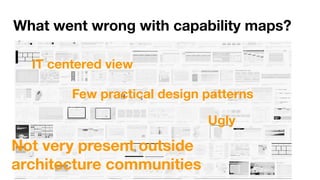
What went wrong with capability maps?
Ugly
Not very present outside
architecture communities
Few practical design patterns
IT centered view
Capabilities are central in organisation design,
business components
used as a modular “master structure”
of the enterprise.
Organisational- and IT structures
can be derived from this
master structure.
“Modular business components.”
Designed for Digital, J.Ross et.al
What we want to change…
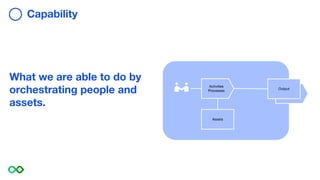
What we are able to do by
orchestrating people and
assets.
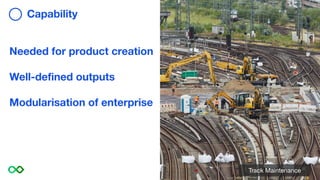
Capability
Track Maintenance
What we are able to do by
orchestrating people and
assets.
Capability
Activities
Processes
Assets
Output
What we are able to do by
orchestrating people and
assets.
Capability
Track
Maintenance
Digger
(Machine)
Serviceable
Track
Gravel
(Raw Material)
Trackinator
(Application)
What we are able to do by
orchestrating people and
assets.
Capability
Track Maintenance
Needed for product creation
Well-defined outputs
Modularisation of enterprise
A structure we need and use
to perform our capabilities.
Asset
Machines, Buildings
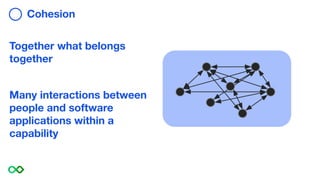
Cohesion (“together what belongs together”)
Together what belongs
together
Many interactions between
people and software
applications within a
capability
Cohesion
Clear accountabilities
Avoid redundancy
Minimise interactions
between capabilities
Key to adaptivity
Loose coupling
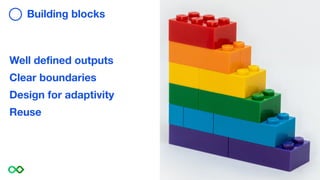
Well defined outputs
Clear boundaries
Design for adaptivity
Reuse
Building blocks
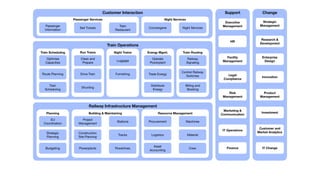
Customer Interaction
Passenger Services
Passenger
Information
Sell Tickets
Train
Restaurant
Night Services
Conciergerie Night Services
Train Operations
Train Scheduling
Optimise
Capacities
Route Planning
Train
Scheduling
Run Trains
Clean and
Prepare
Drive Train
Shunting
Energy Mgmt. Train Routing
Night Trains
Luggage
Furnishing
Railway Infrastructure Management
Planning
EU
Coordination
Strategic
Planning
Budgeting
Resource Management
Building & Maintaining
Project
Management
Construction
Site Planning
Stations
Tracks
Powerlines
Powerplants
Machines
Material
Crew
Procurement
Logistics
Asset
Accounting
Change
Enterprise
Design
IT Change
Product
Management
Strategic
Management
Research &
Development
Innovation
Investment
Customer and
Market Analytics
Support
HR
IT Operations
Legal
Compliance
Finance
Executive
Management
Facility
Management
Risk
Management
Marketing &
Communication
Railway
Signaling
Control Railway
Switches
Billing and
Booking
Operate
Powerplant
Distribute
Energy
Trade Energy
When are groupings “good”?
By color?
By size?
By shape?
By species?
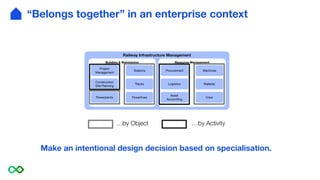
By object (powerlines)
“Belongs together” in an enterprise context
By activity (logistics)
Make an intentional design decision based on specialisation.
Railway Infrastructure Management
Resource Management
Building & Maintaining
Stations
Tracks
Powerlines
Powerplants
Machines
Material
Crew
Project
Management
Construction
Site Planning
Procurement
Logistics
Asset
Accounting
…by Activity
…by Object
“Belongs together” in an enterprise context
Make an intentional design decision based on specialisation.
Get in touch with
our customer
Sales via various channels
Customer services
Customer information
Customer Facing
Ticket sales
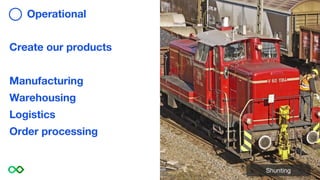
Create our products
Manufacturing
Warehousing
Logistics
Order processing
Operational
Shunting
Needed for
other capabilities
Marketing
Legal
Human resources
Accounting
Shared
Finance
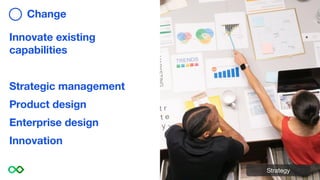
Innovate existing
capabilities
Strategic management
Product design
Enterprise design
Innovation
Change
Strategy
Customer Interaction
Passenger Services
Passenger
Information
Sell Tickets
Train
Restaurant
Night Services
Conciergerie Night Services
Train Operations
Train Scheduling
Optimise
Capacities
Route Planning
Train
Scheduling
Run Trains
Clean and
Prepare
Drive Train
Shunting
Energy Mgmt. Train Routing
Night Trains
Luggage
Furnishing
Railway Infrastructure Management
Planning
EU
Coordination
Strategic
Planning
Budgeting
Resource Management
Building & Maintaining
Project
Management
Construction
Site Planning
Stations
Tracks
Powerlines
Powerplants
Machines
Material
Crew
Procurement
Logistics
Asset
Accounting
Change
Enterprise
Design
IT Change
Product
Management
Strategic
Management
Research &
Development
Innovation
Investment
Customer and
Market Analytics
Support
HR
IT Operations
Legal
Compliance
Finance
Executive
Management
Facility
Management
Risk
Management
Marketing &
Communication
Railway
Signaling
Control Railway
Switches
Billing and
Booking
Operate
Powerplant
Distribute
Energy
Trade Energy
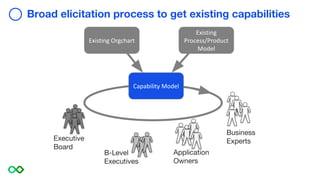
Existing Orgchart
Existing
Process/Product
Model
Capability Model
Executive
Board
Application
Owners
Business
Experts
B-Level
Executives
Broad elicitation process to get existing capabilities
Customer Interaction
Passenger Services
Passenger
Information
Sell Tickets
Train
Restaurant
Night Services
Conciergerie Night Services
Train Operations
Train Scheduling
Optimise
Capacities
Route Planning
Train
Scheduling
Run Trains
Clean and
Prepare
Drive Train
Shunting
Energy Mgmt. Train Routing
Night Trains
Luggage
Furnishing
Railway Infrastructure Management
Planning
EU
Coordination
Strategic
Planning
Budgeting
Resource Management
Building & Maintaining
Project
Management
Construction
Site Planning
Stations
Tracks
Powerlines
Powerplants
Machines
Material
Crew
Procurement
Logistics
Asset
Accounting
Change
Enterprise
Design
IT Change
Product
Management
Strategic
Management
Research &
Development
Innovation
Investment
Customer and
Market Analytics
Support
HR
IT Operations
Legal
Compliance
Finance
Executive
Management
Facility
Management
Risk
Management
Marketing &
Communication
Railway
Signaling
Control Railway
Switches
Billing and
Booking
Operate
Powerplant
Distribute
Energy
Trade Energy
Involve broad range of business experts
Use common terminology
Make products visible
Use categories consciously
Clear outputs
Avoid overlaps
Focus on essence (3-4 levels, ~100 capabilities)
Align boxes well
Capability design patterns
Capability maps use
uncommon language and
are used exclusively by
Enterprise Architects.
Today
Capability Boards are
co-designed by all relevant
business experts and used
throughout the company
(for Management,
Organisation, Finance, IT,
Asset Management, ...)
Tomorrow
What went wrong with capability maps?
"Always based on information objects”
call everything “management”
(product-, claim-, money-, track-, train,...)
“Tennis Racket Management”?
“Tennis Ball Acceleration Management”?
Unnatural language
Capabilities present in IT only
Extremely weak biz & IT alignment
What we want to change…
"Always based on information objects”
Serve
Unnatural language
Capabilities present in IT only
Extremely weak biz & IT alignment
Based on highest cohesion
common
everywhere
Seamless busIT co-design
“Related activities our enterprise carries out.”
Process
Process/Activity = actually performed capability
Only ONE way to design boundaries (caps, orga, activities, processes)
Seamless connection of process management & capabilities & org design
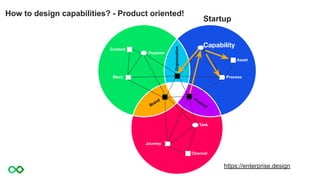
Brand Product
Organisation
Story
Purpose
Process
Capability
Journey
Task
Channel
Asset
Content
How to design capabilities? - Product oriented!
Startup
https://enterprise.design
Brand Product
Organisation
Story
Purpose
Process
Capability
Journey
Task
Channel
Asset
Content
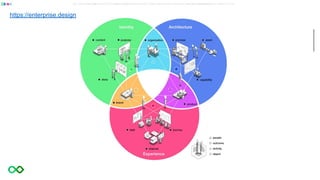
How to design capabilities? - Driven by legacy
Existing Company
https://enterprise.design
What you’ve learned in this section..
› Only ONE decomposition of the business
› Start from existing docs (org, processes, website..)
› Run a broad elicitation process
› Enable business to own their capability design
› Design for highest cohesion
› Select categories with care
› Consolidate Process Models with Capabilities
› Layout for beauty
Business / IT Alignment -> BusinessIT Co-Design
Intersection Group is a Non Profit Association
EDGY
www.enterprise.design
A set of connected Open
Source tools for your
Enterprise Design practice
Community
and Events
Events for a global
community of thinkers
and practitioners
Learning and
Knowledge
Publications, content,
courses and digital
tools with our partners
enterprisedesignpatterns.com
Patterns
Journey to impact
Behaviour patterns
Practice patterns
Creations patterns
https://enterprise.design
https://intersection.group/events
Upcoming Events
https://intersection.group/events/intersection23
Thank you!
Wolfgang Goebl
wolfgang@intersection.group
www.intersection.group

Capability Maps - The Next Generation

  • 1.
    Capability Maps The NextGeneration Wolfgang Goebl
  • 2.
    We help peoplecreate better enterprises. INTERSECTION GROUP
  • 3.
    What went wrongwith capability maps?
  • 4.
    What went wrongwith capability maps? Ugly Not very present outside architecture communities Few practical design patterns IT centered view
  • 5.
    Capabilities are centralin organisation design, business components used as a modular “master structure” of the enterprise. Organisational- and IT structures can be derived from this master structure. “Modular business components.” Designed for Digital, J.Ross et.al What we want to change…
  • 6.
    What we areable to do by orchestrating people and assets. Capability Track Maintenance
  • 7.
    What we areable to do by orchestrating people and assets. Capability Activities Processes Assets Output
  • 8.
    What we areable to do by orchestrating people and assets. Capability Track Maintenance Digger (Machine) Serviceable Track Gravel (Raw Material) Trackinator (Application)
  • 9.
    What we areable to do by orchestrating people and assets. Capability Track Maintenance Needed for product creation Well-defined outputs Modularisation of enterprise
  • 10.
    A structure weneed and use to perform our capabilities. Asset Machines, Buildings
  • 11.
    Cohesion (“together whatbelongs together”)
  • 12.
    Together what belongs together Manyinteractions between people and software applications within a capability Cohesion
  • 13.
    Clear accountabilities Avoid redundancy Minimiseinteractions between capabilities Key to adaptivity Loose coupling
  • 14.
    Well defined outputs Clearboundaries Design for adaptivity Reuse Building blocks
  • 15.
    Customer Interaction Passenger Services Passenger Information SellTickets Train Restaurant Night Services Conciergerie Night Services Train Operations Train Scheduling Optimise Capacities Route Planning Train Scheduling Run Trains Clean and Prepare Drive Train Shunting Energy Mgmt. Train Routing Night Trains Luggage Furnishing Railway Infrastructure Management Planning EU Coordination Strategic Planning Budgeting Resource Management Building & Maintaining Project Management Construction Site Planning Stations Tracks Powerlines Powerplants Machines Material Crew Procurement Logistics Asset Accounting Change Enterprise Design IT Change Product Management Strategic Management Research & Development Innovation Investment Customer and Market Analytics Support HR IT Operations Legal Compliance Finance Executive Management Facility Management Risk Management Marketing & Communication Railway Signaling Control Railway Switches Billing and Booking Operate Powerplant Distribute Energy Trade Energy
  • 16.
    When are groupings“good”? By color? By size? By shape? By species?
  • 17.
    By object (powerlines) “Belongstogether” in an enterprise context By activity (logistics) Make an intentional design decision based on specialisation.
  • 18.
    Railway Infrastructure Management ResourceManagement Building & Maintaining Stations Tracks Powerlines Powerplants Machines Material Crew Project Management Construction Site Planning Procurement Logistics Asset Accounting …by Activity …by Object “Belongs together” in an enterprise context Make an intentional design decision based on specialisation.
  • 19.
    Get in touchwith our customer Sales via various channels Customer services Customer information Customer Facing Ticket sales
  • 20.
  • 21.
    Needed for other capabilities Marketing Legal Humanresources Accounting Shared Finance
  • 22.
    Innovate existing capabilities Strategic management Productdesign Enterprise design Innovation Change Strategy
  • 23.
    Customer Interaction Passenger Services Passenger Information SellTickets Train Restaurant Night Services Conciergerie Night Services Train Operations Train Scheduling Optimise Capacities Route Planning Train Scheduling Run Trains Clean and Prepare Drive Train Shunting Energy Mgmt. Train Routing Night Trains Luggage Furnishing Railway Infrastructure Management Planning EU Coordination Strategic Planning Budgeting Resource Management Building & Maintaining Project Management Construction Site Planning Stations Tracks Powerlines Powerplants Machines Material Crew Procurement Logistics Asset Accounting Change Enterprise Design IT Change Product Management Strategic Management Research & Development Innovation Investment Customer and Market Analytics Support HR IT Operations Legal Compliance Finance Executive Management Facility Management Risk Management Marketing & Communication Railway Signaling Control Railway Switches Billing and Booking Operate Powerplant Distribute Energy Trade Energy
  • 24.
  • 25.
    Customer Interaction Passenger Services Passenger Information SellTickets Train Restaurant Night Services Conciergerie Night Services Train Operations Train Scheduling Optimise Capacities Route Planning Train Scheduling Run Trains Clean and Prepare Drive Train Shunting Energy Mgmt. Train Routing Night Trains Luggage Furnishing Railway Infrastructure Management Planning EU Coordination Strategic Planning Budgeting Resource Management Building & Maintaining Project Management Construction Site Planning Stations Tracks Powerlines Powerplants Machines Material Crew Procurement Logistics Asset Accounting Change Enterprise Design IT Change Product Management Strategic Management Research & Development Innovation Investment Customer and Market Analytics Support HR IT Operations Legal Compliance Finance Executive Management Facility Management Risk Management Marketing & Communication Railway Signaling Control Railway Switches Billing and Booking Operate Powerplant Distribute Energy Trade Energy
  • 26.
    Involve broad rangeof business experts Use common terminology Make products visible Use categories consciously Clear outputs Avoid overlaps Focus on essence (3-4 levels, ~100 capabilities) Align boxes well Capability design patterns
  • 27.
    Capability maps use uncommonlanguage and are used exclusively by Enterprise Architects. Today Capability Boards are co-designed by all relevant business experts and used throughout the company (for Management, Organisation, Finance, IT, Asset Management, ...) Tomorrow
  • 28.
    What went wrongwith capability maps? "Always based on information objects” call everything “management” (product-, claim-, money-, track-, train,...) “Tennis Racket Management”? “Tennis Ball Acceleration Management”? Unnatural language Capabilities present in IT only Extremely weak biz & IT alignment
  • 29.
    What we wantto change… "Always based on information objects” Serve Unnatural language Capabilities present in IT only Extremely weak biz & IT alignment Based on highest cohesion common everywhere Seamless busIT co-design
  • 30.
    “Related activities ourenterprise carries out.” Process Process/Activity = actually performed capability Only ONE way to design boundaries (caps, orga, activities, processes) Seamless connection of process management & capabilities & org design
  • 31.
    Brand Product Organisation Story Purpose Process Capability Journey Task Channel Asset Content How todesign capabilities? - Product oriented! Startup https://enterprise.design
  • 32.
    Brand Product Organisation Story Purpose Process Capability Journey Task Channel Asset Content How todesign capabilities? - Driven by legacy Existing Company https://enterprise.design
  • 33.
    What you’ve learnedin this section.. › Only ONE decomposition of the business › Start from existing docs (org, processes, website..) › Run a broad elicitation process › Enable business to own their capability design › Design for highest cohesion › Select categories with care › Consolidate Process Models with Capabilities › Layout for beauty Business / IT Alignment -> BusinessIT Co-Design
  • 34.
    Intersection Group isa Non Profit Association EDGY www.enterprise.design A set of connected Open Source tools for your Enterprise Design practice Community and Events Events for a global community of thinkers and practitioners Learning and Knowledge Publications, content, courses and digital tools with our partners
  • 35.
    enterprisedesignpatterns.com Patterns Journey to impact Behaviourpatterns Practice patterns Creations patterns
  • 36.
  • 37.
  • 38.
  • 39.