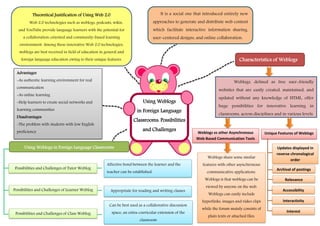
Using Weblogs
in Foreign Language
Classrooms: Possibilities
and Challenges
It is a social one that introduced entirely new
approaches to generate and distribute web content
which facilitate interactive information sharing,
user-centered designs, and online collaboration.
Theoretical Justification of Using Web 2.0
Web 2.0 technologies such as weblogs, podcasts, wikis,
and YouTube provide language learners with the potential for
a collaboration-oriented and community-based learning
environment. Among these innovative Web 2.0 technologies,
weblogs are best received in field of education in general and
foreign language education owing to their unique features. Characteristics of Weblogs
Weblogs, defined as free user-friendly
websites that are easily created, maintained, and
updated without any knowledge of HTML, offer
huge possibilities for innovative learning in
classrooms, across disciplines and in various levels.
Weblogs share some similar
features with other asynchronous
communicative applications.
Weblogs is that weblogs can be
viewed by anyone on the web.
Weblogs can easily include
hyperlinks, images and video clips
while the forum mainly consists of
plain texts or attached files.
Weblogs vs other Asynchronous
Web-Based Communication Tools
Unique Features of Weblogs
Updates displayed in
reverse chronological
order
Archival of postings
Interactivity
Interest
Relevance
Accessibility
Using Weblogs in Foreign Language Classrooms
Possibilities and Challenges of Tutor Weblog
Possibilities and Challenges of Learner Weblog
Possibilities and Challenges of Class Weblog
Affective bond between the learner and the
teacher can be established.
Appropriate for reading and writing classes
Can be best used as a collaborative discussion
space, an extra-curricular extension of the
classroom
Advantages
-As authentic learning environment for real
communication
-As online learning
-Help learners to create social networks and
learning communities
Disadvantages
-The problem with students with low English
proficiency

Weblogs

  • 1.
    Using Weblogs in ForeignLanguage Classrooms: Possibilities and Challenges It is a social one that introduced entirely new approaches to generate and distribute web content which facilitate interactive information sharing, user-centered designs, and online collaboration. Theoretical Justification of Using Web 2.0 Web 2.0 technologies such as weblogs, podcasts, wikis, and YouTube provide language learners with the potential for a collaboration-oriented and community-based learning environment. Among these innovative Web 2.0 technologies, weblogs are best received in field of education in general and foreign language education owing to their unique features. Characteristics of Weblogs Weblogs, defined as free user-friendly websites that are easily created, maintained, and updated without any knowledge of HTML, offer huge possibilities for innovative learning in classrooms, across disciplines and in various levels. Weblogs share some similar features with other asynchronous communicative applications. Weblogs is that weblogs can be viewed by anyone on the web. Weblogs can easily include hyperlinks, images and video clips while the forum mainly consists of plain texts or attached files. Weblogs vs other Asynchronous Web-Based Communication Tools Unique Features of Weblogs Updates displayed in reverse chronological order Archival of postings Interactivity Interest Relevance Accessibility Using Weblogs in Foreign Language Classrooms Possibilities and Challenges of Tutor Weblog Possibilities and Challenges of Learner Weblog Possibilities and Challenges of Class Weblog Affective bond between the learner and the teacher can be established. Appropriate for reading and writing classes Can be best used as a collaborative discussion space, an extra-curricular extension of the classroom Advantages -As authentic learning environment for real communication -As online learning -Help learners to create social networks and learning communities Disadvantages -The problem with students with low English proficiency