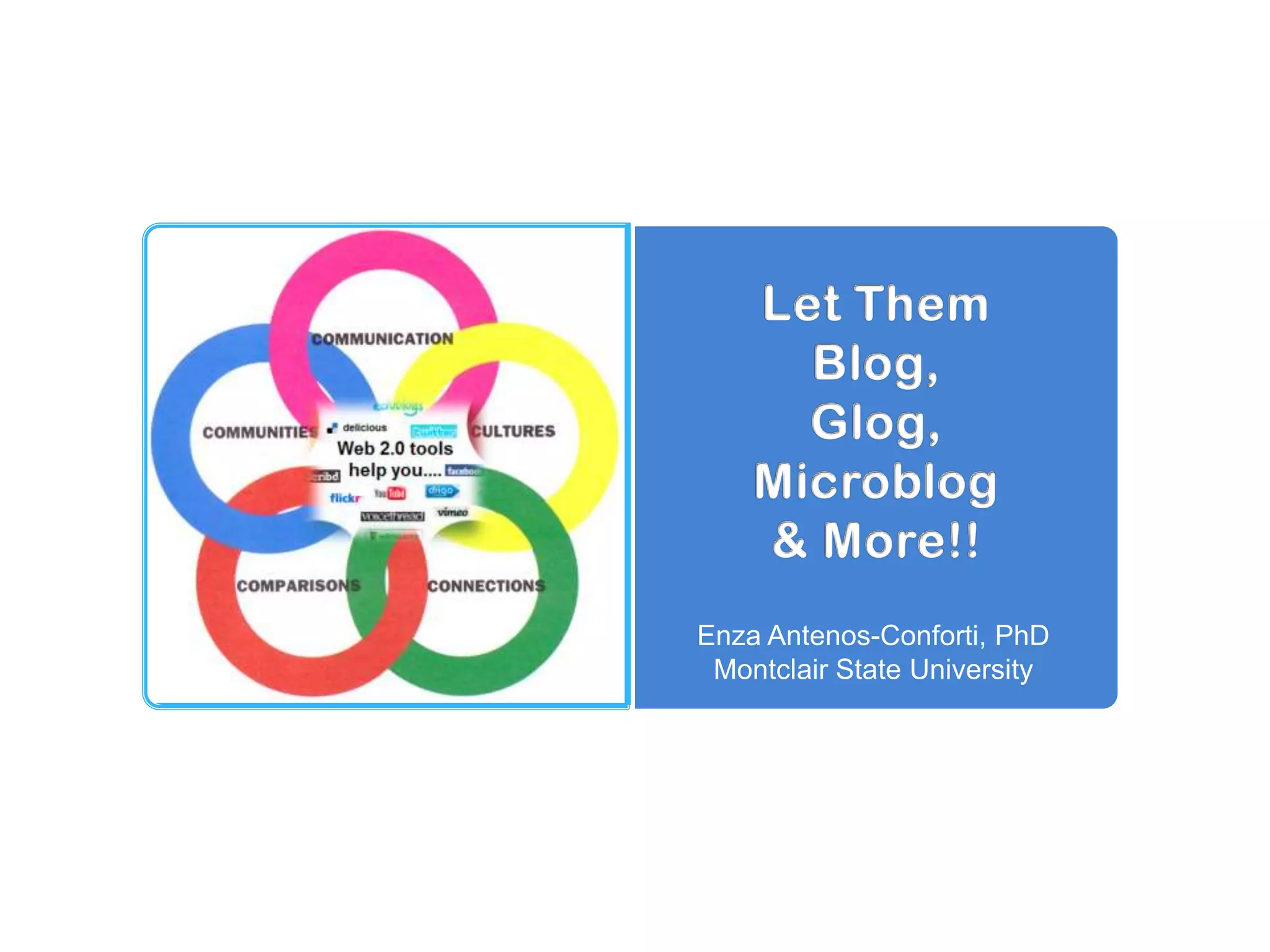
Let ThemBlog,Glog,Microblog& More!!Enza Antenos-Conforti, PhDMontclair State University
Revolución de lasRedesSociales
Educational ChallengeDo students use technology in class?A recent study by Professor Reynol Junco of Lock Haven University states that 29% use Facebook while 66% sends or receives a text messageStudents use the Internet to communicateAuthentic and transparent in their use (perhaps too transparent!) They aren’t knowledgeable users
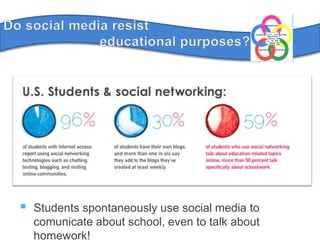
Do social media resisteducational purposes?Students spontaneously use social media to comunicate aboutschool, even to talk abouthomework!
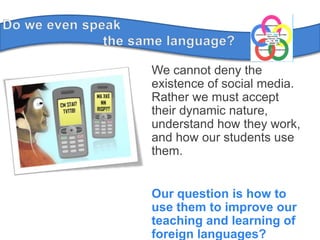
Do weevenspeak	the samelanguage?We cannot deny the existence of social media. Rather we must accept their dynamic nature, understand how they work, and how our students use them.Our question is how to use them to improve our teaching and learning of foreign languages?
WhyBring SM to the FL Classroom?Share (knowledge, materials, opinions & reflections)Collaborate (students & teachers, students & students, groups of students)Integrate & alternate (from typical traditional lessons)Participate (in CMC, computer mediated communication)
Why would you use social media in your Spanish/Portuguese class?
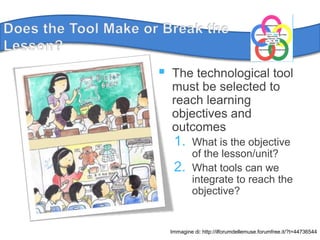
Does the ToolMake or Break the Lesson?The technological tool must be selected to reach learning objectives and outcomesWhat is the objective of the lesson/unit? What tools can we integrate to reach the objective?Immagine di: http://ilforumdellemuse.forumfree.it/?t=44736544
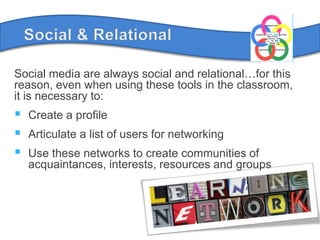
Social & RelationalSocial media are always social and relational…for this reason, even when using these tools in the classroom, it is necessary to:Create a profileArticulate a list of users for networking Use these networks to create communities of acquaintances, interests, resources and groups
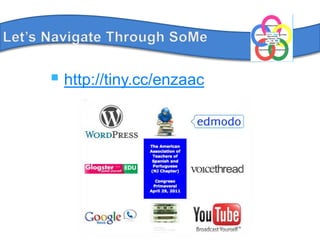
Let’sNavigate ThroughSoMehttp://tiny.cc/enzaac
BlogginngIn the blogsphere, there is(Inter)cultural CompetenceIn-depth analysis in reading comprehension and lexical developmentParticipation of both author and reader in a more formal platform
LetThem Blog!Develop the presentational mode of written communication (ACTFL)Allow for all students to provide feedback on an argument/topicHow toCreate a blog for the course/classThe teacher starts with a post and asks for feedback/commentsEach student is responsible for a future post and then to comment on posts of other classmates
GloggingPromotes creative thinkingCreatesconditionsfavorable to learningthroughinterest and funDevelopdigitalcomptencies/literacies: supportsintegration of multi-mediaIt’sfunctional to cooperative learning: students can work in pairs/grouphttp://lcstudentwiki.wikispaces.com/Spanish+Glogster
LetThemGlog!The poster board of our day gets a facelift!Presenting onself or a topic more creatively (using texts, audio, video, images, links to sites, etc.)How toAllregisteron Glogster.comThe teachercreates a class with the names and email adresses of classmatesStudents share and collaborate on these e-postershttp://ivenus.edu.glogster.com/tuttosudime/
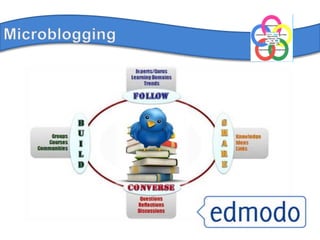
Microblogging
LetThemMicroblog!Allow students to communicate in writing via brief messages (only 140 characters!) in the target language, with more frequencyCommunicate with classmates, me and native language speakers in a relaxed atmosphereYou can read my complete study on Twitter in Italian III (intermediate level) http://chss.montclair.edu/~antenose/mytwitter.pdfHow toEvery opens a Twitter account – new one that is TL specific!Prompt students to share Twitter/Edmodo using questions or tasksAs they become more familiar with Twitter (it’s self-perpuating, organic),many will share without being prompted, and create their own network for learning
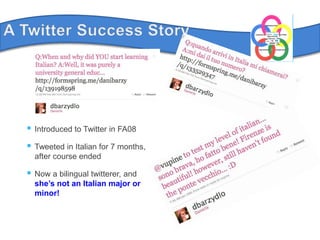
A Twitter Success StoryIntroduced to Twitter in FA08Tweeted in Italian for 7 months, after course endedNow a bilingual twitterer, and she’s not an Italian major or minor!
Youtube-ingContent and InformationCultural and languagevideos(One semester of Spanish)CollaborationMashups on certaintopicsPartecipationComments/reviewsVideo uploadingtoohttp://bit.ly/dHq8cp [pdf]http://www.youtube.com/watch?v=gk5fp6MMFNQ
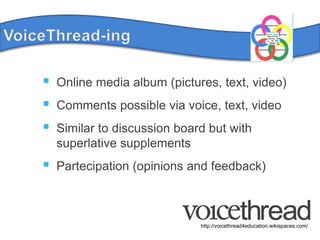
VoiceThread-ingOnline media album (pictures, text, video)Commentspossible via voice, text, videoSimilar to discussionboardbut with superlative supplementsPartecipation (opinions and feedback)http://voicethread4education.wikispaces.com/
Google Voice-ingA free audio product by Google (needonlyhave a Google account)Can be shared with teachers and classmatesLeavephonemessages to developspeakingskillsRecord conversations with speakers to developspeaking, listening and negotionskillsSome Spanish examples:http://span2313.wikispaces.com/GoogleVoice
Regular Use of Social Media!?!BenefitsStudents are alreadyfamiliar with many of the  toolsTheyalready use thesecommunicationtoolsContinualinteraction of students face-to-face and onlineMinor resistanceDrawbacksTeachers need to knowthesetoolswellStudents mightnotappreciate the educational use of thesetoolsCommunicationis24/7 Muchnoise in SMIttakes timehttp://www.slideshare.net/catepol/social-network-nella-didattica
Appendix: Technology in MFL“Originally published as a series of blog posts titled Technology in Modern Foreign Languages, this collection of articles explores how teachers are successfully incorporating the use of new technologies into their classroom practice with a focus on enhancing teaching and learning.Technologies such as blogging, microblogging, web 2.0, wikis, sound recording and videoconferencing have all found their way into our classrooms and harnessing them effectively is at the heart of 21st century pedagogy.The original articles can be read at Boxoftricks.net”José Picardo
Muchasgraciasfor sharingideas with me:Julia Cozzarelli (Voicethread)Reynol Junco (Students & SM)José Picardo (Technology in MFL)CaterinaPolincaro (Italian e-learning)Esperanza Roman  (YouTube) Donna Shelton (Google Voice)

Let Them Blog, Glog, Microblog & More!

  • 1.
    Let ThemBlog,Glog,Microblog& More!!EnzaAntenos-Conforti, PhDMontclair State University
  • 2.
  • 3.
    Educational ChallengeDo studentsuse technology in class?A recent study by Professor Reynol Junco of Lock Haven University states that 29% use Facebook while 66% sends or receives a text messageStudents use the Internet to communicateAuthentic and transparent in their use (perhaps too transparent!) They aren’t knowledgeable users
  • 4.
    Do social mediaresisteducational purposes?Students spontaneously use social media to comunicate aboutschool, even to talk abouthomework!
  • 5.
    Do weevenspeak the samelanguage?Wecannot deny the existence of social media. Rather we must accept their dynamic nature, understand how they work, and how our students use them.Our question is how to use them to improve our teaching and learning of foreign languages?
  • 6.
    WhyBring SM tothe FL Classroom?Share (knowledge, materials, opinions & reflections)Collaborate (students & teachers, students & students, groups of students)Integrate & alternate (from typical traditional lessons)Participate (in CMC, computer mediated communication)
  • 7.
    Why would youuse social media in your Spanish/Portuguese class?
  • 8.
    Does the ToolMakeor Break the Lesson?The technological tool must be selected to reach learning objectives and outcomesWhat is the objective of the lesson/unit? What tools can we integrate to reach the objective?Immagine di: http://ilforumdellemuse.forumfree.it/?t=44736544
  • 9.
    Social & RelationalSocialmedia are always social and relational…for this reason, even when using these tools in the classroom, it is necessary to:Create a profileArticulate a list of users for networking Use these networks to create communities of acquaintances, interests, resources and groups
  • 10.
  • 11.
    BlogginngIn the blogsphere,there is(Inter)cultural CompetenceIn-depth analysis in reading comprehension and lexical developmentParticipation of both author and reader in a more formal platform
  • 12.
    LetThem Blog!Develop thepresentational mode of written communication (ACTFL)Allow for all students to provide feedback on an argument/topicHow toCreate a blog for the course/classThe teacher starts with a post and asks for feedback/commentsEach student is responsible for a future post and then to comment on posts of other classmates
  • 13.
    GloggingPromotes creative thinkingCreatesconditionsfavorableto learningthroughinterest and funDevelopdigitalcomptencies/literacies: supportsintegration of multi-mediaIt’sfunctional to cooperative learning: students can work in pairs/grouphttp://lcstudentwiki.wikispaces.com/Spanish+Glogster
  • 14.
    LetThemGlog!The poster boardof our day gets a facelift!Presenting onself or a topic more creatively (using texts, audio, video, images, links to sites, etc.)How toAllregisteron Glogster.comThe teachercreates a class with the names and email adresses of classmatesStudents share and collaborate on these e-postershttp://ivenus.edu.glogster.com/tuttosudime/
  • 15.
  • 16.
    LetThemMicroblog!Allow students tocommunicate in writing via brief messages (only 140 characters!) in the target language, with more frequencyCommunicate with classmates, me and native language speakers in a relaxed atmosphereYou can read my complete study on Twitter in Italian III (intermediate level) http://chss.montclair.edu/~antenose/mytwitter.pdfHow toEvery opens a Twitter account – new one that is TL specific!Prompt students to share Twitter/Edmodo using questions or tasksAs they become more familiar with Twitter (it’s self-perpuating, organic),many will share without being prompted, and create their own network for learning
  • 17.
    A Twitter SuccessStoryIntroduced to Twitter in FA08Tweeted in Italian for 7 months, after course endedNow a bilingual twitterer, and she’s not an Italian major or minor!
  • 18.
    Youtube-ingContent and InformationCulturaland languagevideos(One semester of Spanish)CollaborationMashups on certaintopicsPartecipationComments/reviewsVideo uploadingtoohttp://bit.ly/dHq8cp [pdf]http://www.youtube.com/watch?v=gk5fp6MMFNQ
  • 19.
    VoiceThread-ingOnline media album(pictures, text, video)Commentspossible via voice, text, videoSimilar to discussionboardbut with superlative supplementsPartecipation (opinions and feedback)http://voicethread4education.wikispaces.com/
  • 20.
    Google Voice-ingA freeaudio product by Google (needonlyhave a Google account)Can be shared with teachers and classmatesLeavephonemessages to developspeakingskillsRecord conversations with speakers to developspeaking, listening and negotionskillsSome Spanish examples:http://span2313.wikispaces.com/GoogleVoice
  • 21.
    Regular Use ofSocial Media!?!BenefitsStudents are alreadyfamiliar with many of the toolsTheyalready use thesecommunicationtoolsContinualinteraction of students face-to-face and onlineMinor resistanceDrawbacksTeachers need to knowthesetoolswellStudents mightnotappreciate the educational use of thesetoolsCommunicationis24/7 Muchnoise in SMIttakes timehttp://www.slideshare.net/catepol/social-network-nella-didattica
  • 22.
    Appendix: Technology inMFL“Originally published as a series of blog posts titled Technology in Modern Foreign Languages, this collection of articles explores how teachers are successfully incorporating the use of new technologies into their classroom practice with a focus on enhancing teaching and learning.Technologies such as blogging, microblogging, web 2.0, wikis, sound recording and videoconferencing have all found their way into our classrooms and harnessing them effectively is at the heart of 21st century pedagogy.The original articles can be read at Boxoftricks.net”José Picardo
  • 23.
    Muchasgraciasfor sharingideas withme:Julia Cozzarelli (Voicethread)Reynol Junco (Students & SM)José Picardo (Technology in MFL)CaterinaPolincaro (Italian e-learning)Esperanza Roman (YouTube) Donna Shelton (Google Voice)

Editor's Notes

  • #2 L’alfabetizzazione nel 21o secoloGli indicatori della performance comprendono la comunicazione e collaborazione, la cittadinanza (comunità) digitale, la consapevolezza e espressione culturale e competenze sociali e civiche, i quali riflettono gli Standards.
  • #4 Un ultimo sondaggio fatto dal professor Reynol Junco, Lock HavenUniversity, risulta che il 29% usano Facebook e il 66% mandano e ricevono SMS durante lezioniConsiderare la vita online parte integrante della quotidianitàGli studenti usano la rete per motivi COMUNICATIVI e LUCIDI ma non sono UTENTI CONSAPEVOLII processi cognitivi complessiLo sviluppo di un approccio consapevole e maturo alla rete necessitano di una guida formativa
  • #5 Alfabetizzati nel 21 secolo- Noi restiamo le guide…se perdono in tecnologismo, restano depositari di accortezze d’uso e approcci consapevoli agli usi evoluti della rete
  • #6 Qualisono le sfide?Non negarne l'esistenza, accettarne le dinamicheCapire come funzionanoCapire come li usano gli studentiUtilizzarli come canale comunicativoConsiderare la vita online parte integrante della quotidianitàEducare alla consapevolezzaProvare ad integrare/migliorare la didattica
  • #7 CONDIVIDO ergo sumCome integrare i social network nella didattica:Condividendo sapere, materiale didattico, opinioni e riflessioni ecc.Collaborando: docente/studente, studente/studente, gruppi di studenti ecc.Interagendo e usando la multimedialità come alternativa alla lezione classicaPartecipandoUtilizzandoli come punto di accesso alla conoscenza in rete (risorse, relazioni, informazioni, eventi)Il concetto di “goodinteraction” per quanto riguarda la comunicazione mediata dal computer (CMC), vogliamo avere l’input poi se lo imparano “intake” poi creano output per avere occasioni di interagire con altri e negoziare il significato (Chapelle 1998).
  • #10 / Contestuali e situati
  • #12 abilità di interpretare e lasciare commentiAspetti culturali con risorse dall'internet
  • #16 Condividere – idee, link a risorse, con messaggi brevissimi (SMS) (limitati a 140 caratteri)Seguire esperti; entità; i trend (osservali)Creare una network – gruppi (liste di gruppi; corsi; comunità)Dialogare (domande, riflessioni, discussioni)Chat di classe e canale comunicativoAvere il senso di ciò che accade nel mondoTenere traccia di una parola chiaveSeguire un convegnoOttenere feedback immediatoSeguire un esperto o una persona famosaPrendere appunti pubblici, collettiviAssegnare i compitiImparare le lingueecc.
  • #19 Collaborazione: creazione dei playlistPartecipazione:Contenuti video preparati dal docenteVisione di contenuti di altri, di espertiDocumentazione di progetti didatticiEsercitazioniElaborati video degli studentiRicercaProduzioneCreatività
  • #20 online media album that can hold essentially any type of media (images, documents and videos) and allows people to make comments in 5 different ways - using voice (with a microphone or telephone), text, audio file, or video (with a webcam) - and share them with anyone they wish. A VoiceThread allows group conversations to be collected and shared in one place, from anywhere in the world.
  • #21 Foreign Language Class - Sentence Structure Students use a voice mail as their homeworkStudents speak a sentence in English and the foreign languageTeacher and Student can listen to it together for critiqueMessage is stored so students and teacher can see progression of fluencyDonna shelton,professore di spagnolo a Northeastern State Univeristy (Oklahama)
  • #22 Limiti dell'uso dei social network nella didatticaLa partecipazione richiede impegno, motivazione, continuità, tempo, produzione di contenuti e scambio di informazioni: nulla è scontato.Lo scambio deve essere reciproco e non monodirezionaleLa rete fa parte della vita reale degli utenti, non è un mondo a séNon è detto che gli studenti accettino questa invasione di campoBisogna conoscere le dinamiche d'uso, non si improvvisaOverload comunicativo e troppo multitaskingNon sostituiscono la didattica ma la possono integrare