Web Analytics &
Business Organization
Strategy & Implementation
TOPIC REQUIREMENTS
Web Analytics User Account linked to
Google Analytics.
Business understanding of the account
linked to Google Analytics.
Business Functions
Stakeholders
Expectations
Reporting to Stakeholders Needs
WEB ANALYTICS &
BUSINESS ORGANIZATION
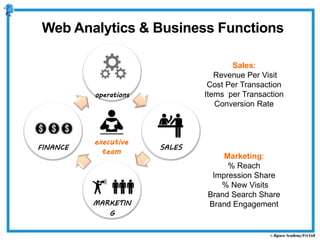
operations
SALES
MARKETIN
G
FINANCE
executive
team
Web Analytics & Business Functions
Sales:
Revenue Per Visit
Cost Per Transaction
Items per Transaction
Conversion Rate
Marketing:
% Reach
Impression Share
% New Visits
Brand Search Share
Brand Engagement
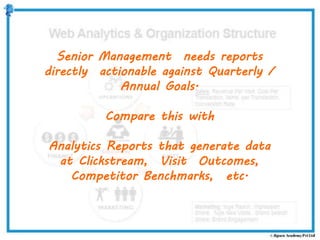
Senior Management needs reports
directly actionable against Quarterly /
Annual Goals.
Compare this with
Analytics Reports that generate data
at Clickstream, Visit Outcomes,
Competitor Benchmarks, etc.
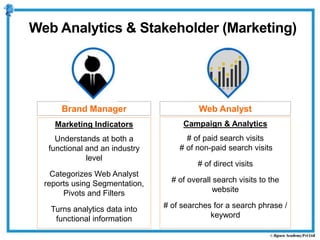
Brand Manager Web Analyst
Campaign & Analytics
# of paid search visits
# of non-paid search visits
# of direct visits
# of overall search visits to the
website
# of searches for a search phrase /
keyword
Marketing Indicators
Understands at both a
functional and an industry
level
Categorizes Web Analyst
reports using Segmentation,
Pivots and Filters
Turns analytics data into
functional information
Web Analytics & Stakeholder (Marketing)

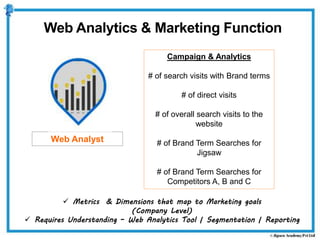
Web Analyst
Campaign & Analytics
# of search visits with Brand terms
# of direct visits
# of overall search visits to the
website
# of Brand Term Searches for
Jigsaw
# of Brand Term Searches for
Competitors A, B and C
 Metrics & Dimensions that map to Marketing goals
(Company Level)

 Requires Understanding – Web Analytics Tool | Segmentation | Reporting
Web Analytics & Marketing Function
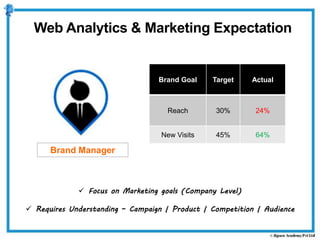
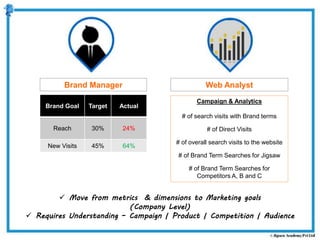
Brand Manager
 Focus on Marketing goals (Company Level)
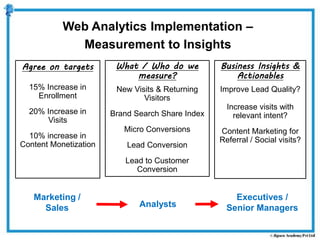
 Requires Understanding – Campaign | Product | Competition | Audience
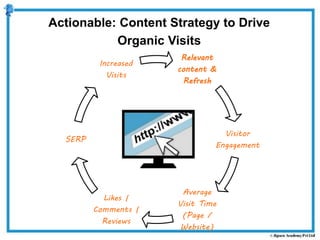
Brand Goal Target Actual
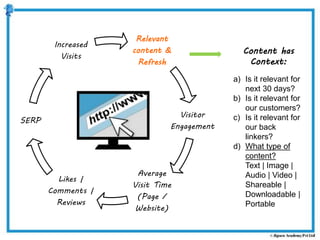
Reach 30% 24%
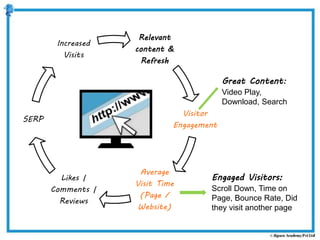
New Visits 45% 64%
Web Analytics & Marketing Expectation
Brand Manager
Brand Goal Target Actual
Reach 30% 24%
New Visits 45% 64%
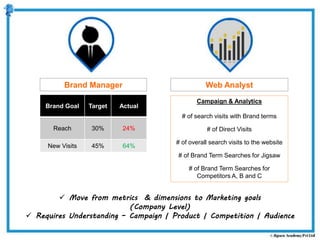
Web Analyst
Campaign & Analytics
# of search visits with Brand terms
# of Direct Visits
# of overall search visits to the website
# of Brand Term Searches for Jigsaw
# of Brand Term Searches for
Competitors A, B and C
 Move from metrics & dimensions to Marketing goals
(Company Level)
 Requires Understanding – Campaign | Product | Competition | Audience
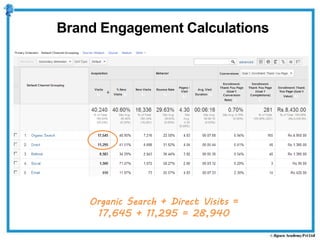
Organic Search + Direct Visits =
17,645 + 11,295 = 28,940
Brand Engagement Calculations
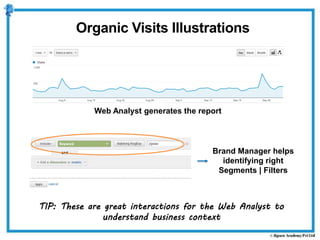
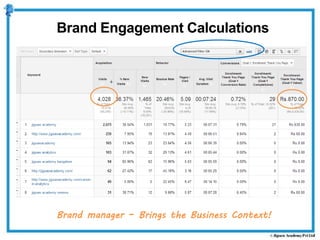
Brand Manager helps
identifying right
Segments | Filters
Web Analyst generates the report
TIP: These are great interactions for the Web Analyst to
understand business context
Organic Visits Illustrations
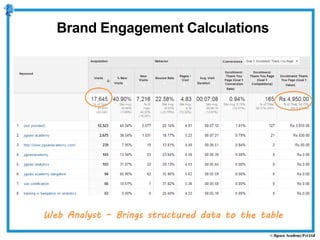
Web Analyst – Brings structured data to the table
Brand Engagement Calculations
Brand manager – Brings the Business Context!
Brand Engagement Calculations
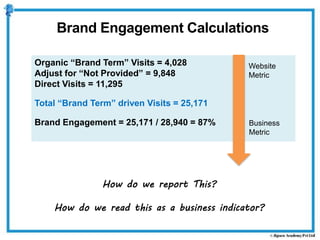
Organic “Brand Term” Visits = 4,028
Adjust for “Not Provided” = 9,848
Direct Visits = 11,295
Total “Brand Term” driven Visits = 25,171
Brand Engagement = 25,171 / 28,940 = 87%
How do we report This?
How do we read this as a business indicator?
Website
Metric
Business
Metric
Brand Engagement Calculations
0%
10%
20%
30%
40%
50%
60%
70%
80%
Q1 Q2 Q3 Q4
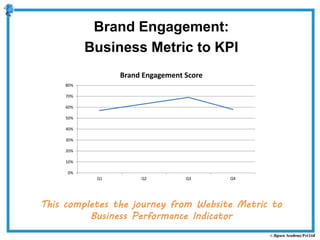
Brand Engagement Score
This completes the journey from Website Metric to
Business Performance Indicator
Brand Engagement:
Business Metric to KPI
Brand Manager
Brand Goal Target Actual
Reach 30% 24%
New Visits 45% 64%
Web Analyst
Campaign & Analytics
# of search visits with Brand terms
# of Direct Visits
# of overall search visits to the website
# of Brand Term Searches for Jigsaw
# of Brand Term Searches for
Competitors A, B and C
 Move from metrics & dimensions to Marketing goals
(Company Level)
 Requires Understanding – Campaign | Product | Competition | Audience
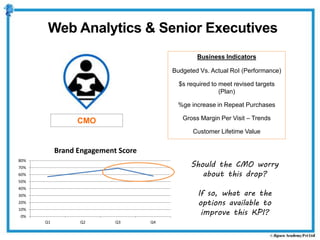
CMO
Business Indicators
Budgeted Vs. Actual RoI (Performance)
$s required to meet revised targets
(Plan)
%ge increase in Repeat Purchases
Gross Margin Per Visit – Trends
Customer Lifetime Value
0%
10%
20%
30%
40%
50%
60%
70%
80%
Q1 Q2 Q3 Q4
Brand Engagement Score
Should the CMO worry
about this drop?
If so, what are the
options available to
improve this KPI?
Web Analytics & Senior Executives
CMO Brand Manager
• (# of Brand Term Search Visits + # of Direct Visits) /
(# of Search Visits + # of Direct visits)
Brand
Engagement
• (# of Brand Term Searches for Jigsaw) / (# of Brand
Term Searches for [Jigsaw + Competitors])
Brand Search
Share Index
move from marketing metrics to business measures (industry perspective)
Take actions – requires business understanding
Web Analytics & Business Expectations
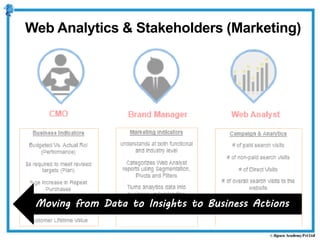
Moving from Data to Insights to Business Actions
Web Analytics & Stakeholders (Marketing)
RECAP
 Data converted to:
online metrics;
Business indicators;
Actionable insights.
 Analytical and business capabilities
required across different functions.
Thank You
Web Analytics &
Business Strategy
Strategy & Implementation
Understanding Business Strategy
Business Strategy – Performance Indicator
Measuring Marketing Performance
Measuring Models
Creating Measurement Models & Reporting
WEB ANALYTICS &
BUSINESS STRATEGY
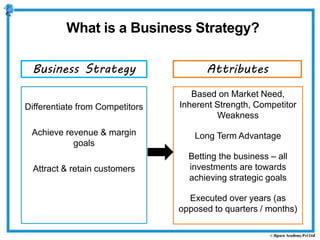
Business Strategy
Differentiate from Competitors
Achieve revenue & margin
goals
Attract & retain customers
Attributes
Based on Market Need,
Inherent Strength, Competitor
Weakness
Long Term Advantage
Betting the business – all
investments are towards
achieving strategic goals
Executed over years (as
opposed to quarters / months)
What is a Business Strategy?
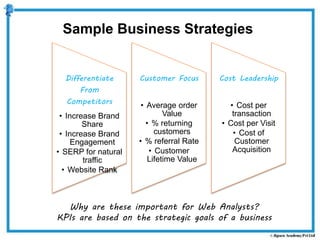
Differentiate
From
Competitors
• Increase Brand
Share
• Increase Brand
Engagement
• SERP for natural
traffic
• Website Rank
Customer Focus
• Average order
Value
• % returning
customers
• % referral Rate
• Customer
Lifetime Value
Cost Leadership
• Cost per
transaction
• Cost per Visit
• Cost of
Customer
Acquisition
Sample Business Strategies
Why are these important for Web Analysts?
KPIs are based on the strategic goals of a business
Understanding Business Strategy
Business Strategy – Performance Indicator
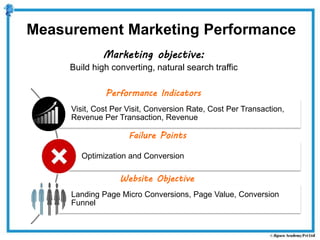
Measuring Marketing Performance
Measuring Models
Creating Measurement Models & Reporting
WEB ANALYTICS &
BUSINESS STRATEGY
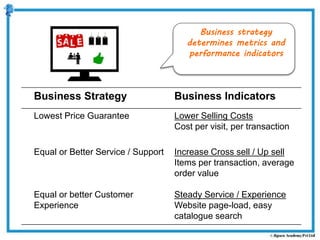
Business Strategy Business Indicators
Lowest Price Guarantee Lower Selling Costs
Cost per visit, per transaction
Equal or Better Service / Support
Equal or better Customer
Experience
Increase Cross sell / Up sell
Items per transaction, average
order value
Steady Service / Experience
Website page-load, easy
catalogue search
Business strategy
determines metrics and
performance indicators
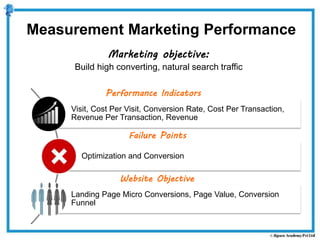
Visit, Cost Per Visit, Conversion Rate, Cost Per Transaction,
Revenue Per Transaction, Revenue
Optimization and Conversion
Landing Page Micro Conversions, Page Value, Conversion
Funnel
Performance Indicators
Failure Points
Website Objective
Marketing objective:
Build high converting, natural search traffic
Measurement Marketing Performance
Understanding Business Strategy
Business Strategy – Performance Indicator
Measuring Marketing Performance
Measuring Models
Creating Measurement Models & Reporting
WEB ANALYTICS &
BUSINESS STRATEGY
Example:
Jigsaw Academy - Training for
Business Professionals
Micro-conversions- Lead Generation
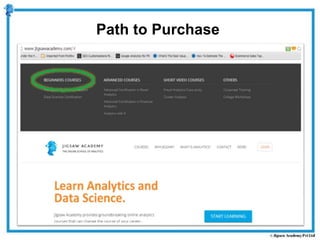
Path to Purchase
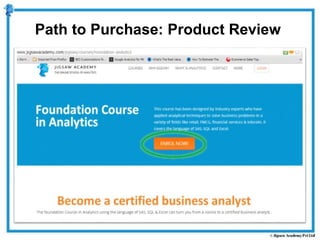
Path to Purchase: Product Review
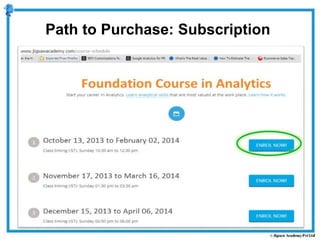
Path to Purchase: Subscription
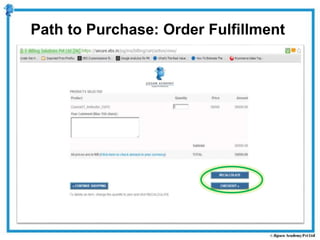
Path to Purchase: Order Fulfillment
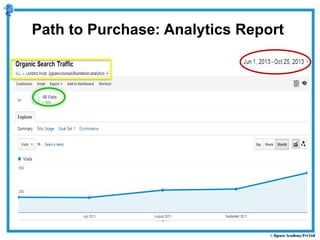
Path to Purchase: Analytics Report
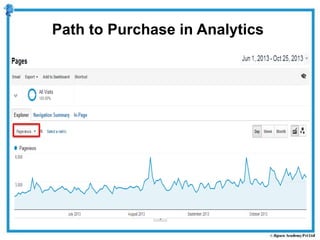
Path to Purchase in Analytics
Understanding Business Strategy
Business Strategy – Performance Indicator
Measuring Marketing Performance
Measuring Models
Creating Measurement Models & Reporting
WEB ANALYTICS &
BUSINESS STRATEGY
 Track progress of business objective(s) on a regular
basis
 Identify & measure metrics / KPIs
 Indicate which initiatives are working and which do not
 Help calibrate business actions based on data driven
insights
What is a Measurement Model?
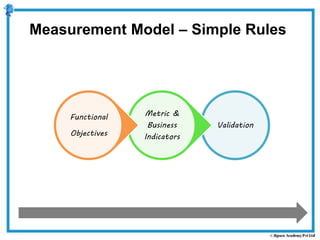
Validation
Metric &
Business
Indicators
Functional
Objectives
Measurement Model – Simple Rules
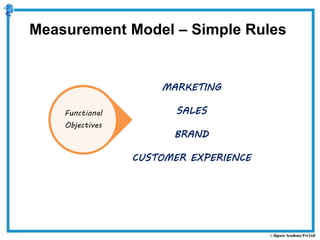
Functional
Objectives
MARKETING
SALES
BRAND
CUSTOMER EXPERIENCE
Measurement Model – Simple Rules
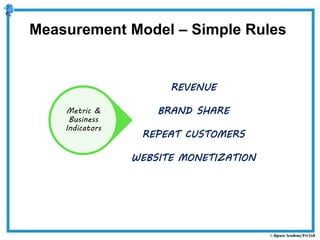
REVENUE
BRAND SHARE
REPEAT CUSTOMERS
WEBSITE MONETIZATION
Metric &
Business
Indicators
Measurement Model – Simple Rules
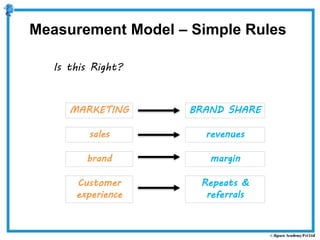
MARKETING BRAND SHARE
Measurement Model – Simple Rules
Is this Right?
sales
brand
Customer
experience
revenues
margin
Repeats &
referrals
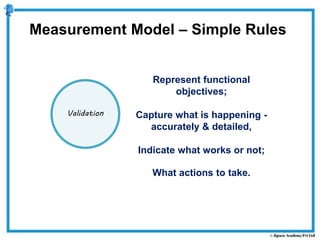
Represent functional
objectives;
Capture what is happening -
accurately & detailed,
Indicate what works or not;
What actions to take.
Validation
Measurement Model – Simple Rules
Understanding Business Strategy
Business Strategy – Performance Indicator
Measuring Marketing Performance
Measuring Models
Creating Measurement Models & Reporting
WEB ANALYTICS &
BUSINESS STRATEGY
Visit, Cost Per Visit, Conversion Rate, Cost Per Transaction,
Revenue Per Transaction, Revenue
Optimization and Conversion
Landing Page Micro Conversions, Page Value, Conversion
Funnel
Performance Indicators
Failure Points
Website Objective
Measurement Marketing Performance
Marketing objective:
Build high converting, natural search traffic
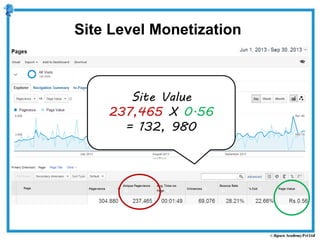
Site Level Monetization
Site Value
237,465 X 0.56
= 132, 980
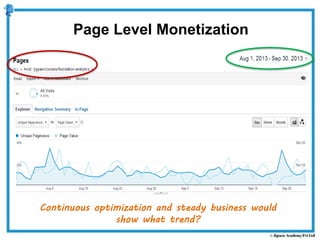
Page Level Monetization
Continuous optimization and steady business would
show what trend?
RECAP
 Relationship between business strategy
and Web Analytics identified through
business indicators,
 Linked the indicators to web analytics
metrics.
Thank You
Web Analytics
Measurement Framework
Strategy & Implementation
Identifying & Agreeing on
Performance Indicators
Web Analytics Implementation
Framework
Reporting Business Insights
Highlighting Business Actionables
Web Analytics
Measurement Framework
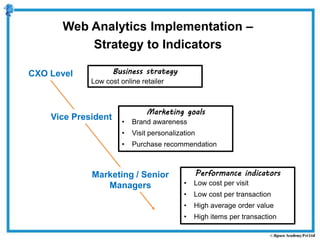
CXO Level Business strategy
Low cost online retailer
Vice President
Marketing goals
• Brand awareness
• Visit personalization
• Purchase recommendation
Marketing / Senior
Managers
Performance indicators
• Low cost per visit
• Low cost per transaction
• High average order value
• High items per transaction
Web Analytics Implementation –
Strategy to Indicators
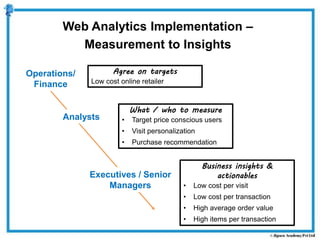
Operations/
Finance
Agree on targets
Low cost online retailer
Analysts
What / who to measure
• Target price conscious users
• Visit personalization
• Purchase recommendation
Executives / Senior
Managers
Business insights &
actionables
• Low cost per visit
• Low cost per transaction
• High average order value
• High items per transaction
Web Analytics Implementation –
Measurement to Insights
Identifying & Agreeing on
Performance Indicators
Web Analytics Implementation
Framework
Reporting Business Insights
Highlighting Business Actionables
Web Analytics
Measurement Framework
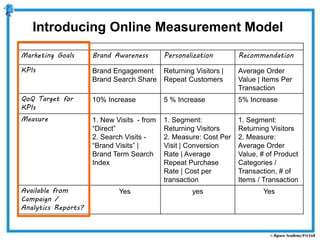
Introducing Online Measurement Model
Marketing Goals Brand Awareness Personalization Recommendation
KPIs Brand Engagement
Brand Search Share
Returning Visitors |
Repeat Customers
Average Order
Value | Items Per
Transaction
QoQ Target for
KPIs
10% Increase 5 % Increase 5% Increase
Measure 1. New Visits - from
“Direct”
2. Search Visits -
“Brand Visits” |
Brand Term Search
Index
1. Segment:
Returning Visitors
2. Measure: Cost Per
Visit | Conversion
Rate | Average
Repeat Purchase
Rate | Cost per
transaction
1. Segment:
Returning Visitors
2. Measure:
Average Order
Value, # of Product
Categories /
Transaction, # of
Items / Transaction
Available from
Campaign /
Analytics Reports?
Yes yes Yes
Example:
Jigsaw Academy - Training for
Business Professionals
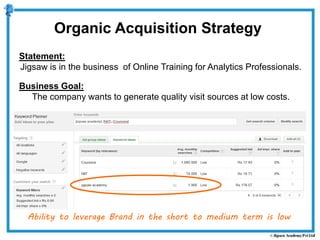
Statement:
Jigsaw is in the business of Online Training for Analytics Professionals.
Business Goal:
The company wants to generate quality visit sources at low costs.
Organic Acquisition Strategy
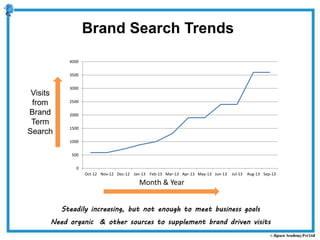
Ability to leverage Brand in the short to medium term is low
0
500
1000
1500
2000
2500
3000
3500
4000
Oct-12 Nov-12 Dec-12 Jan-13 Feb-13 Mar-13 Apr-13 May-13 Jun-13 Jul-13 Aug-13 Sep-13
Steadily increasing, but not enough to meet business goals
Need organic & other sources to supplement brand driven visits
Visits
from
Brand
Term
Search
Month & Year
Brand Search Trends
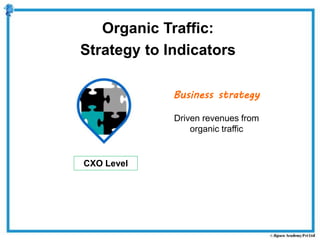
CXO Level
Business strategy
Driven revenues from
organic traffic
Organic Traffic:
Strategy to Indicators
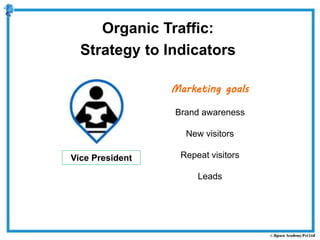
Vice President
Marketing goals
Brand awareness
New visitors
Repeat visitors
Leads
Organic Traffic:
Strategy to Indicators
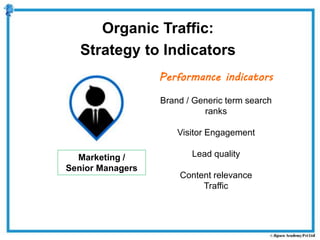
Performance indicators
Brand / Generic term search
ranks
Visitor Engagement
Lead quality
Content relevance
Traffic
Marketing /
Senior Managers
Organic Traffic:
Strategy to Indicators
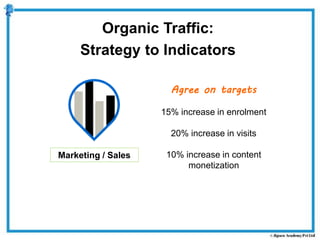
Marketing / Sales
Agree on targets
15% increase in enrolment
20% increase in visits
10% increase in content
monetization
Organic Traffic:
Strategy to Indicators
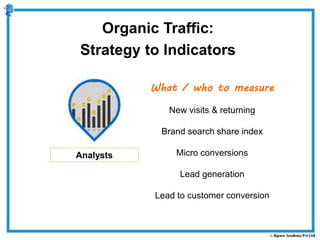
Analysts
Organic Traffic:
Strategy to Indicators
What / who to measure
New visits & returning
Brand search share index
Micro conversions
Lead generation
Lead to customer conversion
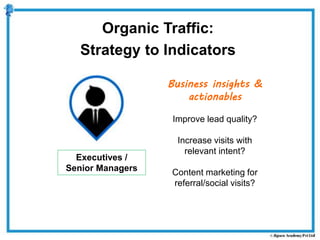
Executives /
Senior Managers
Business insights &
actionables
Improve lead quality?
Increase visits with
relevant intent?
Content marketing for
referral/social visits?
Organic Traffic:
Strategy to Indicators
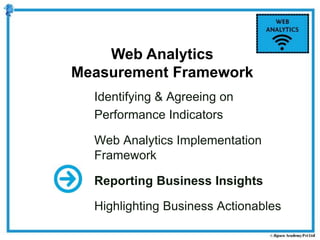
Identifying & Agreeing on
Performance Indicators
Web Analytics Implementation
Framework
Reporting Business Insights
Highlighting Business Actionables
Web Analytics
Measurement Framework
Marketing /
Sales Analysts
Executives /
Senior Managers
Agree on targets
15% Increase in
Enrollment
20% Increase in
Visits
10% increase in
Content Monetization
What / Who do we
measure?
New Visits & Returning
Visitors
Brand Search Share Index
Micro Conversions
Lead Conversion
Lead to Customer
Conversion
Business Insights &
Actionables
Improve Lead Quality?
Increase visits with
relevant intent?
Content Marketing for
Referral / Social visits?
Web Analytics Implementation –
Measurement to Insights
Relevant
content &
Refresh
Visitor
Engagement
Average
Visit Time
(Page /
Website)
Likes |
Comments |
Reviews
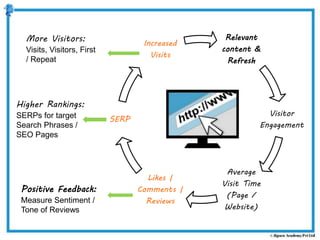
SERP
Increased
Visits
Actionable: Content Strategy to Drive
Organic Visits
Relevant
content &
Refresh
Visitor
Engagement
Average
Visit Time
(Page /
Website)
Likes |
Comments |
Reviews
SERP
Increased
Visits
Content has
Context:
a) Is it relevant for
next 30 days?
b) Is it relevant for
our customers?
c) Is it relevant for
our back
linkers?
d) What type of
content?
Text | Image |
Audio | Video |
Shareable |
Downloadable |
Portable
Relevant
content &
Refresh
Visitor
Engagement
Average
Visit Time
(Page /
Website)
Likes |
Comments |
Reviews
SERP
Increased
Visits
Great Content:
Video Play,
Download, Search
Engaged Visitors:
Scroll Down, Time on
Page, Bounce Rate, Did
they visit another page
Relevant
content &
Refresh
Visitor
Engagement
Average
Visit Time
(Page /
Website)
Likes |
Comments |
Reviews
SERP
Increased
Visits
Higher Rankings:
SERPs for target
Search Phrases /
SEO Pages
Positive Feedback:
Measure Sentiment /
Tone of Reviews
More Visitors:
Visits, Visitors, First
/ Repeat
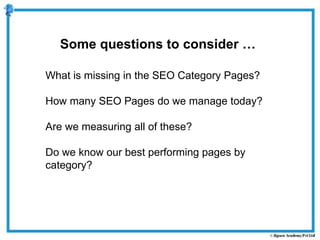
Some questions to consider …
What is missing in the SEO Category Pages?
How many SEO Pages do we manage today?
Are we measuring all of these?
Do we know our best performing pages by
category?
Outcomes Company Product Blog
Engagement Time on Page, Bounce rates, Pages / Visit, Chats /
Visit
Positives Comments / Likes
Interaction Comments | Scroll Downs | Video Play
Site
Monetization
[Micro Conversions, Leads, Page] - $ Values / Visit
Visits # of First Time | Repeat Visitors
Leads # of Leads / Enquiries
Higher
Conversions /
Conversion
Rates
Visits to Leads| Leads to Purchase| # of Purchases |
Average Purchase Value
SiteExperienceBusinessOutcome
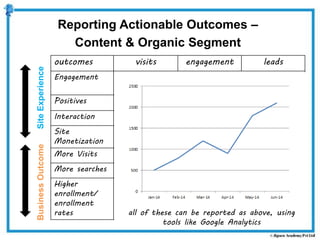
Reporting Actionable Outcomes –
Content & Organic Segment
outcomes visits engagement leads
Engagement
Positives
Interaction
Site
Monetization
More Visits
More searches
Higher
enrollment/
enrollment
rates
SiteExperienceBusinessOutcome
Reporting Actionable Outcomes –
Content & Organic Segment
all of these can be reported as above, using
tools like Google Analytics
Identifying & Agreeing on
Performance Indicators
Web Analytics Implementation
Framework
Reporting Business Insights
Highlighting Business Actionables
Web Analytics
Measurement Framework
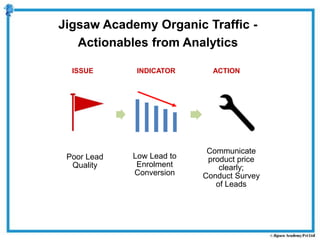
Poor Lead
Quality
Low Lead to
Enrolment
Conversion
Communicate
product price
clearly;
Conduct Survey
of Leads
Jigsaw Academy Organic Traffic -
Actionables from Analytics
ISSUE INDICATOR ACTION
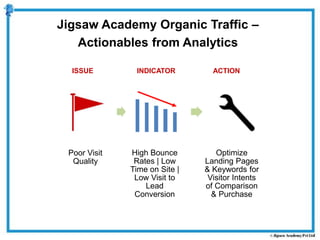
Poor Visit
Quality
High Bounce
Rates | Low
Time on Site |
Low Visit to
Lead
Conversion
Optimize
Landing Pages
& Keywords for
Visitor Intents
of Comparison
& Purchase
Jigsaw Academy Organic Traffic –
Actionables from Analytics
ISSUE INDICATOR ACTION
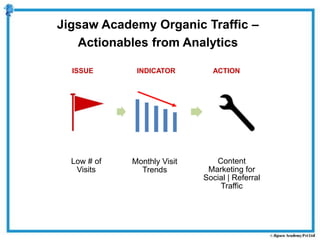
Low # of
Visits
Monthly Visit
Trends
Content
Marketing for
Social | Referral
Traffic
Jigsaw Academy Organic Traffic –
Actionables from Analytics
ISSUE INDICATOR ACTION
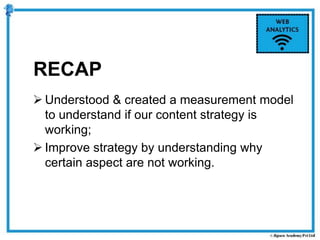
RECAP
 Understood & created a measurement model
to understand if our content strategy is
working;
 Improve strategy by understanding why
certain aspect are not working.
Thank You

WebC2 t1 t2-t3

  • 2.
    Web Analytics & BusinessOrganization Strategy & Implementation
  • 3.
    TOPIC REQUIREMENTS Web AnalyticsUser Account linked to Google Analytics. Business understanding of the account linked to Google Analytics.
  • 4.
    Business Functions Stakeholders Expectations Reporting toStakeholders Needs WEB ANALYTICS & BUSINESS ORGANIZATION
  • 5.
    operations SALES MARKETIN G FINANCE executive team Web Analytics &Business Functions Sales: Revenue Per Visit Cost Per Transaction Items per Transaction Conversion Rate Marketing: % Reach Impression Share % New Visits Brand Search Share Brand Engagement
  • 6.
    Senior Management needsreports directly actionable against Quarterly / Annual Goals. Compare this with Analytics Reports that generate data at Clickstream, Visit Outcomes, Competitor Benchmarks, etc.
  • 7.
    Brand Manager WebAnalyst Campaign & Analytics # of paid search visits # of non-paid search visits # of direct visits # of overall search visits to the website # of searches for a search phrase / keyword Marketing Indicators Understands at both a functional and an industry level Categorizes Web Analyst reports using Segmentation, Pivots and Filters Turns analytics data into functional information Web Analytics & Stakeholder (Marketing)
  • 8.
    Web Analyst Campaign &Analytics # of search visits with Brand terms # of direct visits # of overall search visits to the website # of Brand Term Searches for Jigsaw # of Brand Term Searches for Competitors A, B and C  Metrics & Dimensions that map to Marketing goals (Company Level)  Requires Understanding – Web Analytics Tool | Segmentation | Reporting Web Analytics & Marketing Function
  • 9.
    Brand Manager  Focuson Marketing goals (Company Level)  Requires Understanding – Campaign | Product | Competition | Audience Brand Goal Target Actual Reach 30% 24% New Visits 45% 64% Web Analytics & Marketing Expectation
  • 10.
    Brand Manager Brand GoalTarget Actual Reach 30% 24% New Visits 45% 64% Web Analyst Campaign & Analytics # of search visits with Brand terms # of Direct Visits # of overall search visits to the website # of Brand Term Searches for Jigsaw # of Brand Term Searches for Competitors A, B and C  Move from metrics & dimensions to Marketing goals (Company Level)  Requires Understanding – Campaign | Product | Competition | Audience
  • 11.
    Organic Search +Direct Visits = 17,645 + 11,295 = 28,940 Brand Engagement Calculations
  • 12.
    Brand Manager helps identifyingright Segments | Filters Web Analyst generates the report TIP: These are great interactions for the Web Analyst to understand business context Organic Visits Illustrations
  • 13.
    Web Analyst –Brings structured data to the table Brand Engagement Calculations
  • 14.
    Brand manager –Brings the Business Context! Brand Engagement Calculations
  • 15.
    Organic “Brand Term”Visits = 4,028 Adjust for “Not Provided” = 9,848 Direct Visits = 11,295 Total “Brand Term” driven Visits = 25,171 Brand Engagement = 25,171 / 28,940 = 87% How do we report This? How do we read this as a business indicator? Website Metric Business Metric Brand Engagement Calculations
  • 16.
    0% 10% 20% 30% 40% 50% 60% 70% 80% Q1 Q2 Q3Q4 Brand Engagement Score This completes the journey from Website Metric to Business Performance Indicator Brand Engagement: Business Metric to KPI
  • 17.
    Brand Manager Brand GoalTarget Actual Reach 30% 24% New Visits 45% 64% Web Analyst Campaign & Analytics # of search visits with Brand terms # of Direct Visits # of overall search visits to the website # of Brand Term Searches for Jigsaw # of Brand Term Searches for Competitors A, B and C  Move from metrics & dimensions to Marketing goals (Company Level)  Requires Understanding – Campaign | Product | Competition | Audience
  • 18.
    CMO Business Indicators Budgeted Vs.Actual RoI (Performance) $s required to meet revised targets (Plan) %ge increase in Repeat Purchases Gross Margin Per Visit – Trends Customer Lifetime Value 0% 10% 20% 30% 40% 50% 60% 70% 80% Q1 Q2 Q3 Q4 Brand Engagement Score Should the CMO worry about this drop? If so, what are the options available to improve this KPI? Web Analytics & Senior Executives
  • 19.
    CMO Brand Manager •(# of Brand Term Search Visits + # of Direct Visits) / (# of Search Visits + # of Direct visits) Brand Engagement • (# of Brand Term Searches for Jigsaw) / (# of Brand Term Searches for [Jigsaw + Competitors]) Brand Search Share Index move from marketing metrics to business measures (industry perspective) Take actions – requires business understanding Web Analytics & Business Expectations
  • 20.
    Moving from Datato Insights to Business Actions Web Analytics & Stakeholders (Marketing)
  • 21.
    RECAP  Data convertedto: online metrics; Business indicators; Actionable insights.  Analytical and business capabilities required across different functions.
  • 22.
  • 24.
    Web Analytics & BusinessStrategy Strategy & Implementation
  • 25.
    Understanding Business Strategy BusinessStrategy – Performance Indicator Measuring Marketing Performance Measuring Models Creating Measurement Models & Reporting WEB ANALYTICS & BUSINESS STRATEGY
  • 26.
    Business Strategy Differentiate fromCompetitors Achieve revenue & margin goals Attract & retain customers Attributes Based on Market Need, Inherent Strength, Competitor Weakness Long Term Advantage Betting the business – all investments are towards achieving strategic goals Executed over years (as opposed to quarters / months) What is a Business Strategy?
  • 27.
    Differentiate From Competitors • Increase Brand Share •Increase Brand Engagement • SERP for natural traffic • Website Rank Customer Focus • Average order Value • % returning customers • % referral Rate • Customer Lifetime Value Cost Leadership • Cost per transaction • Cost per Visit • Cost of Customer Acquisition Sample Business Strategies Why are these important for Web Analysts? KPIs are based on the strategic goals of a business
  • 28.
    Understanding Business Strategy BusinessStrategy – Performance Indicator Measuring Marketing Performance Measuring Models Creating Measurement Models & Reporting WEB ANALYTICS & BUSINESS STRATEGY
  • 29.
    Business Strategy BusinessIndicators Lowest Price Guarantee Lower Selling Costs Cost per visit, per transaction Equal or Better Service / Support Equal or better Customer Experience Increase Cross sell / Up sell Items per transaction, average order value Steady Service / Experience Website page-load, easy catalogue search Business strategy determines metrics and performance indicators
  • 30.
    Visit, Cost PerVisit, Conversion Rate, Cost Per Transaction, Revenue Per Transaction, Revenue Optimization and Conversion Landing Page Micro Conversions, Page Value, Conversion Funnel Performance Indicators Failure Points Website Objective Marketing objective: Build high converting, natural search traffic Measurement Marketing Performance
  • 31.
    Understanding Business Strategy BusinessStrategy – Performance Indicator Measuring Marketing Performance Measuring Models Creating Measurement Models & Reporting WEB ANALYTICS & BUSINESS STRATEGY
  • 32.
    Example: Jigsaw Academy -Training for Business Professionals
  • 35.
  • 37.
  • 38.
    Path to Purchase:Product Review
  • 39.
    Path to Purchase:Subscription
  • 40.
    Path to Purchase:Order Fulfillment
  • 41.
    Path to Purchase:Analytics Report
  • 42.
    Path to Purchasein Analytics
  • 43.
    Path to Purchasein Analytics
  • 44.
    Path to Purchasein Analytics
  • 45.
    Understanding Business Strategy BusinessStrategy – Performance Indicator Measuring Marketing Performance Measuring Models Creating Measurement Models & Reporting WEB ANALYTICS & BUSINESS STRATEGY
  • 46.
     Track progressof business objective(s) on a regular basis  Identify & measure metrics / KPIs  Indicate which initiatives are working and which do not  Help calibrate business actions based on data driven insights What is a Measurement Model?
  • 47.
  • 48.
  • 49.
    REVENUE BRAND SHARE REPEAT CUSTOMERS WEBSITEMONETIZATION Metric & Business Indicators Measurement Model – Simple Rules
  • 50.
    MARKETING BRAND SHARE MeasurementModel – Simple Rules Is this Right? sales brand Customer experience revenues margin Repeats & referrals
  • 51.
    Represent functional objectives; Capture whatis happening - accurately & detailed, Indicate what works or not; What actions to take. Validation Measurement Model – Simple Rules
  • 52.
    Understanding Business Strategy BusinessStrategy – Performance Indicator Measuring Marketing Performance Measuring Models Creating Measurement Models & Reporting WEB ANALYTICS & BUSINESS STRATEGY
  • 53.
    Visit, Cost PerVisit, Conversion Rate, Cost Per Transaction, Revenue Per Transaction, Revenue Optimization and Conversion Landing Page Micro Conversions, Page Value, Conversion Funnel Performance Indicators Failure Points Website Objective Measurement Marketing Performance Marketing objective: Build high converting, natural search traffic
  • 54.
    Site Level Monetization SiteValue 237,465 X 0.56 = 132, 980
  • 55.
    Page Level Monetization Continuousoptimization and steady business would show what trend?
  • 56.
    RECAP  Relationship betweenbusiness strategy and Web Analytics identified through business indicators,  Linked the indicators to web analytics metrics.
  • 57.
  • 59.
  • 60.
    Identifying & Agreeingon Performance Indicators Web Analytics Implementation Framework Reporting Business Insights Highlighting Business Actionables Web Analytics Measurement Framework
  • 61.
    CXO Level Businessstrategy Low cost online retailer Vice President Marketing goals • Brand awareness • Visit personalization • Purchase recommendation Marketing / Senior Managers Performance indicators • Low cost per visit • Low cost per transaction • High average order value • High items per transaction Web Analytics Implementation – Strategy to Indicators
  • 62.
    Operations/ Finance Agree on targets Lowcost online retailer Analysts What / who to measure • Target price conscious users • Visit personalization • Purchase recommendation Executives / Senior Managers Business insights & actionables • Low cost per visit • Low cost per transaction • High average order value • High items per transaction Web Analytics Implementation – Measurement to Insights
  • 63.
    Identifying & Agreeingon Performance Indicators Web Analytics Implementation Framework Reporting Business Insights Highlighting Business Actionables Web Analytics Measurement Framework
  • 64.
    Introducing Online MeasurementModel Marketing Goals Brand Awareness Personalization Recommendation KPIs Brand Engagement Brand Search Share Returning Visitors | Repeat Customers Average Order Value | Items Per Transaction QoQ Target for KPIs 10% Increase 5 % Increase 5% Increase Measure 1. New Visits - from “Direct” 2. Search Visits - “Brand Visits” | Brand Term Search Index 1. Segment: Returning Visitors 2. Measure: Cost Per Visit | Conversion Rate | Average Repeat Purchase Rate | Cost per transaction 1. Segment: Returning Visitors 2. Measure: Average Order Value, # of Product Categories / Transaction, # of Items / Transaction Available from Campaign / Analytics Reports? Yes yes Yes
  • 65.
    Example: Jigsaw Academy -Training for Business Professionals
  • 66.
    Statement: Jigsaw is inthe business of Online Training for Analytics Professionals. Business Goal: The company wants to generate quality visit sources at low costs. Organic Acquisition Strategy Ability to leverage Brand in the short to medium term is low
  • 67.
    0 500 1000 1500 2000 2500 3000 3500 4000 Oct-12 Nov-12 Dec-12Jan-13 Feb-13 Mar-13 Apr-13 May-13 Jun-13 Jul-13 Aug-13 Sep-13 Steadily increasing, but not enough to meet business goals Need organic & other sources to supplement brand driven visits Visits from Brand Term Search Month & Year Brand Search Trends
  • 68.
    CXO Level Business strategy Drivenrevenues from organic traffic Organic Traffic: Strategy to Indicators
  • 69.
    Vice President Marketing goals Brandawareness New visitors Repeat visitors Leads Organic Traffic: Strategy to Indicators
  • 70.
    Performance indicators Brand /Generic term search ranks Visitor Engagement Lead quality Content relevance Traffic Marketing / Senior Managers Organic Traffic: Strategy to Indicators
  • 71.
    Marketing / Sales Agreeon targets 15% increase in enrolment 20% increase in visits 10% increase in content monetization Organic Traffic: Strategy to Indicators
  • 72.
    Analysts Organic Traffic: Strategy toIndicators What / who to measure New visits & returning Brand search share index Micro conversions Lead generation Lead to customer conversion
  • 73.
    Executives / Senior Managers Businessinsights & actionables Improve lead quality? Increase visits with relevant intent? Content marketing for referral/social visits? Organic Traffic: Strategy to Indicators
  • 74.
    Identifying & Agreeingon Performance Indicators Web Analytics Implementation Framework Reporting Business Insights Highlighting Business Actionables Web Analytics Measurement Framework
  • 75.
    Marketing / Sales Analysts Executives/ Senior Managers Agree on targets 15% Increase in Enrollment 20% Increase in Visits 10% increase in Content Monetization What / Who do we measure? New Visits & Returning Visitors Brand Search Share Index Micro Conversions Lead Conversion Lead to Customer Conversion Business Insights & Actionables Improve Lead Quality? Increase visits with relevant intent? Content Marketing for Referral / Social visits? Web Analytics Implementation – Measurement to Insights
  • 76.
    Relevant content & Refresh Visitor Engagement Average Visit Time (Page/ Website) Likes | Comments | Reviews SERP Increased Visits Actionable: Content Strategy to Drive Organic Visits
  • 77.
    Relevant content & Refresh Visitor Engagement Average Visit Time (Page/ Website) Likes | Comments | Reviews SERP Increased Visits Content has Context: a) Is it relevant for next 30 days? b) Is it relevant for our customers? c) Is it relevant for our back linkers? d) What type of content? Text | Image | Audio | Video | Shareable | Downloadable | Portable
  • 78.
    Relevant content & Refresh Visitor Engagement Average Visit Time (Page/ Website) Likes | Comments | Reviews SERP Increased Visits Great Content: Video Play, Download, Search Engaged Visitors: Scroll Down, Time on Page, Bounce Rate, Did they visit another page
  • 79.
    Relevant content & Refresh Visitor Engagement Average Visit Time (Page/ Website) Likes | Comments | Reviews SERP Increased Visits Higher Rankings: SERPs for target Search Phrases / SEO Pages Positive Feedback: Measure Sentiment / Tone of Reviews More Visitors: Visits, Visitors, First / Repeat
  • 80.
    Some questions toconsider … What is missing in the SEO Category Pages? How many SEO Pages do we manage today? Are we measuring all of these? Do we know our best performing pages by category?
  • 81.
    Outcomes Company ProductBlog Engagement Time on Page, Bounce rates, Pages / Visit, Chats / Visit Positives Comments / Likes Interaction Comments | Scroll Downs | Video Play Site Monetization [Micro Conversions, Leads, Page] - $ Values / Visit Visits # of First Time | Repeat Visitors Leads # of Leads / Enquiries Higher Conversions / Conversion Rates Visits to Leads| Leads to Purchase| # of Purchases | Average Purchase Value SiteExperienceBusinessOutcome Reporting Actionable Outcomes – Content & Organic Segment
  • 82.
    outcomes visits engagementleads Engagement Positives Interaction Site Monetization More Visits More searches Higher enrollment/ enrollment rates SiteExperienceBusinessOutcome Reporting Actionable Outcomes – Content & Organic Segment all of these can be reported as above, using tools like Google Analytics
  • 83.
    Identifying & Agreeingon Performance Indicators Web Analytics Implementation Framework Reporting Business Insights Highlighting Business Actionables Web Analytics Measurement Framework
  • 84.
    Poor Lead Quality Low Leadto Enrolment Conversion Communicate product price clearly; Conduct Survey of Leads Jigsaw Academy Organic Traffic - Actionables from Analytics ISSUE INDICATOR ACTION
  • 85.
    Poor Visit Quality High Bounce Rates| Low Time on Site | Low Visit to Lead Conversion Optimize Landing Pages & Keywords for Visitor Intents of Comparison & Purchase Jigsaw Academy Organic Traffic – Actionables from Analytics ISSUE INDICATOR ACTION
  • 86.
    Low # of Visits MonthlyVisit Trends Content Marketing for Social | Referral Traffic Jigsaw Academy Organic Traffic – Actionables from Analytics ISSUE INDICATOR ACTION
  • 87.
    RECAP  Understood &created a measurement model to understand if our content strategy is working;  Improve strategy by understanding why certain aspect are not working.
  • 88.

Editor's Notes

  • #26 Opening Audio for Session & its Subtopics to be recorded Under this topic, we will make the connection between Business Strategy & Web Analytics. Typically Business Strategy determines what data needs to be collected and analysed- thus determining the digital measurement model.
  • #27 To start off, we get to define what are some possible objectives of Business strategy – regardless of the nature of industry all businesses try to differentiate from Competitors, build larger customer base & achieve above industry standard Revenue / Profitability & RoI. These are determined by multiple attributes – Customer Expectations & Needs, Relative Competitor Strengths, Execution Timeframe, etc. Could you come up with 3 business functions that would be involved in the Strategic Outcomes listed here? Also how would you differentiate any of these from a business goal of achieving a sales target in the next 3 months?
  • #28 Here are some sample Business Strategies – along three dimensions – Brand Positioning, Customer & Cost Leadership. What could be the reason companies do not execute on all three at the same time? Would you choose one over the other? If so, which one? Can you name the strategies of some of the larger Brands or two strategies adopted by your company?
  • #30 The approach we would take here is to map Business Strategy to Business Indicators and then subsequently identify Web Metrics that help measure these Indicators. Our example here is based on an ecommerce retailer. Here we have a set of business indicators for this ecommerce retailer looking to raise business performance by offering value for money products with great customer experience. Lower selling Costs allow them to maintain maximum possible margins – when offering lowest prices. Also the ability to take advantage of lower prices to increase Order Value / Items sold helps offset fixed costs faster. One aspect of Service measured here is to manage superior site speed and help visitors navigate to product information / shopping cart faster. (question in slide) What does Cross Sell / Up Sell do? Which strategy is adopted by your business? How well is it working?
  • #31 When a website owner decides to leverage the low cost Natural Search (also called Organic Search) route, the Business Indicators to be tracked are as follows: Visits (of either category), Costs – of Visits & Transactions, Revenue per Transaction, Conversion Rates & Revenues. While these are Performance metrics, it is also vital to track Failure Points / Catalysts for achieving higher performance – 1. Is the page optimized to attract high quality visits (optimization refers to bringing in high quality visitors with the intent to learn more about Jigsaw, compare products / course fees , enroll for a course, etc. ) 2. Are visitors able to review products and purchase without website issues, etc. Metrics on Landing Page Engagement like Micro conversions, measuring Page Monetary Value, Conversion Funnel Data, etc provide insights that help catalyze business performance.
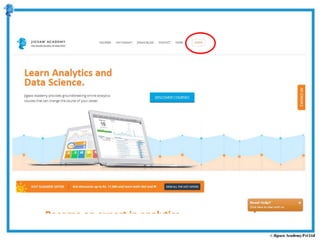
  • #34 Let me elaborate on what these Visitor / Website Engagement metrics are…I had referred to these as micro-conversions. So let’s review this page on Jigsaw Academy website. One interaction I see is the Log In page
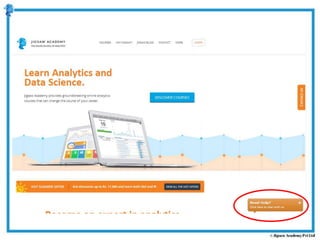
  • #35 The other interaction I see are Clicking on Need Help. “Log-In” and “Help” are Valuable Website Interactions that encourage Visitors to engage actively (part of website goal)
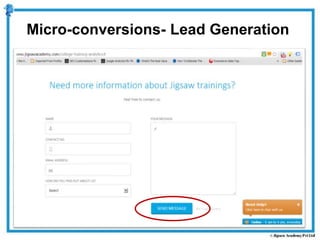
  • #36 Here is another one - Contact Jigsaw Academy for additional information – All of these interactions help a visitor learn more about the company and its products – extremely valuable from a website engagement perspective.
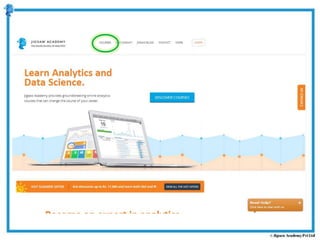
  • #37 Read and review Jigsaw’s Products & Services – This interestingly is the first step in the Path to Purchase – Get to know the products & services catalog
  • #38 Various programs offered by Jigsaw are listed here – by Customer Category (Advanced or Beginners) and Course Format (like Videos). So let me choose the Foundation Course here
  • #39 I get to know the specific of these program and the value it offers – and I now click on the Enroll Now button – This is when I show clear intent to purchase the product
  • #40 After clicking Enroll now, I get to the Product Schedule (or in eCommerce Product Lingo – SKUs) page – and need to make a choice in terms of what would be a convenient program start date & duration
  • #41 After selecting the appropriate program I now enter the Shopping Cart section – where I sign up for the program at a specified price and avail of discount if any. After entering the information I move to the Cart Check Out page – where I make the Payment. This completes the path to purchase.
  • #42 In Analytics Reporting – I get to see the Page Views for Foundation Analytics – the product we had purchased
  • #43 In Analytics Reporting – I get to see the Page Views for Foundation Analytics – the product we had purchased
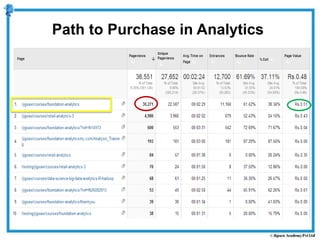
  • #44 Among many other pages, I see that this page has 30,271 page view – the largest among all pages of the website. This is the first step in the Path to Purchase as we had discussed.
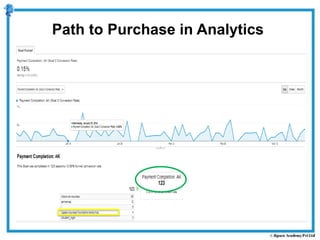
  • #45 The Funnel Report looks at Completions from the Product category – Foundation Analytics – with payment Completions being the last step in the Path to Purchase. It is also possible to track the intermediate steps and analyze where people drop off before they make the purchase. This analysis would offer insights to improve conversion rates – increase the %ge of Folks who visit the Foundation Analytics Page and end up making the Payment.
  • #47 Now let me introduce a concept known as Web Analytics Measurement Models – primarily track business performance by defining KPIs and capturing insights from Data Reporting & Analysis.
  • #48 The Measurement model flows from the strategic objectives of the company. Once a quantified strategic goal is identified to be executed over a definite timeline, we can break this down into trackable Business Metrics. Once Performance Indicators are identified we need to tag Validated Web Analytics Metrics that will provide insights to achieve strategic objectives.
  • #49 Let’s line up the Business Objectives into 4 categories – Marketing, Sales, Brand & Customer Experience
  • #50 The metrics that would indicate business performance are listed here – can you match these against the strategic goals identified?
  • #51 Primary Marketing Goal is to create and sustain Brand Awareness amidst competing products. Sales is determined by Revenues at Product, Category, Geography & Aggregate Customer levels. The power of the brand is determined by the Gross margin the company is able to hold on to compared to competitors with similar products / services. Why do you think Gross Margin would be a good indicator of Brand Strength? --- because customers are ok purchase your product without discount – compared to competitors – because of the superior value it offers. Customer Experience is primarily indicated by Repeat Purchases and Referrals – Keep in mind except for the Marketing Objective, all other Indicators are monetized.
  • #52 One important validation required here is whether the right metrics are being tracked at both the Performance Indicators and Web Analytics Reporting levels. The standard validation techniques include Whether these metrics represent Functional Objectives in a monetized form Whether these capture at great detail & accuracy what is happening to the business Do they explain what is going right and help spot negative trends? Do they guide your course of action – by identifying potential Cause & Effect, etc
  • #54 Let’s see how to create a Measurement Framework for a well defined marketing objective – in this situation I would like to Build a high converting natural search traffic. The Website Indicators that indicate progress here are Visits (by Visitor category) – Conversion Rate that indicates quality of visits & intent of visitors, Cost & Revenue at Aggregate & Per Transaction levels. Secondary monitors that could indicate what is going right / what is trending negative would be Optimization parameters like Landing Page Micro Conversions, Page Value, etc. Another indicator here will be the Conversion Funnel Fallouts and how do we plug the drop-offs. Achieve 50% revenue growth from Natural Traffic in 2 years Break this down into Business Performance Indicators – Tracking Revenue from New and Existing Customers via Organic Channel – why do I do this? Need to understand maximum potential of each customer category. Can also segment by Geography, Acquisition Channels (Paid, Direct or Organic), Purchase Behavior (Discount Seeker, Seasonal, etc) Cross Sell & Upsell for the Organic Channel Keyword Expansion for Natural Search Driving Brand Term Search via Awareness Campaigns in the Social Channels
  • #55 How do I track failure points – at an aggregate level you need to understand whether your customers are engaging at a higher rate over a period of time – this is measured using a monetized number arrived at by multiplying Unique Page Views with Page Value. This is a report that is typically provided within a standard tool like Google Analytics.
  • #56 Here is a trend chart of Page Value over a period of time…for a threshold daily visitor traffic, when website product pages are continuously optimized for meeting Visitor Intent better how would you expect the page value to trend? We should see a constant increase in Page Value – over time. As long as this is an uptrend, I would know that my organic revenue increase strategy is going in the right direction.
  • #57 Closing Audio to be recorded Under this topic we have discussed: the connection between Business Strategy & Web Analytics. How Business Strategy determines what data needs to be collected and analysed, and we looked at digital measurement models. That’s it for this topic. For any queries, do email us at info@jigsawacademy.com Thanks!
  • #60 While we have already covered what measurement models are and why they are essential, it is important to understand how to create a measurement model.
  • #61 Opening Audio for Session & its Subtopics to be recorded Under this topic, we will be looking at: Identifying & Agreeing on Performance Indicators Web Analytics Implementation Framework Reporting Business Insights Highlighting Business Actionables
  • #62 Let’s consider the situation of an Online Retailer looking to be the Low Cost leader in its category. Having established its differentiator, it needs to create a Brand around this position with matching Purchase experience – in terms of merchandise and relevant cross-sell & upsell. This gets decided at CXO level and the execution passes on to the Senior executives, say a Vice President , who would head Marketing / Sales functions. Given the Low Cost positioning, it is vital to generate higher volumes via new visits, repeat purchases and higher order value – hence the approach to online personalization that generates “high retention”. These would become my Marketing goals in this case. In terms of Performance Indicators that need to be targeted, monitored and achieved I now would look at lowering my acquisition costs – for Visits & Transactions while maximizing order value. Allowing for the business to sell at lower price and still stay profitable.
  • #63 Once this approach is finalized by the Marketing & Sales Function, the next step is to agree on Benchmarks / Targets for the Business Targets & Indicators. 2% below market be my Low Cost Position? What should be my Acquisition cost to maintain profitability at these price points? What should be my retention levels & average order value – to achieve break-evens over the next X quarters? What are my target QoQ for these insights? Who are the folks who need to agree these are the metrics and these are the targets?
  • #65 Using the low cost online retailer as an example, here is a summary of the outcomes from Strategy to Business Indicator to Performance Measurement against Targets – captured in a measurement framework. Review this carefully and you will notice that the entire business strategy is being measured against execution on a continual basis – using this framework.
  • #67 Here is a situation where a business is looking to increase its Customer Acquisition via Organic channels – The brand search share is fairly low compared to its competitors. Less than 0.2%
  • #68 However it is encouraging to note that the Brand Search terms are increasing month over month – still not good enough to meet revenue goals. So the challenge is to find an alternate source to build revenues via Organic channels
  • #69 The focus now switches to the Generics Terms that could lead to higher conversion rates – because of better visitor quality & engagement. The Business Strategy now flows down to implementation & measurement levels as you see here == read from screen
  • #70 The focus now switches to the Generics Terms that could lead to higher conversion rates – because of better visitor quality & engagement. The Business Strategy now flows down to implementation & measurement levels as you see here == read from screen
  • #71 The focus now switches to the Generics Terms that could lead to higher conversion rates – because of better visitor quality & engagement. The Business Strategy now flows down to implementation & measurement levels as you see here == read from screen
  • #72 Here the business units agree on targets and plan budgets and create an implementation plan that can be measured on a periodic basis. The functions that are involved here are ==== “read from screen”
  • #73 Here the business units agree on targets and plan budgets and create an implementation plan that can be measured on a periodic basis. The functions that are involved here are ==== “read from screen”
  • #74 Here the business units agree on targets and plan budgets and create an implementation plan that can be measured on a periodic basis. The functions that are involved here are ==== “read from screen”
  • #76 Here the business units agree on targets and plan budgets and create an implementation plan that can be measured on a periodic basis. The functions that are involved here are ==== “read from screen”
  • #77 Now lets look at an intangible – that needs to drive quality visits that engage Visitors better and convince them to purchase. This would be the content on your site – that you need to leverage to build Organic traffic.
  • #78 It starts with creating Content with Context – across multiple video formats. How do I measure whether this content is relevant and what format engages visitors better? How do I measure visitor engagement – need to capture time on page, scroll downs, # of comments, etc Also need to measure visitor feedback on content – from a sentiment perspective to understand relevance better. From the demand generation angle, I need to make sure my content appears right at the top of search engine results – these again can be trended for improvement over a period of time. The outcome of all of these efforts would be the total # of visits, Returning visitors and actual revenue generated via leads & sales. Thus an intangible can actually be metricized and tracked for monetary performance using a measurement framework loosely outlined here. We can certainly do an independent exercise to gain a deeper insight into this model.
  • #79 How do I measure visitor engagement – need to capture time on page, scroll downs, # of comments, etc
  • #80 Also need to measure visitor feedback on content – from a sentiment perspective to understand relevance better. From the demand generation angle, I need to make sure my content appears right at the top of search engine results – these again can be trended for improvement over a period of time. The outcome of all of these efforts would be the total # of visits, Returning visitors and actual revenue generated via leads & sales. Thus an intangible can actually be metricized and tracked for monetary performance using a measurement framework loosely outlined here. We can certainly do an independent exercise to gain a deeper insight into this model.
  • #82 The measurement model discussed for Content is highlighted here – All of these are metricized and when trended over time provides a good indicator of where the business is heading. “ read from slide”
  • #83 And we can measure these trends across two business performance indicators – Visitor Experience on Site and Monetization of the Organic Channel – a really cool way to measure what was seemingly intangible.
  • #85 Some possible actionables that could arise for a sub-set of the content are listed here – “read from slide”…the metrics measured are good enough to indicate potential problems and when measured at a detailed level also provide ideas for resolution.
  • #86 Some possible actionables that could arise for a sub-set of the content are listed here – “read from slide”…the metrics measured are good enough to indicate potential problems and when measured at a detailed level also provide ideas for resolution.
  • #87 Some possible actionables that could arise for a sub-set of the content are listed here – “read from slide”…the metrics measured are good enough to indicate potential problems and when measured at a detailed level also provide ideas for resolution.
  • #88 Closing Audio to be recorded Under this topic we have discussed in detail : How to Identify & Agree on Performance Indicators Web Analytics Implementation Framework Reporting Business Insights Highlighting Business Actionables That’s it for this topic. For any queries, do email us at info@jigsawacademy.com Thanks!