© 2015 IBM Corporation
IBM Retail Analytics
Solutions
Introducing Social Merchandising
© 2015 IBM Corporation
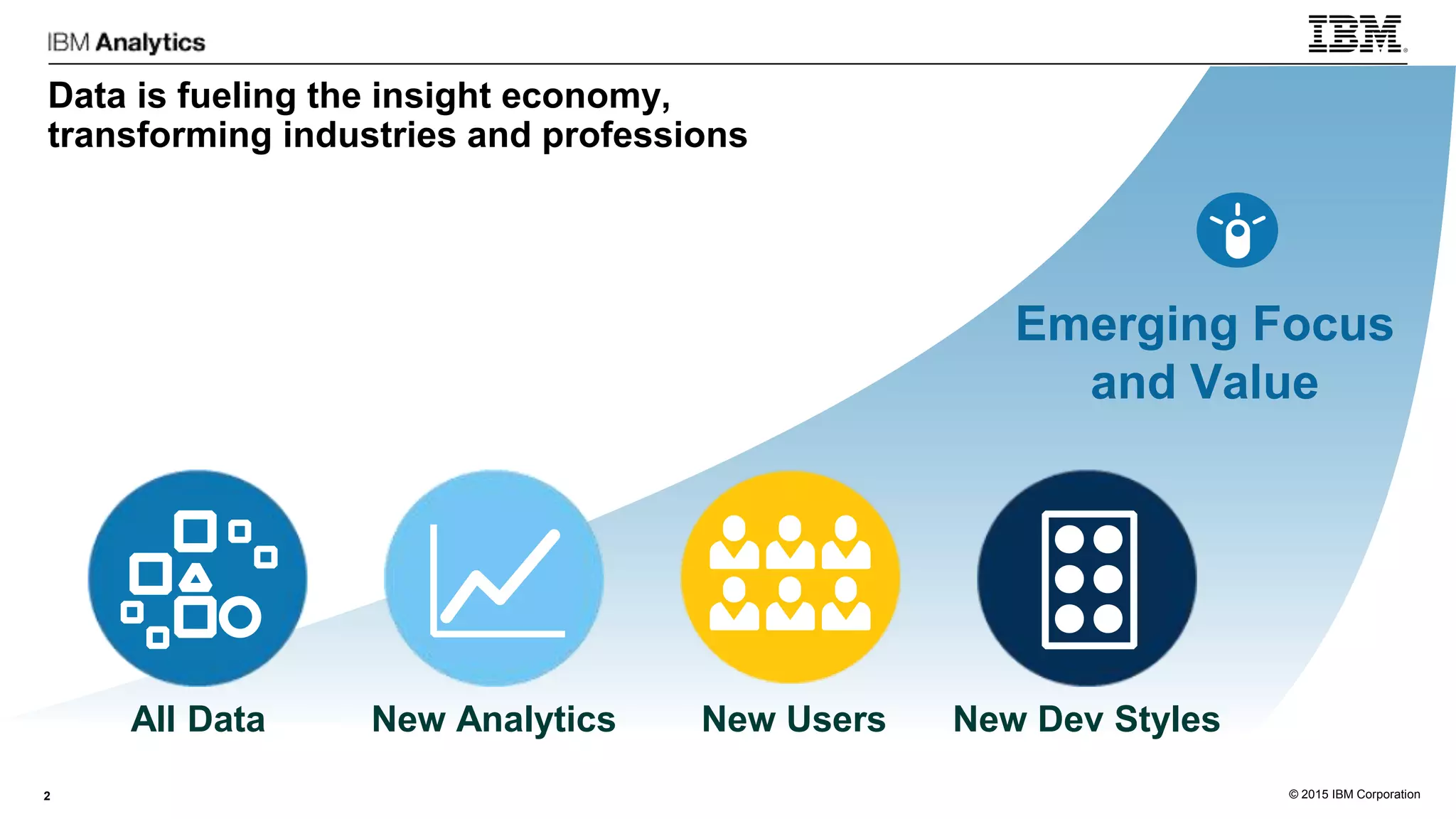
All Data New Dev StylesNew Analytics New Users
Emerging Focus
and Value
Data is fueling the insight economy,
transforming industries and professions
2
© 2015 IBM Corporation
Retailers must embrace this change, find new ways to understand,
engage and fulfill on consumer demand
3
Seamless
Shopping
Protect and
leverage data
Engage in
Context
Innovate, transform,
experiment
© 2015 IBM Corporation
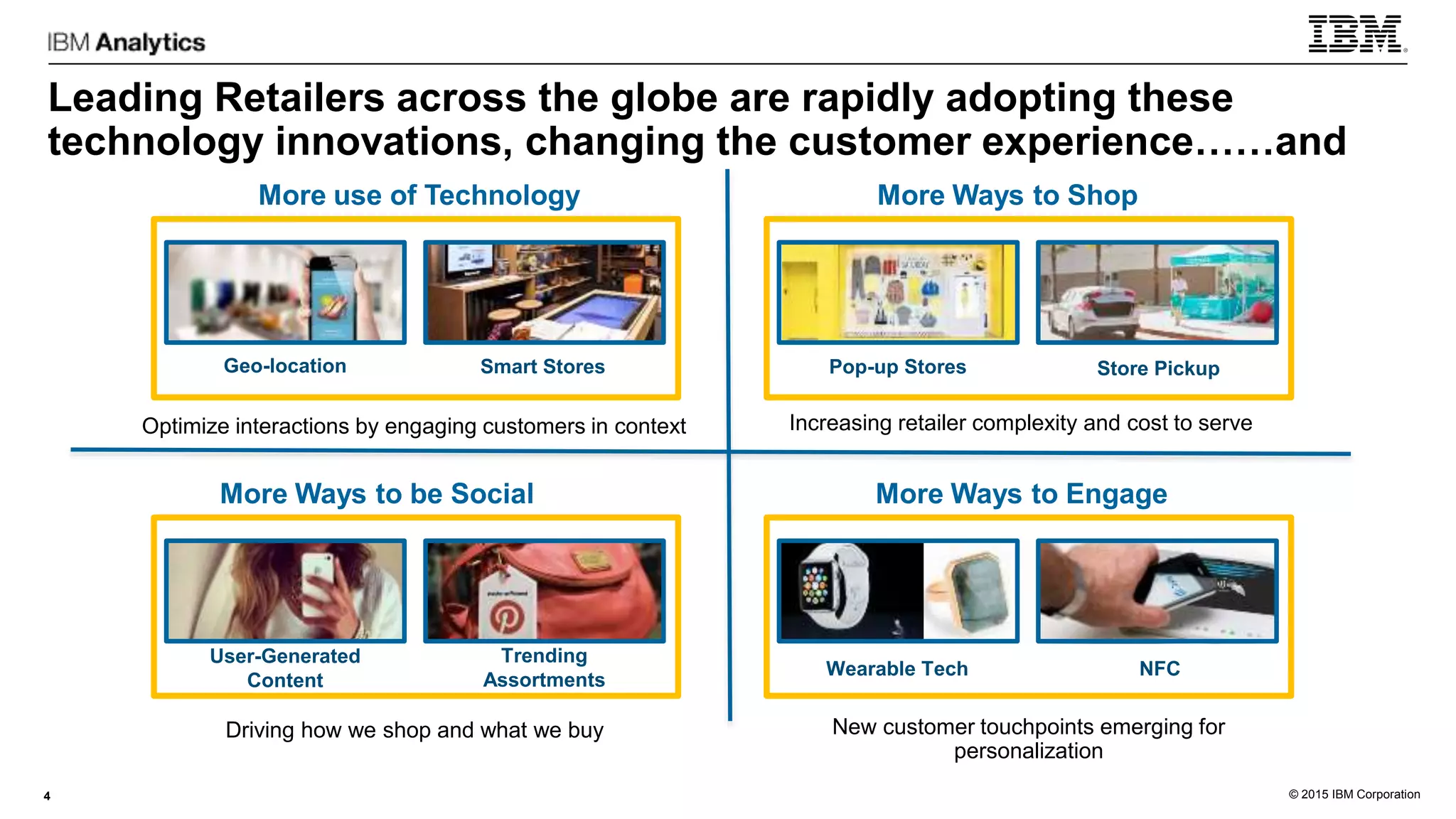
Leading Retailers across the globe are rapidly adopting these
technology innovations, changing the customer experience……and
Geo-location
NFCWearable Tech
Trending
Assortments
Smart Stores Pop-up Stores
User-Generated
Content
Store Pickup
More use of Technology
More Ways to be Social More Ways to Engage
More Ways to Shop
Optimize interactions by engaging customers in context Increasing retailer complexity and cost to serve
Driving how we shop and what we buy New customer touchpoints emerging for
personalization
4
© 2015 IBM Corporation
These new experiences generate huge volumes of data about
customers’ needs and wants – information that can be used to serve
them better
5
73% of CEOs
identify customer insights as the most critical
investment area
US $ 83 Billion
is lost each year in the US from poor customer
experiences
© 2015 IBM Corporation
To capitalize on these opportunities retailers must leverage new
technologies and execute three imperatives flawlessly using pre-built
advanced analytics
6
Customer
Implemented together, these
imperatives mean retail success. —
connecting with consumers,
operating efficiently and capturing
loyalty to gain market share and
driving profitable growth.
Visit ibm.com to learn more about IBM Analytics solutions for Retail
© 2015 IBM Corporation
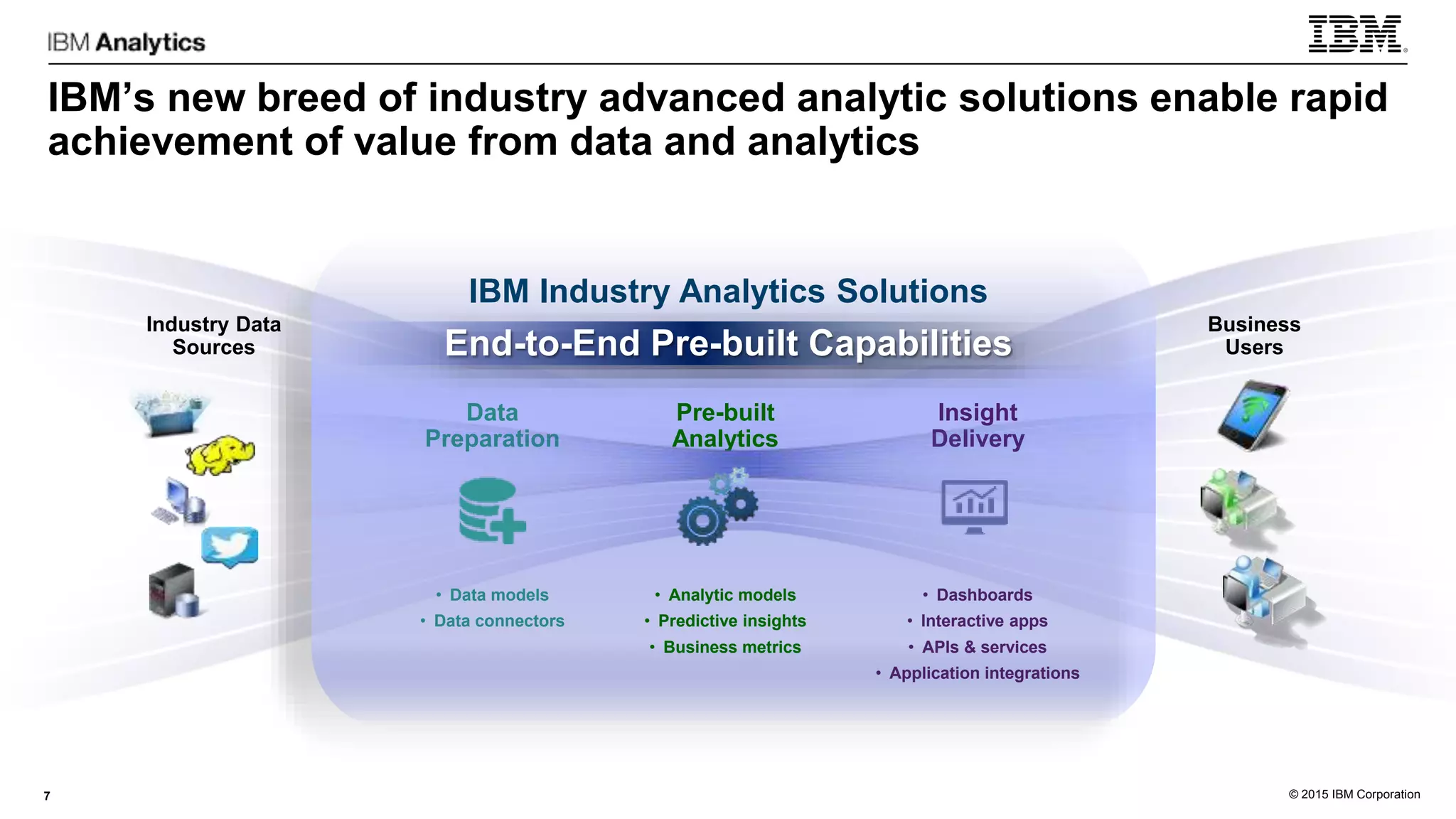
IBM’s new breed of industry advanced analytic solutions enable rapid
achievement of value from data and analytics
7
Data
Preparation
Pre-built
Analytics
Insight
Delivery
Industry Data
Sources
Business
Users
• Analytic models
• Predictive insights
• Business metrics
• Dashboards
• Interactive apps
• APIs & services
• Application integrations
IBM Industry Analytics Solutions
• Data models
• Data connectors
End-to-End Pre-built Capabilities
© 2015 IBM Corporation8
Combined multiple data sources – both external (Twitter,
Pinterest, weather, Facebook) and internal
Helps merchants, marketers and planners to understand
why (not just “what”)
Identifies trends and root causes based upon scientific
analysis
Introducing…
IBM Social Merchandising for Retail
© 2015 IBM Corporation
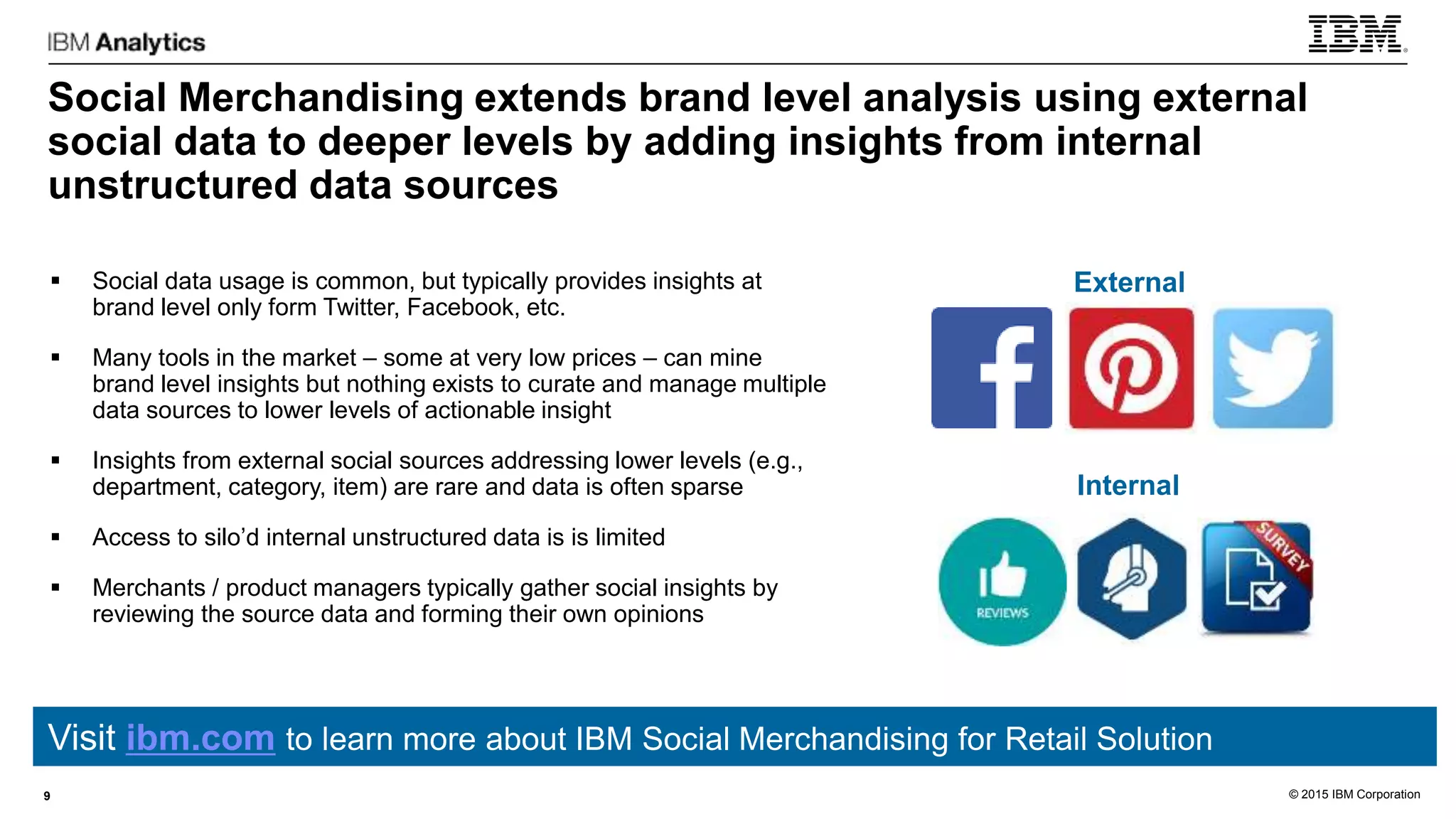
Social Merchandising extends brand level analysis using external
social data to deeper levels by adding insights from internal
unstructured data sources
9
 Social data usage is common, but typically provides insights at
brand level only form Twitter, Facebook, etc.
 Many tools in the market – some at very low prices – can mine
brand level insights but nothing exists to curate and manage multiple
data sources to lower levels of actionable insight
 Insights from external social sources addressing lower levels (e.g.,
department, category, item) are rare and data is often sparse
 Access to silo’d internal unstructured data is is limited
 Merchants / product managers typically gather social insights by
reviewing the source data and forming their own opinions
External
Internal
Visit ibm.com to learn more about IBM Social Merchandising for Retail Solution
© 2015 IBM Corporation
Social Merchandising curates internal and external sources of
customer insight into a merchant dashboard that tracks customer
trends and perceptions
10
Before After
External
Social Data
Internal
Social Data
Survey
Data
Call Center
Data
Product
Review
Data
Benefits
 Identify trends and react more quickly to
improve inventory turnover and sales
 Gain insights into quality and value
perceptions to improve client satisfaction and
loyalty
Curated
dashboard for
merchants,
planners, and
marketers
Leverage social
insights to make
price, promotion,
and assortment
decisions
Monitor changes
in perception
about brand and
products
Provide insights
at item, category,
department and
GEO levels
Social Merchandising helps merchants and marketers obtain a robust picture of customer perceptions
related to attributes such as quality, convenience and price below the brand level
© 2015 IBM Corporation
With Social Merchandising, merchants can answers critical questions
scientifically versus anecdotally – insights to why
 What is the social sentiment for the category I
manage today?
 How do shoppers perceive the quality, value,
convenience of my category?
 Why are customers perceiving my category to be
lower in quality, convenience, or value? What is
being said and how often is it being said?
 Who is the most influential shopper from Twitter,
from my own product reviews?
 What has been said about my favorite topics today?
Is a new topic trending?
11
© 2015 IBM Corporation
What makes Social Merchandising different?
 Unlike other solutions in the market, Social
Merchandising combines multiple data sources
 Helps merchants, marketers and planners to
understand why (not just “what”) by aggregating,
analyzing and synthesizing the wealth of that today
is unmanageable or inaccessible
 Identifies trends and root causes based upon
scientific analysis rather than anecdotal evidence
alone
 Provides a deeper level of analysis and insight –
extends below the brand level to the
department/category/item
12
Click here to learn more about IBM Social Merchandising for Retail
© 2015 IBM Corporation13
© 2015 IBM Corporation
Legal Disclaimer
• © IBM Corporation 2015. All Rights Reserved.
• The information contained in this publication is provided for informational purposes only. While efforts were made to verify the completeness and accuracy of the information contained in this publication, it is
provided AS IS without warranty of any kind, express or implied. In addition, this information is based on IBM’s current product plans and strategy, which are subject to change by IBM without notice. IBM shall
not be responsible for any damages arising out of the use of, or otherwise related to, this publication or any other materials. Nothing contained in this publication is intended to, nor shall have the effect of,
creating any warranties or representations from IBM or its suppliers or licensors, or altering the terms and conditions of the applicable license agreement governing the use of IBM software.
• References in this presentation to IBM products, programs, or services do not imply that they will be available in all countries in which IBM operates. Product release dates and/or capabilities referenced in this
presentation may change at any time at IBM’s sole discretion based on market opportunities or other factors, and are not intended to be a commitment to future product or feature availability in any way.
Nothing contained in these materials is intended to, nor shall have the effect of, stating or implying that any activities undertaken by you will result in any specific sales, revenue growth or other results.
• If the text contains performance statistics or references to benchmarks, insert the following language; otherwise delete:
Performance is based on measurements and projections using standard IBM benchmarks in a controlled environment. The actual throughput or performance that any user will experience will vary depending
upon many factors, including considerations such as the amount of multiprogramming in the user's job stream, the I/O configuration, the storage configuration, and the workload processed. Therefore, no
assurance can be given that an individual user will achieve results similar to those stated here.
• If the text includes any customer examples, please confirm we have prior written approval from such customer and insert the following language; otherwise delete:
All customer examples described are presented as illustrations of how those customers have used IBM products and the results they may have achieved. Actual environmental costs and performance
characteristics may vary by customer.
• Please review text for proper trademark attribution of IBM products. At first use, each product name must be the full name and include appropriate trademark symbols (e.g., IBM Lotus® Sametime® Unyte™).
Subsequent references can drop “IBM” but should include the proper branding (e.g., Lotus Sametime Gateway, or WebSphere Application Server). Please refer to http://www.ibm.com/legal/copytrade.shtml for
guidance on which trademarks require the ® or ™ symbol. Do not use abbreviations for IBM product names in your presentation. All product names must be used as adjectives rather than nouns. Please list all
of the trademarks that you use in your presentation as follows; delete any not included in your presentation. IBM, the IBM logo, Lotus, Lotus Notes, Notes, Domino, Quickr, Sametime, WebSphere, UC2,
PartnerWorld and Lotusphere are trademarks of International Business Machines Corporation in the United States, other countries, or both. Unyte is a trademark of WebDialogs, Inc., in the United States, other
countries, or both.
• If you reference Adobe® in the text, please mark the first use and include the following; otherwise delete:
Adobe, the Adobe logo, PostScript, and the PostScript logo are either registered trademarks or trademarks of Adobe Systems Incorporated in the United States, and/or other countries.
• If you reference Java™ in the text, please mark the first use and include the following; otherwise delete:
Java and all Java-based trademarks are trademarks of Sun Microsystems, Inc. in the United States, other countries, or both.
• If you reference Microsoft® and/or Windows® in the text, please mark the first use and include the following, as applicable; otherwise delete:
Microsoft and Windows are trademarks of Microsoft Corporation in the United States, other countries, or both.
• If you reference Intel® and/or any of the following Intel products in the text, please mark the first use and include those that you use as follows; otherwise delete:
Intel, Intel Centrino, Celeron, Intel Xeon, Intel SpeedStep, Itanium, and Pentium are trademarks or registered trademarks of Intel Corporation or its subsidiaries in the United States and other countries.
• If you reference UNIX® in the text, please mark the first use and include the following; otherwise delete:
UNIX is a registered trademark of The Open Group in the United States and other countries.
• If you reference Linux® in your presentation, please mark the first use and include the following; otherwise delete:
Linux is a registered trademark of Linus Torvalds in the United States, other countries, or both. Other company, product, or service names may be trademarks or service marks of others.
• If the text/graphics include screenshots, no actual IBM employee names may be used (even your own), if your screenshots include fictitious company names (e.g., Renovations, Zeta Bank, Acme) please update
and insert the following; otherwise delete: All references to [insert fictitious company name] refer to a fictitious company and are used for illustration purposes only.
14

IBM Retail Analytics Solutions

  • 1.
    © 2015 IBMCorporation IBM Retail Analytics Solutions Introducing Social Merchandising
  • 2.
    © 2015 IBMCorporation All Data New Dev StylesNew Analytics New Users Emerging Focus and Value Data is fueling the insight economy, transforming industries and professions 2
  • 3.
    © 2015 IBMCorporation Retailers must embrace this change, find new ways to understand, engage and fulfill on consumer demand 3 Seamless Shopping Protect and leverage data Engage in Context Innovate, transform, experiment
  • 4.
    © 2015 IBMCorporation Leading Retailers across the globe are rapidly adopting these technology innovations, changing the customer experience……and Geo-location NFCWearable Tech Trending Assortments Smart Stores Pop-up Stores User-Generated Content Store Pickup More use of Technology More Ways to be Social More Ways to Engage More Ways to Shop Optimize interactions by engaging customers in context Increasing retailer complexity and cost to serve Driving how we shop and what we buy New customer touchpoints emerging for personalization 4
  • 5.
    © 2015 IBMCorporation These new experiences generate huge volumes of data about customers’ needs and wants – information that can be used to serve them better 5 73% of CEOs identify customer insights as the most critical investment area US $ 83 Billion is lost each year in the US from poor customer experiences
  • 6.
    © 2015 IBMCorporation To capitalize on these opportunities retailers must leverage new technologies and execute three imperatives flawlessly using pre-built advanced analytics 6 Customer Implemented together, these imperatives mean retail success. — connecting with consumers, operating efficiently and capturing loyalty to gain market share and driving profitable growth. Visit ibm.com to learn more about IBM Analytics solutions for Retail
  • 7.
    © 2015 IBMCorporation IBM’s new breed of industry advanced analytic solutions enable rapid achievement of value from data and analytics 7 Data Preparation Pre-built Analytics Insight Delivery Industry Data Sources Business Users • Analytic models • Predictive insights • Business metrics • Dashboards • Interactive apps • APIs & services • Application integrations IBM Industry Analytics Solutions • Data models • Data connectors End-to-End Pre-built Capabilities
  • 8.
    © 2015 IBMCorporation8 Combined multiple data sources – both external (Twitter, Pinterest, weather, Facebook) and internal Helps merchants, marketers and planners to understand why (not just “what”) Identifies trends and root causes based upon scientific analysis Introducing… IBM Social Merchandising for Retail
  • 9.
    © 2015 IBMCorporation Social Merchandising extends brand level analysis using external social data to deeper levels by adding insights from internal unstructured data sources 9  Social data usage is common, but typically provides insights at brand level only form Twitter, Facebook, etc.  Many tools in the market – some at very low prices – can mine brand level insights but nothing exists to curate and manage multiple data sources to lower levels of actionable insight  Insights from external social sources addressing lower levels (e.g., department, category, item) are rare and data is often sparse  Access to silo’d internal unstructured data is is limited  Merchants / product managers typically gather social insights by reviewing the source data and forming their own opinions External Internal Visit ibm.com to learn more about IBM Social Merchandising for Retail Solution
  • 10.
    © 2015 IBMCorporation Social Merchandising curates internal and external sources of customer insight into a merchant dashboard that tracks customer trends and perceptions 10 Before After External Social Data Internal Social Data Survey Data Call Center Data Product Review Data Benefits  Identify trends and react more quickly to improve inventory turnover and sales  Gain insights into quality and value perceptions to improve client satisfaction and loyalty Curated dashboard for merchants, planners, and marketers Leverage social insights to make price, promotion, and assortment decisions Monitor changes in perception about brand and products Provide insights at item, category, department and GEO levels Social Merchandising helps merchants and marketers obtain a robust picture of customer perceptions related to attributes such as quality, convenience and price below the brand level
  • 11.
    © 2015 IBMCorporation With Social Merchandising, merchants can answers critical questions scientifically versus anecdotally – insights to why  What is the social sentiment for the category I manage today?  How do shoppers perceive the quality, value, convenience of my category?  Why are customers perceiving my category to be lower in quality, convenience, or value? What is being said and how often is it being said?  Who is the most influential shopper from Twitter, from my own product reviews?  What has been said about my favorite topics today? Is a new topic trending? 11
  • 12.
    © 2015 IBMCorporation What makes Social Merchandising different?  Unlike other solutions in the market, Social Merchandising combines multiple data sources  Helps merchants, marketers and planners to understand why (not just “what”) by aggregating, analyzing and synthesizing the wealth of that today is unmanageable or inaccessible  Identifies trends and root causes based upon scientific analysis rather than anecdotal evidence alone  Provides a deeper level of analysis and insight – extends below the brand level to the department/category/item 12 Click here to learn more about IBM Social Merchandising for Retail
  • 13.
    © 2015 IBMCorporation13
  • 14.
    © 2015 IBMCorporation Legal Disclaimer • © IBM Corporation 2015. All Rights Reserved. • The information contained in this publication is provided for informational purposes only. While efforts were made to verify the completeness and accuracy of the information contained in this publication, it is provided AS IS without warranty of any kind, express or implied. In addition, this information is based on IBM’s current product plans and strategy, which are subject to change by IBM without notice. IBM shall not be responsible for any damages arising out of the use of, or otherwise related to, this publication or any other materials. Nothing contained in this publication is intended to, nor shall have the effect of, creating any warranties or representations from IBM or its suppliers or licensors, or altering the terms and conditions of the applicable license agreement governing the use of IBM software. • References in this presentation to IBM products, programs, or services do not imply that they will be available in all countries in which IBM operates. Product release dates and/or capabilities referenced in this presentation may change at any time at IBM’s sole discretion based on market opportunities or other factors, and are not intended to be a commitment to future product or feature availability in any way. Nothing contained in these materials is intended to, nor shall have the effect of, stating or implying that any activities undertaken by you will result in any specific sales, revenue growth or other results. • If the text contains performance statistics or references to benchmarks, insert the following language; otherwise delete: Performance is based on measurements and projections using standard IBM benchmarks in a controlled environment. The actual throughput or performance that any user will experience will vary depending upon many factors, including considerations such as the amount of multiprogramming in the user's job stream, the I/O configuration, the storage configuration, and the workload processed. Therefore, no assurance can be given that an individual user will achieve results similar to those stated here. • If the text includes any customer examples, please confirm we have prior written approval from such customer and insert the following language; otherwise delete: All customer examples described are presented as illustrations of how those customers have used IBM products and the results they may have achieved. Actual environmental costs and performance characteristics may vary by customer. • Please review text for proper trademark attribution of IBM products. At first use, each product name must be the full name and include appropriate trademark symbols (e.g., IBM Lotus® Sametime® Unyte™). Subsequent references can drop “IBM” but should include the proper branding (e.g., Lotus Sametime Gateway, or WebSphere Application Server). Please refer to http://www.ibm.com/legal/copytrade.shtml for guidance on which trademarks require the ® or ™ symbol. Do not use abbreviations for IBM product names in your presentation. All product names must be used as adjectives rather than nouns. Please list all of the trademarks that you use in your presentation as follows; delete any not included in your presentation. IBM, the IBM logo, Lotus, Lotus Notes, Notes, Domino, Quickr, Sametime, WebSphere, UC2, PartnerWorld and Lotusphere are trademarks of International Business Machines Corporation in the United States, other countries, or both. Unyte is a trademark of WebDialogs, Inc., in the United States, other countries, or both. • If you reference Adobe® in the text, please mark the first use and include the following; otherwise delete: Adobe, the Adobe logo, PostScript, and the PostScript logo are either registered trademarks or trademarks of Adobe Systems Incorporated in the United States, and/or other countries. • If you reference Java™ in the text, please mark the first use and include the following; otherwise delete: Java and all Java-based trademarks are trademarks of Sun Microsystems, Inc. in the United States, other countries, or both. • If you reference Microsoft® and/or Windows® in the text, please mark the first use and include the following, as applicable; otherwise delete: Microsoft and Windows are trademarks of Microsoft Corporation in the United States, other countries, or both. • If you reference Intel® and/or any of the following Intel products in the text, please mark the first use and include those that you use as follows; otherwise delete: Intel, Intel Centrino, Celeron, Intel Xeon, Intel SpeedStep, Itanium, and Pentium are trademarks or registered trademarks of Intel Corporation or its subsidiaries in the United States and other countries. • If you reference UNIX® in the text, please mark the first use and include the following; otherwise delete: UNIX is a registered trademark of The Open Group in the United States and other countries. • If you reference Linux® in your presentation, please mark the first use and include the following; otherwise delete: Linux is a registered trademark of Linus Torvalds in the United States, other countries, or both. Other company, product, or service names may be trademarks or service marks of others. • If the text/graphics include screenshots, no actual IBM employee names may be used (even your own), if your screenshots include fictitious company names (e.g., Renovations, Zeta Bank, Acme) please update and insert the following; otherwise delete: All references to [insert fictitious company name] refer to a fictitious company and are used for illustration purposes only. 14

Editor's Notes

  • #3 2
  • #4 Bring on-line and physical touchpoints together and deliver a seamless, personalized shopping. Take advantage of physical stores to create compelling experiences for consumers. differentiated customer relationships mean having a relevant, personal and continuous dialogue based on current context. Provide a seamless experience that consistently delivers on a unique brand promise. Turn historic and real-time information into actionable insights to inform decisions across the organization – from personalized promotions and pricing to tailored assortment and supply chains. More competition means less room for inefficiency. Retailers must maximize value from every resource to increase revenue, protect profits and overhead through to take advantage of new business opportunities.
  • #5 Geo-location  Bluetooth Low Energy (BLE) or ‘Bluetooth Marketing’ has exploded in popularity with the adoption of new Beacon technologies. Beacons are essentially ‘GPS for indoors’, which allow for personalized, micro-location –based notifications and alerts. For Retail, early adopters have used their iBeacons to communicate with smartphones in their stores by sending notifications with news, information and promotions. NFC  Near field communication is a technology that specifies a set of radio frequencies used by two devices in close proximity to exchange files and data. Retailers should expect to see a spike in demand to use their phones as payment. Other use cases include… if an NFC tag is attached to a poster, an NFC smartphone can "tap" the tag to access the information stored there. The phone might display a map to a store, product information, and even a link to a "buy page". Or for grocery, a shopper can touch their phone to a food package and instantly see its ingredients and nutrition information. Wearable Tech  Wearables are quickly extending beyond tech companies and fitness brands. Fashion houses are sizing up the market and exploring ways to create wearables for a new breed of shopper. Wearables rang up $475 million in sales during the last 12 months, according to the NPD Group, and awareness is growing fast: 52 percent of consumers said they had heard of wearable technology devices as of January. Top fashion brands have said they have a shared vision to “accelerate wearable technology innovation and create products that both enhance peoples' lives and are desirable to wear” Pop Up Stores  as mobile technology continues to advance (mobile wallet, NFC, wearable tech), mobile businesses will evolve with it. For instance, aside from food trucks, expect to see more fashion trucks, flower trucks, and even hair salon trucks. Pop-up stores, usually reserved for apparel retailers, will diversify as well. Curbside wants to become the go-to solution for same-day pickup from local stores. That is, it’s combining the convenience of mobile ordering with the option to pickup the items from the store, without having to leave the comfort of your car. Mobile-ordering for curbside pick up requires an extensive amount of big data capabilities to manage real-time availability, pricing, and location-based mobile tech Social Assortments  Retailers are currently using social sites to monitor feedback and connect with customers, but they will take a step further and use social media to influence product displays/assortments, and marketing campaigns. Nordstrom for example, has started using Pinterest to decide which products to display in their stores. According to Business Insider, “popular items on Pinterest will be displayed with a red tag identifying them as popular in the women's shoe and handbag departments of a major retailer.” User-Generated Content  60M photos are shared on Instagram everyday. Those images are often shared on Facebook and pinned on Pinterest. This has created an enormous library of digital content that Retailers can potentially leverage to compliment their stock photography or use for merchandise which does not have an image online.
  • #6 59% of retailers said that a lack of consumer insight was their top data related pain point Top three reasons why retailers use big data #1 analyzing consumer data #2 bringing together different data sources #3 improving personalization 
  • #7 Smarter Shopping Experience: Retailers that deliver a smarter shopping experience interact with consumers in ways that provide each of them with a timely, relevant and personalized experience. IBM helps retailers collect, secure and analyze big data generated through mobile, social and the Internet of Things, allowing them to get to know each customer as an individual in context. Using all the information that’s available— from new sources, structured and unstructured, inside and outside the organization—it becomes possible to not only understand an individual’s history but also perceive each person’s interests and current lifestyle needs and wants. Merchandising & Supply Networks: While merchandising is often viewed as an art, new technologies can now add science to these processes. By quickly identifying shifting trends, consumer sentiments and selling opportunities, buyers can make the best choices so as to maximize their return on inventory and avoid markdowns. If you take into account targeted consumers, you can develop tailored and differentiated assortments - by location or channel - that achieve the highest sales, margin and customer satisfaction. IBM helps retailers to accurately anticipate customer needs and align a compelling offering of products, prices, and promotions. IBM also helps retailers in real-time inventory visibility to optimize planning and fulfillment processes, so as to create a supply network that can provide dependable delivery against changing demand, while also maximizing inventory productivity and profitability. Smarter Operations: Smarter operations encompasses a range of improvements that are designed to streamline back-office processes; take advantage of reduced-cost delivery models; optimize people, process and system capabilities at the store and enterprise level; protect the business in the face of fast-evolving threats; and establish much better visibility into organizational performance.
  • #14 13
  • #15 14