Web 2.0 What is it? What can we do now?
Objectives To define the term  Web 2.0  and related vocabulary To describe common features of Web 2.0 applications To identify common Web 2.0 applications To identify uses for Web 2.0 applications in education To use various Web 2.0 applications
Web 2.0 a term used to describe many recently popularized web applications such as  YouTube ,  del.icio.us , and  Flickr   does not have a singular authoritative definition
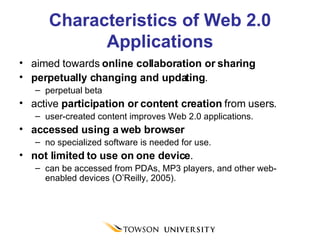
Characteristics of Web 2.0 Applications aimed towards  online collaboration or sharing perpetually changing and updating . perpetual beta active  participation or content creation  from users.  user-created content improves Web 2.0 applications. accessed using a web browser no specialized software is needed for use. not limited to use on one device .  can be accessed from PDAs, MP3 players, and other web-enabled devices (O’Reilly, 2005).
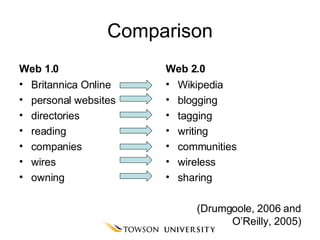
Comparison Web 1.0 Britannica Online  personal websites directories reading companies wires owning Web 2.0 Wikipedia blogging tagging writing communities wireless sharing (Drumgoole, 2006   and   O’Reilly, 2005)
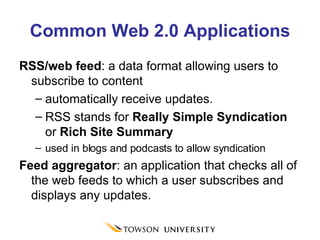
Common Web 2.0 Applications RSS/web feed : a data format allowing users to subscribe to content  automatically receive updates.  RSS stands for  Really Simple Syndication  or  Rich Site Summary used in blogs and podcasts to allow syndication Feed aggregator : an application that checks all of the web feeds to which a user subscribes and displays any updates.
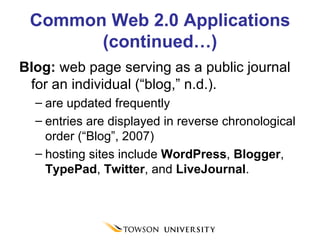
Common Web 2.0 Applications (continued…) Blog:  web page serving as a public journal for an individual (“blog,” n.d.).  are updated frequently  entries are displayed in reverse chronological order (“Blog”, 2007) hosting sites include  WordPress ,  Blogger ,  TypePad ,  Twitter , and  LiveJournal .
Common Web 2.0 Applications (continued…) Podcast:  a series of multimedia files (usually audio MP3 files) distributed over the Internet using subscription services (“Podcast,” 2007)  individual files called  episodes .  hosting and distribution sites include  Gabcast  and  Odeo .  distribution sites include  iTunes Podcast Directory  and  Podcast Alley .
Common Web 2.0 Applications (continued…) Podcatcher : an application that allows users to subscribe to and download podcasts. can play the podcast files on their computers or transfer the files to an MP3 player.  iTunes  and  Juice  are podcatchers.
Common Web 2.0 Applications (continued…) Wiki : a website permitting users to add, remove, and edit content (“Wiki,” 2007).  a tool for collaborative authoring. “ wiki” can refer to the software used to generate the website or to the website itself. most famous example of a wiki is  Wikipedia .
Common Web 2.0 Applications (continued…) File sharing services:  web-based service to store, share, tag, and search. Can share: Internet bookmarks ( del.icio.us, Furl ,  BlinkList ,  Shadows , and  clipmarks ) Photos ( Flickr ,  Slide , and  Zoto ) Video ( YouTube ,  Google Video ,  VideoEgg )
Common Web 2.0 Applications (continued…) Collaborative authoring:  allows users to write, revise, and comment on common office productivity files. Often saves various versions so users can track changes. Spreadsheets ( Google Spreadsheets ,  Zoho Sheet ) Word processing documents ( Google Docs ,  Zoho Writer ) Presentations ( Zoho Show ) Drawing ( gliffy )
Common Web 2.0 Applications (continued…) Other worthwhile apps: Digg:  users determine the content of the site by submitting, rating, and sharing content. Gabcast : users record audio files by phone or Voice over Internet Protocol. Omnidrive : online file storage available from any internet-connected device. Similar to  Xdrive  and  Avvenu . Splashcast:  create multimedia presentations using video, ppt, audio, text, images, and screencasts Wink:  allows you to capture your actions on your computer and create a movie file
Workshop Activities We will try 4-5 Web 2.0 applications ZohoShow  (collaborative office application) Google Docs  (collaborative office application) Google Reader  (RSS feed aggregator) Splashcast   (online multimedia creation) Wetpaint  (wiki) Accounts are already created.
Wiki Projects at UMCP French 306  – In groups, students drew up a description, business plan, ad campaign, and organizational structure for a fictional business.  https://wiki.math.umd.edu/arhu_fren306/Main_Page Theatre 290  – Instructor used a wiki to communicate class expectations and to add supplementary information that could not be covered in class.  https://wiki.math.umd.edu/arhu_thet290/Main_Page Women’s Studies 250  – Groups developed multiple entries on a chosen topic for the wiki.  https://wiki.math.umd.edu/arhu_wmst250/Main_Page
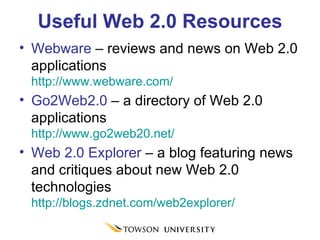
Useful Web 2.0 Resources Webware  – reviews and news on Web 2.0 applications http://www.webware.com/ Go2Web2.0  – a directory of Web 2.0 applications http://www.go2web20.net/ Web 2.0 Explorer  – a blog featuring news and critiques about new Web 2.0 technologies http://blogs.zdnet.com/web2explorer/

Web2 0

  • 1.
    Web 2.0 Whatis it? What can we do now?
  • 2.
    Objectives To definethe term Web 2.0 and related vocabulary To describe common features of Web 2.0 applications To identify common Web 2.0 applications To identify uses for Web 2.0 applications in education To use various Web 2.0 applications
  • 3.
    Web 2.0 aterm used to describe many recently popularized web applications such as YouTube , del.icio.us , and Flickr does not have a singular authoritative definition
  • 4.
    Characteristics of Web2.0 Applications aimed towards online collaboration or sharing perpetually changing and updating . perpetual beta active participation or content creation from users. user-created content improves Web 2.0 applications. accessed using a web browser no specialized software is needed for use. not limited to use on one device . can be accessed from PDAs, MP3 players, and other web-enabled devices (O’Reilly, 2005).
  • 5.
    Comparison Web 1.0Britannica Online personal websites directories reading companies wires owning Web 2.0 Wikipedia blogging tagging writing communities wireless sharing (Drumgoole, 2006 and O’Reilly, 2005)
  • 6.
    Common Web 2.0Applications RSS/web feed : a data format allowing users to subscribe to content automatically receive updates. RSS stands for Really Simple Syndication or Rich Site Summary used in blogs and podcasts to allow syndication Feed aggregator : an application that checks all of the web feeds to which a user subscribes and displays any updates.
  • 7.
    Common Web 2.0Applications (continued…) Blog: web page serving as a public journal for an individual (“blog,” n.d.). are updated frequently entries are displayed in reverse chronological order (“Blog”, 2007) hosting sites include WordPress , Blogger , TypePad , Twitter , and LiveJournal .
  • 8.
    Common Web 2.0Applications (continued…) Podcast: a series of multimedia files (usually audio MP3 files) distributed over the Internet using subscription services (“Podcast,” 2007) individual files called episodes . hosting and distribution sites include Gabcast and Odeo . distribution sites include iTunes Podcast Directory and Podcast Alley .
  • 9.
    Common Web 2.0Applications (continued…) Podcatcher : an application that allows users to subscribe to and download podcasts. can play the podcast files on their computers or transfer the files to an MP3 player. iTunes and Juice are podcatchers.
  • 10.
    Common Web 2.0Applications (continued…) Wiki : a website permitting users to add, remove, and edit content (“Wiki,” 2007). a tool for collaborative authoring. “ wiki” can refer to the software used to generate the website or to the website itself. most famous example of a wiki is Wikipedia .
  • 11.
    Common Web 2.0Applications (continued…) File sharing services: web-based service to store, share, tag, and search. Can share: Internet bookmarks ( del.icio.us, Furl , BlinkList , Shadows , and clipmarks ) Photos ( Flickr , Slide , and Zoto ) Video ( YouTube , Google Video , VideoEgg )
  • 12.
    Common Web 2.0Applications (continued…) Collaborative authoring: allows users to write, revise, and comment on common office productivity files. Often saves various versions so users can track changes. Spreadsheets ( Google Spreadsheets , Zoho Sheet ) Word processing documents ( Google Docs , Zoho Writer ) Presentations ( Zoho Show ) Drawing ( gliffy )
  • 13.
    Common Web 2.0Applications (continued…) Other worthwhile apps: Digg: users determine the content of the site by submitting, rating, and sharing content. Gabcast : users record audio files by phone or Voice over Internet Protocol. Omnidrive : online file storage available from any internet-connected device. Similar to Xdrive and Avvenu . Splashcast: create multimedia presentations using video, ppt, audio, text, images, and screencasts Wink: allows you to capture your actions on your computer and create a movie file
  • 14.
    Workshop Activities Wewill try 4-5 Web 2.0 applications ZohoShow (collaborative office application) Google Docs (collaborative office application) Google Reader (RSS feed aggregator) Splashcast (online multimedia creation) Wetpaint (wiki) Accounts are already created.
  • 15.
    Wiki Projects atUMCP French 306 – In groups, students drew up a description, business plan, ad campaign, and organizational structure for a fictional business. https://wiki.math.umd.edu/arhu_fren306/Main_Page Theatre 290 – Instructor used a wiki to communicate class expectations and to add supplementary information that could not be covered in class. https://wiki.math.umd.edu/arhu_thet290/Main_Page Women’s Studies 250 – Groups developed multiple entries on a chosen topic for the wiki. https://wiki.math.umd.edu/arhu_wmst250/Main_Page
  • 16.
    Useful Web 2.0Resources Webware – reviews and news on Web 2.0 applications http://www.webware.com/ Go2Web2.0 – a directory of Web 2.0 applications http://www.go2web20.net/ Web 2.0 Explorer – a blog featuring news and critiques about new Web 2.0 technologies http://blogs.zdnet.com/web2explorer/