Web Services Overview Francisco Curbera IBM T.J. Watson Research Center
Outline Why Web Services? The Web Services Computing Stack. Summary.
1. Why Web Services?
Today’s Web Web designed for application to human interactions Served very well its purpose: Information sharing: a distributed content library.  Enabled B2C e-commerce. Non-automated B2B interactions. How did it happen? Built on very few standards: http + html Shallow interaction model: very few assumptions made about computing platforms. Result was ubiquity.
What’s next? The Web is everywhere. There is a lot more we can do! E-marketplaces. Open, automated B2B e-commerce. Business process integration on the Web. Resource sharing, distributed computing.  Current approach is  ad-hoc  on top of existing standards. e.g., application-to-application interactions with HTML forms.  Goal:  enabling systematic application-to-application interaction on the Web.
Web Services “Web services” is an effort to build a distributed computing platform for the Web. Yet another one!
Designing Web Services I Goals Enable universal interoperability. Widespread adoption, ubiquity: fast! Compare with the good but still limited adoption of the OMG’s OMA.  Enable (Internet scale) dynamic binding. Support a service oriented architecture (SOA). Efficiently support both open (Web) and more constrained environments.
Designing Web Services II Requirements Based on standards. Pervasive support is critical.  Minimal amount of required infrastructure is assumed. Only a minimal set of standards must be implemented. Very low level of application integration is expected. But may be increased in a flexible way.  Focuses on messages and documents, not on APIs.
Web Services Model Web service applications are encapsulated, loosely coupled Web “components” that can bind dynamically to each other
2. The Web Services Framework
Web Services Framework Framework can be described in terms of What goes “on the wire”:  Formats and protocols . What describes what goes on the wire: Description languages. What allows us to find these descriptions: Discovery of services.
XML Messaging: SOAP SOAP 1.1 defined: An XML envelope for XML messaging, Headers + body An HTTP binding for SOAP messaging. SOAP is “transport independent”. A convention for doing RPC. An XML serialization format for structured data SOAP Attachments adds How to carry and reference data attachments using in a MIME envelope and a SOAP envelope.
The SOAP Envelope <SOAP-ENV:Envelope  xmlns=&quot;http://schemas.xmlsoap.org/soap/envelope/&quot;> < SOAP-ENV:Header> ... </ SOAP-ENV:Header> < SOAP-ENV:Body> ... </ SOAP-ENV:Body> ... </ SOAP-ENV: Envelope>
What goes on the wire Internet-scale integration needs a  lingua-franca XML messaging protocol over HTTP: SOAP Intra-enterprise  integration needs to allow alternates: CORBA, RMI Messaging In-memory method calls SOAP  Security Attachments Reliability Routing Transactions Context W3C
Descriptions: Meta-data Integration requires interoperable machine-understandable descriptions Enables dynamic, delayed binding of components.  Language extensibility provides support for different levels of application integration. Interface Service QoS  Service Public Flows Flows and Composition Agreements WSDL WSFL XML Schema
Web Services Description Language Provides functional description of network services:  IDL description Protocol and deployment details Platform independent description.  Extensible language. A short history: WSDL v1.0, 9/2000 WSDL v1.1 submitted to W3C 3/2001. A  de facto  industry standard.
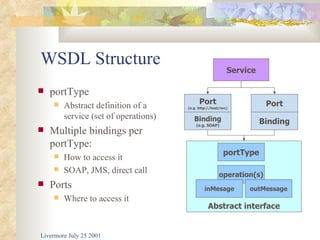
WSDL Structure portType Abstract definition of a service (set of operations) Multiple bindings per portType: How to access it SOAP, JMS, direct call Ports Where to access it Service Port (e.g. http://host/svc) Binding (e.g. SOAP) Abstract interface portType operation(s) inMesage outMessage Port Binding
Using WSDL As extended IDL: WSDL allows tools to generate compatible client and server stubs. Tool support for top-down, bottom-up and “meet in the middle” development. Allows industries to define standardized service interfaces. Allows advertisement of service descriptions, enables dynamic discovery and binding of compatible services.  Used in conjunction with UDDI registry Provides a normalized description of heterogeneous applications.
Client invocation Single stub can invoke services over different bindings Depends only on abstract interface. Are independent of binding (but pluggable). Add new bindings without recompiling/redeploying stub Allows optimisations  based on the bindings of service. Will support extended  services models if described In WSDL Client Proxy  object RMI- IIOP JMS/ MQ SOAP/ HTTP
WSFL Overview WSFL describes Web Service compositions. Usage patterns of Web Services: describes  workflow or business processes . Interaction patterns: describes  overall partner interactions . [ WS] [ WS] A B C
WSFL Flow Models Activities represent  units of processing. Flow of data is modeled through data links.  [ WS] Activities can be mapped to the flow interface Control links define execution flow as a directed acyclic graph Activities are associated with specific typed  service providers
Using Flow Models “ Public flows” provide a representation of the service behavior as required by its users. Typically, an abstraction of the actual flow begin executed Defines a “behavioral contract” for the service. Internal implementation need not be flow-based. Flows are reusable: specify components types, but not what specific services should be used! “ Private flows” are the flows executed in practice.  WSFL serves as a “portable flow implementation language” Same language is used in WSFL to represent both types of processes.
Global Models Global models describe how the composed Web Services interact.  RosettaNet automated. Like an ADL. Interactions are modeled as links between endpoints of two service interfaces (WSDL operations). An essentially distributed description of the interaction.  A B C
Discovery: Finding Meta-data Static binding requires service “libraries”. Dynamic binding requires runtime discovery of meta-data Inspection Directory ADS, DISCO UDDI
UDDI Overview UDDI defines the operation of a service registry: Data structures for registering Businesses Technical specifications: tModel is a keyed reference to a technical specification. Service and service endpoints: referencing the supported tModels SOAP Access API Rules for the operation of a global registry “ private” UDDI nodes are likely to appear, though.
UDDI Relationships Web Service Web Service SIC CODE NAICS DUNS Numbers Thomas Registry ID Rosetta-Net BASDA Simple.Buy Schemas, Interchange specification businessEntity businessEntity businessEntity businessService businessService bindingTemplate bindingTemplate InstanceDetails InstanceDetails categoryBag keyedReference keyedReference identifierBag keyedReference keyedReference tModels
3. Summary
Summary The Web services framework is being defined, standardized and supported by the industry at a record pace. Broad industry acceptance and standard compliance will make it ubiquitous. Will bring an unprecedented  level of interoperability to  Web applications. The benefits of Web services, however, are not limited to the Web!
For more information SOAP http://www.w3c.org/TR/soap WSDL  http://www.w3c.org/TR/wsdl UDDI http://www.uddi.org WSFL http://www.ibm.com/software/webservices Me:  mailto:curbera@us.ibm.com

webservices overview

  • 1.
    Web Services OverviewFrancisco Curbera IBM T.J. Watson Research Center
  • 2.
    Outline Why WebServices? The Web Services Computing Stack. Summary.
  • 3.
    1. Why WebServices?
  • 4.
    Today’s Web Webdesigned for application to human interactions Served very well its purpose: Information sharing: a distributed content library. Enabled B2C e-commerce. Non-automated B2B interactions. How did it happen? Built on very few standards: http + html Shallow interaction model: very few assumptions made about computing platforms. Result was ubiquity.
  • 5.
    What’s next? TheWeb is everywhere. There is a lot more we can do! E-marketplaces. Open, automated B2B e-commerce. Business process integration on the Web. Resource sharing, distributed computing. Current approach is ad-hoc on top of existing standards. e.g., application-to-application interactions with HTML forms. Goal: enabling systematic application-to-application interaction on the Web.
  • 6.
    Web Services “Webservices” is an effort to build a distributed computing platform for the Web. Yet another one!
  • 7.
    Designing Web ServicesI Goals Enable universal interoperability. Widespread adoption, ubiquity: fast! Compare with the good but still limited adoption of the OMG’s OMA. Enable (Internet scale) dynamic binding. Support a service oriented architecture (SOA). Efficiently support both open (Web) and more constrained environments.
  • 8.
    Designing Web ServicesII Requirements Based on standards. Pervasive support is critical. Minimal amount of required infrastructure is assumed. Only a minimal set of standards must be implemented. Very low level of application integration is expected. But may be increased in a flexible way. Focuses on messages and documents, not on APIs.
  • 9.
    Web Services ModelWeb service applications are encapsulated, loosely coupled Web “components” that can bind dynamically to each other
  • 10.
    2. The WebServices Framework
  • 11.
    Web Services FrameworkFramework can be described in terms of What goes “on the wire”: Formats and protocols . What describes what goes on the wire: Description languages. What allows us to find these descriptions: Discovery of services.
  • 12.
    XML Messaging: SOAPSOAP 1.1 defined: An XML envelope for XML messaging, Headers + body An HTTP binding for SOAP messaging. SOAP is “transport independent”. A convention for doing RPC. An XML serialization format for structured data SOAP Attachments adds How to carry and reference data attachments using in a MIME envelope and a SOAP envelope.
  • 13.
    The SOAP Envelope<SOAP-ENV:Envelope xmlns=&quot;http://schemas.xmlsoap.org/soap/envelope/&quot;> < SOAP-ENV:Header> ... </ SOAP-ENV:Header> < SOAP-ENV:Body> ... </ SOAP-ENV:Body> ... </ SOAP-ENV: Envelope>
  • 14.
    What goes onthe wire Internet-scale integration needs a lingua-franca XML messaging protocol over HTTP: SOAP Intra-enterprise integration needs to allow alternates: CORBA, RMI Messaging In-memory method calls SOAP Security Attachments Reliability Routing Transactions Context W3C
  • 15.
    Descriptions: Meta-data Integrationrequires interoperable machine-understandable descriptions Enables dynamic, delayed binding of components. Language extensibility provides support for different levels of application integration. Interface Service QoS Service Public Flows Flows and Composition Agreements WSDL WSFL XML Schema
  • 16.
    Web Services DescriptionLanguage Provides functional description of network services: IDL description Protocol and deployment details Platform independent description. Extensible language. A short history: WSDL v1.0, 9/2000 WSDL v1.1 submitted to W3C 3/2001. A de facto industry standard.
  • 17.
    WSDL Structure portTypeAbstract definition of a service (set of operations) Multiple bindings per portType: How to access it SOAP, JMS, direct call Ports Where to access it Service Port (e.g. http://host/svc) Binding (e.g. SOAP) Abstract interface portType operation(s) inMesage outMessage Port Binding
  • 18.
    Using WSDL Asextended IDL: WSDL allows tools to generate compatible client and server stubs. Tool support for top-down, bottom-up and “meet in the middle” development. Allows industries to define standardized service interfaces. Allows advertisement of service descriptions, enables dynamic discovery and binding of compatible services. Used in conjunction with UDDI registry Provides a normalized description of heterogeneous applications.
  • 19.
    Client invocation Singlestub can invoke services over different bindings Depends only on abstract interface. Are independent of binding (but pluggable). Add new bindings without recompiling/redeploying stub Allows optimisations based on the bindings of service. Will support extended services models if described In WSDL Client Proxy object RMI- IIOP JMS/ MQ SOAP/ HTTP
  • 20.
    WSFL Overview WSFLdescribes Web Service compositions. Usage patterns of Web Services: describes workflow or business processes . Interaction patterns: describes overall partner interactions . [ WS] [ WS] A B C
  • 21.
    WSFL Flow ModelsActivities represent units of processing. Flow of data is modeled through data links. [ WS] Activities can be mapped to the flow interface Control links define execution flow as a directed acyclic graph Activities are associated with specific typed service providers
  • 22.
    Using Flow Models“ Public flows” provide a representation of the service behavior as required by its users. Typically, an abstraction of the actual flow begin executed Defines a “behavioral contract” for the service. Internal implementation need not be flow-based. Flows are reusable: specify components types, but not what specific services should be used! “ Private flows” are the flows executed in practice. WSFL serves as a “portable flow implementation language” Same language is used in WSFL to represent both types of processes.
  • 23.
    Global Models Globalmodels describe how the composed Web Services interact. RosettaNet automated. Like an ADL. Interactions are modeled as links between endpoints of two service interfaces (WSDL operations). An essentially distributed description of the interaction. A B C
  • 24.
    Discovery: Finding Meta-dataStatic binding requires service “libraries”. Dynamic binding requires runtime discovery of meta-data Inspection Directory ADS, DISCO UDDI
  • 25.
    UDDI Overview UDDIdefines the operation of a service registry: Data structures for registering Businesses Technical specifications: tModel is a keyed reference to a technical specification. Service and service endpoints: referencing the supported tModels SOAP Access API Rules for the operation of a global registry “ private” UDDI nodes are likely to appear, though.
  • 26.
    UDDI Relationships WebService Web Service SIC CODE NAICS DUNS Numbers Thomas Registry ID Rosetta-Net BASDA Simple.Buy Schemas, Interchange specification businessEntity businessEntity businessEntity businessService businessService bindingTemplate bindingTemplate InstanceDetails InstanceDetails categoryBag keyedReference keyedReference identifierBag keyedReference keyedReference tModels
  • 27.
  • 28.
    Summary The Webservices framework is being defined, standardized and supported by the industry at a record pace. Broad industry acceptance and standard compliance will make it ubiquitous. Will bring an unprecedented level of interoperability to Web applications. The benefits of Web services, however, are not limited to the Web!
  • 29.
    For more informationSOAP http://www.w3c.org/TR/soap WSDL http://www.w3c.org/TR/wsdl UDDI http://www.uddi.org WSFL http://www.ibm.com/software/webservices Me: mailto:curbera@us.ibm.com