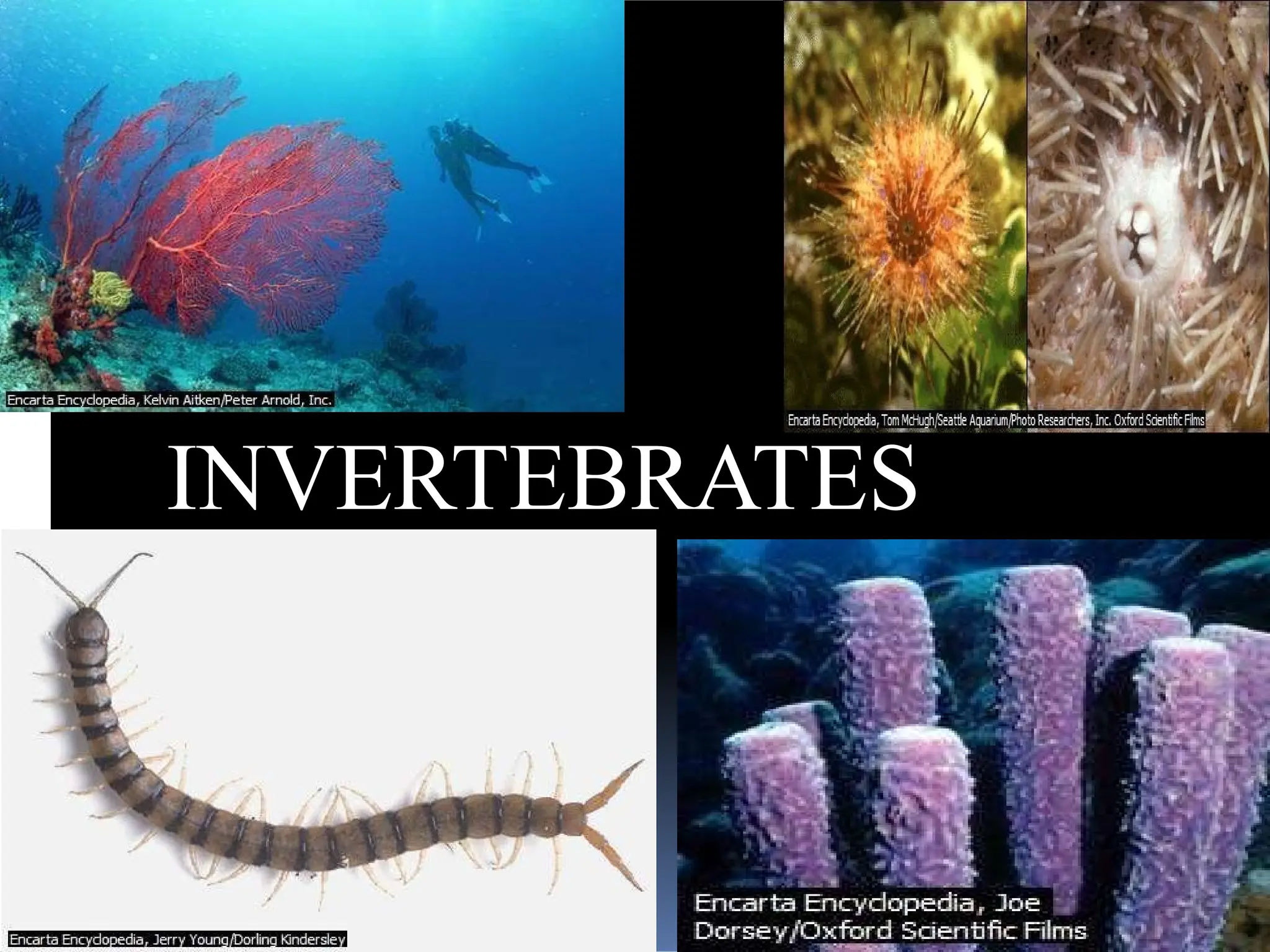
INVERTEBRATES
INTRODUCTION
1. In order to study animals more easily, scientists
divide them into two major groups.
2. Animals with backbones are called vertebrates and
animals without backbones are called invertebrates.
3. Invertebrates live almost everywhere on Earth.
Invertebrates make up 97% of all animals.
4. Invertebrates are classified into several smaller
groups. Animals that have many of the same
characteristics, or traits, are classified in the same
group.
RECAP:
VERTEBRATES
1. Animals with backbones
2. Five groups: Mammals, Birds, Reptiles, Amphibians,
and Fishes
3. Cold-blooded: these animals take on the
temperature of their surroundings. They are hot
when their environment is hot, and cold when their
environment is cold.
4. Warm-blooded: these animals try to keep the
inside of their bodies at a constant temperature.
They do this by generating their own heat when they
are in a cooler environment, and by cooling themselves
when they are in a hotter environment.
INVERTEBRATES
1. Animals without backbones
2. More than three out of every four animals on
Earth is an invertebrate
3. Most invertebrates have exoskeletons (hard
outer covering that protects an animal’s body and
gives the animal support)
4. Simple Invertebrates, Mollusks, Echinoderms, and
Arthropods are four major groups of invertebrates.
5. Some invertebrate groups include: insects,
spiders, mollusks, sponges, spiny-skinned animals,
and worms.
INVERTEBRAT
ES
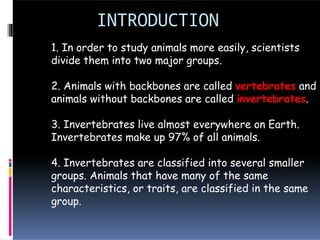
1. ECHINODERMS
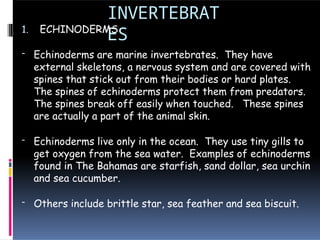
- Echinoderms are marine invertebrates. They have
external skeletons, a nervous system and are covered with
spines that stick out from their bodies or hard plates.
The spines of echinoderms protect them from predators.
The spines break off easily when touched. These spines
are actually a part of the animal skin.
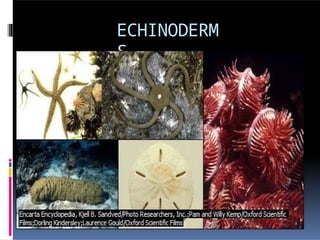
- Echinoderms live only in the ocean. They use tiny gills to
get oxygen from the sea water. Examples of echinoderms
found in The Bahamas are starfish, sand dollar, sea urchin
and sea cucumber.
- Others include brittle star, sea feather and sea biscuit.
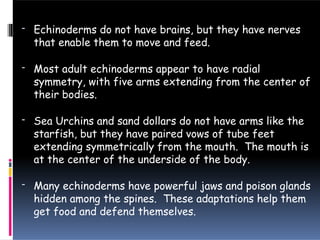
- Echinoderms do not have brains, but they have nerves
that enable them to move and feed.
- Most adult echinoderms appear to have radial
symmetry, with five arms extending from the center of
their bodies.
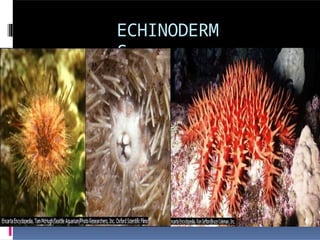
- Sea Urchins and sand dollars do not have arms like the
starfish, but they have paired vows of tube feet
extending symmetrically from the mouth. The mouth is
at the center of the underside of the body.
- Many echinoderms have powerful jaws and poison glands
hidden among the spines. These adaptations help them
get food and defend themselves.
ECHINODERM
S
ECHINODERM
S
INVERTEBRAT
ES
2. ARTHOPODS
- Divided into four groups: Crustaceans, Insects, Arachnids
(Spiders), and Myriapods
- They have a pair of 3 or more jointed legs
- They have an exoskeleton or hard outer body covering made
up of chitin
- The largest phylum in the Animal Kingdom
ARTHOPODS: Crustaceans
- Arthropods that have two body sections and
two pairs of antennas are called crustaceans.
They include invertebrates such as lobster,
shrimp, crab, krill, spiny lobster, and soldier
crab.
- The hard outer covering of these animals is
called an exoskeleton. The exoskeleton
protects the organs inside the animal’s body.
It also prevents the loss of water from the
body.
- The skeleton does not grow, it molts. To molt
means to shed the outer body covering.
ARTHOPODS: Crustaceans
- Crustaceans use gills to breathe and they reproduce by laying
eggs. The eggs are laid in water and young crustaceans that
hatch do not look like the adult. As they grow, their bodies
change until they resemble the adult. Most crustaceans
spend all their time in water, but some crabs live all their
adult lives on land.
- CRABS
Crabs are the most common land crustaceans found in The
Bahamas. The largest crab population is found in Andros.
Black and pond crabs are used for food.
- THE SPINY LOBSTER
The spiny lobster is also a crustacean. The spiny
lobster and crab are sold locally but the spiny lobster is an
Export – sold abroad to help bring money into The Bahamian
economy. The spiny lobster is protected by law and can only be
captured during the crawfish season August 1st to March
31st.
- Have 3 pairs of legs (6 legs)
- One pair of antennae
- Body divided into 3 parts: head, thorax,
abdomen
- Have 1 or 2 pairs of wings
ARTHOPODS: Insects
Ex. Grasshoppers, ants, fleas, locusts, beetles, bee, butterfly
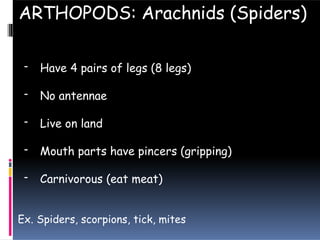
- Have 4 pairs of legs (8 legs)
- No antennae
- Live on land
- Mouth parts have pincers (gripping)
- Carnivorous (eat meat)
ARTHOPODS: Arachnids (Spiders)
Ex. Spiders, scorpions, tick, mites
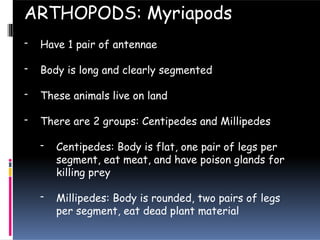
- Have 1 pair of antennae
- Body is long and clearly segmented
- These animals live on land
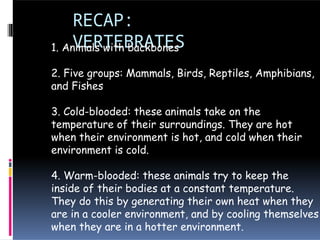
- There are 2 groups: Centipedes and Millipedes
- Centipedes: Body is flat, one pair of legs per
segment, eat meat, and have poison glands for
killing prey
- Millipedes: Body is rounded, two pairs of legs
per segment, eat dead plant material
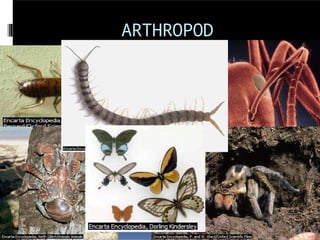
ARTHOPODS: Myriapods
ARTHROPOD
S
INVERTEBRAT
ES
3. MOLLUSK
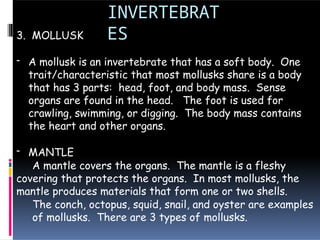
- A mollusk is an invertebrate that has a soft body. One
trait/characteristic that most mollusks share is a body
that has 3 parts: head, foot, and body mass. Sense
organs are found in the head. The foot is used for
crawling, swimming, or digging. The body mass contains
the heart and other organs.
- MANTLE
A mantle covers the organs. The mantle is a fleshy
covering that protects the organs. In most mollusks, the
mantle produces materials that form one or two shells.
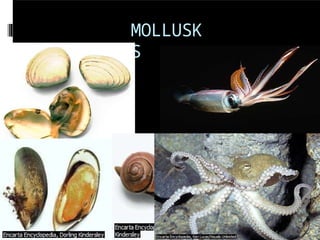
The conch, octopus, squid, snail, and oyster are examples
of mollusks. There are 3 types of mollusks.
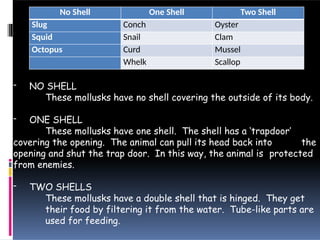
- NO SHELL
These mollusks have no shell covering the outside of its body.
- ONE SHELL
These mollusks have one shell. The shell has a ‘trapdoor’
covering the opening. The animal can pull its head back into the
opening and shut the trap door. In this way, the animal is protected
from enemies.
- TWO SHELLS
These mollusks have a double shell that is hinged. They get
their food by filtering it from the water. Tube-like parts are
used for feeding.
No Shell One Shell Two Shell
Slug Conch Oyster
Squid Snail Clam
Octopus Curd Mussel
Whelk Scallop
- The queen conch is one of the
largest marine snails. It is used for
food. It feeds on algae found on
seaweed, sand and floating organic
debris.
- The queen conch also has an
important cultural and economic
role in The Bahamas. It is
vulnerable to over fishing because
it matures and moves slowly.
MOLLUSK
S
INVERTEBRAT
ES
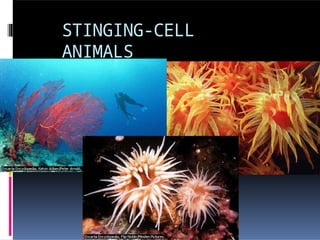
4. STINGING-CELL ANIMALS
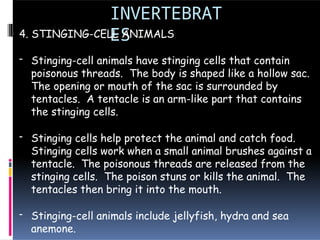
- Stinging-cell animals have stinging cells that contain
poisonous threads. The body is shaped like a hollow sac.
The opening or mouth of the sac is surrounded by
tentacles. A tentacle is an arm-like part that contains
the stinging cells.
- Stinging cells help protect the animal and catch food.
Stinging cells work when a small animal brushes against a
tentacle. The poisonous threads are released from the
stinging cells. The poison stuns or kills the animal. The
tentacles then bring it into the mouth.
- Stinging-cell animals include jellyfish, hydra and sea
anemone.
STINGING-CELL
ANIMALS
INVERTEBRAT
ES
5. Segmented Worms
- Segmented Worms have bodies in sections
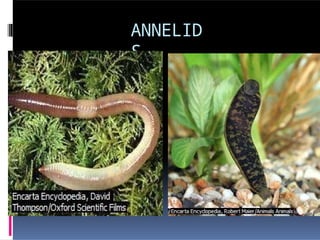
- The earth worm and leech are segmented worms. Their
bodies are in sections. The earthworm lives in the soil. It
makes the soil soft, and also enriches the soil with its waste
which comes from the dead leaves that it eats.
- The leech is a parasite which sucks blood.
Ex. Earthworms, leech, ragworms, tubeworms
ANNELID
S
INVERTEBRAT
ES
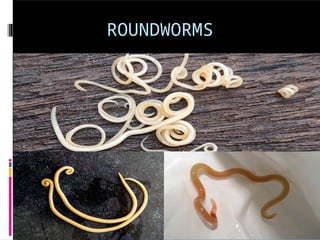
6. Round Worms
- Round Worms have round tube-like bodies with two body
openings. At one end, food is taken in and at the other
end, waste is passed out.
- A round worm has a nervous system with a brain and other
sense organs.
- Hook worms are round worms. They are parasites.
- Some round worms live in animals and can pass into
humans if they eat meat that is not properly cooked.
Ex. Ascaris (Human Roundworm), hookworm
ROUNDWORMS
INVERTEBRAT
ES
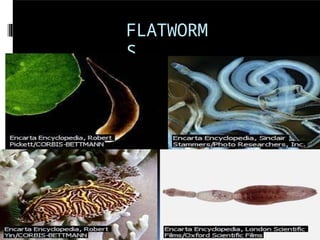
7. Flatworms
- Flatworms have a flattened body, a digestive system, and one
body opening.
- Planarians, tapeworms, and flukes are flatworms. The planarian
is not a common worm.
- They have a triangular-shaped head and eye spots on the head.
They re-grow parts. If a planarian is cut into two pieces, the
head part will grow a tail and the tail part will grow a head.
- All parasitic worms lay eggs. Tapeworms lay eggs in the
digestive system of the host. If these eggs burrow
themselves into tissues in our brains, hearts, or kidneys, they
will kill us.
Ex. Planarian, liver fluke, tapeworm, fresh water flatworm
FLATWORM
S
INVERTEBRAT
ES
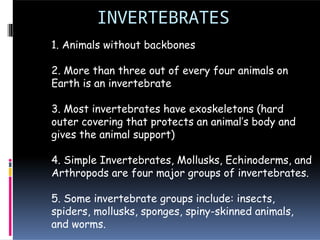
8. SPONGES
- Sponges are marine animals. They usually remain
anchored in one place all their lives.
- Sponges are filter feeders (they filter tiny particles of
food from the water).
- A sponge has only two layers of cells. The outer
covering of the sponge’s body is covered with tiny holes
called pores. These pores lead to canals which are
made up of specialized cells with whip like structures
that beat rapidly. This motion helps to purify water
into canals. Thread like structures remove the tiny
pieces of food from the water. The water then flows
out through an opening called a vent.
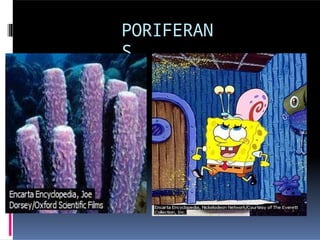
- Sponges have needle like parts that give them shape.
Different species of sponges have different colors,
shapes and sizes.
- Sponges are found on reefs in The Bahamas. At one
time, Bahamian fishermen harvested sponges which
were sold to foreign countries where sponges were
processed into a variety of household items that could
be used for decorations and bathing.
- At that time the sponging industry was the most
important economic activity in The Bahamas.
PORIFERAN
S

Invertebrates (Primary School) PowerPoint Presentation

  • 1.
  • 2.
    INTRODUCTION 1. In orderto study animals more easily, scientists divide them into two major groups. 2. Animals with backbones are called vertebrates and animals without backbones are called invertebrates. 3. Invertebrates live almost everywhere on Earth. Invertebrates make up 97% of all animals. 4. Invertebrates are classified into several smaller groups. Animals that have many of the same characteristics, or traits, are classified in the same group.
  • 3.
    RECAP: VERTEBRATES 1. Animals withbackbones 2. Five groups: Mammals, Birds, Reptiles, Amphibians, and Fishes 3. Cold-blooded: these animals take on the temperature of their surroundings. They are hot when their environment is hot, and cold when their environment is cold. 4. Warm-blooded: these animals try to keep the inside of their bodies at a constant temperature. They do this by generating their own heat when they are in a cooler environment, and by cooling themselves when they are in a hotter environment.
  • 4.
    INVERTEBRATES 1. Animals withoutbackbones 2. More than three out of every four animals on Earth is an invertebrate 3. Most invertebrates have exoskeletons (hard outer covering that protects an animal’s body and gives the animal support) 4. Simple Invertebrates, Mollusks, Echinoderms, and Arthropods are four major groups of invertebrates. 5. Some invertebrate groups include: insects, spiders, mollusks, sponges, spiny-skinned animals, and worms.
  • 5.
    INVERTEBRAT ES 1. ECHINODERMS - Echinodermsare marine invertebrates. They have external skeletons, a nervous system and are covered with spines that stick out from their bodies or hard plates. The spines of echinoderms protect them from predators. The spines break off easily when touched. These spines are actually a part of the animal skin. - Echinoderms live only in the ocean. They use tiny gills to get oxygen from the sea water. Examples of echinoderms found in The Bahamas are starfish, sand dollar, sea urchin and sea cucumber. - Others include brittle star, sea feather and sea biscuit.
  • 6.
    - Echinoderms donot have brains, but they have nerves that enable them to move and feed. - Most adult echinoderms appear to have radial symmetry, with five arms extending from the center of their bodies. - Sea Urchins and sand dollars do not have arms like the starfish, but they have paired vows of tube feet extending symmetrically from the mouth. The mouth is at the center of the underside of the body. - Many echinoderms have powerful jaws and poison glands hidden among the spines. These adaptations help them get food and defend themselves.
  • 7.
  • 8.
  • 9.
    INVERTEBRAT ES 2. ARTHOPODS - Dividedinto four groups: Crustaceans, Insects, Arachnids (Spiders), and Myriapods - They have a pair of 3 or more jointed legs - They have an exoskeleton or hard outer body covering made up of chitin - The largest phylum in the Animal Kingdom
  • 10.
    ARTHOPODS: Crustaceans - Arthropodsthat have two body sections and two pairs of antennas are called crustaceans. They include invertebrates such as lobster, shrimp, crab, krill, spiny lobster, and soldier crab. - The hard outer covering of these animals is called an exoskeleton. The exoskeleton protects the organs inside the animal’s body. It also prevents the loss of water from the body. - The skeleton does not grow, it molts. To molt means to shed the outer body covering.
  • 11.
    ARTHOPODS: Crustaceans - Crustaceansuse gills to breathe and they reproduce by laying eggs. The eggs are laid in water and young crustaceans that hatch do not look like the adult. As they grow, their bodies change until they resemble the adult. Most crustaceans spend all their time in water, but some crabs live all their adult lives on land. - CRABS Crabs are the most common land crustaceans found in The Bahamas. The largest crab population is found in Andros. Black and pond crabs are used for food. - THE SPINY LOBSTER The spiny lobster is also a crustacean. The spiny lobster and crab are sold locally but the spiny lobster is an Export – sold abroad to help bring money into The Bahamian economy. The spiny lobster is protected by law and can only be captured during the crawfish season August 1st to March 31st.
  • 12.
    - Have 3pairs of legs (6 legs) - One pair of antennae - Body divided into 3 parts: head, thorax, abdomen - Have 1 or 2 pairs of wings ARTHOPODS: Insects Ex. Grasshoppers, ants, fleas, locusts, beetles, bee, butterfly
  • 13.
    - Have 4pairs of legs (8 legs) - No antennae - Live on land - Mouth parts have pincers (gripping) - Carnivorous (eat meat) ARTHOPODS: Arachnids (Spiders) Ex. Spiders, scorpions, tick, mites
  • 14.
    - Have 1pair of antennae - Body is long and clearly segmented - These animals live on land - There are 2 groups: Centipedes and Millipedes - Centipedes: Body is flat, one pair of legs per segment, eat meat, and have poison glands for killing prey - Millipedes: Body is rounded, two pairs of legs per segment, eat dead plant material ARTHOPODS: Myriapods
  • 15.
  • 16.
    INVERTEBRAT ES 3. MOLLUSK - Amollusk is an invertebrate that has a soft body. One trait/characteristic that most mollusks share is a body that has 3 parts: head, foot, and body mass. Sense organs are found in the head. The foot is used for crawling, swimming, or digging. The body mass contains the heart and other organs. - MANTLE A mantle covers the organs. The mantle is a fleshy covering that protects the organs. In most mollusks, the mantle produces materials that form one or two shells. The conch, octopus, squid, snail, and oyster are examples of mollusks. There are 3 types of mollusks.
  • 17.
    - NO SHELL Thesemollusks have no shell covering the outside of its body. - ONE SHELL These mollusks have one shell. The shell has a ‘trapdoor’ covering the opening. The animal can pull its head back into the opening and shut the trap door. In this way, the animal is protected from enemies. - TWO SHELLS These mollusks have a double shell that is hinged. They get their food by filtering it from the water. Tube-like parts are used for feeding. No Shell One Shell Two Shell Slug Conch Oyster Squid Snail Clam Octopus Curd Mussel Whelk Scallop
  • 18.
    - The queenconch is one of the largest marine snails. It is used for food. It feeds on algae found on seaweed, sand and floating organic debris. - The queen conch also has an important cultural and economic role in The Bahamas. It is vulnerable to over fishing because it matures and moves slowly.
  • 19.
  • 20.
    INVERTEBRAT ES 4. STINGING-CELL ANIMALS -Stinging-cell animals have stinging cells that contain poisonous threads. The body is shaped like a hollow sac. The opening or mouth of the sac is surrounded by tentacles. A tentacle is an arm-like part that contains the stinging cells. - Stinging cells help protect the animal and catch food. Stinging cells work when a small animal brushes against a tentacle. The poisonous threads are released from the stinging cells. The poison stuns or kills the animal. The tentacles then bring it into the mouth. - Stinging-cell animals include jellyfish, hydra and sea anemone.
  • 21.
  • 22.
    INVERTEBRAT ES 5. Segmented Worms -Segmented Worms have bodies in sections - The earth worm and leech are segmented worms. Their bodies are in sections. The earthworm lives in the soil. It makes the soil soft, and also enriches the soil with its waste which comes from the dead leaves that it eats. - The leech is a parasite which sucks blood. Ex. Earthworms, leech, ragworms, tubeworms
  • 23.
  • 24.
    INVERTEBRAT ES 6. Round Worms -Round Worms have round tube-like bodies with two body openings. At one end, food is taken in and at the other end, waste is passed out. - A round worm has a nervous system with a brain and other sense organs. - Hook worms are round worms. They are parasites. - Some round worms live in animals and can pass into humans if they eat meat that is not properly cooked. Ex. Ascaris (Human Roundworm), hookworm
  • 25.
  • 26.
    INVERTEBRAT ES 7. Flatworms - Flatwormshave a flattened body, a digestive system, and one body opening. - Planarians, tapeworms, and flukes are flatworms. The planarian is not a common worm. - They have a triangular-shaped head and eye spots on the head. They re-grow parts. If a planarian is cut into two pieces, the head part will grow a tail and the tail part will grow a head. - All parasitic worms lay eggs. Tapeworms lay eggs in the digestive system of the host. If these eggs burrow themselves into tissues in our brains, hearts, or kidneys, they will kill us. Ex. Planarian, liver fluke, tapeworm, fresh water flatworm
  • 27.
  • 28.
    INVERTEBRAT ES 8. SPONGES - Spongesare marine animals. They usually remain anchored in one place all their lives. - Sponges are filter feeders (they filter tiny particles of food from the water). - A sponge has only two layers of cells. The outer covering of the sponge’s body is covered with tiny holes called pores. These pores lead to canals which are made up of specialized cells with whip like structures that beat rapidly. This motion helps to purify water into canals. Thread like structures remove the tiny pieces of food from the water. The water then flows out through an opening called a vent.
  • 29.
    - Sponges haveneedle like parts that give them shape. Different species of sponges have different colors, shapes and sizes. - Sponges are found on reefs in The Bahamas. At one time, Bahamian fishermen harvested sponges which were sold to foreign countries where sponges were processed into a variety of household items that could be used for decorations and bathing. - At that time the sponging industry was the most important economic activity in The Bahamas.
  • 30.