SARAJEVO, 27.10.2014 
Agile Secure Development 
Petter Sandholdt 
-How to make the agile team work with security requirements
Who am I? 
Petter Sandholdt 
-Senior Developer 
-Senior Security Consultant 
-Java, C, C++, C#, Cocoa, Erlang, PHP, Pike, Ruby, Cobol, Fortran, Lisp 
-Security in R&D for last 6 years 
... in agile teams the last 5 years
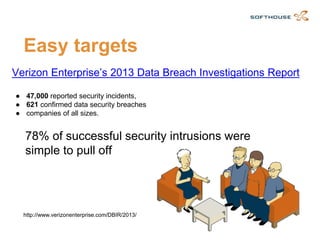
Easy targets 
Verizon Enterprise’s 2013 Data Breach Investigations Report 
●47,000reported security incidents, 
●621confirmed data security breaches 
●companies of all sizes. 
http://www.verizonenterprise.com/DBIR/2013/ 
78% of successful security intrusions were simple to pull off
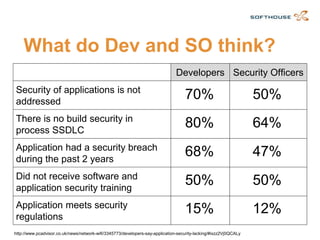
What do Dev and SO think? 
http://www.pcadvisor.co.uk/news/network-wifi/3345773/developers-say-application-security-lacking/#ixzz2Vj0QCALy 
Developers 
Security Officers 
Security of applications is not addressed 
There is no build security in process SSDLC 
Application had a security breach during the past 2 years 
Did not receive software and application security training 
Application meets security regulations 
70% 
50% 
80% 
64% 
68% 
47% 
50% 
50% 
15% 
12%
Agile application ≠ Secure? 
Agile moto: 
●Do what’s in the sprint 
XP moto: 
●Never do more that what’s required 
TDD moto: 
●Code until its green
Agile application = Secure? 
REQS 
CODE
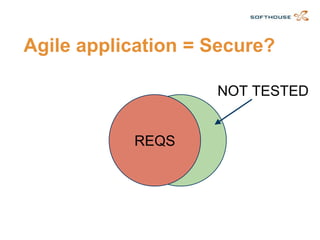
Agile application = Secure? 
CODE 
REQS 
NOT TESTED
When is an application secure? 
●Requires hard-to-guess passwords? 
●Has input validation? 
●Has up-to-date and hardened 3rd-party libraries? 
●The one that fulfills the security requirementsof the application
How can the POs know about security? 
POs are OWNERSin that role decide what is important for this application. 
●Deployability (Architects or Operations) 
●Performance (Architects,Testers & DBA) 
●How to code it (Developers)
Secure Software Development Life Cycles 
●Microsoft SDL 
●Adobe SPLC 
●CLASP 
●Cigital Touchpoints
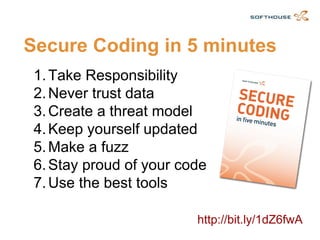
Secure Coding in 5 minutes 
1.Take Responsibility 
2.Never trust data 
3.Create a threat model 
4.Keep yourself updated 
5.Make a fuzz 
6.Stay proud of your code 
7.Use the best tools 
http://bit.ly/1dZ6fwA
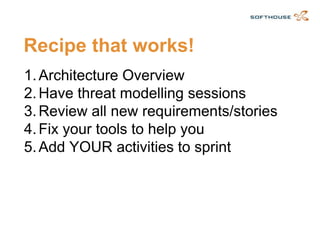
Recipe that works! 
1.Architecture Overview 
2.Have threat modelling sessions 
3.Review all new requirements/stories 
4.Fix your tools to help you 
5.Add YOUR activities to sprint
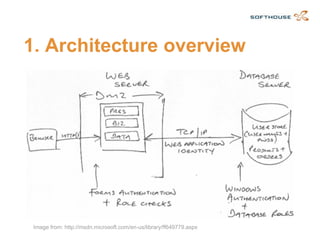
1. Architecture overview
1. Architecture overview 
Image from: http://msdn.microsoft.com/en-us/library/ff649779.aspx
Data-Flow-Diagrams are great
Agile??? 
WTF! More artifacts! Not on my watch! 
-Helps collaboration-Find discrepancies-Creates ONE terminology
2. Threat Modeling session 
●First session 
○Brainstorming 
●Following sessions 
○Discussions aroundadded entities
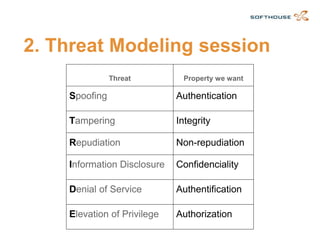
2. Threat Modeling session 
Threat 
Property we want 
Spoofing 
Authentication 
Tampering 
Integrity 
Repudiation 
Non-repudiation 
Information Disclosure 
Confidenciality 
Denial of Service 
Authentification 
Elevation of Privilege 
Authorization
Threat Modeling session 
Elevation of Privilege (EoP) Card Game
3. Backlog Review 
Look at the backlog from a security perspective 
Security Expert (from team) and PO 
Create checklist to facilitate
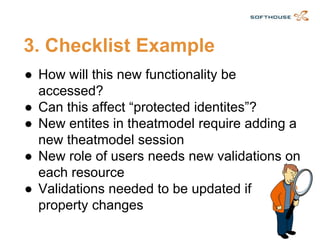
3. Checklist Example 
●How will this new functionality be accessed? 
●Can this affect “protected identites”? 
●New entites in theatmodel require adding a new theatmodel session 
●New role of users needs new validations on each resource 
●Validations needed to be updated if property changes
4. Fix your tools to help you 
●Continuous Integration 
●Static code analyzers 
●Dynamic code analyzers 
●Penetration tests tools
4 Continuous Integration 
●Find compile errors in configuration 
●Automate robustness testing 
○Unit 
○Integration 
○System 
○Fuzz
4 Analyze the code 
●Evaluate state of code checked in 
○Complexity 
○Rule breaking 
●Tools 
○SonarQube 
○Coverity 
○Fortify
5. Add activities to sprints 
●Update high level diagram 
●Keep updated 
●Fuzz-testing
Buckets 
●Verification 
○Fuzz 
○Data-flow 
●Design 
○Cryptology 
○Privacy 
●Planning 
○Privacy tests 
○Internal symbols
Recipe that works! 
1.Architecture Overview 
2.Have threat modelling sessions 
3.Review all new requirements/stories 
4.Fix your tools to help you 
5.Add YOUR activities to sprint
Q & A 
-This won’t work in my team since… 
petter.sandholdt@softhouse.se
Thank You

Agile Secure Development

  • 1.
    SARAJEVO, 27.10.2014 AgileSecure Development Petter Sandholdt -How to make the agile team work with security requirements
  • 2.
    Who am I? Petter Sandholdt -Senior Developer -Senior Security Consultant -Java, C, C++, C#, Cocoa, Erlang, PHP, Pike, Ruby, Cobol, Fortran, Lisp -Security in R&D for last 6 years ... in agile teams the last 5 years
  • 3.
    Easy targets VerizonEnterprise’s 2013 Data Breach Investigations Report ●47,000reported security incidents, ●621confirmed data security breaches ●companies of all sizes. http://www.verizonenterprise.com/DBIR/2013/ 78% of successful security intrusions were simple to pull off
  • 4.
    What do Devand SO think? http://www.pcadvisor.co.uk/news/network-wifi/3345773/developers-say-application-security-lacking/#ixzz2Vj0QCALy Developers Security Officers Security of applications is not addressed There is no build security in process SSDLC Application had a security breach during the past 2 years Did not receive software and application security training Application meets security regulations 70% 50% 80% 64% 68% 47% 50% 50% 15% 12%
  • 5.
    Agile application ≠Secure? Agile moto: ●Do what’s in the sprint XP moto: ●Never do more that what’s required TDD moto: ●Code until its green
  • 6.
    Agile application =Secure? REQS CODE
  • 7.
    Agile application =Secure? CODE REQS NOT TESTED
  • 8.
    When is anapplication secure? ●Requires hard-to-guess passwords? ●Has input validation? ●Has up-to-date and hardened 3rd-party libraries? ●The one that fulfills the security requirementsof the application
  • 9.
    How can thePOs know about security? POs are OWNERSin that role decide what is important for this application. ●Deployability (Architects or Operations) ●Performance (Architects,Testers & DBA) ●How to code it (Developers)
  • 10.
    Secure Software DevelopmentLife Cycles ●Microsoft SDL ●Adobe SPLC ●CLASP ●Cigital Touchpoints
  • 11.
    Secure Coding in5 minutes 1.Take Responsibility 2.Never trust data 3.Create a threat model 4.Keep yourself updated 5.Make a fuzz 6.Stay proud of your code 7.Use the best tools http://bit.ly/1dZ6fwA
  • 12.
    Recipe that works! 1.Architecture Overview 2.Have threat modelling sessions 3.Review all new requirements/stories 4.Fix your tools to help you 5.Add YOUR activities to sprint
  • 13.
  • 14.
    1. Architecture overview Image from: http://msdn.microsoft.com/en-us/library/ff649779.aspx
  • 15.
  • 16.
    Agile??? WTF! Moreartifacts! Not on my watch! -Helps collaboration-Find discrepancies-Creates ONE terminology
  • 17.
    2. Threat Modelingsession ●First session ○Brainstorming ●Following sessions ○Discussions aroundadded entities
  • 18.
    2. Threat Modelingsession Threat Property we want Spoofing Authentication Tampering Integrity Repudiation Non-repudiation Information Disclosure Confidenciality Denial of Service Authentification Elevation of Privilege Authorization
  • 19.
    Threat Modeling session Elevation of Privilege (EoP) Card Game
  • 20.
    3. Backlog Review Look at the backlog from a security perspective Security Expert (from team) and PO Create checklist to facilitate
  • 21.
    3. Checklist Example ●How will this new functionality be accessed? ●Can this affect “protected identites”? ●New entites in theatmodel require adding a new theatmodel session ●New role of users needs new validations on each resource ●Validations needed to be updated if property changes
  • 22.
    4. Fix yourtools to help you ●Continuous Integration ●Static code analyzers ●Dynamic code analyzers ●Penetration tests tools
  • 23.
    4 Continuous Integration ●Find compile errors in configuration ●Automate robustness testing ○Unit ○Integration ○System ○Fuzz
  • 24.
    4 Analyze thecode ●Evaluate state of code checked in ○Complexity ○Rule breaking ●Tools ○SonarQube ○Coverity ○Fortify
  • 25.
    5. Add activitiesto sprints ●Update high level diagram ●Keep updated ●Fuzz-testing
  • 26.
    Buckets ●Verification ○Fuzz ○Data-flow ●Design ○Cryptology ○Privacy ●Planning ○Privacy tests ○Internal symbols
  • 27.
    Recipe that works! 1.Architecture Overview 2.Have threat modelling sessions 3.Review all new requirements/stories 4.Fix your tools to help you 5.Add YOUR activities to sprint
  • 28.
    Q & A -This won’t work in my team since… petter.sandholdt@softhouse.se
  • 30.