History of Video Art
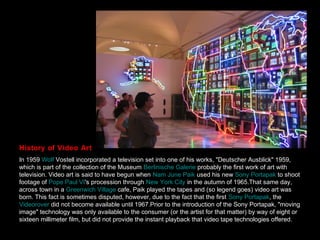
In 1959 Wolf Vostell incorporated a television set into one of his works, "Deutscher Ausblick" 1959,
which is part of the collection of the Museum Berlinische Galerie probably the first work of art with
television. Video art is said to have begun when Nam June Paik used his new Sony Portapak to shoot
footage of Pope Paul VI's procession through New York City in the autumn of 1965.That same day,
across town in a Greenwich Village cafe, Paik played the tapes and (so legend goes) video art was
born. This fact is sometimes disputed, however, due to the fact that the first Sony Portapak, the
Videorover did not become available until 1967.Prior to the introduction of the Sony Portapak, "moving
image" technology was only available to the consumer (or the artist for that matter) by way of eight or
sixteen millimeter film, but did not provide the instant playback that video tape technologies offered.
Consequently, many artists found video more appealing than film, even more so when the
greater accessibility was coupled technologies which could edit or modify the video image.The
two examples mentioned above both made use of "low tech tricks" to produce seminal video art
works. Peter Campus' Double Vision combined the video signals from two Sony Portapaks
through an electronic mixer, resulting in a distorted and radically dissonant image. Jonas'
Organic Honey's Vertical Roll involved recording previously recorded material as it was played
back on a television -- with the vertical hold setting intentionally in error.
VIDEO
NTSC
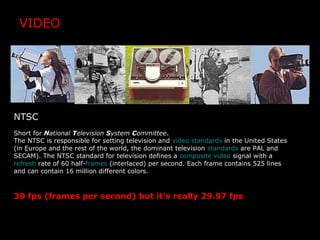
Short for National Television System Committee.
The NTSC is responsible for setting television and video standards in the United States
(in Europe and the rest of the world, the dominant television standards are PAL and
SECAM). The NTSC standard for television defines a composite video signal with a
refresh rate of 60 half-frames (interlaced) per second. Each frame contains 525 lines
and can contain 16 million different colors.
30 fps (frames per second) but it’s really 29.97 fps
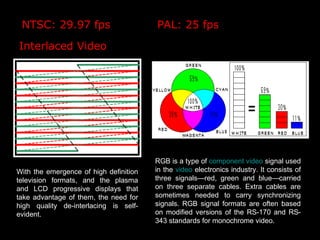
With the emergence of high definition
television formats, and the plasma
and LCD progressive displays that
take advantage of them, the need for
high quality de-interlacing is self-
evident.
NTSC: 29.97 fps PAL: 25 fps
Interlaced Video
RGB is a type of component video signal used
in the video electronics industry. It consists of
three signals—red, green and blue—carried
on three separate cables. Extra cables are
sometimes needed to carry synchronizing
signals. RGB signal formats are often based
on modified versions of the RS-170 and RS-
343 standards for monochrome video.
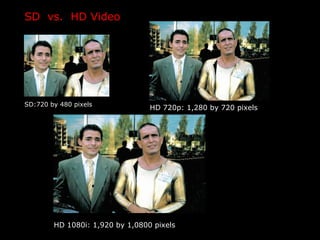
SD:720 by 480 pixels
HD 720p: 1,280 by 720 pixels
HD 1080i: 1,920 by 1,0800 pixels
SD vs. HD Video
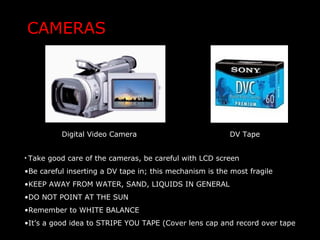
CAMERAS
Digital Video Camera DV Tape
• Take good care of the cameras, be careful with LCD screen
•Be careful inserting a DV tape in; this mechanism is the most fragile
•KEEP AWAY FROM WATER, SAND, LIQUIDS IN GENERAL
•DO NOT POINT AT THE SUN
•Remember to WHITE BALANCE
•It’s a good idea to STRIPE YOU TAPE (Cover lens cap and record over tape
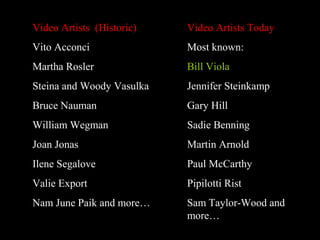
Video Artists (Historic)
Vito Acconci
Martha Rosler
Steina and Woody Vasulka
Bruce Nauman
William Wegman
Joan Jonas
Ilene Segalove
Valie Export
Nam June Paik and more…
Video Artists Today
Most known:
Bill Viola
Jennifer Steinkamp
Gary Hill
Sadie Benning
Martin Arnold
Paul McCarthy
Pipilotti Rist
Sam Taylor-Wood and
more…

Demo

  • 1.
    History of VideoArt In 1959 Wolf Vostell incorporated a television set into one of his works, "Deutscher Ausblick" 1959, which is part of the collection of the Museum Berlinische Galerie probably the first work of art with television. Video art is said to have begun when Nam June Paik used his new Sony Portapak to shoot footage of Pope Paul VI's procession through New York City in the autumn of 1965.That same day, across town in a Greenwich Village cafe, Paik played the tapes and (so legend goes) video art was born. This fact is sometimes disputed, however, due to the fact that the first Sony Portapak, the Videorover did not become available until 1967.Prior to the introduction of the Sony Portapak, "moving image" technology was only available to the consumer (or the artist for that matter) by way of eight or sixteen millimeter film, but did not provide the instant playback that video tape technologies offered.
  • 2.
    Consequently, many artistsfound video more appealing than film, even more so when the greater accessibility was coupled technologies which could edit or modify the video image.The two examples mentioned above both made use of "low tech tricks" to produce seminal video art works. Peter Campus' Double Vision combined the video signals from two Sony Portapaks through an electronic mixer, resulting in a distorted and radically dissonant image. Jonas' Organic Honey's Vertical Roll involved recording previously recorded material as it was played back on a television -- with the vertical hold setting intentionally in error.
  • 3.
    VIDEO NTSC Short for NationalTelevision System Committee. The NTSC is responsible for setting television and video standards in the United States (in Europe and the rest of the world, the dominant television standards are PAL and SECAM). The NTSC standard for television defines a composite video signal with a refresh rate of 60 half-frames (interlaced) per second. Each frame contains 525 lines and can contain 16 million different colors. 30 fps (frames per second) but it’s really 29.97 fps
  • 4.
    With the emergenceof high definition television formats, and the plasma and LCD progressive displays that take advantage of them, the need for high quality de-interlacing is self- evident. NTSC: 29.97 fps PAL: 25 fps Interlaced Video RGB is a type of component video signal used in the video electronics industry. It consists of three signals—red, green and blue—carried on three separate cables. Extra cables are sometimes needed to carry synchronizing signals. RGB signal formats are often based on modified versions of the RS-170 and RS- 343 standards for monochrome video.
  • 5.
    SD:720 by 480pixels HD 720p: 1,280 by 720 pixels HD 1080i: 1,920 by 1,0800 pixels SD vs. HD Video
  • 6.
    CAMERAS Digital Video CameraDV Tape • Take good care of the cameras, be careful with LCD screen •Be careful inserting a DV tape in; this mechanism is the most fragile •KEEP AWAY FROM WATER, SAND, LIQUIDS IN GENERAL •DO NOT POINT AT THE SUN •Remember to WHITE BALANCE •It’s a good idea to STRIPE YOU TAPE (Cover lens cap and record over tape
  • 7.
    Video Artists (Historic) VitoAcconci Martha Rosler Steina and Woody Vasulka Bruce Nauman William Wegman Joan Jonas Ilene Segalove Valie Export Nam June Paik and more… Video Artists Today Most known: Bill Viola Jennifer Steinkamp Gary Hill Sadie Benning Martin Arnold Paul McCarthy Pipilotti Rist Sam Taylor-Wood and more…