WORLD OF ARTWORLD OF ART
CHAPTER
EIGHTH EDITION
World of Art, Eighth Edition
Henry M. Sayre
Copyright © 2016, 2013, 2010
by Pearson Education, Inc. or its affiliates.
All rights reserved.
The Principles of
Design
7
Learning ObjectivesLearning Objectives
1 of 21 of 2
1. Define symmetrical, asymmetrical, and
radial balance.
2. Explain the relationship between
emphasis and focal point.
3. Differentiate between scale and
proportion.
4. Describe the relationship between
pattern, repetition, and rhythm.
Learning ObjectivesLearning Objectives
2 of 22 of 2
5. Discuss the traditional relationship
between unity and variety, and why
postmodernist artists have tended to
emphasize variety over unity.
IntroductionIntroduction
1 of 31 of 3
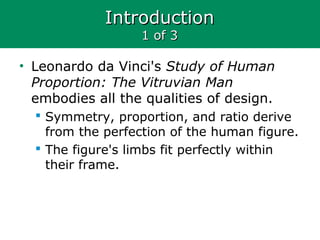
• Leonardo da Vinci's Study of Human
Proportion: The Vitruvian Man
embodies all the qualities of design.
 Symmetry, proportion, and ratio derive
from the perfection of the human figure.
 The figure's limbs fit perfectly within
their frame.
Leonardo da Vinci, Study of Human Proportion: The Vitruvian Man.
ca. 1492. Pen-and-ink drawing, 13-1/2 × 9-5/8". Gallerie dell'Accademia, Venice.
CAMERAPHOTO Arte, Venice. [Fig. 7-1]
IntroductionIntroduction
2 of 32 of 3
• In contrast, the Rasin Building in
Prague seems to teeter in its
playfulness.
 It is nicknamed "Fred and Ginger" for its
seemingly dancing frame.
 However, both parts of the building
balance each other out like a dialogue.
Frank Gehry and Vlado Milunić, Rasin Building (a.k.a. the "Dancing House" or "Fred and
Ginger"), Prague, Czech Republic.
1992–96.
© Curva de Luz/Alamy. [Fig. 7-2]
IntroductionIntroduction
3 of 33 of 3
• In the creative process, even such
"rules" as created by the Vitruvian Man
are meant to be broken so that artists
can discover new ways to express
themselves.
• Media are the materials that artists
use to create their works.
BalanceBalance
• Balance refers to even distribution of
weight in a composition.
 In works, balance can be symmetrical,
asymmetrical, or radial.
• In sculpture, actual weight is the
physical weight of materials in pounds.
• All art deals with visual weight, or the
apparent "heaviness" or "lightness" of
the forms in the composition.
Symmetrical BalanceSymmetrical Balance
1 of 41 of 4
• Symmetrical representations recall
Leonardo's Study.
 When each side is exactly the same, it is
called absolute symmetry.
 When there are minor discrepancies but
the overall effect is symmetrical, it is
called bilateral symmetry.
Symmetrical BalanceSymmetrical Balance
2 of 42 of 4
• The Taj Mahal is one of the most
symmetrically balanced buildings in the
world.
 Each facade is identical with openings
that give the building a sense of
weightlessness.
Taj Mahal, Agra, India.
Mughal period, ca. 1632–48.
© 2015 Photo Scala, Florence. [Fig. 7-3]
Symmetrical BalanceSymmetrical Balance
3 of 43 of 4
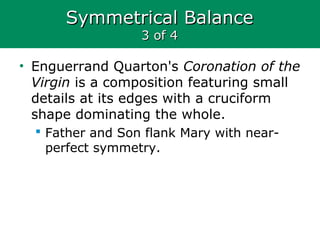
• Enguerrand Quarton's Coronation of the
Virgin is a composition featuring small
details at its edges with a cruciform
shape dominating the whole.
 Father and Son flank Mary with near-
perfect symmetry.
Enguerrand Quarton, Coronation of the Virgin.
1453–54. Panel painting, 6' × 7' 2-5/8. Musée de l'Hospice, Villeneuve-lès-Avignon,
France.
Bridgeman Images. [Fig. 7-4]
Symmetrical BalanceSymmetrical Balance
4 of 44 of 4
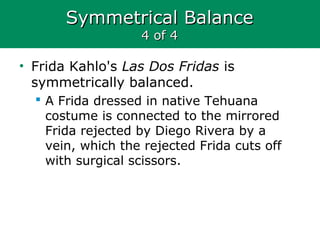
• Frida Kahlo's Las Dos Fridas is
symmetrically balanced.
 A Frida dressed in native Tehuana
costume is connected to the mirrored
Frida rejected by Diego Rivera by a
vein, which the rejected Frida cuts off
with surgical scissors.
Frida Kahlo, Las Dos Fridas (The Two Fridas).
1939. Oil on canvas, 5' 9-1⁄5" × 5 ft. 9-1⁄5". Museo de Arte Moderno, Mexico City.
© 2015. Photo Art Resource/Bob Schalkwijk/Scala, Florence. © 2015 Banco de México
Diego Rivera Frida Kahlo Museums Trust, Mexico, D.F./Artists Rights Society (ARS), New
York. [Fig. 7-5]
Asymmetrical BalanceAsymmetrical Balance
1 of 31 of 3
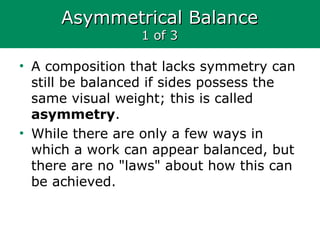
• A composition that lacks symmetry can
still be balanced if sides possess the
same visual weight; this is called
asymmetry.
• While there are only a few ways in
which a work can appear balanced, but
there are no "laws" about how this can
be achieved.
Some different varieties of asymmetrical balance. [Fig. 7-6]
Asymmetrical BalanceAsymmetrical Balance
2 of 32 of 3
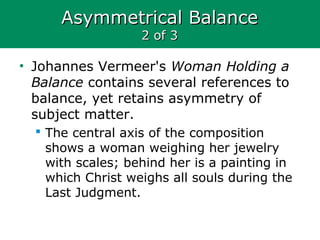
• Johannes Vermeer's Woman Holding a
Balance contains several references to
balance, yet retains asymmetry of
subject matter.
 The central axis of the composition
shows a woman weighing her jewelry
with scales; behind her is a painting in
which Christ weighs all souls during the
Last Judgment.
Johannes Vermeer, Woman Holding a Balance.
ca. 1664. Oil on canvas, 15-7/8 × 14", framed 24-3/4 × 23 × 3". National Gallery of Art,
Washington, D.C.
Widener Collection. Photo © 2015 Board of Trustees, National Gallery of Art. Photo: Bob
Grove. [Fig. 7-7]
Asymmetrical BalanceAsymmetrical Balance
3 of 33 of 3
• Childe Hassam's Boston Common at
Twilight features a central axis left of
the middle, where a woman and her
daughters feed birds at the edge of a
tree-lined expanse of Boston Common.
• Tension between light and dark as well
as the open Common and the street
reinforce asymmetrical balance.
Childe Hassam, Boston Common at Twilight.
1885–86. Oil on canvas, 42" × 5'. Museum of Fine Arts, Boston.
Gift of Miss Maud E. Appleton, 1931.952. Photograph © 2015 Museum of Fine Arts,
Boston. [Fig. 7-8]
Radial BalanceRadial Balance
• In radial balance, everything radiates
outward from a central point.
 The "rose window" above the south
portal of Chartres Cathedral is an
example.
• The Villa La Rotonda by Andrea Palladio
also features radial balance.
 The central domed rotunda is flanked by
four symmetrical reception rooms.
Rose window, south transept, Chartres Cathedral.
ca. 1215. Chartres, France.
Angelo Hornak. [Fig. 7-9]
Andrea Palladio, Villa La Rotonda.
Begun 1560s.
CAMERAPHOTO Arte, Venice. [Fig. 7-10a]
Andrea Palladio, Plan of main floor (piano nobile), Villa La Rotunda. [Fig. 7-10b]
Emphasis and Focal PointEmphasis and Focal Point
1 of 31 of 3
• The focal point of a composition is an
area to which the artist draws the
viewer's attention the most.
• Strong contrasts of light and color can
create a focal point easily.
 Still Life with Lobster uses
complementary colors with the focal
lobster in red and everything else in
green.
Anna Vallayer-Coster, Still Life with Lobster.
1781. Oil on canvas, 27-3/4 × 35-1/4". Toledo Museum of Art, Toledo, Ohio.
Purchased with funds from the Libbey Endowment, Gift of Edward Drummond Libbey,
1968.1A. Photo: Photography Incorporated, Toledo. [Fig. 7-11]
Emphasis and Focal PointEmphasis and Focal Point
2 of 32 of 3
• Light in Georges de La Tour's Joseph
the Carpenter draws attention away
from Joseph and to the brightly lit face
of Christ, symbolizing the Divine Light.
• It is also possible to make a work that
is afocal, or without a single point of
focus.
Georges de La Tour, Joseph the Carpenter.
ca. 1645. Oil on canvas, 18-1/2 × 25-1/2". Musée du Louvre, Paris.
Inv. RF1948-27. Photo © RMN-Grand Palais (musée du Louvre)/Michel Urtado.
[Fig. 7-12]
Emphasis and Focal PointEmphasis and Focal Point
3 of 33 of 3
• Lucas Samaras's Room No. 2 is an 8-
by-8-foot space lined entirely with
mirrors.
 Only two visitors are allowed inside
simultaneously.
 Viewer and work become inseparable;
the viewer enables the work, yet loses
their individuality.
Lucas Samaras, Room No. 2 (popularly known as the Mirrored Room) (detail).
1966. Mirror on wood, 8 × 8 × 10'. Albright-Knox Art Gallery, Buffalo, New York.
Gift of Seymour H. Knox, Jr., 1966. © Lucas Samaras, courtesy of Pace Gallery.
[Fig. 7-13]
The Creative ProcessThe Creative Process
1 of 21 of 2
• A Multiplication of Focal Points:Diego
Velázquez's Las Meninas
 An obvious focal point is the infanta
Margarita at center, but figures outside
of her central group gaze away from the
infanta.
 Their focal point appears to be the King
and Queen, who are reflected in the
mirror at the opposite end of the room.
Diego Velázquez, Philip IV, King of Spain.
1652–53. Oil on canvas, 17-1/2 x 14-3/4". Kunsthistorisches Museum, Vienna.
Inv. 324. © 2015. Photo Austrian Archives/Scala, Florence. [Fig. 7-14]
Portrait of Queen Mariana.
ca. 1656. Oil on canvas, 18-3/8 × 17-1/8". Meadows Museum, Southern Methodist
University, Dallas.
Alger H. Meadows Collection. MM.78.01. Photo: Michael Bodycomb. [Fig. 7-15]
Diego Velázquez, Las Meninas (The Maids of Honor).
1656. Oil on canvas, 10' 3/4" × 9’ 3/4". Museo Nacional del Prado, Madrid.
© 2015. Image copyright Museo Nacional del Prado © Photo MNP/Scala, Florence. [Fig.
7-16]
The Creative ProcessThe Creative Process
2 of 22 of 2
• A Multiplication of Focal Points:Diego
Velázquez's Las Meninas
 Either the royal couple is the actual
subject of the painting or they have
entered the room to see their daughter
being painted; or, in fact, their images
are a double portrait rather than
themselves reflected in the mirror.
 The painting depicts a work-in-progress,
although it is unclear what that work is.
Diego Velázquez, Las Meninas (The Maids of Honor)(detail).
© 2015. Image copyright Museo Nacional del Prado © Photo MNP/Scala, Florence. [Fig.
7-17]
Scale and ProportionScale and Proportion
1 of 71 of 7
• Scale describes the dimensions of an
art object in relation to the original
object or objects around it.
• Julie Mehretu's Mural is "large-scale" at
80 feet long and 23 feet high.
• When looking at a textbook or screen
reproduction, it is important to consider
the actual size of the work.
Julie Mehretu, Mural, detail.
2010. Acrylic on canvas, 23 × 80'. Goldman Sachs headquarters, New York.
Courtesy of the artist and Marian Goodman Gallery, New York. [Fig. 7-18]
Scale and ProportionScale and Proportion
2 of 72 of 7
• Comparing Do-Ho Suh's Public Figures
and Kara Walker's Subtlety, both artists
have manipulated the scale of the
object depicted.
• Do-Ho Suh's work shows the people
carrying the pediment in a diminished
scale.
 The expected figure atop the pedestal is
purposely absent.
Do-Ho Suh, Public Figures.
1998–99. Installation view, MetroTech Center Commons, Brooklyn, New York.
Fiberglass/resin, steel pipes, pipe fittings, 10 × 7 × 9'.
Courtesy the artist and Lehmann Maupin Gallery, New York. [Fig. 7-19]
Scale and ProportionScale and Proportion
3 of 73 of 7
• Walker's work is a large, exaggerated
homage to carved sugar centerpieces
that would have decorated the tables of
the upper classes through history.
• Artists can manipulate scale through
the relative scale of objects.
 An object "closer" to us is larger, while
one that recesses in to the background
appears smaller.
Kara Walker, A Subtlety: The Marvelous Sugar Baby, an Homage to the unpaid and
overworked Artisans who have refined our Sweet tastes from the cane fields to the
Kitchens of the New World on the Occasion of the demolition of the Domino Sugar
Refining Plant.
2014. Installation view, Domino Sugar Factory, Williamsburg, Brooklyn, New York.
Carved polystyrene coated with 160,000 lb of sugar, 10 × 7 × 75'.
Courtesy the artist and Creative Projects, New York. [Fig. 7-20]
Scale and ProportionScale and Proportion
4 of 74 of 7
• Hokusai's views of Mount Fuji subvert
the knowledge of how large the
mountain is.
 The Great Wave off Kanagawa shows
two boats in a tumultuous wave in the
foreground, visually diminishing the
importance of Fuji in the distance.
Hokusai, The Great Wave off Kanagawa, from the series Thirty-Six Views of Mount Fuji.
1823–29. Color woodcut, 10 × 15".
© Historical Picture Archive/CORBIS. [Fig. 7-21]
Scale and ProportionScale and Proportion
5 of 75 of 7
• Proportion refers to the relationship
between parts of an object and the
whole.
• Ingres's Mme. Rivière appears at first
to be natural, but upon closer
inspection, her arm has been elongated
to accommodate the curve of the
frame.
Jean-Auguste-Dominique Ingres, Mme. Rivière.
1805. Oil on canvas, 45-5/8 × 35-3/8". Musée du Louvre, Paris.
Photo © RMN-Grand Palais (musée du Louvre)/Thierry Le Mage. [Fig. 7-22]
Scale and ProportionScale and Proportion
6 of 76 of 7
• Greek sculptor Polyclitus described
"perfect" proportions of the human
body in a text called The Canon.
 Both the text and the original
Doryphoros statue were lost, but both
proclaim that each part of the body is a
common fraction of the figure's height.
Polyclitus, Doryphoros (The Spear Bearer).
450 BCE. Marble, Roman copy after lost bronze original, height 7'. National Archaeological
Museum, Naples.
Art Archive/Musée Archéologique Naples/Collection Dagli Orti. [Fig. 7-23]
Scale and ProportionScale and Proportion
7 of 77 of 7
• The Greek Parthenon possesses
proportions on the facade in a ratio
based on the algebraic formula x = 2y
+ 1.
 The ratio of the length of the top step of
the platform (or stylobate) to its width
is 9:4.
Parthenon.
447–438 BCE. Pentelic marble, 111 × 237' at base. Athens, Greece.
© Craig & Marie Mauzy, Athens. [Fig. 7-24]
Pattern, Repetition, and RhythmPattern, Repetition, and Rhythm
1 of 51 of 5
• Pattern is the systematic repetitive use
of the same motif or design and it can
be used as a decorative tool.
• The Lindisfarne Gospels, particularly
the Cross page, features pre-Christian
pagan motifs woven into Christian
imagery.
 Beasts were drawn in "animal style"
with intricate, ribbonlike traceries.
Cross page from the Lindisfarne Gospels.
ca. 700. Ink and tempera on vellum, 13-1/2 × 9-1/4". British Library, London.
© British Library Board. All Rights Reserved/Bridgeman Images. [Fig. 7-25]
Pattern, Repetition, and RhythmPattern, Repetition, and Rhythm
2 of 52 of 5
• Patterned kente cloths from Ghana's
Ewe and Asante societies contained
patterns that designated social
prestige.
• African sculptor El Anatsui used kente
cloths as inspiration for his pieces,
which are made from discarded
aluminum caps and seals rather than
strips of cloth.
Kente prestige cloth (detail), Ghana, Ewe peoples.
19th century. Cotton, silk, warp (vertical threads) 6' 2", weft (horizontal threads) 9' 1-
7/8". The British Museum, London.
© The Trustees of the British Museum. [Fig. 7-26]
El Anatsui, Between Earth and Heaven.
2006. Aluminum and copper wire, 7' 2-3/4" × 10' 4". Metropolitan Museum of Art, New
York.
Purchase, Fred M. and Rita Richman, Noah-Sadie K. Wachtel Foundation Inc., David and
Holly Ross, Doreen and Gilbert Bassin Family Foundation and William B. Goldstein Gifts,
2007.96. © 2015. Image copyright Metropolitan Museum of Art/Art Resource/Scala,
Florence. [Fig. 7-27]
Pattern, Repetition, and RhythmPattern, Repetition, and Rhythm
3 of 53 of 5
• Repetition can imply monotony, but if
certain elements are used repeatedly,
they can create a visual rhythm.
• Jacob Lawrence establishes rhythm in
Barber Shop through the repetition of
both shape and color.
 Each diamond-shaped client wears a
different colored apron; the color is
repeated again elsewhere in the work.
Jacob Lawrence, Barber Shop.
1946. Gouache on paper, 21-1/8 × 29-3/8". Toledo Museum of Art, Toledo, Ohio.
Purchased with funds from the Libbey Endowment, Gift of Edward Drummond Libbey,
1975.15. Photo: Photography Incorporated, Toledo. © 2015 Jacob and Gwendolyn Knight
Lawrence Foundation, Seattle/Artists Rights Society (ARS), New York. [Fig. 7-28]
Pattern, Repetition, and RhythmPattern, Repetition, and Rhythm
4 of 54 of 5
• Auguste Rodin's The Gates of Hell was
based on Dante's Inferno and features
nearly 200 figures.
 At the top, a grouping of figures called
The Three Shades is actually the same
figure cast three times and arranged in
a semicircle.
 Below, the posture of Adam echoes the
Shades, implying that it was he who
brought us to the Gates of Hell.
Auguste Rodin, The Gates of Hell with Adam and Eve.
1880–1917. Bronze, 20' 10-3/4" × 13' 2" × 33-3/8". Stanford University Museum of Art.
Photo: Frank Wing. [Fig. 7-29]
Auguste Rodin, The Three Shades.
1881–86. Bronze, Coubertin Foundry, posthumous cast authorized by Musée Rodin,
1980, 6' 3-1/2" × 6' 3-1/2" × 42". Iris & B. Gerald Cantor Center for Visual Arts at
Stanford University.
Gift of the B. Gerald Cantor Collections. [Fig. 7-30]
Pattern, Repetition, and RhythmPattern, Repetition, and Rhythm
5 of 55 of 5
• Layla Ali's Greenheads series features
brown-skinned, gender-neutral
"Others" that appear at once alien and
familiar.
 In this piece, three nearly identical
Greenheads have been hanged in front
of a fourth victim.
• It symbolizes that such a horrifying act
can inevitably happen again, though the
place could be anywhere.
Laylah Ali, Untitled, from the series Greenheads.
2000. Gouache on paper, 13 × 19".
Courtesy of the artist and Paul Kasmin Gallery. [Fig. 7-31]
Unity and VarietyUnity and Variety
1 of 41 of 4
• In Barber Shop, Lawrence kept his
figures consistent, yet unique.
• If every subject or figure were the
same, there would be no need to
discuss the unity of diversity that
makes a work "complete."
 Generally, variety must coexist with
unity in order for the work to succeed.
Unity and VarietyUnity and Variety
2 of 42 of 4
• Louise Lawler's Pollock and Tureen
brings seemingly contradictory objects
in a state of opposition and tension.
 The Pollock painting is transformed into
a decorative object that seems as
marketable and empty of its original
meaning when placed by the tureen.
Louise Lawler, Pollock and Tureen.
1984. Cibachrome, 16 × 20".
Courtesy of the artist and Metro Pictures, New York. [Fig. 7-32]
Unity and VarietyUnity and Variety
3 of 43 of 4
• A sense that parts can never form a
unified whole is commonly called
postmodernism.
• Robert Venturi wrote in Learning from
Las Vegas that a collision of styles,
signs, and symbols such as those seen
on an American "strip" can be seen as a
new kind of unity; anything can be put
next to anything else.
Las Vegas, Nevada.
ca. 1985.
Vidler/Mauritius. [Fig. 7-33]
Unity and VarietyUnity and Variety
4 of 44 of 4
• Elizabeth Murray's Just in Time appears
at first to be abstract, but reveals a
teacup split in half.
 Its ordinary subject matter is
monumentalized by a height of 9 feet.
 Animal forms and pop lyrics also inspire
interpretations.
 The work is rich in meaning, each
fragment unifying the whole.
Elizabeth Murray, Just in Time.
1981. Oil on canvas in two sections, 8' 10" × 8' 1". Philadelphia Museum of Art.
Purchased: Edward and Althea Budd Fund, the Adele Haas Turner and Beatrice Pastorius
Turner Memorial Fund, and funds contributed by Marion Stroud and Lorine E. Vogt, 1981.
© 2015. Photo Philadelphia Museum of Art/Art Resource/Scala, Florence. © 2015
Murray-Holman Family Trust/Artists Rights Society (ARS), New York. [Fig. 7-34]
The Critical ProcessThe Critical Process
Thinking about the Principles of DesignThinking about the Principles of Design
• Claude Monet's The Railroad Bridge,
Argenteuil employs line in a number of
ways.
 Opposition is apparent in the two
diagonals as well as opposing directional
lines of the train and boat.
• What appears to be a simple landscape
of a newly-built bridge is fraught with
complexities.
Claude Monet, The Railroad Bridge, Argenteuil.
1874. Oil on canvas, 21-4⁄5 × 29-2⁄5". Philadelphia Museum of Art.
John G. Johnson collection, 1917. © 2015. Photo Philadelphia Museum of Art/Art
Resource/Scala, Florence. [Fig. 7-35]
Thinking BackThinking Back
1 of 21 of 2
1. Define symmetrical, asymmetrical, and
radial balance.
2. Explain the relationship between
emphasis and focal point.
3. Differentiate between scale and
proportion.
4. Describe the relationship between
pattern, repetition, and rhythm.
Thinking BackThinking Back
2 of 22 of 2
5. Discuss the traditional relationship
between unity and variety, and why
postmodernist artists have tended to
emphasize variety over unity.

Sayre woa ch07_lecture-243770

  • 1.
    WORLD OF ARTWORLDOF ART CHAPTER EIGHTH EDITION World of Art, Eighth Edition Henry M. Sayre Copyright © 2016, 2013, 2010 by Pearson Education, Inc. or its affiliates. All rights reserved. The Principles of Design 7
  • 2.
    Learning ObjectivesLearning Objectives 1of 21 of 2 1. Define symmetrical, asymmetrical, and radial balance. 2. Explain the relationship between emphasis and focal point. 3. Differentiate between scale and proportion. 4. Describe the relationship between pattern, repetition, and rhythm.
  • 3.
    Learning ObjectivesLearning Objectives 2of 22 of 2 5. Discuss the traditional relationship between unity and variety, and why postmodernist artists have tended to emphasize variety over unity.
  • 4.
    IntroductionIntroduction 1 of 31of 3 • Leonardo da Vinci's Study of Human Proportion: The Vitruvian Man embodies all the qualities of design.  Symmetry, proportion, and ratio derive from the perfection of the human figure.  The figure's limbs fit perfectly within their frame.
  • 5.
    Leonardo da Vinci,Study of Human Proportion: The Vitruvian Man. ca. 1492. Pen-and-ink drawing, 13-1/2 × 9-5/8". Gallerie dell'Accademia, Venice. CAMERAPHOTO Arte, Venice. [Fig. 7-1]
  • 6.
    IntroductionIntroduction 2 of 32of 3 • In contrast, the Rasin Building in Prague seems to teeter in its playfulness.  It is nicknamed "Fred and Ginger" for its seemingly dancing frame.  However, both parts of the building balance each other out like a dialogue.
  • 7.
    Frank Gehry andVlado Milunić, Rasin Building (a.k.a. the "Dancing House" or "Fred and Ginger"), Prague, Czech Republic. 1992–96. © Curva de Luz/Alamy. [Fig. 7-2]
  • 8.
    IntroductionIntroduction 3 of 33of 3 • In the creative process, even such "rules" as created by the Vitruvian Man are meant to be broken so that artists can discover new ways to express themselves. • Media are the materials that artists use to create their works.
  • 9.
    BalanceBalance • Balance refersto even distribution of weight in a composition.  In works, balance can be symmetrical, asymmetrical, or radial. • In sculpture, actual weight is the physical weight of materials in pounds. • All art deals with visual weight, or the apparent "heaviness" or "lightness" of the forms in the composition.
  • 10.
    Symmetrical BalanceSymmetrical Balance 1of 41 of 4 • Symmetrical representations recall Leonardo's Study.  When each side is exactly the same, it is called absolute symmetry.  When there are minor discrepancies but the overall effect is symmetrical, it is called bilateral symmetry.
  • 11.
    Symmetrical BalanceSymmetrical Balance 2of 42 of 4 • The Taj Mahal is one of the most symmetrically balanced buildings in the world.  Each facade is identical with openings that give the building a sense of weightlessness.
  • 12.
    Taj Mahal, Agra,India. Mughal period, ca. 1632–48. © 2015 Photo Scala, Florence. [Fig. 7-3]
  • 13.
    Symmetrical BalanceSymmetrical Balance 3of 43 of 4 • Enguerrand Quarton's Coronation of the Virgin is a composition featuring small details at its edges with a cruciform shape dominating the whole.  Father and Son flank Mary with near- perfect symmetry.
  • 14.
    Enguerrand Quarton, Coronationof the Virgin. 1453–54. Panel painting, 6' × 7' 2-5/8. Musée de l'Hospice, Villeneuve-lès-Avignon, France. Bridgeman Images. [Fig. 7-4]
  • 15.
    Symmetrical BalanceSymmetrical Balance 4of 44 of 4 • Frida Kahlo's Las Dos Fridas is symmetrically balanced.  A Frida dressed in native Tehuana costume is connected to the mirrored Frida rejected by Diego Rivera by a vein, which the rejected Frida cuts off with surgical scissors.
  • 16.
    Frida Kahlo, LasDos Fridas (The Two Fridas). 1939. Oil on canvas, 5' 9-1⁄5" × 5 ft. 9-1⁄5". Museo de Arte Moderno, Mexico City. © 2015. Photo Art Resource/Bob Schalkwijk/Scala, Florence. © 2015 Banco de México Diego Rivera Frida Kahlo Museums Trust, Mexico, D.F./Artists Rights Society (ARS), New York. [Fig. 7-5]
  • 17.
    Asymmetrical BalanceAsymmetrical Balance 1of 31 of 3 • A composition that lacks symmetry can still be balanced if sides possess the same visual weight; this is called asymmetry. • While there are only a few ways in which a work can appear balanced, but there are no "laws" about how this can be achieved.
  • 18.
    Some different varietiesof asymmetrical balance. [Fig. 7-6]
  • 19.
    Asymmetrical BalanceAsymmetrical Balance 2of 32 of 3 • Johannes Vermeer's Woman Holding a Balance contains several references to balance, yet retains asymmetry of subject matter.  The central axis of the composition shows a woman weighing her jewelry with scales; behind her is a painting in which Christ weighs all souls during the Last Judgment.
  • 20.
    Johannes Vermeer, WomanHolding a Balance. ca. 1664. Oil on canvas, 15-7/8 × 14", framed 24-3/4 × 23 × 3". National Gallery of Art, Washington, D.C. Widener Collection. Photo © 2015 Board of Trustees, National Gallery of Art. Photo: Bob Grove. [Fig. 7-7]
  • 21.
    Asymmetrical BalanceAsymmetrical Balance 3of 33 of 3 • Childe Hassam's Boston Common at Twilight features a central axis left of the middle, where a woman and her daughters feed birds at the edge of a tree-lined expanse of Boston Common. • Tension between light and dark as well as the open Common and the street reinforce asymmetrical balance.
  • 22.
    Childe Hassam, BostonCommon at Twilight. 1885–86. Oil on canvas, 42" × 5'. Museum of Fine Arts, Boston. Gift of Miss Maud E. Appleton, 1931.952. Photograph © 2015 Museum of Fine Arts, Boston. [Fig. 7-8]
  • 23.
    Radial BalanceRadial Balance •In radial balance, everything radiates outward from a central point.  The "rose window" above the south portal of Chartres Cathedral is an example. • The Villa La Rotonda by Andrea Palladio also features radial balance.  The central domed rotunda is flanked by four symmetrical reception rooms.
  • 24.
    Rose window, southtransept, Chartres Cathedral. ca. 1215. Chartres, France. Angelo Hornak. [Fig. 7-9]
  • 25.
    Andrea Palladio, VillaLa Rotonda. Begun 1560s. CAMERAPHOTO Arte, Venice. [Fig. 7-10a]
  • 26.
    Andrea Palladio, Planof main floor (piano nobile), Villa La Rotunda. [Fig. 7-10b]
  • 27.
    Emphasis and FocalPointEmphasis and Focal Point 1 of 31 of 3 • The focal point of a composition is an area to which the artist draws the viewer's attention the most. • Strong contrasts of light and color can create a focal point easily.  Still Life with Lobster uses complementary colors with the focal lobster in red and everything else in green.
  • 28.
    Anna Vallayer-Coster, StillLife with Lobster. 1781. Oil on canvas, 27-3/4 × 35-1/4". Toledo Museum of Art, Toledo, Ohio. Purchased with funds from the Libbey Endowment, Gift of Edward Drummond Libbey, 1968.1A. Photo: Photography Incorporated, Toledo. [Fig. 7-11]
  • 29.
    Emphasis and FocalPointEmphasis and Focal Point 2 of 32 of 3 • Light in Georges de La Tour's Joseph the Carpenter draws attention away from Joseph and to the brightly lit face of Christ, symbolizing the Divine Light. • It is also possible to make a work that is afocal, or without a single point of focus.
  • 30.
    Georges de LaTour, Joseph the Carpenter. ca. 1645. Oil on canvas, 18-1/2 × 25-1/2". Musée du Louvre, Paris. Inv. RF1948-27. Photo © RMN-Grand Palais (musée du Louvre)/Michel Urtado. [Fig. 7-12]
  • 31.
    Emphasis and FocalPointEmphasis and Focal Point 3 of 33 of 3 • Lucas Samaras's Room No. 2 is an 8- by-8-foot space lined entirely with mirrors.  Only two visitors are allowed inside simultaneously.  Viewer and work become inseparable; the viewer enables the work, yet loses their individuality.
  • 32.
    Lucas Samaras, RoomNo. 2 (popularly known as the Mirrored Room) (detail). 1966. Mirror on wood, 8 × 8 × 10'. Albright-Knox Art Gallery, Buffalo, New York. Gift of Seymour H. Knox, Jr., 1966. © Lucas Samaras, courtesy of Pace Gallery. [Fig. 7-13]
  • 33.
    The Creative ProcessTheCreative Process 1 of 21 of 2 • A Multiplication of Focal Points:Diego Velázquez's Las Meninas  An obvious focal point is the infanta Margarita at center, but figures outside of her central group gaze away from the infanta.  Their focal point appears to be the King and Queen, who are reflected in the mirror at the opposite end of the room.
  • 34.
    Diego Velázquez, PhilipIV, King of Spain. 1652–53. Oil on canvas, 17-1/2 x 14-3/4". Kunsthistorisches Museum, Vienna. Inv. 324. © 2015. Photo Austrian Archives/Scala, Florence. [Fig. 7-14]
  • 35.
    Portrait of QueenMariana. ca. 1656. Oil on canvas, 18-3/8 × 17-1/8". Meadows Museum, Southern Methodist University, Dallas. Alger H. Meadows Collection. MM.78.01. Photo: Michael Bodycomb. [Fig. 7-15]
  • 36.
    Diego Velázquez, LasMeninas (The Maids of Honor). 1656. Oil on canvas, 10' 3/4" × 9’ 3/4". Museo Nacional del Prado, Madrid. © 2015. Image copyright Museo Nacional del Prado © Photo MNP/Scala, Florence. [Fig. 7-16]
  • 37.
    The Creative ProcessTheCreative Process 2 of 22 of 2 • A Multiplication of Focal Points:Diego Velázquez's Las Meninas  Either the royal couple is the actual subject of the painting or they have entered the room to see their daughter being painted; or, in fact, their images are a double portrait rather than themselves reflected in the mirror.  The painting depicts a work-in-progress, although it is unclear what that work is.
  • 38.
    Diego Velázquez, LasMeninas (The Maids of Honor)(detail). © 2015. Image copyright Museo Nacional del Prado © Photo MNP/Scala, Florence. [Fig. 7-17]
  • 39.
    Scale and ProportionScaleand Proportion 1 of 71 of 7 • Scale describes the dimensions of an art object in relation to the original object or objects around it. • Julie Mehretu's Mural is "large-scale" at 80 feet long and 23 feet high. • When looking at a textbook or screen reproduction, it is important to consider the actual size of the work.
  • 40.
    Julie Mehretu, Mural,detail. 2010. Acrylic on canvas, 23 × 80'. Goldman Sachs headquarters, New York. Courtesy of the artist and Marian Goodman Gallery, New York. [Fig. 7-18]
  • 41.
    Scale and ProportionScaleand Proportion 2 of 72 of 7 • Comparing Do-Ho Suh's Public Figures and Kara Walker's Subtlety, both artists have manipulated the scale of the object depicted. • Do-Ho Suh's work shows the people carrying the pediment in a diminished scale.  The expected figure atop the pedestal is purposely absent.
  • 42.
    Do-Ho Suh, PublicFigures. 1998–99. Installation view, MetroTech Center Commons, Brooklyn, New York. Fiberglass/resin, steel pipes, pipe fittings, 10 × 7 × 9'. Courtesy the artist and Lehmann Maupin Gallery, New York. [Fig. 7-19]
  • 43.
    Scale and ProportionScaleand Proportion 3 of 73 of 7 • Walker's work is a large, exaggerated homage to carved sugar centerpieces that would have decorated the tables of the upper classes through history. • Artists can manipulate scale through the relative scale of objects.  An object "closer" to us is larger, while one that recesses in to the background appears smaller.
  • 44.
    Kara Walker, ASubtlety: The Marvelous Sugar Baby, an Homage to the unpaid and overworked Artisans who have refined our Sweet tastes from the cane fields to the Kitchens of the New World on the Occasion of the demolition of the Domino Sugar Refining Plant. 2014. Installation view, Domino Sugar Factory, Williamsburg, Brooklyn, New York. Carved polystyrene coated with 160,000 lb of sugar, 10 × 7 × 75'. Courtesy the artist and Creative Projects, New York. [Fig. 7-20]
  • 45.
    Scale and ProportionScaleand Proportion 4 of 74 of 7 • Hokusai's views of Mount Fuji subvert the knowledge of how large the mountain is.  The Great Wave off Kanagawa shows two boats in a tumultuous wave in the foreground, visually diminishing the importance of Fuji in the distance.
  • 46.
    Hokusai, The GreatWave off Kanagawa, from the series Thirty-Six Views of Mount Fuji. 1823–29. Color woodcut, 10 × 15". © Historical Picture Archive/CORBIS. [Fig. 7-21]
  • 47.
    Scale and ProportionScaleand Proportion 5 of 75 of 7 • Proportion refers to the relationship between parts of an object and the whole. • Ingres's Mme. Rivière appears at first to be natural, but upon closer inspection, her arm has been elongated to accommodate the curve of the frame.
  • 48.
    Jean-Auguste-Dominique Ingres, Mme.Rivière. 1805. Oil on canvas, 45-5/8 × 35-3/8". Musée du Louvre, Paris. Photo © RMN-Grand Palais (musée du Louvre)/Thierry Le Mage. [Fig. 7-22]
  • 49.
    Scale and ProportionScaleand Proportion 6 of 76 of 7 • Greek sculptor Polyclitus described "perfect" proportions of the human body in a text called The Canon.  Both the text and the original Doryphoros statue were lost, but both proclaim that each part of the body is a common fraction of the figure's height.
  • 50.
    Polyclitus, Doryphoros (TheSpear Bearer). 450 BCE. Marble, Roman copy after lost bronze original, height 7'. National Archaeological Museum, Naples. Art Archive/Musée Archéologique Naples/Collection Dagli Orti. [Fig. 7-23]
  • 51.
    Scale and ProportionScaleand Proportion 7 of 77 of 7 • The Greek Parthenon possesses proportions on the facade in a ratio based on the algebraic formula x = 2y + 1.  The ratio of the length of the top step of the platform (or stylobate) to its width is 9:4.
  • 52.
    Parthenon. 447–438 BCE. Pentelicmarble, 111 × 237' at base. Athens, Greece. © Craig & Marie Mauzy, Athens. [Fig. 7-24]
  • 53.
    Pattern, Repetition, andRhythmPattern, Repetition, and Rhythm 1 of 51 of 5 • Pattern is the systematic repetitive use of the same motif or design and it can be used as a decorative tool. • The Lindisfarne Gospels, particularly the Cross page, features pre-Christian pagan motifs woven into Christian imagery.  Beasts were drawn in "animal style" with intricate, ribbonlike traceries.
  • 54.
    Cross page fromthe Lindisfarne Gospels. ca. 700. Ink and tempera on vellum, 13-1/2 × 9-1/4". British Library, London. © British Library Board. All Rights Reserved/Bridgeman Images. [Fig. 7-25]
  • 55.
    Pattern, Repetition, andRhythmPattern, Repetition, and Rhythm 2 of 52 of 5 • Patterned kente cloths from Ghana's Ewe and Asante societies contained patterns that designated social prestige. • African sculptor El Anatsui used kente cloths as inspiration for his pieces, which are made from discarded aluminum caps and seals rather than strips of cloth.
  • 56.
    Kente prestige cloth(detail), Ghana, Ewe peoples. 19th century. Cotton, silk, warp (vertical threads) 6' 2", weft (horizontal threads) 9' 1- 7/8". The British Museum, London. © The Trustees of the British Museum. [Fig. 7-26]
  • 57.
    El Anatsui, BetweenEarth and Heaven. 2006. Aluminum and copper wire, 7' 2-3/4" × 10' 4". Metropolitan Museum of Art, New York. Purchase, Fred M. and Rita Richman, Noah-Sadie K. Wachtel Foundation Inc., David and Holly Ross, Doreen and Gilbert Bassin Family Foundation and William B. Goldstein Gifts, 2007.96. © 2015. Image copyright Metropolitan Museum of Art/Art Resource/Scala, Florence. [Fig. 7-27]
  • 58.
    Pattern, Repetition, andRhythmPattern, Repetition, and Rhythm 3 of 53 of 5 • Repetition can imply monotony, but if certain elements are used repeatedly, they can create a visual rhythm. • Jacob Lawrence establishes rhythm in Barber Shop through the repetition of both shape and color.  Each diamond-shaped client wears a different colored apron; the color is repeated again elsewhere in the work.
  • 59.
    Jacob Lawrence, BarberShop. 1946. Gouache on paper, 21-1/8 × 29-3/8". Toledo Museum of Art, Toledo, Ohio. Purchased with funds from the Libbey Endowment, Gift of Edward Drummond Libbey, 1975.15. Photo: Photography Incorporated, Toledo. © 2015 Jacob and Gwendolyn Knight Lawrence Foundation, Seattle/Artists Rights Society (ARS), New York. [Fig. 7-28]
  • 60.
    Pattern, Repetition, andRhythmPattern, Repetition, and Rhythm 4 of 54 of 5 • Auguste Rodin's The Gates of Hell was based on Dante's Inferno and features nearly 200 figures.  At the top, a grouping of figures called The Three Shades is actually the same figure cast three times and arranged in a semicircle.  Below, the posture of Adam echoes the Shades, implying that it was he who brought us to the Gates of Hell.
  • 61.
    Auguste Rodin, TheGates of Hell with Adam and Eve. 1880–1917. Bronze, 20' 10-3/4" × 13' 2" × 33-3/8". Stanford University Museum of Art. Photo: Frank Wing. [Fig. 7-29]
  • 62.
    Auguste Rodin, TheThree Shades. 1881–86. Bronze, Coubertin Foundry, posthumous cast authorized by Musée Rodin, 1980, 6' 3-1/2" × 6' 3-1/2" × 42". Iris & B. Gerald Cantor Center for Visual Arts at Stanford University. Gift of the B. Gerald Cantor Collections. [Fig. 7-30]
  • 63.
    Pattern, Repetition, andRhythmPattern, Repetition, and Rhythm 5 of 55 of 5 • Layla Ali's Greenheads series features brown-skinned, gender-neutral "Others" that appear at once alien and familiar.  In this piece, three nearly identical Greenheads have been hanged in front of a fourth victim. • It symbolizes that such a horrifying act can inevitably happen again, though the place could be anywhere.
  • 64.
    Laylah Ali, Untitled,from the series Greenheads. 2000. Gouache on paper, 13 × 19". Courtesy of the artist and Paul Kasmin Gallery. [Fig. 7-31]
  • 65.
    Unity and VarietyUnityand Variety 1 of 41 of 4 • In Barber Shop, Lawrence kept his figures consistent, yet unique. • If every subject or figure were the same, there would be no need to discuss the unity of diversity that makes a work "complete."  Generally, variety must coexist with unity in order for the work to succeed.
  • 66.
    Unity and VarietyUnityand Variety 2 of 42 of 4 • Louise Lawler's Pollock and Tureen brings seemingly contradictory objects in a state of opposition and tension.  The Pollock painting is transformed into a decorative object that seems as marketable and empty of its original meaning when placed by the tureen.
  • 67.
    Louise Lawler, Pollockand Tureen. 1984. Cibachrome, 16 × 20". Courtesy of the artist and Metro Pictures, New York. [Fig. 7-32]
  • 68.
    Unity and VarietyUnityand Variety 3 of 43 of 4 • A sense that parts can never form a unified whole is commonly called postmodernism. • Robert Venturi wrote in Learning from Las Vegas that a collision of styles, signs, and symbols such as those seen on an American "strip" can be seen as a new kind of unity; anything can be put next to anything else.
  • 69.
    Las Vegas, Nevada. ca.1985. Vidler/Mauritius. [Fig. 7-33]
  • 70.
    Unity and VarietyUnityand Variety 4 of 44 of 4 • Elizabeth Murray's Just in Time appears at first to be abstract, but reveals a teacup split in half.  Its ordinary subject matter is monumentalized by a height of 9 feet.  Animal forms and pop lyrics also inspire interpretations.  The work is rich in meaning, each fragment unifying the whole.
  • 71.
    Elizabeth Murray, Justin Time. 1981. Oil on canvas in two sections, 8' 10" × 8' 1". Philadelphia Museum of Art. Purchased: Edward and Althea Budd Fund, the Adele Haas Turner and Beatrice Pastorius Turner Memorial Fund, and funds contributed by Marion Stroud and Lorine E. Vogt, 1981. © 2015. Photo Philadelphia Museum of Art/Art Resource/Scala, Florence. © 2015 Murray-Holman Family Trust/Artists Rights Society (ARS), New York. [Fig. 7-34]
  • 72.
    The Critical ProcessTheCritical Process Thinking about the Principles of DesignThinking about the Principles of Design • Claude Monet's The Railroad Bridge, Argenteuil employs line in a number of ways.  Opposition is apparent in the two diagonals as well as opposing directional lines of the train and boat. • What appears to be a simple landscape of a newly-built bridge is fraught with complexities.
  • 73.
    Claude Monet, TheRailroad Bridge, Argenteuil. 1874. Oil on canvas, 21-4⁄5 × 29-2⁄5". Philadelphia Museum of Art. John G. Johnson collection, 1917. © 2015. Photo Philadelphia Museum of Art/Art Resource/Scala, Florence. [Fig. 7-35]
  • 74.
    Thinking BackThinking Back 1of 21 of 2 1. Define symmetrical, asymmetrical, and radial balance. 2. Explain the relationship between emphasis and focal point. 3. Differentiate between scale and proportion. 4. Describe the relationship between pattern, repetition, and rhythm.
  • 75.
    Thinking BackThinking Back 2of 22 of 2 5. Discuss the traditional relationship between unity and variety, and why postmodernist artists have tended to emphasize variety over unity.