

And Recording Jaw Relationship of RPD
Nuha fadhil
The fourth phase in the treatment of patients
with removable partial dentures is the estab-
lishment of a functional and harmonious
occlusion.
Occlusal harmony between a removable partial
denture and the remaining natural teeth is a
major factor in the preservation of the health of
their surrounding structures.

In removable partial dentures, occlusal stresses
can be transmitted directly to the abutment teeth
and other supporting structures because of the
attachment of the removable partial denture to the
abutment teeth.
Failure to provide and maintain adequate
occlusion on the removable partial denture is
primarily a result of:

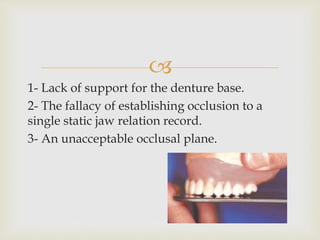
1- Lack of support for the denture base.
2- The fallacy of establishing occlusion to a
single static jaw relation record.
3- An unacceptable occlusal plane.
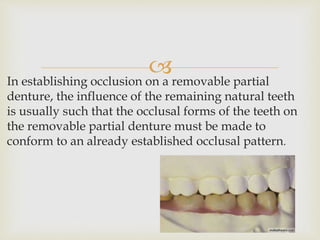
In establishing occlusion on a removable partial
denture, the influence of the remaining natural teeth
is usually such that the occlusal forms of the teeth on
the removable partial denture must be made to
conform to an already established occlusal pattern.

1- Analysis of the existing occlusion.
2- Correction of the existing occlusal disharmony.
3- Recording of centric relation or an adjusted centric
occlusion.
3- Harmonizing of eccentric jaw movements for a
functional eccentric occlusion.
5- Correction of occlusal discrepancies created by the fit
of the framework and during processing of the
removable partial denture.
The establishment of satisfactory occlusion
for RPD should include:-
 The following occlusal arrangements are recommended to
develop a harmonious occlusal relationship among
removable partial dentures and to enhance stability of the
removable partial dentures:-
1- Simultaneous bilateral contacts of opposing pos-
terior teeth must occur in centric occlusion.
2- Occlusion for tooth-supported removable partial
dentures may be arranged similar to the occlusion
seen in a harmonious natural dentition.
Desirable occlusal contact
relationships for various RPD:
3- Bilateral balanced occlusion in eccentric positions
should be formulated when a maxillary complete
opposes the removable partial denture. (Fiq.A)
4- Working side contacts should be obtained for the
mandibular distal extension denture these contacts
should occur simultaneously with working side
contacts of the natural teeth to (Fiq.B)

A B

5- Simultaneous working and balancing contacts
should be formulated for the maxillary bilateral
distal extension removable partial denture when-
ever possible. *teeth often set a lateral to crest of the
ridge and the teeth arranged too minimize tipping
of the denture and distribute the forces broadly to
supporting structure
6- Only working contacts need to be formulated for
either the maxillary or mandibular unilateral distal
extension removable partial denture. *Balancing side
contacts would not enhance the stability of the
denture .
7- In the Kennedy Class IV removable partial
denture configuration, contact of opposing anterior
teeth in the planned intercuspal position is desired to
prevent a continuous eruption of the opposing
natural incisors, *unless they are otherwise
prevented from extrusion.
8- Balanced contact of opposing posterior teeth in a
straight forward protrusive relationship and func-
tional excursive positions is desired only when an
opposing complete denture or bilateral distal
extension maxillary removable partial denture is
placed.
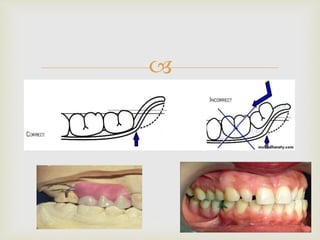
9- Artificial posterior teeth should not be arranged
farther distally than the beginning of a sharp upward
incline of the mandibular residual ridge or over the
retromolar pad.
1- Whatever is the treatment of choice, it must be
capable of function within the pattern of the patient’s
own functional requirements.
2- The combined occlusal patterns of natural and
artificial teeth must be adjusted to function
harmonically with other parts of the masticatory
system.
Occlusion in RPD’s
(Requirements):
3- When posterior teeth of one jaw are brought into contact
with their antagonists in centric occlusion, they should
touch simultaneously with no deflective occlusal contacts.
4- Opposing, contacting teeth should glide freely and
without cuspal interference throughout the functional
range of occlusal movement.
5- Attempts to create artificial occlusal surfaces should be
preceded by the elimination of any occlusal discrepancies
in the natural teeth.
6- Artificial posterior teeth should be smaller bucco-
lingualy than the natural teeth which they replace.
7- Artificial teeth should be arranged so the tongue will not
be inhibited nor will the shape of the palatal vault be
substantially altered.
8- The horizontal jaw position to which the RPD’s will be
constructed-centric relation or centric occlusion, when these
factors do not coincide in the remaining natural teeth – is
an important decision which must be made prior to the
construction of the restorations.

a) Direct apposition of cast.
b) Interocclusal records with posterior teeth remaining.
c) Occlusal relations using occlusion rims on record base.
d) Jaw relations records made entirely on occlusion rims.
e) Establishing occlusion by the recording of occlusal
pathways.
*Five methods of establishing occlusal relationships for
RPDs, vary from simple apposition of opposing casts by
occluding sufficient remaining natural teeth to the recording
of jaw relations (vertical and horizontal) in the same manner
as for completely edentulous patient.
Methods for establishing
occlusal relationship
 For the purpose of jaw relationships and their registration
partially dentate patients can be divided into two
categories:-
1- Patients without an occlusal stop to indicate the
correct intercuspal position or vertical dimension of
occlusion.
2- Patients with occlusal contact in the intercuspal
position.
Recording Jaw Relationships for
RPD
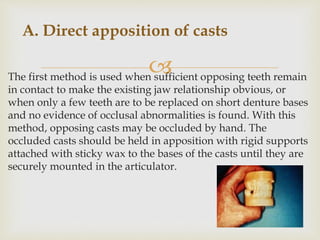
The first method is used when sufficient opposing teeth remain
in contact to make the existing jaw relationship obvious, or
when only a few teeth are to be replaced on short denture bases
and no evidence of occlusal abnormalities is found. With this
method, opposing casts may be occluded by hand. The
occluded casts should be held in apposition with rigid supports
attached with sticky wax to the bases of the casts until they are
securely mounted in the articulator.
A. Direct apposition of casts
 A second method, which is a modification of the first, is
used when sufficient natural teeth remain to support the
removable partial denture (Kennedy Class III or IV) but the
relation of opposing natural teeth does not permit the
occluding of casts by hand. In such situations, jaw relations
must be established as for fixed restorations with some type
of interocclusal record.
 The least accurate of these methods is the interocclusal wax
record. The bulk, consistency, and accuracy of the wax will
influence the successful recording of centric relation.
Therefore a definite procedure for making interocclusal wax
records is given as follows:-
B. Interocclusal records with
posterior teeth remaining
 A uniformly softened, metal-reinforced wafer of baseplate or set-up
wax is placed between the teeth, and the patient is guided to close
in centric relation. The wax then is removed and immediately
chilled thoroughly in room-temperature water. It should be
replaced a second time to correct the distortion that results from
chilling and then again chilled after removal.
 Any excess wax is removed, in these cases a contact between upper
and lower natural teeth occurs at acceptable vertical dimension.
 A wax record can be further corrected with a freely flowing
occlusal registration material, such as a metallic oxide paste, which
is used as the final recording medium. The occlusal registration
material then is mixed and applied to both sides of the metal-
reinforced wax record. It is quickly placed, and the patient is
assisted to close into centric relation, which will be guided by the
previous wax record
 After the occlusal registration material has set, the corrected
wax record is removed and inspected for accuracy. Some of
the advantages of using a metallic oxide paste over wax as a
recording medium for occlusal records include:
1. Uniformity of consistency.
2. Ease of displacement on closure.
3. Accuracy of occlusal surface reproduction.
4. Dimensional stability.
5. The possibility of some modification in occlusal relationship
after closure, if it is made before the material sets.
6. Reduced likelihood of distortion during mounting
procedures.
 Indications:-
1. When one or more distal extension areas are present.
2. When a tooth- supported edentulous space is large.
3. When opposing teeth do not meet.
 In these instances occlusion rims on accurate bases are used
where the occlusal surface of a rim opposes standing teeth, a
layer of modelling wax approximately 2mm depth is added to
occlusal surface of the rim, and the wax is thoroughly softened
by using a hot wax knife. The rim is seated in the mouth and the
mandible guided carefully into closure until maximal
intercuspal contact for natural teeth occurs.
C. Occlusal relations using
occlusion rims on record base:
 Indications:-
1. When an opposing maxillary complete denture is to be made
concurrently with a mandibular removable partial denture.
2. Used in those rare situation in which the few remaining teeth do not
occlude and will not influence eccentric jaw movements.
3. When either arch has only anterior teeth present.
 In any of these situations, jaw relation records are made entirely on
occlusion rims. The occlusion rims must be supported by accurate jaw
relation record bases. Here, the choice of method for recording jaw
relations is much the same as that for complete dentures
D. Jaw relation records made
entirely on occlusion rims
. Either some direct inter- occlusal method or a
stylus tracing may be used. As with complete
denture fabrication, the use of a face bow, the
choice of articulator, the choice of method for
recording jaw relations, and the use of eccentric
positional records are optional, based on the
training, ability, and desires of the individual
dentist
The fifth method of establishing occlusion on the
removable partial denture is the registration of
occlusal path- ways and the use of an occluding
template rather than a cast of the opposing arch.
When a static jaw relation record is used, with or
without eccentric articulatory movements, the
prosthetically supplied teeth are arranged to
occlude according to a specific concept of occlusion.
On the other hand, when a functional occlusal
record is used, the teeth are modified to accept
every recorded eccentric jaw movement.
E. Establishing Occlusion by the
Recording of Occlusal Pathways
These movements are made more complicated by the
influence of the remaining natural teeth. In the partially
edentulous arch in which RPD is to be fabricated, a hard
inlay wax is placed over the stable denture base and
patient is asked to carry out all extremes of mandibular
movement. Inform the patient that the occlusion rim
must be worn for 24 hours or longer. It should be worn
constantly, including at nighttime, except for removal
during meals. With wearing and biting into a hard wax
occlusion rim, a record is made of all extremes of jaw
movement.

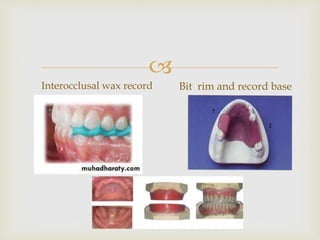
Interocclusal wax record Bit rim and record base
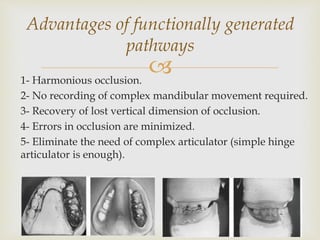
1- Harmonious occlusion.
2- No recording of complex mandibular movement required.
3- Recovery of lost vertical dimension of occlusion.
4- Errors in occlusion are minimized.
5- Eliminate the need of complex articulator (simple hinge
articulator is enough).
Advantages of functionally generated
pathways
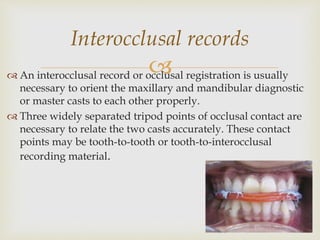
 An interocclusal record or occlusal registration is usually
necessary to orient the maxillary and mandibular diagnostic
or master casts to each other properly.
 Three widely separated tripod points of occlusal contact are
necessary to relate the two casts accurately. These contact
points may be tooth-to-tooth or tooth-to-interocclusal
recording material.
Interocclusal records
 A stable orientation of the opposing casts may exist if
sufficient teeth remain, and in these patients no
interocclusal relation recording is necessary. It is suggested,
however, that orientation lines be drawn on the casts to
guarantee proper cast alignment in the future. An
interocclusal recording will be necessary if insufficient teeth
remain to allow a stable cast-to-cast relationship. Some
mention must be made of the ridge on which the record
bases are formed. If the prosthesis is to be tooth supported
or if a distal extension base is to be made on the anatomic
ridge form, the bases will be made to fit that form of the
residual ridge.
 When a recording is necessary, a record base, occlusion rim,
and occlusal recording material are needed to make the
recording accurately. It has been suggested that the record
base be fabricated using auto-polymerizing acrylic resin,
although they often are fabricated of light polymerized
resin. The record base must be made on the cast to be
attached to the articulator. The occlusion rims most often
are made using hard baseplate wax.
zinc oxide eugenol impression material.
plaster impression material.
modeling compound.
Polyether.
Polyvinyl siloxane.
Wax records made in edentulous areas with or
without the support of record bases may not be
sufficiently stable to be acceptable.
Excellent occlusal recording
materials include
The interocclusal recording is most often made after
fabrication of the removable partial denture framework.
Following the fitting of the framework and the making
of a corrected cast impression (if indicated), the record
base is fabricated on the edentulous areas of the
framework/master cast. Occlusion rims are added, and
an occlusal recording material is used to make the
record. The cast is oriented to the opposing cast with
the recording, and desired denture teeth are selected.
This fabrication is followed by a trial insertion
appointment.

Thank
you

Occlusal relationship for removable partial denture

  • 1.
    And Recording JawRelationship of RPD Nuha fadhil
  • 2.
    The fourth phasein the treatment of patients with removable partial dentures is the estab- lishment of a functional and harmonious occlusion. Occlusal harmony between a removable partial denture and the remaining natural teeth is a major factor in the preservation of the health of their surrounding structures.
  • 3.
     In removable partialdentures, occlusal stresses can be transmitted directly to the abutment teeth and other supporting structures because of the attachment of the removable partial denture to the abutment teeth. Failure to provide and maintain adequate occlusion on the removable partial denture is primarily a result of:
  • 4.
     1- Lack ofsupport for the denture base. 2- The fallacy of establishing occlusion to a single static jaw relation record. 3- An unacceptable occlusal plane.
  • 5.
    In establishing occlusionon a removable partial denture, the influence of the remaining natural teeth is usually such that the occlusal forms of the teeth on the removable partial denture must be made to conform to an already established occlusal pattern.
  • 6.
     1- Analysis ofthe existing occlusion. 2- Correction of the existing occlusal disharmony. 3- Recording of centric relation or an adjusted centric occlusion. 3- Harmonizing of eccentric jaw movements for a functional eccentric occlusion. 5- Correction of occlusal discrepancies created by the fit of the framework and during processing of the removable partial denture. The establishment of satisfactory occlusion for RPD should include:-
  • 7.
     The followingocclusal arrangements are recommended to develop a harmonious occlusal relationship among removable partial dentures and to enhance stability of the removable partial dentures:- 1- Simultaneous bilateral contacts of opposing pos- terior teeth must occur in centric occlusion. 2- Occlusion for tooth-supported removable partial dentures may be arranged similar to the occlusion seen in a harmonious natural dentition. Desirable occlusal contact relationships for various RPD:
  • 8.
    3- Bilateral balancedocclusion in eccentric positions should be formulated when a maxillary complete opposes the removable partial denture. (Fiq.A) 4- Working side contacts should be obtained for the mandibular distal extension denture these contacts should occur simultaneously with working side contacts of the natural teeth to (Fiq.B)
  • 9.
  • 10.
     5- Simultaneous workingand balancing contacts should be formulated for the maxillary bilateral distal extension removable partial denture when- ever possible. *teeth often set a lateral to crest of the ridge and the teeth arranged too minimize tipping of the denture and distribute the forces broadly to supporting structure
  • 11.
    6- Only workingcontacts need to be formulated for either the maxillary or mandibular unilateral distal extension removable partial denture. *Balancing side contacts would not enhance the stability of the denture . 7- In the Kennedy Class IV removable partial denture configuration, contact of opposing anterior teeth in the planned intercuspal position is desired to prevent a continuous eruption of the opposing natural incisors, *unless they are otherwise prevented from extrusion.
  • 12.
    8- Balanced contactof opposing posterior teeth in a straight forward protrusive relationship and func- tional excursive positions is desired only when an opposing complete denture or bilateral distal extension maxillary removable partial denture is placed. 9- Artificial posterior teeth should not be arranged farther distally than the beginning of a sharp upward incline of the mandibular residual ridge or over the retromolar pad.
  • 13.
    1- Whatever isthe treatment of choice, it must be capable of function within the pattern of the patient’s own functional requirements. 2- The combined occlusal patterns of natural and artificial teeth must be adjusted to function harmonically with other parts of the masticatory system. Occlusion in RPD’s (Requirements):
  • 14.
    3- When posteriorteeth of one jaw are brought into contact with their antagonists in centric occlusion, they should touch simultaneously with no deflective occlusal contacts. 4- Opposing, contacting teeth should glide freely and without cuspal interference throughout the functional range of occlusal movement. 5- Attempts to create artificial occlusal surfaces should be preceded by the elimination of any occlusal discrepancies in the natural teeth.
  • 15.
    6- Artificial posteriorteeth should be smaller bucco- lingualy than the natural teeth which they replace. 7- Artificial teeth should be arranged so the tongue will not be inhibited nor will the shape of the palatal vault be substantially altered. 8- The horizontal jaw position to which the RPD’s will be constructed-centric relation or centric occlusion, when these factors do not coincide in the remaining natural teeth – is an important decision which must be made prior to the construction of the restorations.
  • 16.
  • 17.
    a) Direct appositionof cast. b) Interocclusal records with posterior teeth remaining. c) Occlusal relations using occlusion rims on record base. d) Jaw relations records made entirely on occlusion rims. e) Establishing occlusion by the recording of occlusal pathways. *Five methods of establishing occlusal relationships for RPDs, vary from simple apposition of opposing casts by occluding sufficient remaining natural teeth to the recording of jaw relations (vertical and horizontal) in the same manner as for completely edentulous patient. Methods for establishing occlusal relationship
  • 18.
     For thepurpose of jaw relationships and their registration partially dentate patients can be divided into two categories:- 1- Patients without an occlusal stop to indicate the correct intercuspal position or vertical dimension of occlusion. 2- Patients with occlusal contact in the intercuspal position. Recording Jaw Relationships for RPD
  • 19.
    The first methodis used when sufficient opposing teeth remain in contact to make the existing jaw relationship obvious, or when only a few teeth are to be replaced on short denture bases and no evidence of occlusal abnormalities is found. With this method, opposing casts may be occluded by hand. The occluded casts should be held in apposition with rigid supports attached with sticky wax to the bases of the casts until they are securely mounted in the articulator. A. Direct apposition of casts
  • 20.
     A secondmethod, which is a modification of the first, is used when sufficient natural teeth remain to support the removable partial denture (Kennedy Class III or IV) but the relation of opposing natural teeth does not permit the occluding of casts by hand. In such situations, jaw relations must be established as for fixed restorations with some type of interocclusal record.  The least accurate of these methods is the interocclusal wax record. The bulk, consistency, and accuracy of the wax will influence the successful recording of centric relation. Therefore a definite procedure for making interocclusal wax records is given as follows:- B. Interocclusal records with posterior teeth remaining
  • 21.
     A uniformlysoftened, metal-reinforced wafer of baseplate or set-up wax is placed between the teeth, and the patient is guided to close in centric relation. The wax then is removed and immediately chilled thoroughly in room-temperature water. It should be replaced a second time to correct the distortion that results from chilling and then again chilled after removal.  Any excess wax is removed, in these cases a contact between upper and lower natural teeth occurs at acceptable vertical dimension.  A wax record can be further corrected with a freely flowing occlusal registration material, such as a metallic oxide paste, which is used as the final recording medium. The occlusal registration material then is mixed and applied to both sides of the metal- reinforced wax record. It is quickly placed, and the patient is assisted to close into centric relation, which will be guided by the previous wax record
  • 22.
     After theocclusal registration material has set, the corrected wax record is removed and inspected for accuracy. Some of the advantages of using a metallic oxide paste over wax as a recording medium for occlusal records include: 1. Uniformity of consistency. 2. Ease of displacement on closure. 3. Accuracy of occlusal surface reproduction. 4. Dimensional stability. 5. The possibility of some modification in occlusal relationship after closure, if it is made before the material sets. 6. Reduced likelihood of distortion during mounting procedures.
  • 23.
     Indications:- 1. Whenone or more distal extension areas are present. 2. When a tooth- supported edentulous space is large. 3. When opposing teeth do not meet.  In these instances occlusion rims on accurate bases are used where the occlusal surface of a rim opposes standing teeth, a layer of modelling wax approximately 2mm depth is added to occlusal surface of the rim, and the wax is thoroughly softened by using a hot wax knife. The rim is seated in the mouth and the mandible guided carefully into closure until maximal intercuspal contact for natural teeth occurs. C. Occlusal relations using occlusion rims on record base:
  • 24.
     Indications:- 1. Whenan opposing maxillary complete denture is to be made concurrently with a mandibular removable partial denture. 2. Used in those rare situation in which the few remaining teeth do not occlude and will not influence eccentric jaw movements. 3. When either arch has only anterior teeth present.  In any of these situations, jaw relation records are made entirely on occlusion rims. The occlusion rims must be supported by accurate jaw relation record bases. Here, the choice of method for recording jaw relations is much the same as that for complete dentures D. Jaw relation records made entirely on occlusion rims
  • 25.
    . Either somedirect inter- occlusal method or a stylus tracing may be used. As with complete denture fabrication, the use of a face bow, the choice of articulator, the choice of method for recording jaw relations, and the use of eccentric positional records are optional, based on the training, ability, and desires of the individual dentist
  • 26.
    The fifth methodof establishing occlusion on the removable partial denture is the registration of occlusal path- ways and the use of an occluding template rather than a cast of the opposing arch. When a static jaw relation record is used, with or without eccentric articulatory movements, the prosthetically supplied teeth are arranged to occlude according to a specific concept of occlusion. On the other hand, when a functional occlusal record is used, the teeth are modified to accept every recorded eccentric jaw movement. E. Establishing Occlusion by the Recording of Occlusal Pathways
  • 27.
    These movements aremade more complicated by the influence of the remaining natural teeth. In the partially edentulous arch in which RPD is to be fabricated, a hard inlay wax is placed over the stable denture base and patient is asked to carry out all extremes of mandibular movement. Inform the patient that the occlusion rim must be worn for 24 hours or longer. It should be worn constantly, including at nighttime, except for removal during meals. With wearing and biting into a hard wax occlusion rim, a record is made of all extremes of jaw movement.
  • 28.
     Interocclusal wax recordBit rim and record base
  • 29.
    1- Harmonious occlusion. 2-No recording of complex mandibular movement required. 3- Recovery of lost vertical dimension of occlusion. 4- Errors in occlusion are minimized. 5- Eliminate the need of complex articulator (simple hinge articulator is enough). Advantages of functionally generated pathways
  • 30.
     An interocclusalrecord or occlusal registration is usually necessary to orient the maxillary and mandibular diagnostic or master casts to each other properly.  Three widely separated tripod points of occlusal contact are necessary to relate the two casts accurately. These contact points may be tooth-to-tooth or tooth-to-interocclusal recording material. Interocclusal records
  • 31.
     A stableorientation of the opposing casts may exist if sufficient teeth remain, and in these patients no interocclusal relation recording is necessary. It is suggested, however, that orientation lines be drawn on the casts to guarantee proper cast alignment in the future. An interocclusal recording will be necessary if insufficient teeth remain to allow a stable cast-to-cast relationship. Some mention must be made of the ridge on which the record bases are formed. If the prosthesis is to be tooth supported or if a distal extension base is to be made on the anatomic ridge form, the bases will be made to fit that form of the residual ridge.
  • 32.
     When arecording is necessary, a record base, occlusion rim, and occlusal recording material are needed to make the recording accurately. It has been suggested that the record base be fabricated using auto-polymerizing acrylic resin, although they often are fabricated of light polymerized resin. The record base must be made on the cast to be attached to the articulator. The occlusion rims most often are made using hard baseplate wax.
  • 33.
    zinc oxide eugenolimpression material. plaster impression material. modeling compound. Polyether. Polyvinyl siloxane. Wax records made in edentulous areas with or without the support of record bases may not be sufficiently stable to be acceptable. Excellent occlusal recording materials include
  • 34.
    The interocclusal recordingis most often made after fabrication of the removable partial denture framework. Following the fitting of the framework and the making of a corrected cast impression (if indicated), the record base is fabricated on the edentulous areas of the framework/master cast. Occlusion rims are added, and an occlusal recording material is used to make the record. The cast is oriented to the opposing cast with the recording, and desired denture teeth are selected. This fabrication is followed by a trial insertion appointment.
  • 35.