WAVES
I. Types of Waves
A. What is a wave?
A wave is a disturbance that carries energy through
matter or space.
A leaf floating on water will bob up as a wave passes by.
After the wave passes, the leaf will drop back close to
its original position. Likewise, individual drops of water
are lifted up when a wave passes and then drop back
close to their resting places. They do not travel with the
wave.
If leaves and drops of water don’t move along with the
wave as the wave passes, then what does? Energy
Most waves travel through a medium.
Examples:
1.) Ripples in a pond are disturbances that travel
through water.
2.) The sound you hear from your stereo is a
disturbance that travels in waves through air.
3.) Earthquakes are disturbances that travel in
seismic waves, waves that travel through Earth.
In each of these examples, waves involve the
movement of some kind of matter. The matter
through which a wave travels is called the
medium.
Size of Wave
The bigger the wave is, the more
energy it carries. A wave caused by
dropping a stone in a pond may carry
enoughj energy to move a leaf up and
down several centimeters. A cruise
ship moving through the ocean may
create waves big enough to move a
fishing boat up and down a few
meters.
Energy May Spread Out As A Wave

Example: If you stand next to the
speakers at a rock concert, the sound
waves may damage your ears. But if
you stand 100m away, the sound of
the rock band is harmless. Why?
Why??? Continued…….
Think about the waves created when a stone falls
into a pond. The waves spread out in circles
that get bigger as the waves move farther from
the center. Each of these circles, called a wave
front, carries the same amount of energy. But in
the larger circles, the energy is spread out over
a larger area. When sound waves travel in air,
the waves spread out in spheres. As the waves
travel outward, the spherical wave fronts get
bigger, so the energy spreads out over a larger
volume.
Vibrations and Waves
Waves are related to vibrations. Most waves are
caused by vibrating objects.
Example: 1.) The sound waves produced by a
singer are caused by vibrating vocal cords.
2.) Electromagnetic waves may be caused by
vibrating charged particles.
In the case of a mechanical wave, the particles in
the medium through which the wave passes
vibrate, too.
What is the source of most waves?
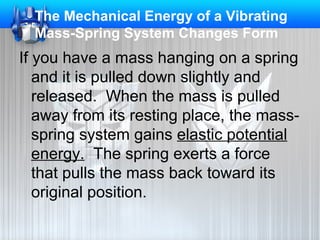
The Mechanical Energy of a Vibrating
Mass-Spring System Changes Form

If you have a mass hanging on a spring
and it is pulled down slightly and
released. When the mass is pulled
away from its resting place, the massspring system gains elastic potential
energy. The spring exerts a force
that pulls the mass back toward its
original position.
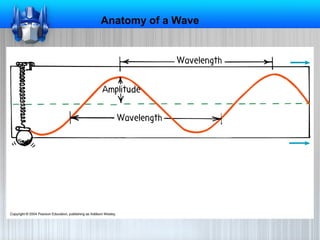
Anatomy of a Wave
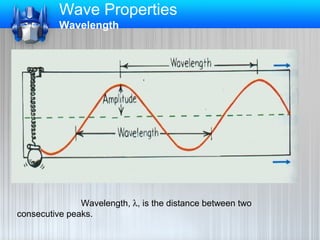
Wave Properties
Wavelength

Wavelength, λ, is the distance between two
consecutive peaks.
Waves

Waves

  • 1.
  • 2.
    I. Types ofWaves A. What is a wave? A wave is a disturbance that carries energy through matter or space. A leaf floating on water will bob up as a wave passes by. After the wave passes, the leaf will drop back close to its original position. Likewise, individual drops of water are lifted up when a wave passes and then drop back close to their resting places. They do not travel with the wave. If leaves and drops of water don’t move along with the wave as the wave passes, then what does? Energy
  • 3.
    Most waves travelthrough a medium. Examples: 1.) Ripples in a pond are disturbances that travel through water. 2.) The sound you hear from your stereo is a disturbance that travels in waves through air. 3.) Earthquakes are disturbances that travel in seismic waves, waves that travel through Earth. In each of these examples, waves involve the movement of some kind of matter. The matter through which a wave travels is called the medium.
  • 4.
    Size of Wave Thebigger the wave is, the more energy it carries. A wave caused by dropping a stone in a pond may carry enoughj energy to move a leaf up and down several centimeters. A cruise ship moving through the ocean may create waves big enough to move a fishing boat up and down a few meters.
  • 5.
    Energy May SpreadOut As A Wave Example: If you stand next to the speakers at a rock concert, the sound waves may damage your ears. But if you stand 100m away, the sound of the rock band is harmless. Why?
  • 6.
    Why??? Continued……. Think aboutthe waves created when a stone falls into a pond. The waves spread out in circles that get bigger as the waves move farther from the center. Each of these circles, called a wave front, carries the same amount of energy. But in the larger circles, the energy is spread out over a larger area. When sound waves travel in air, the waves spread out in spheres. As the waves travel outward, the spherical wave fronts get bigger, so the energy spreads out over a larger volume.
  • 7.
    Vibrations and Waves Wavesare related to vibrations. Most waves are caused by vibrating objects. Example: 1.) The sound waves produced by a singer are caused by vibrating vocal cords. 2.) Electromagnetic waves may be caused by vibrating charged particles. In the case of a mechanical wave, the particles in the medium through which the wave passes vibrate, too. What is the source of most waves?
  • 8.
    The Mechanical Energyof a Vibrating Mass-Spring System Changes Form If you have a mass hanging on a spring and it is pulled down slightly and released. When the mass is pulled away from its resting place, the massspring system gains elastic potential energy. The spring exerts a force that pulls the mass back toward its original position.
  • 9.
  • 11.
    Wave Properties Wavelength Wavelength, λ,is the distance between two consecutive peaks.