Wave MOTION
 Disturbance of form of energy
Transfer of energy through vibration of
particle
Possible in a medium which posses the
property of elasticity and inertia
Transfer of energy depends on the nature of
medium
Types of wave
1. Transverse Wave
2. Longitudinal wave
Transverse wave
Particle of medium vibrates perpendicular to
the direction of propagation of wave
Travels producing crests and troughs in
medium
Propagates only in solid and surface of liquid
No pressure vibration
E.g. Ripples on the surface of water, vibration
on the guitar string
Longitudinal wave
Particle of medium vibrate along the direction
of propagation of wave
Travels producing series of compression and
rarefaction
Propagates in all type of media
Pressure and density maximum at
compression and minimum at rarefaction
E.g Sound wave , ultra sound waves
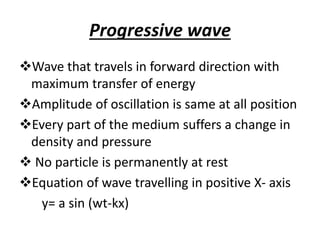
Progressive wave
Wave that travels in forward direction with
maximum transfer of energy
Amplitude of oscillation is same at all position
Every part of the medium suffers a change in
density and pressure
 No particle is permanently at rest
Equation of wave travelling in positive X- axis
y= a sin (wt-kx)
Stationary wave
 Resultant wave formed due to the superposition
of two waves
 Component waves have equal frequency and
travels in opposite direction
 Amplitude and pressure of oscillation varies from
zero at node and maximum at antinode
 Particles at node are at rest
 Equation of stationary wave : y= 2a coskx sinwt
i.e y= A sinwt , A=resultant amplitude

Wave motion

  • 1.
    Wave MOTION  Disturbanceof form of energy Transfer of energy through vibration of particle Possible in a medium which posses the property of elasticity and inertia Transfer of energy depends on the nature of medium
  • 2.
    Types of wave 1.Transverse Wave 2. Longitudinal wave
  • 3.
    Transverse wave Particle ofmedium vibrates perpendicular to the direction of propagation of wave Travels producing crests and troughs in medium Propagates only in solid and surface of liquid No pressure vibration E.g. Ripples on the surface of water, vibration on the guitar string
  • 4.
    Longitudinal wave Particle ofmedium vibrate along the direction of propagation of wave Travels producing series of compression and rarefaction Propagates in all type of media Pressure and density maximum at compression and minimum at rarefaction E.g Sound wave , ultra sound waves
  • 5.
    Progressive wave Wave thattravels in forward direction with maximum transfer of energy Amplitude of oscillation is same at all position Every part of the medium suffers a change in density and pressure  No particle is permanently at rest Equation of wave travelling in positive X- axis y= a sin (wt-kx)
  • 6.
    Stationary wave  Resultantwave formed due to the superposition of two waves  Component waves have equal frequency and travels in opposite direction  Amplitude and pressure of oscillation varies from zero at node and maximum at antinode  Particles at node are at rest  Equation of stationary wave : y= 2a coskx sinwt i.e y= A sinwt , A=resultant amplitude