The Story Of Waves Marine Biology
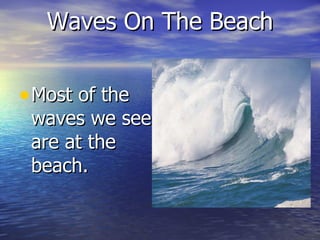
Waves On The Beach Most of the waves we see are at the beach.
Waves On The Beach As the wave travels in shallower water it slows and eventually falls forward as a breaker.
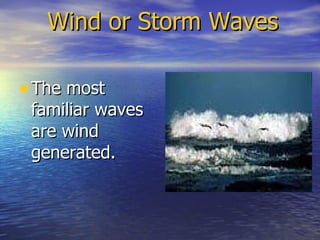
Wind or Storm Waves The most familiar waves are wind generated.
Wind or Storm Waves Three things determine how large these waves can become.
1. Wind Speed This is the speed that the wind is blowing. This is usually measured in knots or nautical miles per hour.
2. Duration Duration refers to the time over which the wind blows. Winds in some areas may blow strong for long periods of time which can produce large waves.
3. Fetch Fetch refers to the distance over which the wind blows. If a wind blows over thousands of miles the waves can get much larger than blowing across a small pond.
Tides Tides are caused mainly by the gravitational pull of the moon.
Other Things That Influence Tides The gravitational pull of the sun. The distance of the sun and the moon from earth. Winds and other factors.
Tides tend to be high where the gravitational force between the earth and the moon are the strongest, along with the opposite side of the earth where the centrifugal force is strongest.
Tidal Range Spring Tides Tides have the greatest range during spring tides. This occurs during the new and full moons.
Tidal Range Neap Tides Tides have the least amount of range during neap tides. This occurs during the  first and third quarters.
Tsunamis Tsunamis were once called Tidal waves, but they have nothing to do with the tides.
Tsunamis They are produced by earthquakes and other seismic disturbances. That’s why they’re also called  seismic sea waves.
Tsunamis are very long, fast moving waves! They can have wavelengths of 150 miles.
Tsunamis are very long, fast moving waves! They can travel at over 450 miles per hour! As fast as a jet!
The Danger of Tsunamis In the open ocean, a tsunami may only have a wave height of a few feet.
The Danger of Tsunamis As the wave approaches shallow water, it builds to heights that can reach greater than 100 feet.

Waves

  • 1.
    The Story OfWaves Marine Biology
  • 2.
    Waves On TheBeach Most of the waves we see are at the beach.
  • 3.
    Waves On TheBeach As the wave travels in shallower water it slows and eventually falls forward as a breaker.
  • 4.
    Wind or StormWaves The most familiar waves are wind generated.
  • 5.
    Wind or StormWaves Three things determine how large these waves can become.
  • 6.
    1. Wind SpeedThis is the speed that the wind is blowing. This is usually measured in knots or nautical miles per hour.
  • 7.
    2. Duration Durationrefers to the time over which the wind blows. Winds in some areas may blow strong for long periods of time which can produce large waves.
  • 8.
    3. Fetch Fetchrefers to the distance over which the wind blows. If a wind blows over thousands of miles the waves can get much larger than blowing across a small pond.
  • 9.
    Tides Tides arecaused mainly by the gravitational pull of the moon.
  • 10.
    Other Things ThatInfluence Tides The gravitational pull of the sun. The distance of the sun and the moon from earth. Winds and other factors.
  • 11.
    Tides tend tobe high where the gravitational force between the earth and the moon are the strongest, along with the opposite side of the earth where the centrifugal force is strongest.
  • 12.
    Tidal Range SpringTides Tides have the greatest range during spring tides. This occurs during the new and full moons.
  • 13.
    Tidal Range NeapTides Tides have the least amount of range during neap tides. This occurs during the first and third quarters.
  • 14.
    Tsunamis Tsunamis wereonce called Tidal waves, but they have nothing to do with the tides.
  • 15.
    Tsunamis They areproduced by earthquakes and other seismic disturbances. That’s why they’re also called seismic sea waves.
  • 16.
    Tsunamis are verylong, fast moving waves! They can have wavelengths of 150 miles.
  • 17.
    Tsunamis are verylong, fast moving waves! They can travel at over 450 miles per hour! As fast as a jet!
  • 18.
    The Danger ofTsunamis In the open ocean, a tsunami may only have a wave height of a few feet.
  • 19.
    The Danger ofTsunamis As the wave approaches shallow water, it builds to heights that can reach greater than 100 feet.