Born
Perents
 Emily Wijesinghe
 John Daniel Wijekoon
Kannangara
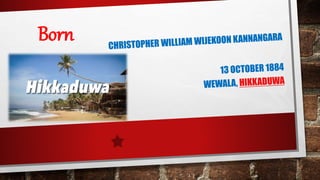
Christopher William Wijekoon Kannangara was born on 13
October 1884, atWee Badu Walawwa (his maternal ancestral
home) in the village ofWewala, off Hikkaduwa in the Southern
Province of Ceylon. It has been inaccurately quoted that
Kannangara was born in Randombe, (off Ambalangoda). Born to
John DanielWijekoon Kannangara, the Deputy Fiscal in
the Police Magistrate's Court Balapitiya, and Emily Wijesinghe,
daughter of MudliyerWijesinghe. He had four siblings and his
mother passed away when he was small.
Early Life
Education
His academic prowess enabled him to win a
Foundation Scholarship to Richmond
College, Galle, a prestigious secondary school
at the time
Family
Spouse(s
Childrens
 Dr. Chithraranjan Swarajweera
Wijekoon Kannangara
 Kusumawathi Wijekoon
Senevirathne -nee Kannangara
Early career
 he joined its teaching staff as a mathematics teacher
and thereafter went on to teach mathematics
at Prince ofWales College, Moratuwa
 he studied law and passed the Proctor's Intermediate
examination and he started his legal practice in civil
law
Kannangara joined Anagarika Dharmapala's historically
significant temperance movement, and worked actively
with its leaders, including Sir D.B. Jayatilleke, D.S.
Senanayake, F.R. Senanayake and ArthurV. Dias.In 1911,
elections were held for the first time to elect an Educated
Ceylonese to the Legislative Council of Ceylon.The two
primary contests were Ponnambalam
Ramanathan and Marcus Fernando. Strongly supporting
Ramanathan, Kannangara was elected Honorary
Secretary of the committee supporting Ramanathan
Entry to politics
 Ceylon National
Congress
Political partys
Legislative Council
His kinsman O. C.Tillekeratne, Legislative Council
member for the Southern Province, died on 13 April 1923
in a fatal train accident at the Wellawatte station.
Kannangara contested for the vacant seat in a by-election
that was held on 23 May 1923 and was elected to the
Legislative Council
State Council
In 1931, he was elected President of the Ceylon National
Congress.That year following the recommendations of
the Donoughmore Commission, the State Council of
Ceylon was established, succeeding the Legislative Council
as the island's legislature. Kannangara was elected to the
State Council, defeating S.H. Dahanayake. For the first
time, the State Council, which had its members elected
via universal suffrage, compromised Executive
Committees and Ministers.Kannangara was appointed as
the first chairman of the Executive Committee of
Education in the State Council and thus became the first
Minister of Education of Ceylon in 1931.
 established a series of central schools (Madhya
Vidhyala), modelled on Royal College, Colombo,
 upgraded ancient pirivenas, educational establishments for
Buddhist monks, and established the University of Ceylon, the
first University in Sri Lanka
HIS thoughts
Education should be free from the Kindergarten to
the University.
The mother tongue should be used as the medium of
instruction in the Primary Schools
His recommendations
English should be taught in all schools from
standard III.
A curriculum for the child which would develop
its "head, heart and hands" should be
introduced. In other words, the education of
the emotions is as necessary as the education
of intellect and practical ability for the well-
being of the child
C.W.W. Kannangara retired from active politics
in 1956.
In 1961, he was awarded a DLitt by
theVidyodaya University.
A statue of C.W.W. Kannangara has been
erected at the Parakramabahu Central College
in Polgahawela.
Last Period
Died
He died on 23 September 1969
at the Colombo General
Hospital.
Memories
Today
Createby
L.A.K.E Bandara
PAS/2019/ICT/M/24
Thank You

Kannangara

  • 2.
  • 3.
    Perents  Emily Wijesinghe John Daniel Wijekoon Kannangara
  • 4.
    Christopher William WijekoonKannangara was born on 13 October 1884, atWee Badu Walawwa (his maternal ancestral home) in the village ofWewala, off Hikkaduwa in the Southern Province of Ceylon. It has been inaccurately quoted that Kannangara was born in Randombe, (off Ambalangoda). Born to John DanielWijekoon Kannangara, the Deputy Fiscal in the Police Magistrate's Court Balapitiya, and Emily Wijesinghe, daughter of MudliyerWijesinghe. He had four siblings and his mother passed away when he was small. Early Life
  • 5.
    Education His academic prowessenabled him to win a Foundation Scholarship to Richmond College, Galle, a prestigious secondary school at the time
  • 6.
  • 7.
  • 8.
    Childrens  Dr. ChithraranjanSwarajweera Wijekoon Kannangara  Kusumawathi Wijekoon Senevirathne -nee Kannangara
  • 9.
    Early career  hejoined its teaching staff as a mathematics teacher and thereafter went on to teach mathematics at Prince ofWales College, Moratuwa  he studied law and passed the Proctor's Intermediate examination and he started his legal practice in civil law
  • 11.
    Kannangara joined AnagarikaDharmapala's historically significant temperance movement, and worked actively with its leaders, including Sir D.B. Jayatilleke, D.S. Senanayake, F.R. Senanayake and ArthurV. Dias.In 1911, elections were held for the first time to elect an Educated Ceylonese to the Legislative Council of Ceylon.The two primary contests were Ponnambalam Ramanathan and Marcus Fernando. Strongly supporting Ramanathan, Kannangara was elected Honorary Secretary of the committee supporting Ramanathan Entry to politics
  • 12.
  • 13.
    Legislative Council His kinsmanO. C.Tillekeratne, Legislative Council member for the Southern Province, died on 13 April 1923 in a fatal train accident at the Wellawatte station. Kannangara contested for the vacant seat in a by-election that was held on 23 May 1923 and was elected to the Legislative Council
  • 14.
    State Council In 1931,he was elected President of the Ceylon National Congress.That year following the recommendations of the Donoughmore Commission, the State Council of Ceylon was established, succeeding the Legislative Council as the island's legislature. Kannangara was elected to the State Council, defeating S.H. Dahanayake. For the first time, the State Council, which had its members elected via universal suffrage, compromised Executive Committees and Ministers.Kannangara was appointed as the first chairman of the Executive Committee of Education in the State Council and thus became the first Minister of Education of Ceylon in 1931.
  • 16.
     established aseries of central schools (Madhya Vidhyala), modelled on Royal College, Colombo,
  • 17.
     upgraded ancientpirivenas, educational establishments for Buddhist monks, and established the University of Ceylon, the first University in Sri Lanka
  • 18.
  • 19.
    Education should befree from the Kindergarten to the University. The mother tongue should be used as the medium of instruction in the Primary Schools His recommendations
  • 20.
    English should betaught in all schools from standard III. A curriculum for the child which would develop its "head, heart and hands" should be introduced. In other words, the education of the emotions is as necessary as the education of intellect and practical ability for the well- being of the child
  • 21.
    C.W.W. Kannangara retiredfrom active politics in 1956. In 1961, he was awarded a DLitt by theVidyodaya University. A statue of C.W.W. Kannangara has been erected at the Parakramabahu Central College in Polgahawela. Last Period
  • 22.
    Died He died on23 September 1969 at the Colombo General Hospital.
  • 23.
  • 25.