How do people use water? With your table partner / group read the following and be prepared to report on how people use water: Agriculture (p 16) Industry (p 17) Transportation (p 17) Recreation (p 18) Home (p 17)
Water: A Vital Resource 6 th  Grade Science  KMS
How do people use water?  (video clip)
Why is water so important to life?  (p 19 -20) 0.037% of 3% Water vapor 0.34 % of 3% Lakes and Rivers 11 % of 3% Deep Groundwater 12% of  3% Shallow Groundwater 76 % of 3% Ice 97% Salt Water 1000 100% Earth ml % Type of Water
How much fresh water do we have? With your group complete the “Sharpen your Skills Activity” p. 20 .0011 0.037% of 3% Water vapor .1020 0.34 % of 3% Lakes and Rivers 3.30 11 % of 3% Deep Groundwater 3.60 12% of  3% Shallow Groundwater 22.8 76 % of 3% Ice 970 97% Salt Water 1000 100% Earth ml % Type of Water
What is the structure of water? Hydrogen (a gas by itself) Oxygen (a gas by itself) 2 H atoms + 1 O atom Polar molecule (like a small magnet)
What is a water molecule?  (video clip)
Surface Tension Tightness across surface of water Water molecules “stick together” like magnets Ex. (drops of water, paper clip floating, “cupside down” demo)
Surface Tension From a height of about 10 cm drop one drop of one liquid on your wax paper watch what happens when it hits the wax paper, move the wax paper around to make the drop follow the path.  Follow the same steps with a different liquid. Record your observations and draw a picture of the differences. Try to float a paper clip on the water and one other liquid
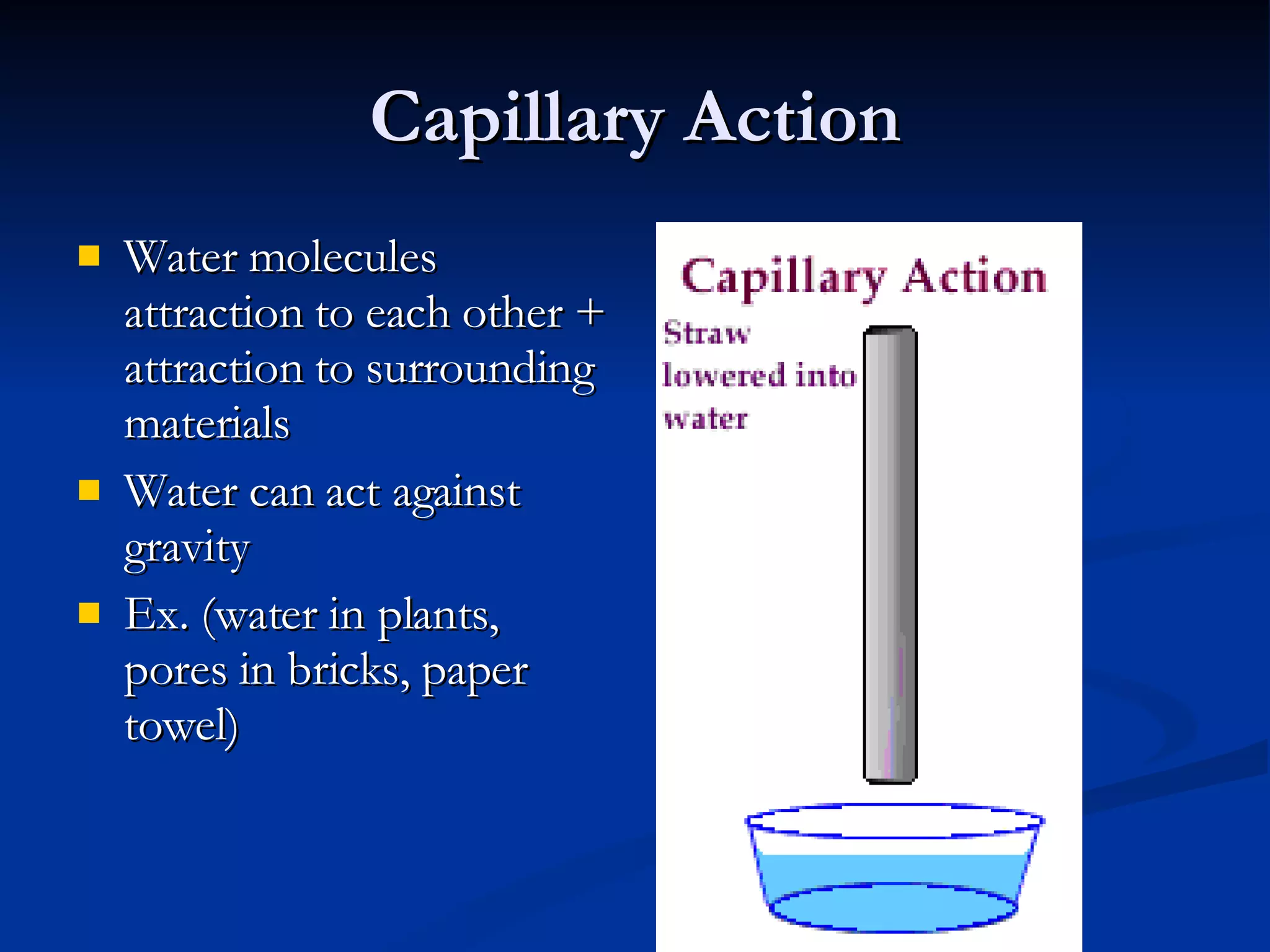
Capillary Action Water molecules attraction to each other + attraction to surrounding materials Water can act against gravity Ex. (water in plants, pores in bricks, paper towel)
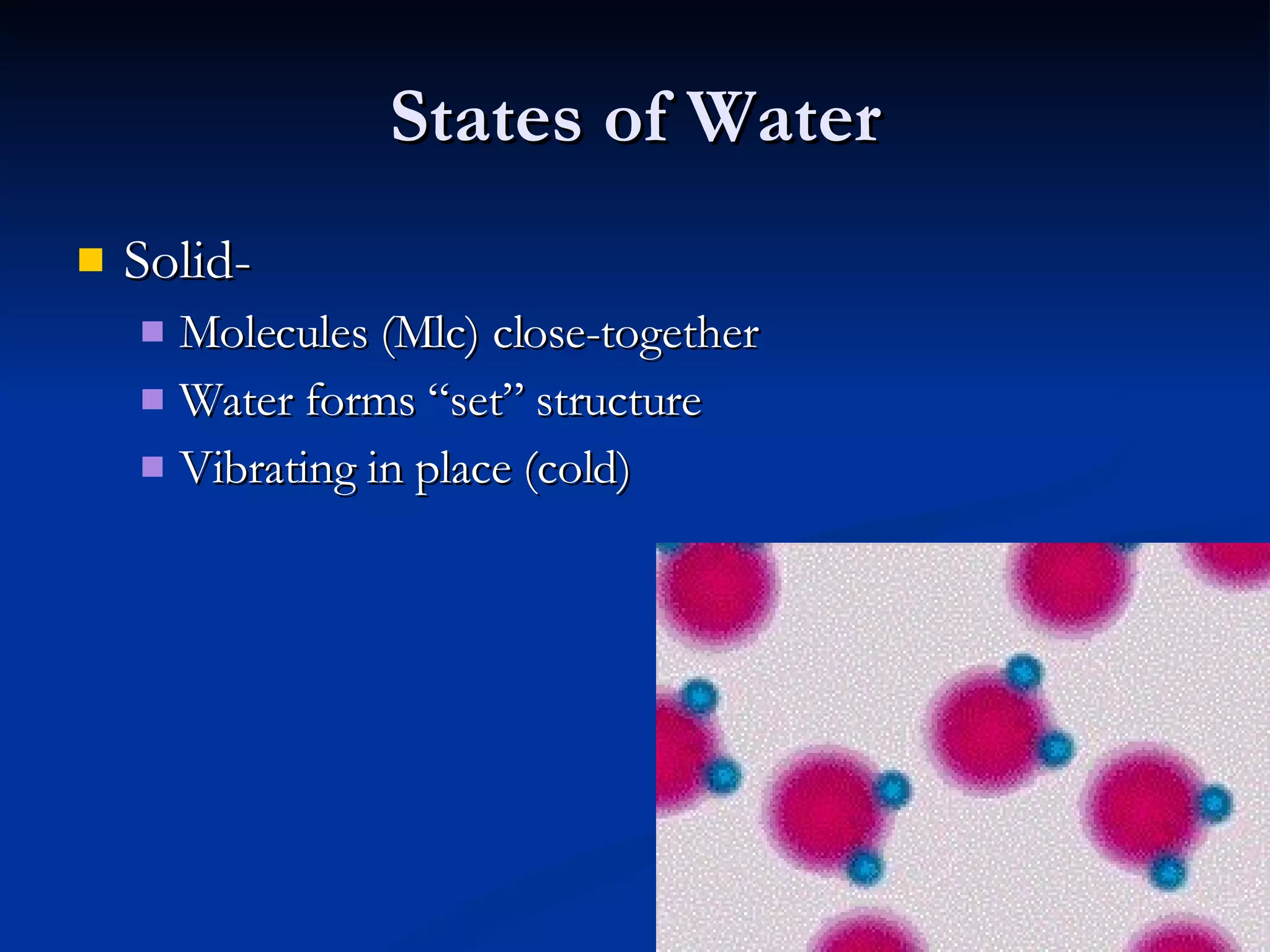
States of Water Solid-  Molecules (Mlc) close-together  Water forms “set” structure Vibrating in place (cold)
States of Water Liquid Mlc move more freely Water takes shape of container Mlc medium speed & temp.
States of Water Gas Mlc move very freely Spread out & fill space Move fast (Hot)
 
Density Each box has the same volume.  If each ball has the same mass, which box would weigh more? Why?
Density The box that has more balls has more mass per unit of volume (DENSITY) Density= Mass/Volume   Density = grams/milliliter http://www.edinformatics.com/math_science/density.htm
Density Practice A certain rock has a mass of 4 g and a volume of 2 ml what is the density?
Soda Comparison: Diet vs Regular The mass of a can of soda is _____ the volume of the can of soda is ________ the density is _________ The mass of a can of diet soda is _____ the volume of the can of diet  soda is ________ the density is _________
Soda Comparison Regular Soda Diet Soda Density Volume Mass
Density Hypothesis Your group will receive a vial with salt water and a vial with fresh water. Write a hypothesis about what you think will happen when both are placed in a tank of water.
Density  The mass of a vial of fresh water is _____ the volume of the vial of fresh water is ________ the density is _________ The mass of a vial of fresh water is _____ the volume of the vial of fresh water is ________ the density is _________
Density Activity Fresh Water Salt Water Density Volume Mass
Density Based on your calculations, do you want to change your hypothesis?
Factors that Effect Density  Dissolved solids (Salt, Minerals, etc.) Temperature Hot water is less dense
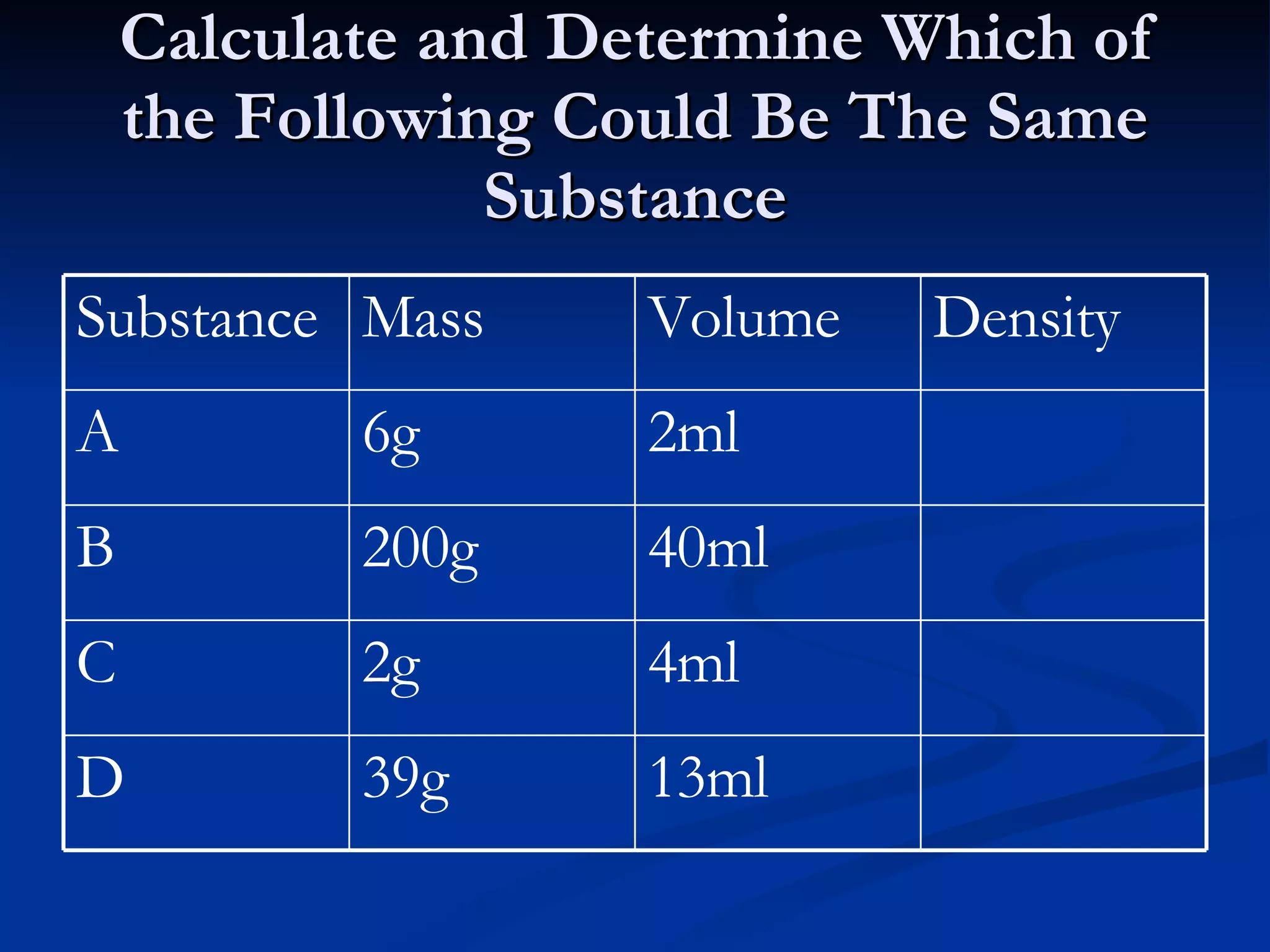
Calculate and Determine Which of the Following Could Be The Same Substance 13ml 39g D 4ml 2g C 40ml 200g B 2ml 6g A Density Volume Mass Substance
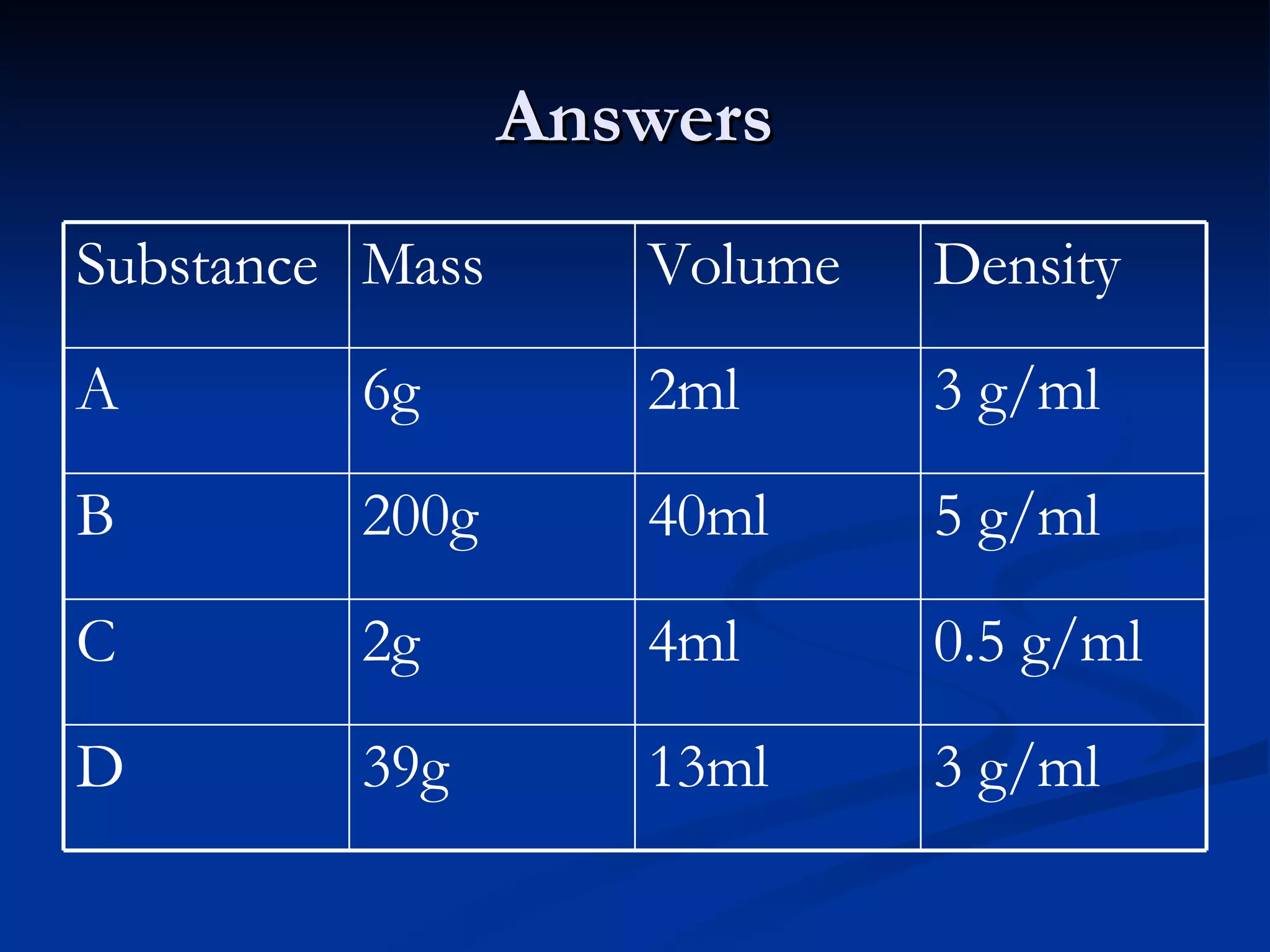
Answers 3 g/ml 13ml 39g D 0.5 g/ml 4ml 2g C 5 g/ml 40ml 200g B 3 g/ml 2ml 6g A Density Volume Mass Substance
Water Properties: Solvent Solvent  A liquid that dissolves another substance Solute Substance that is dissolved (Salt, Sugar, etc.)
Solvent Activity Measure 100 ml of water into each of 4 beakers Add 5ml of each of the following to each of the 4 beakers: Salt, Sand, Powdered Drink Mix, Oil Write a hypothesis stating which substances water will dissolve the best/worst
Solvent Activity Draw a picture and describe the results

Water Long Version

  • 1.
    How do peopleuse water? With your table partner / group read the following and be prepared to report on how people use water: Agriculture (p 16) Industry (p 17) Transportation (p 17) Recreation (p 18) Home (p 17)
  • 2.
    Water: A VitalResource 6 th Grade Science KMS
  • 3.
    How do peopleuse water? (video clip)
  • 4.
    Why is waterso important to life? (p 19 -20) 0.037% of 3% Water vapor 0.34 % of 3% Lakes and Rivers 11 % of 3% Deep Groundwater 12% of 3% Shallow Groundwater 76 % of 3% Ice 97% Salt Water 1000 100% Earth ml % Type of Water
  • 5.
    How much freshwater do we have? With your group complete the “Sharpen your Skills Activity” p. 20 .0011 0.037% of 3% Water vapor .1020 0.34 % of 3% Lakes and Rivers 3.30 11 % of 3% Deep Groundwater 3.60 12% of 3% Shallow Groundwater 22.8 76 % of 3% Ice 970 97% Salt Water 1000 100% Earth ml % Type of Water
  • 6.
    What is thestructure of water? Hydrogen (a gas by itself) Oxygen (a gas by itself) 2 H atoms + 1 O atom Polar molecule (like a small magnet)
  • 7.
    What is awater molecule? (video clip)
  • 8.
    Surface Tension Tightnessacross surface of water Water molecules “stick together” like magnets Ex. (drops of water, paper clip floating, “cupside down” demo)
  • 9.
    Surface Tension Froma height of about 10 cm drop one drop of one liquid on your wax paper watch what happens when it hits the wax paper, move the wax paper around to make the drop follow the path. Follow the same steps with a different liquid. Record your observations and draw a picture of the differences. Try to float a paper clip on the water and one other liquid
  • 10.
    Capillary Action Watermolecules attraction to each other + attraction to surrounding materials Water can act against gravity Ex. (water in plants, pores in bricks, paper towel)
  • 11.
    States of WaterSolid- Molecules (Mlc) close-together Water forms “set” structure Vibrating in place (cold)
  • 12.
    States of WaterLiquid Mlc move more freely Water takes shape of container Mlc medium speed & temp.
  • 13.
    States of WaterGas Mlc move very freely Spread out & fill space Move fast (Hot)
  • 14.
  • 15.
    Density Each boxhas the same volume. If each ball has the same mass, which box would weigh more? Why?
  • 16.
    Density The boxthat has more balls has more mass per unit of volume (DENSITY) Density= Mass/Volume Density = grams/milliliter http://www.edinformatics.com/math_science/density.htm
  • 17.
    Density Practice Acertain rock has a mass of 4 g and a volume of 2 ml what is the density?
  • 18.
    Soda Comparison: Dietvs Regular The mass of a can of soda is _____ the volume of the can of soda is ________ the density is _________ The mass of a can of diet soda is _____ the volume of the can of diet soda is ________ the density is _________
  • 19.
    Soda Comparison RegularSoda Diet Soda Density Volume Mass
  • 20.
    Density Hypothesis Yourgroup will receive a vial with salt water and a vial with fresh water. Write a hypothesis about what you think will happen when both are placed in a tank of water.
  • 21.
    Density Themass of a vial of fresh water is _____ the volume of the vial of fresh water is ________ the density is _________ The mass of a vial of fresh water is _____ the volume of the vial of fresh water is ________ the density is _________
  • 22.
    Density Activity FreshWater Salt Water Density Volume Mass
  • 23.
    Density Based onyour calculations, do you want to change your hypothesis?
  • 24.
    Factors that EffectDensity Dissolved solids (Salt, Minerals, etc.) Temperature Hot water is less dense
  • 25.
    Calculate and DetermineWhich of the Following Could Be The Same Substance 13ml 39g D 4ml 2g C 40ml 200g B 2ml 6g A Density Volume Mass Substance
  • 26.
    Answers 3 g/ml13ml 39g D 0.5 g/ml 4ml 2g C 5 g/ml 40ml 200g B 3 g/ml 2ml 6g A Density Volume Mass Substance
  • 27.
    Water Properties: SolventSolvent A liquid that dissolves another substance Solute Substance that is dissolved (Salt, Sugar, etc.)
  • 28.
    Solvent Activity Measure100 ml of water into each of 4 beakers Add 5ml of each of the following to each of the 4 beakers: Salt, Sand, Powdered Drink Mix, Oil Write a hypothesis stating which substances water will dissolve the best/worst
  • 29.
    Solvent Activity Drawa picture and describe the results