Submitted to:- Submitted by:-
Mr.Sameer Gautam Purushottam Dahal
VOIP
1Tuesday, December 16, 2014
About VoIP
How it Works
Advantages of VoIP
Disadvantage of VoIP
IP Telephony Standards
A Basic IP Telephone System
SIP(Session Initiation Protocol)
Telephone Number Mapping & Routing
CONTENTS:-
2
What is VoIP?
3
Emerging New
Technology
A recent application of Internet technology
4
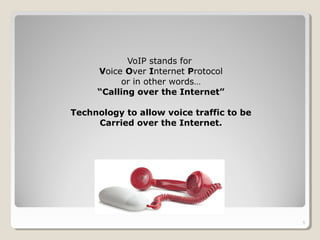
VoIP stands for
Voice Over Internet Protocol
or in other words…
“Calling over the Internet”
Technology to allow voice traffic to be
Carried over the Internet.
5
Voice over IP (VoIP) is a methodology and
group of technologies for the delivery of
voice communications and multimedia
sessions over Internet Protocol (IP)
networks, such as the Internet.
6
Like Skype!
Skype uses VoIP to make video calls over
the Internet
7
Most companies these days are switching to
VoIP phone systems
8
9
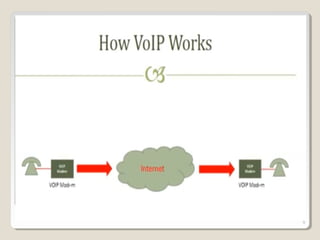
How VoIP works
◦ Continuously sample audio
◦ Convert each sample to digital form
◦ Send digitized stream across Internet in packets
◦ Convert the stream back to analog for playback
10
VoIP costs substantially less than traditional
phone service
VoIP eliminates Hardware. High costs for
traditional telephone switching equipment's.
VoIP lets you make cheap international calls
VoIP enables mobility and remote working
11
Advantages
To use VoIP, you need an Internet-connected device, like a
computer or smartphone
Without power VOIP phones are useless, so in case of
emergencies during power cuts it can be a major
disadvantage.
(Not Reliable)Loss of service during outages.
Some times during calls, there may be periods of silence
when data is lost while it is being unscrambled.
12
Disadvantages
◦ ITU (International Telecommunication Union)
controls telephony standards.
◦ IETF (Internet Engineering Task Force) controls
TCP/IP standards.
IP Telephony Standards:
13
• The simplest IP telephone system uses two basic
components:
- IP telephone: end device allowing humans to place and
receive calls.
- Media Gateway Controller: providing overall control and
coordination between IP phones; allowing a caller to
locate a caller (e.g. call forwarding)
A Basic IP Telephone System
14
 SIP stands for Session Initiation Protocol. It is complementary
with VoIP since it provides signaling functions to it. Apart from
VoIP, it is used in other multimedia technologies as well, like
online games, video and other services. SIP was developed along
with another signaling protocol, H.323, which was used as the
signaling protocol for VoIP before SIP. Now, SIP is has replaced it
to a large extent.
 SIP deals with communication sessions, which are the periods of
time during which parties communicate. These include Internet
telephone calls, multimedia conferences and distribution etc. SIP
provides the necessary signaling for creating, modifying and
terminating sessions with one or more communicating
participants.
SIP (Session Initiation Protocol)SIP (Session Initiation Protocol)
15
SIP is an enabler-protocol for VoIP and Telephony in
general, due to the following features it has:
Name Translation and User Location:
SIP translates an address to a name and thus reaches the called
party at any location. It does a mapping of session description to
location, and ensures support for details of the nature of the call.
Feature negotiation:
Not all communicating parties (which may be more than two) have
the necessary features. For example, not everyone may have video
support. SIP allows the group the negotiate for the features.
SIP Functions
16
 Media negotiation:
This mechanism enables negotiation of the media used in a call, like
selecting the appropriate codec for call establishment between
various devices.
 Call participant management:
SIP allows a participant to make or cancel connections to other users
during a call. Users can also be transferred or placed on hold.
 Call feature changes:
SIP allows a user to change a calls characteristics during the during
the call. For example, as a user, you may want to enable of disable
video, especially while a new user joins a session.
17
SIP works by having the communicating devices sending and
receiving messages. A SIP message carries a lot of information
which help identify the session, control timing, and describe the
media. Below is a list of what a message briefly contains: Protocol
information (e.g. version)
Session information (creator, name etc.)
Participant information (email, phone etc.)
Bandwidth information
Encryption information
Time description (active time and repeat time)
Media description (media name, title, address etc.)
Media bandwidth information
Media encryption key
The structure of a SIP message
18
19
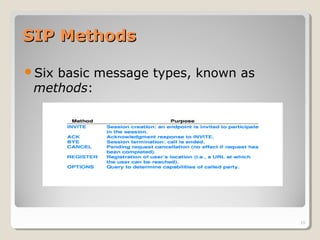
SIP MethodsSIP Methods
Six basic message types, known as
methods:
20
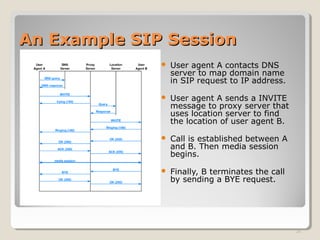
An Example SIP SessionAn Example SIP Session
 User agent A contacts DNS
server to map domain name
in SIP request to IP address.
 User agent A sends a INVITE
message to proxy server that
uses location server to find
the location of user agent B.
 Call is established between A
and B. Then media session
begins.
 Finally, B terminates the call
by sending a BYE request.
References:-
https://www.Slideshare.net
Date:-2014/12/16
https://www.youtube.com/watch?
v=bvngy80paWY
Date:-2014/12/16
21
Thank you……………
22

VoIP

  • 1.
    Submitted to:- Submittedby:- Mr.Sameer Gautam Purushottam Dahal VOIP 1Tuesday, December 16, 2014
  • 2.
    About VoIP How itWorks Advantages of VoIP Disadvantage of VoIP IP Telephony Standards A Basic IP Telephone System SIP(Session Initiation Protocol) Telephone Number Mapping & Routing CONTENTS:- 2
  • 3.
  • 4.
    Emerging New Technology A recentapplication of Internet technology 4
  • 5.
    VoIP stands for VoiceOver Internet Protocol or in other words… “Calling over the Internet” Technology to allow voice traffic to be Carried over the Internet. 5
  • 6.
    Voice over IP(VoIP) is a methodology and group of technologies for the delivery of voice communications and multimedia sessions over Internet Protocol (IP) networks, such as the Internet. 6
  • 7.
    Like Skype! Skype usesVoIP to make video calls over the Internet 7
  • 8.
    Most companies thesedays are switching to VoIP phone systems 8
  • 9.
  • 10.
    How VoIP works ◦Continuously sample audio ◦ Convert each sample to digital form ◦ Send digitized stream across Internet in packets ◦ Convert the stream back to analog for playback 10
  • 11.
    VoIP costs substantiallyless than traditional phone service VoIP eliminates Hardware. High costs for traditional telephone switching equipment's. VoIP lets you make cheap international calls VoIP enables mobility and remote working 11 Advantages
  • 12.
    To use VoIP,you need an Internet-connected device, like a computer or smartphone Without power VOIP phones are useless, so in case of emergencies during power cuts it can be a major disadvantage. (Not Reliable)Loss of service during outages. Some times during calls, there may be periods of silence when data is lost while it is being unscrambled. 12 Disadvantages
  • 13.
    ◦ ITU (InternationalTelecommunication Union) controls telephony standards. ◦ IETF (Internet Engineering Task Force) controls TCP/IP standards. IP Telephony Standards: 13
  • 14.
    • The simplestIP telephone system uses two basic components: - IP telephone: end device allowing humans to place and receive calls. - Media Gateway Controller: providing overall control and coordination between IP phones; allowing a caller to locate a caller (e.g. call forwarding) A Basic IP Telephone System 14
  • 15.
     SIP standsfor Session Initiation Protocol. It is complementary with VoIP since it provides signaling functions to it. Apart from VoIP, it is used in other multimedia technologies as well, like online games, video and other services. SIP was developed along with another signaling protocol, H.323, which was used as the signaling protocol for VoIP before SIP. Now, SIP is has replaced it to a large extent.  SIP deals with communication sessions, which are the periods of time during which parties communicate. These include Internet telephone calls, multimedia conferences and distribution etc. SIP provides the necessary signaling for creating, modifying and terminating sessions with one or more communicating participants. SIP (Session Initiation Protocol)SIP (Session Initiation Protocol) 15
  • 16.
    SIP is anenabler-protocol for VoIP and Telephony in general, due to the following features it has: Name Translation and User Location: SIP translates an address to a name and thus reaches the called party at any location. It does a mapping of session description to location, and ensures support for details of the nature of the call. Feature negotiation: Not all communicating parties (which may be more than two) have the necessary features. For example, not everyone may have video support. SIP allows the group the negotiate for the features. SIP Functions 16
  • 17.
     Media negotiation: Thismechanism enables negotiation of the media used in a call, like selecting the appropriate codec for call establishment between various devices.  Call participant management: SIP allows a participant to make or cancel connections to other users during a call. Users can also be transferred or placed on hold.  Call feature changes: SIP allows a user to change a calls characteristics during the during the call. For example, as a user, you may want to enable of disable video, especially while a new user joins a session. 17
  • 18.
    SIP works byhaving the communicating devices sending and receiving messages. A SIP message carries a lot of information which help identify the session, control timing, and describe the media. Below is a list of what a message briefly contains: Protocol information (e.g. version) Session information (creator, name etc.) Participant information (email, phone etc.) Bandwidth information Encryption information Time description (active time and repeat time) Media description (media name, title, address etc.) Media bandwidth information Media encryption key The structure of a SIP message 18
  • 19.
    19 SIP MethodsSIP Methods Sixbasic message types, known as methods:
  • 20.
    20 An Example SIPSessionAn Example SIP Session  User agent A contacts DNS server to map domain name in SIP request to IP address.  User agent A sends a INVITE message to proxy server that uses location server to find the location of user agent B.  Call is established between A and B. Then media session begins.  Finally, B terminates the call by sending a BYE request.
  • 21.
  • 22.