Division of Chemical Pathology
              David Haarburger
Fluid compartments
 Human body is approximately 60% water

                    Total body water 42ℓ
                                       Transcellular fluid (7%) 1ℓ


                                            Plasma (23%) 3ℓ


                                        Interstitial fluid (70%) 10ℓ


        Intracellular fluid (⅔) 28ℓ   Extracellular fluid (⅓) 14ℓ
Composition of body fluids
 Extracellular fluid (plasma)      Intracellular fluid

        Na+    142   mmol/ℓ            Na+   10      mmol/ℓ
         K+    4     mmol/ℓ             K+   160     mmol/ℓ
       Ca2+    2     mmol/ℓ           Ca2+   <0.01   mmol/ℓ
       Mg2+    1     mmol/ℓ           Mg2+   13      mmol/ℓ
         Cl-   105   mmol/ℓ            Cl-   3       mmol/ℓ
      HCO3-    27    mmol/ℓ          HCO3-   10      mmol/ℓ
 Phosphates    1     mmol/ℓ     Phosphates   100     mmol/ℓ
     Protein   70    g/ℓ           Protein   200     g/ℓ
  Osmolarity 290     mosm/ℓ     Osmolarity 290       mosm/ℓ
Composition of other fluids
              Daily production     Na+        K+         Cl-     HCO3-
                    (mℓ)         (mmol/ℓ)   (mmol/ℓ)   (mmol/ℓ) (mmol/ℓ)
Saliva             1000           20-80      10-20      20-40    20-60

Gastric          1000-2000       20-100       5-10     120-160     0

Pancreatic         1000            120        5-10      10-60    80-120

Bile               1000            150        5-10      40-80    20-40

Small bowel      2000-5000         140        20         105     25-50

Large bowel      200-1500        80-140       30         30        60

Sweat            200-1000         20-70       5-10      40-60      16
Osmotic concentration
 The total concentration of
 solutes in a solution
   Represents the number of
   particles
   Measured in osmoles per litre
 Colligative properties
   Lowering of vapour pressure
   Elevation of boiling point
   Depression of freezing point
   Osmotic pressure
Plasma osmolarity
 Plasma osmolarity                              Molarity
   290 mosmol/ℓ                 5    5 4
                                           11
   Measured vs Estimated        25
                                                             Sodium
                                                             Chloride

     2x([Na+] + [K+]) + Urea                           140
                                                             Bicarbonate
                                                             Glucose
     + Glucose                                               Urea


 Tonicity                      100                           Potassium
                                                             Other

   Active osmolyte /
   Penetrating solute

                                                Cell
Sodium
 Primary cation of extracellular fluid
 Primary determinant of extracellular
 osmolarity
 Intimately related to fluid balance
 Hypernatraemia causes cerebral
 dehydration
   Lethargy, weakness, irritability
   Twitching, seizures, and coma
 Hyponatraemia causes cerebral
 oedema
   Nausea, malaise, lethargy
   Obtundation, seizures, coma
Sodium
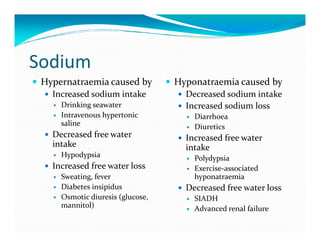
 Hypernatraemia caused by         Hyponatraemia caused by
   Increased sodium intake          Decreased sodium intake
     Drinking seawater              Increased sodium loss
     Intravenous hypertonic           Diarrhoea
     saline                           Diuretics
   Decreased free water             Increased free water
   intake                           intake
     Hypodypsia                       Polydypsia
   Increased free water loss          Exercise-associated
     Sweating, fever                  hyponatraemia
     Diabetes insipidus             Decreased free water loss
     Osmotic diuresis (glucose,       SIADH
     mannitol)                        Advanced renal failure
Sodium and water loss
 Normonatraemic
 hypovolaemia                         Normal
   Loss of sodium and water
     Haemorrhage
     Burns
     Effusion of ECF in body spaces
     (ascites)                             Free
   Prone to circulatory collapse           water
 Hypernatraemic                            loss
 hypovolaemia
   Loss of low sodium water
     Sweating
     Diabetes insipidus
   Prone to cerebral                     Isotonic
   dehydration                             fluid
                                           loss
Sodium and fluid homeostasis
    Renin-angiotensin-aldosterone system
                 Low renal perfusion


              Increased renin secretion


          Angiotensinogen → Angiotensin I

                                                  Vasoconstriction
           Angiotensin I → Angiotensin II      Increased ADH releaseVaso-
                                                                 constriction
                                                 Increased sodium
                                                    reabsorption

           Increased aldosterone secretion


         Increased sodium (water) absorption
Sodium and fluid homeostasis
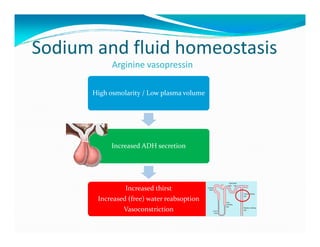
            Arginine vasopressin

      High osmolarity / Low plasma volume


           Increased ADH secretion


                Increased thirst
       Increased (free) water reabsoption
               Vasoconstriction
Sodium
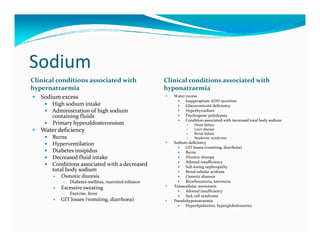
Clinical conditions associated with                 Clinical conditions associated with
hypernatraemia                                      hyponatraemia
   Sodium excess                                       Water excess
                                                             Inappropriate ADH secretion
       High sodium intake                                    Glucocorticoid deficiency
       Administration of high sodium                         Hypothyroidism
       containing fluids                                     Psychogenic polydypsia
                                                             Condition associated with increased total body sodium
       Primary hyperaldosteronsism                                Heart failure
   Water deficiency                                               Liver disease
                                                                  Renal failure
       Burns                                                      Nephrotic syndrome
       Hyperventilation                                Sodium deficiency
                                                             GIT losses (vomiting, diarrhoea)
       Diabetes insipidus                                    Burns
       Decreased fluid intake                                Diuretic therapy
                                                             Adrenal insufficiency
       Conditions associated with a decreased                Salt-losing nephropathy
       total body sodium                                     Renal tubular acidosis
          Osmotic diuresis                                   Osmotic diuresis
             Diabetes mellitus, mannitol infusion            Bicarbonaturia, ketonuria
          Excessive sweating                           Transcellular movement
                                                             Adrenal insufficiency
             Exercise, fever
                                                             Sick cell syndrome
          GIT losses (vomiting, diarrhoea)             Pseudohyponatraemia
                                                             Hyperlipidaemia, hyperglobulinaemia
Potassium
 Predominant intracellular cation
    Only 2% of potassium is extracellular           [K+] = 4    [K+] = 150
 Major role of K+ is to create a membrane                        K+
 potential in excitable cells (nerve,         Na+
 muscle, β-cells of pancreas)
 Plasma potassium negatively regulated
 by aldosterone                                              ―
                                                     +                CELL
 Hypokalaemia hyperpolarises cells                       -90mV
    Muscle weakness
    Decreased cardiac excitability, cardiac
    arrest
    Decreased insulin secretion
 Hyperkalaemia depolarises cells                               voltage-gated
                                                               Na channel,
    Cardiac arrhythmias, ventricular                           opens once
    fibrillation                                               membrane
                                                               potential falls
                                                               to -60mV
Potassium
 Predominant intracellular cation
    Only 2% of potassium is extracellular
    Plasma potassium is a poor indicator of
    body potassium
 Major role of K+ is to create a membrane
 potential in excitable cells (nerve, muscle,
 β-cells of pancreas)                                       Distal convoluted tubule
 Hypokalaemia hyperpolarises cells
    Muscle weakness
                                                Na+
    Decreased cardiac excitability, cardiac           ATP
                                                                                Na+
    arrest                                                  K+                          K+
    Decreased insulin secretion
 Hyperkalaemia depolarises cells                                                        H+

    Cardiac arrhythmias, ventricular
    fibrillation
 Plasma potassium negatively regulated by
 aldosterone                                                                           Tubular
                                                                                       lumen
Potassium
 Hypokalaemia caused by          Hyperkalaemia caused by
   Decreased intake                Increased intake
     Starvation (anorexia            Rapid blood transfusion
     nervosa)                      Decreased losses
   Increased losses                  Renal failure
     GIT loss (diarrhoea)            Aldosterone deficiency
     Urine losses (diuretics,        (Addison’s disease)
     excess aldosterone)           Extra-cellular shift
   Intra-cellular shift              Acute tissue damage
     β-Agonists                      (haemolysis,
     Alkalosis, glucose uptake       rhabdomyolysis, tumour
                                     lysis)
Potassium
Clinical conditions associated with                            Clinical conditions associated with
hypokalaemia                                                   hyperkalaemiea
   Potassium deficiency                                           Potassium excess
        Low intake                                                     Increased intake
                                                                            Oral potassium supplementation
           Alcoholism
                                                                            Intravenous potassium administration
           Anorexia nervosa
                                                                            Transfusion of aged blood
        Increased GIT losses                                           Decreased excretion
           Vomiting, diarrhoea, malabsorption                               Renal failure
           Fistulas, laxatives                                              Hypoaldosteronism
        Increased urinary losses                                            Diuretics
                                                                                Amiloride, spironolactone, triamterene
           Increased aldosterone
               Primary aldosteronism                              Transcellular shift
               Adrenal hyperplasia                                     α-adrenergic stimulation
           Androgenital syndrome                                       β-adrenergic blockade
           Renal disease                                               Metabolic acidosis
               Renal tubular acidosis                                  Crush injuries
               Fanconi syndrome                                        Tissue hypoxia
           Diuretics                                                   Insulin deficiency
               Loop diuretics, thiazides, carbonic anhydrase           Digitalis overdose
               inhibitors
                                                                  Pseudohyperkalaemia
   Transcellular shift                                                 Haemolysis
        Alkalosis                                                      Leukocytosis
        Increased plasma insulin
Chloride
 Primary anion of extracellular fluid
 Intimately associated with sodium
 No symptoms directly associated to hyperchloraemia
 or hypochloraemia
 Hyperchloraemia caused by
   Causes of hypernatraemia
   Metabolic acidosis
 Hypochloraemia caused by
   Causes of hyponatraemia
   Metabolic alkalosis

water electrolyte

  • 1.
    Division of ChemicalPathology David Haarburger
  • 2.
    Fluid compartments Humanbody is approximately 60% water Total body water 42ℓ Transcellular fluid (7%) 1ℓ Plasma (23%) 3ℓ Interstitial fluid (70%) 10ℓ Intracellular fluid (⅔) 28ℓ Extracellular fluid (⅓) 14ℓ
  • 3.
    Composition of bodyfluids Extracellular fluid (plasma) Intracellular fluid Na+ 142 mmol/ℓ Na+ 10 mmol/ℓ K+ 4 mmol/ℓ K+ 160 mmol/ℓ Ca2+ 2 mmol/ℓ Ca2+ <0.01 mmol/ℓ Mg2+ 1 mmol/ℓ Mg2+ 13 mmol/ℓ Cl- 105 mmol/ℓ Cl- 3 mmol/ℓ HCO3- 27 mmol/ℓ HCO3- 10 mmol/ℓ Phosphates 1 mmol/ℓ Phosphates 100 mmol/ℓ Protein 70 g/ℓ Protein 200 g/ℓ Osmolarity 290 mosm/ℓ Osmolarity 290 mosm/ℓ
  • 4.
    Composition of otherfluids Daily production Na+ K+ Cl- HCO3- (mℓ) (mmol/ℓ) (mmol/ℓ) (mmol/ℓ) (mmol/ℓ) Saliva 1000 20-80 10-20 20-40 20-60 Gastric 1000-2000 20-100 5-10 120-160 0 Pancreatic 1000 120 5-10 10-60 80-120 Bile 1000 150 5-10 40-80 20-40 Small bowel 2000-5000 140 20 105 25-50 Large bowel 200-1500 80-140 30 30 60 Sweat 200-1000 20-70 5-10 40-60 16
  • 5.
    Osmotic concentration Thetotal concentration of solutes in a solution Represents the number of particles Measured in osmoles per litre Colligative properties Lowering of vapour pressure Elevation of boiling point Depression of freezing point Osmotic pressure
  • 6.
    Plasma osmolarity Plasmaosmolarity Molarity 290 mosmol/ℓ 5 5 4 11 Measured vs Estimated 25 Sodium Chloride 2x([Na+] + [K+]) + Urea 140 Bicarbonate Glucose + Glucose Urea Tonicity 100 Potassium Other Active osmolyte / Penetrating solute Cell
  • 7.
    Sodium Primary cationof extracellular fluid Primary determinant of extracellular osmolarity Intimately related to fluid balance Hypernatraemia causes cerebral dehydration Lethargy, weakness, irritability Twitching, seizures, and coma Hyponatraemia causes cerebral oedema Nausea, malaise, lethargy Obtundation, seizures, coma
  • 8.
    Sodium Hypernatraemia causedby Hyponatraemia caused by Increased sodium intake Decreased sodium intake Drinking seawater Increased sodium loss Intravenous hypertonic Diarrhoea saline Diuretics Decreased free water Increased free water intake intake Hypodypsia Polydypsia Increased free water loss Exercise-associated Sweating, fever hyponatraemia Diabetes insipidus Decreased free water loss Osmotic diuresis (glucose, SIADH mannitol) Advanced renal failure
  • 9.
    Sodium and waterloss Normonatraemic hypovolaemia Normal Loss of sodium and water Haemorrhage Burns Effusion of ECF in body spaces (ascites) Free Prone to circulatory collapse water Hypernatraemic loss hypovolaemia Loss of low sodium water Sweating Diabetes insipidus Prone to cerebral Isotonic dehydration fluid loss
  • 10.
    Sodium and fluidhomeostasis Renin-angiotensin-aldosterone system Low renal perfusion Increased renin secretion Angiotensinogen → Angiotensin I Vasoconstriction Angiotensin I → Angiotensin II Increased ADH releaseVaso- constriction Increased sodium reabsorption Increased aldosterone secretion Increased sodium (water) absorption
  • 11.
    Sodium and fluidhomeostasis Arginine vasopressin High osmolarity / Low plasma volume Increased ADH secretion Increased thirst Increased (free) water reabsoption Vasoconstriction
  • 12.
    Sodium Clinical conditions associatedwith Clinical conditions associated with hypernatraemia hyponatraemia Sodium excess Water excess Inappropriate ADH secretion High sodium intake Glucocorticoid deficiency Administration of high sodium Hypothyroidism containing fluids Psychogenic polydypsia Condition associated with increased total body sodium Primary hyperaldosteronsism Heart failure Water deficiency Liver disease Renal failure Burns Nephrotic syndrome Hyperventilation Sodium deficiency GIT losses (vomiting, diarrhoea) Diabetes insipidus Burns Decreased fluid intake Diuretic therapy Adrenal insufficiency Conditions associated with a decreased Salt-losing nephropathy total body sodium Renal tubular acidosis Osmotic diuresis Osmotic diuresis Diabetes mellitus, mannitol infusion Bicarbonaturia, ketonuria Excessive sweating Transcellular movement Adrenal insufficiency Exercise, fever Sick cell syndrome GIT losses (vomiting, diarrhoea) Pseudohyponatraemia Hyperlipidaemia, hyperglobulinaemia
  • 13.
    Potassium Predominant intracellularcation Only 2% of potassium is extracellular [K+] = 4 [K+] = 150 Major role of K+ is to create a membrane K+ potential in excitable cells (nerve, Na+ muscle, β-cells of pancreas) Plasma potassium negatively regulated by aldosterone ― + CELL Hypokalaemia hyperpolarises cells -90mV Muscle weakness Decreased cardiac excitability, cardiac arrest Decreased insulin secretion Hyperkalaemia depolarises cells voltage-gated Na channel, Cardiac arrhythmias, ventricular opens once fibrillation membrane potential falls to -60mV
  • 14.
    Potassium Predominant intracellularcation Only 2% of potassium is extracellular Plasma potassium is a poor indicator of body potassium Major role of K+ is to create a membrane potential in excitable cells (nerve, muscle, β-cells of pancreas) Distal convoluted tubule Hypokalaemia hyperpolarises cells Muscle weakness Na+ Decreased cardiac excitability, cardiac ATP Na+ arrest K+ K+ Decreased insulin secretion Hyperkalaemia depolarises cells H+ Cardiac arrhythmias, ventricular fibrillation Plasma potassium negatively regulated by aldosterone Tubular lumen
  • 15.
    Potassium Hypokalaemia causedby Hyperkalaemia caused by Decreased intake Increased intake Starvation (anorexia Rapid blood transfusion nervosa) Decreased losses Increased losses Renal failure GIT loss (diarrhoea) Aldosterone deficiency Urine losses (diuretics, (Addison’s disease) excess aldosterone) Extra-cellular shift Intra-cellular shift Acute tissue damage β-Agonists (haemolysis, Alkalosis, glucose uptake rhabdomyolysis, tumour lysis)
  • 16.
    Potassium Clinical conditions associatedwith Clinical conditions associated with hypokalaemia hyperkalaemiea Potassium deficiency Potassium excess Low intake Increased intake Oral potassium supplementation Alcoholism Intravenous potassium administration Anorexia nervosa Transfusion of aged blood Increased GIT losses Decreased excretion Vomiting, diarrhoea, malabsorption Renal failure Fistulas, laxatives Hypoaldosteronism Increased urinary losses Diuretics Amiloride, spironolactone, triamterene Increased aldosterone Primary aldosteronism Transcellular shift Adrenal hyperplasia α-adrenergic stimulation Androgenital syndrome β-adrenergic blockade Renal disease Metabolic acidosis Renal tubular acidosis Crush injuries Fanconi syndrome Tissue hypoxia Diuretics Insulin deficiency Loop diuretics, thiazides, carbonic anhydrase Digitalis overdose inhibitors Pseudohyperkalaemia Transcellular shift Haemolysis Alkalosis Leukocytosis Increased plasma insulin
  • 17.
    Chloride Primary anionof extracellular fluid Intimately associated with sodium No symptoms directly associated to hyperchloraemia or hypochloraemia Hyperchloraemia caused by Causes of hypernatraemia Metabolic acidosis Hypochloraemia caused by Causes of hyponatraemia Metabolic alkalosis