WATER CANAL SYSTEM IN PORIFERA
Guided by-Dr. Jaya Kishor Seth
Name- Swatirekha Padhy
Roll No.- ZY04823
PART ONE
CONTENT
• INTRODUCTION
• WATER CANAL SYSTEM
• TYPES OF WATER CANAL SYSTEM
• ASCON
• SYCON
• LEUCON
• RHAGON
• FUNCTIONS OF WATER CURRENT
• EVOLUTIONARY SIGNIFICANCE
• REFFERENCES
INTRODUCTION
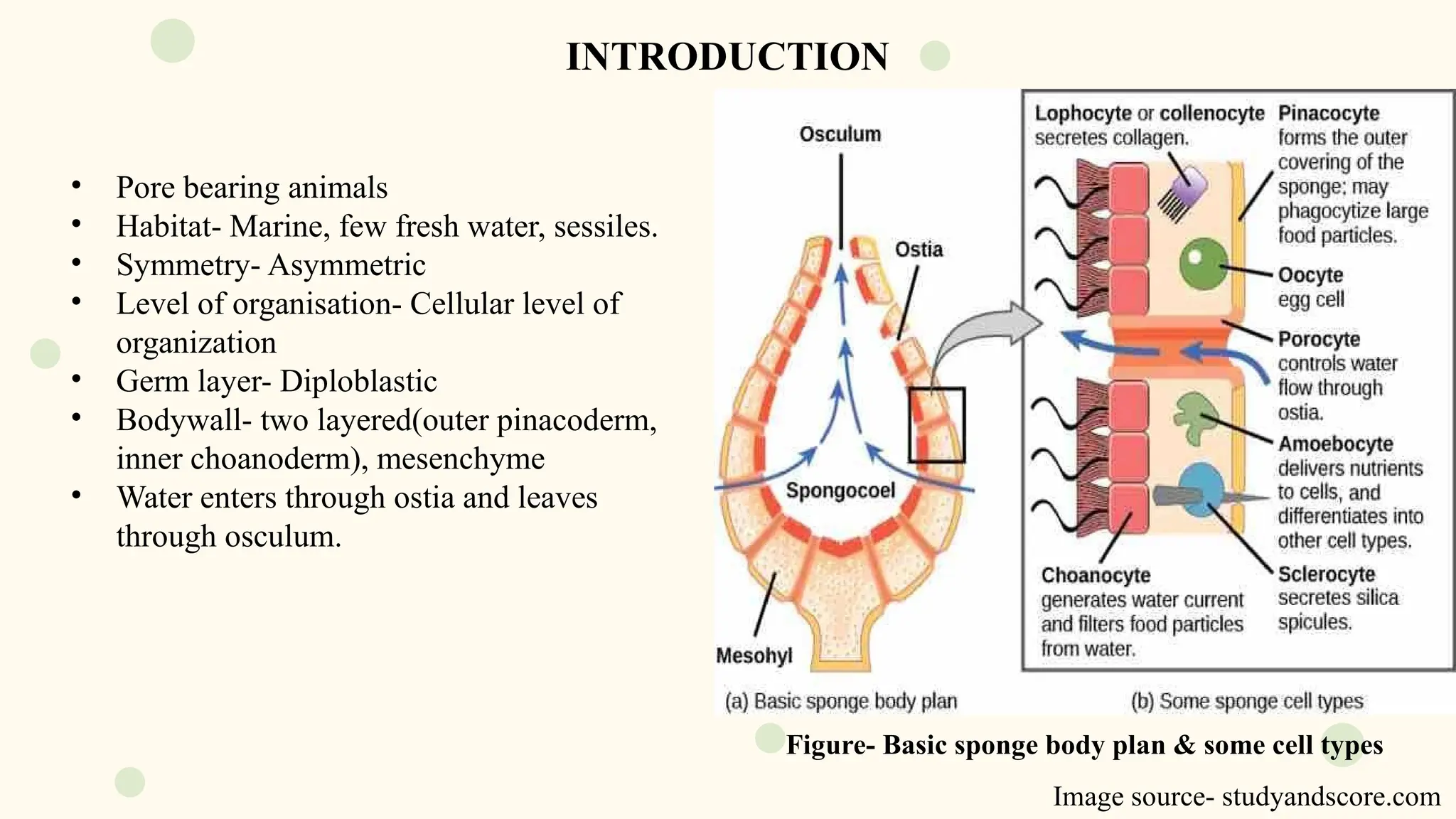
• Pore bearing animals
• Habitat- Marine, few fresh water, sessiles.
• Symmetry- Asymmetric
• Level of organisation- Cellular level of
organization
• Germ layer- Diploblastic
• Bodywall- two layered(outer pinacoderm,
inner choanoderm), mesenchyme
• Water enters through ostia and leaves
through osculum.
Image source- studyandscore.com
Figure- Basic sponge body plan & some cell types
WATER CANAL SYSTEM
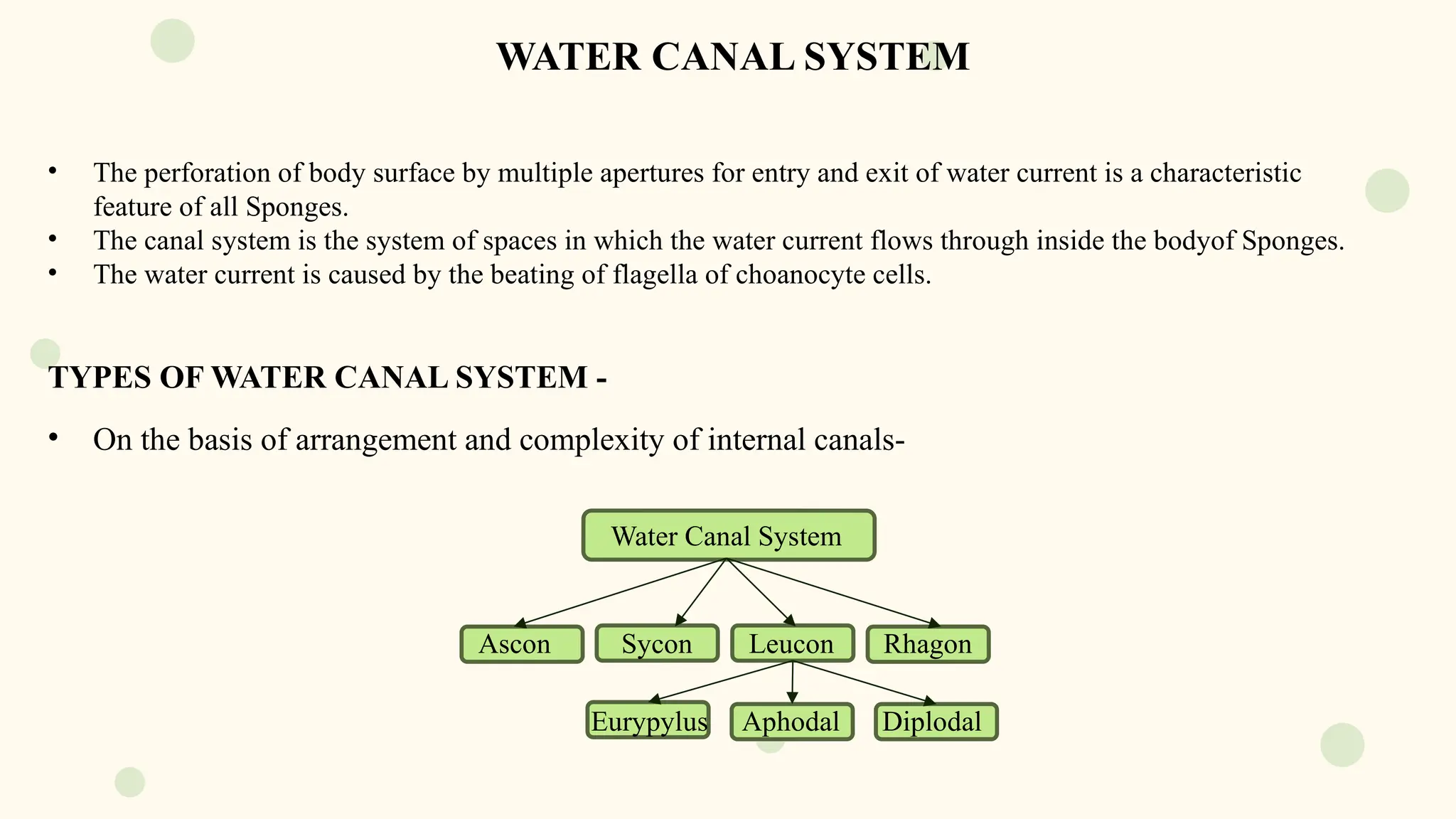
• On the basis of arrangement and complexity of internal canals-
Water Canal System
Ascon Sycon Leucon Rhagon
Eurypylus Aphodal Diplodal
TYPES OF WATER CANAL SYSTEM -
• The perforation of body surface by multiple apertures for entry and exit of water current is a characteristic
feature of all Sponges.
• The canal system is the system of spaces in which the water current flows through inside the bodyof Sponges.
• The water current is caused by the beating of flagella of choanocyte cells.
ASCON
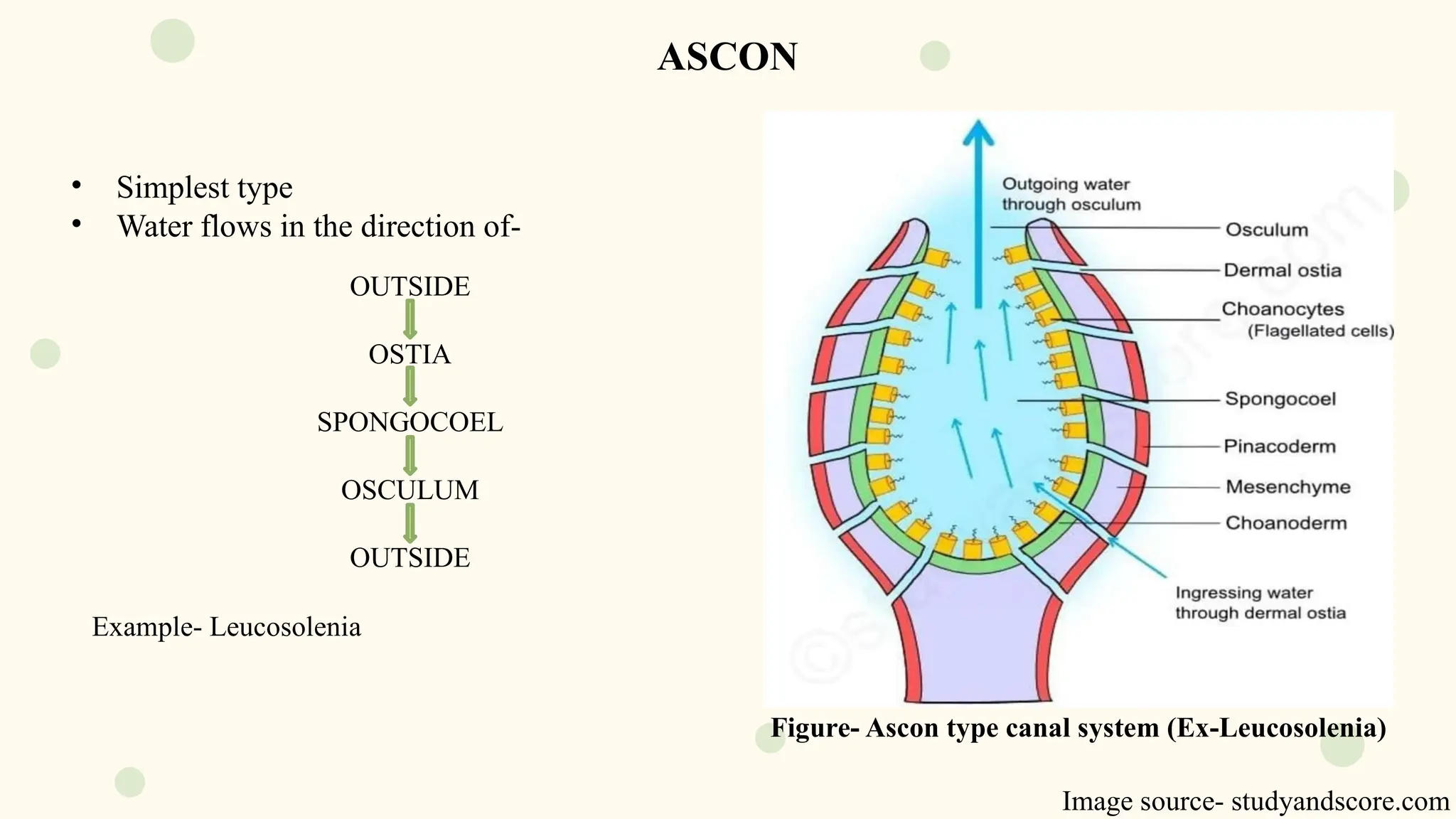
• Simplest type
• Water flows in the direction of-
Image source- studyandscore.com
Figure- Ascon type canal system (Ex-Leucosolenia)
OUTSIDE
OSTIA
SPONGOCOEL
OSCULUM
OUTSIDE
Example- Leucosolenia
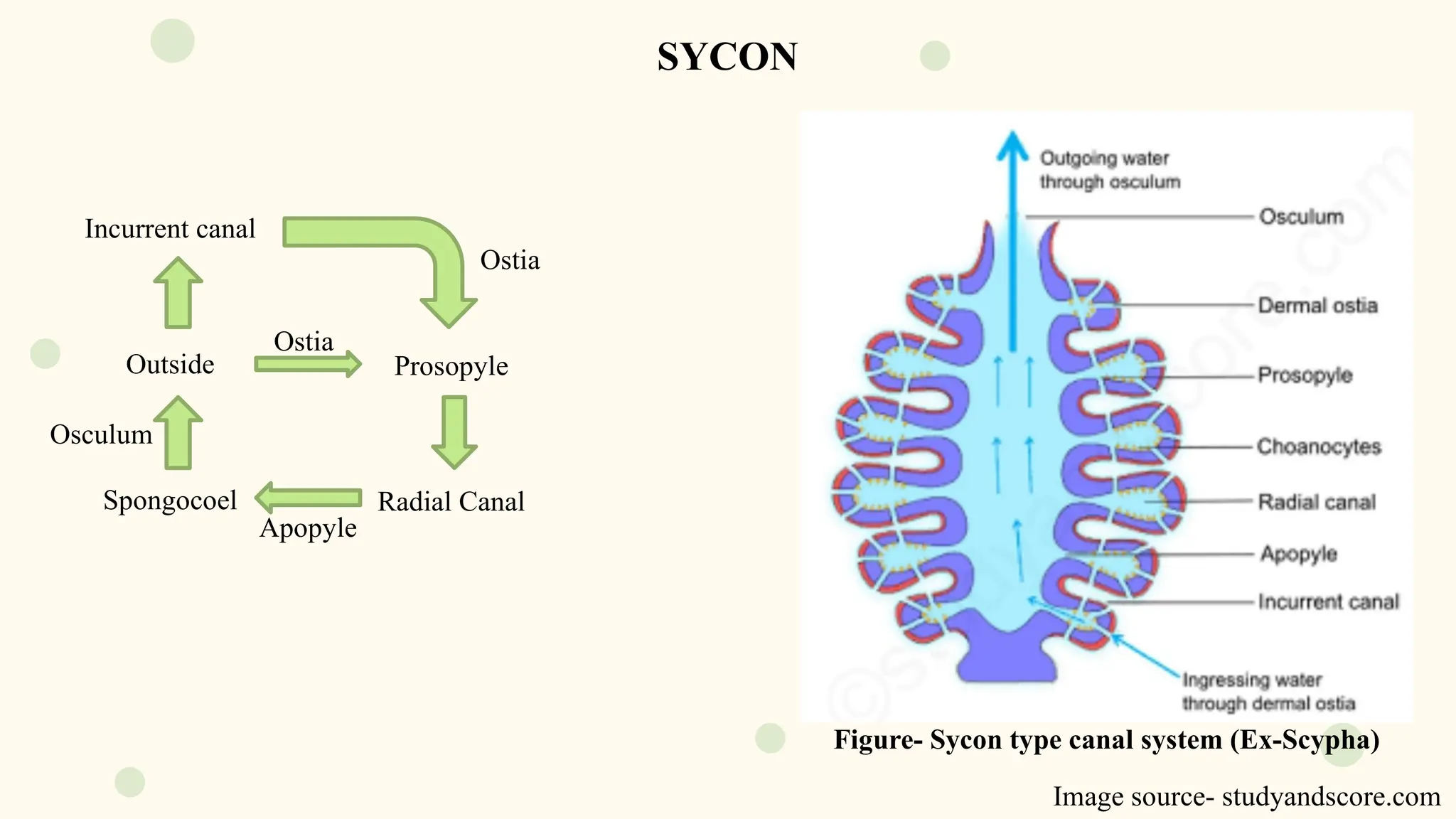
SYCON
Incurrent canal
Outside
Spongocoel
Image source- studyandscore.com
Figure- Sycon type canal system (Ex-Scypha)
Prosopyle
Radial Canal
Osculum
Ostia
Ostia
Apopyle
LEUCON
Outside
Spongocoel
Excurrent Canal
Incurrent Canal
Flagellated
Chamber
Ostia
Prosopyle
Apopyle
Osculum
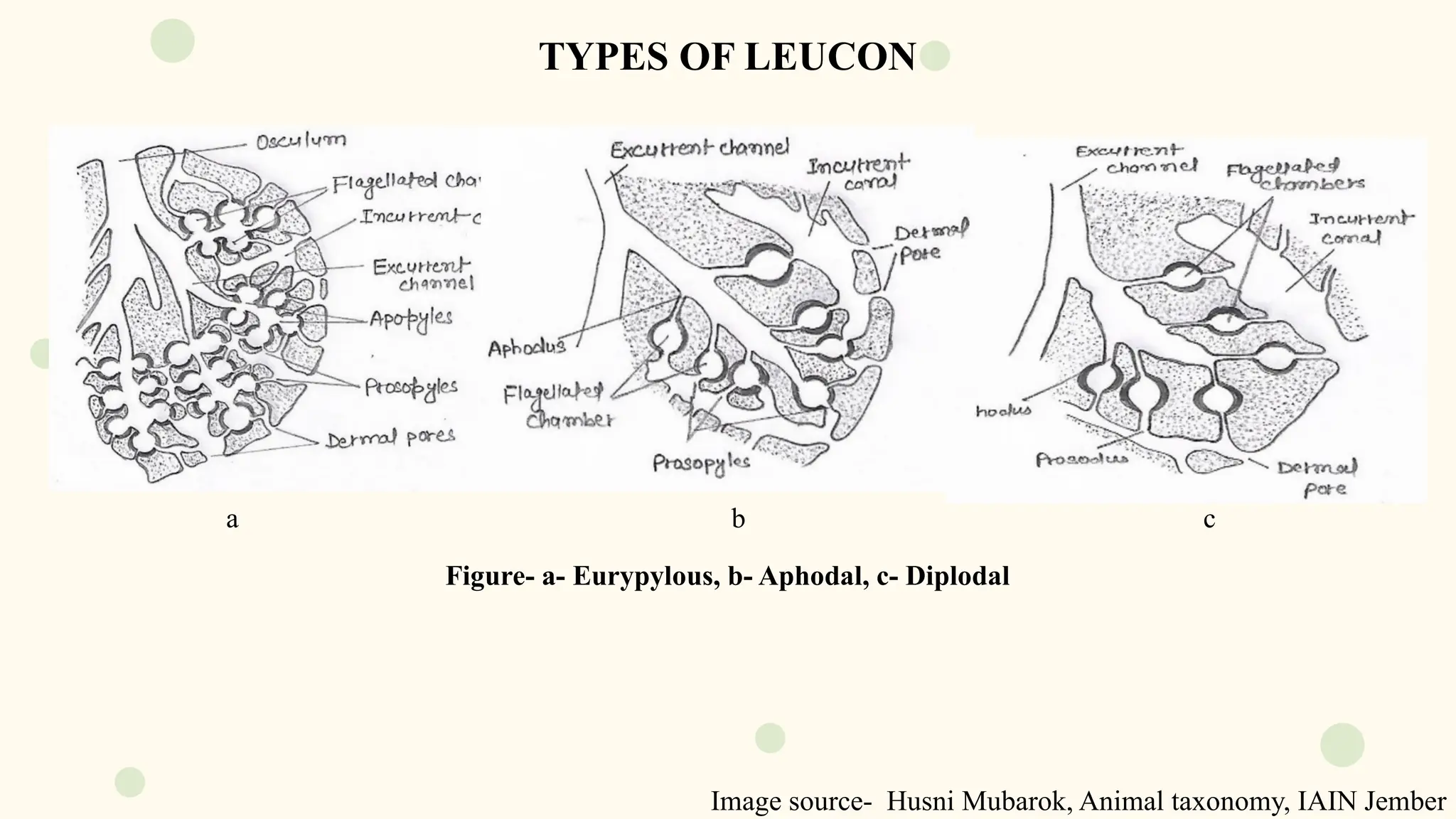
Leucon type of canal system again devided into 3 types on the
basis of successive grades in its evolutionary pattern, These are
a) Eurypylous
b) Aphodal
c) Diplodal Figure- Leucon
Image source- studyandscore.com
TYPES OF LEUCON
Figure- a- Eurypylous, b- Aphodal, c- Diplodal
Image source- Husni Mubarok, Animal taxonomy, IAIN Jember
a b c
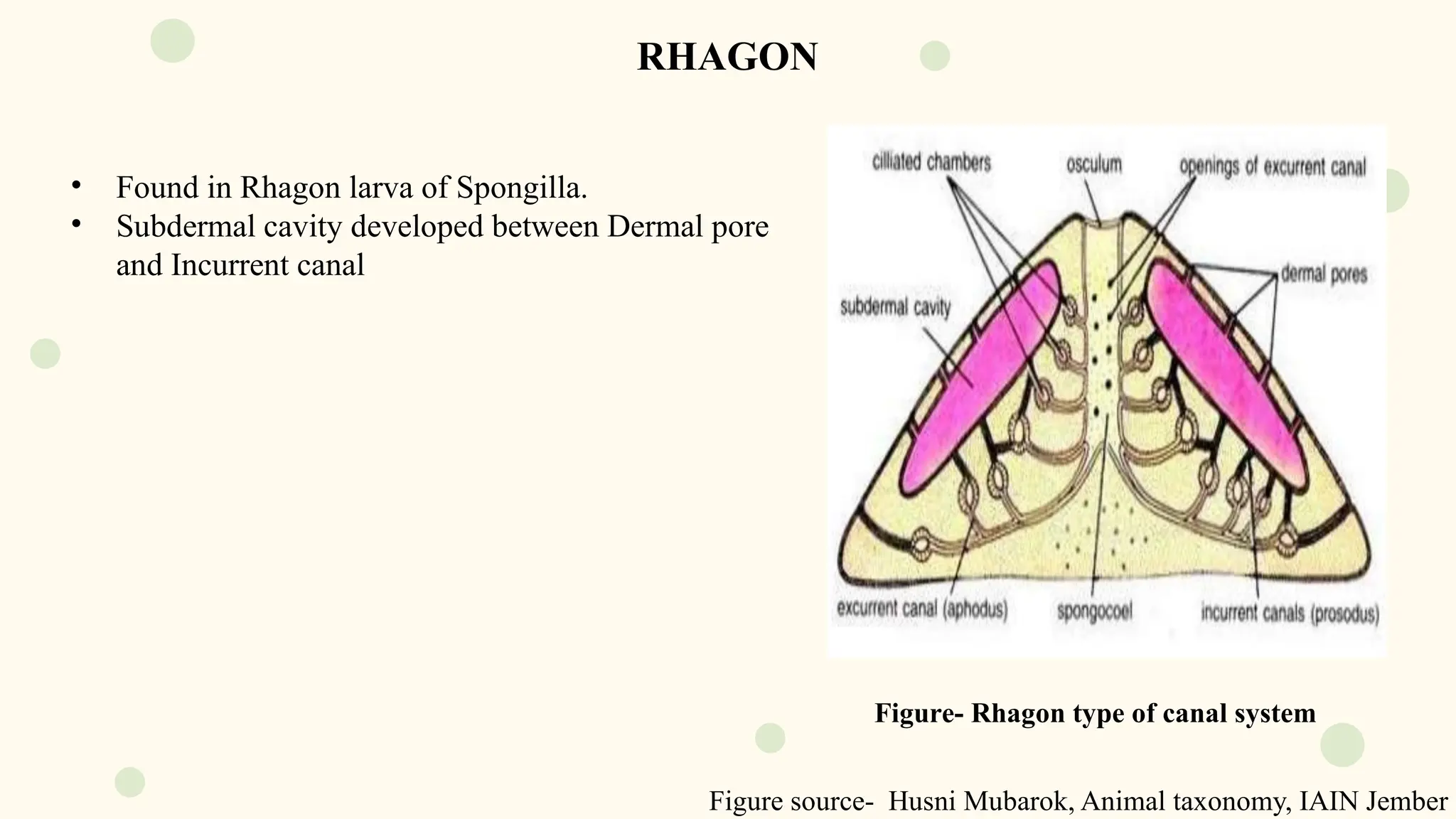
RHAGON
• Found in Rhagon larva of Spongilla.
• Subdermal cavity developed between Dermal pore
and Incurrent canal
Figure- Rhagon type of canal system
Figure source- Husni Mubarok, Animal taxonomy, IAIN Jember
FUNCTION OF WATER CURRENT
• Food collection
• Excretion
• Gaseous exchange
• Reproduction
Evolutionary Significance
Sponge aquiferous systems, or water canal systems, are an evolutionary adaptation and are essential
to sponge survival. It makes it possible for sponges to effectively filter and move water, which promotes
gas exchange and nutrient uptake. This system probably developed as a means for the earliest multicellular
organisms to survive in aquatic settings, encouraging the symbiotic relationships and filter-feeding of
microorganisms. Over millions of years, the development of this system in sponges facilitated their
ecological success and adaptation to a variety of aquatic habitats.
REFERENCES
• Kotpal R.L(2009), Modern Textbook Of Zoology Invertebrate , Rastogi publication , India
• Al-Hussaini(1967) :Practical Animal Morphology ,Macmillan & Co. London
• Moore, J.P. (1959): An Introduction to the invertebrates,542-557 2nd
ed. Wiley, New York
• Bernes R.D(1968) , Invertebrate Biolology, W.B.Saunders. Co.,Philadelphia, London & Toronto
THANK YOU

Water canal system in porifera Phylum __

  • 1.
    WATER CANAL SYSTEMIN PORIFERA Guided by-Dr. Jaya Kishor Seth Name- Swatirekha Padhy Roll No.- ZY04823 PART ONE
  • 2.
    CONTENT • INTRODUCTION • WATERCANAL SYSTEM • TYPES OF WATER CANAL SYSTEM • ASCON • SYCON • LEUCON • RHAGON • FUNCTIONS OF WATER CURRENT • EVOLUTIONARY SIGNIFICANCE • REFFERENCES
  • 3.
    INTRODUCTION • Pore bearinganimals • Habitat- Marine, few fresh water, sessiles. • Symmetry- Asymmetric • Level of organisation- Cellular level of organization • Germ layer- Diploblastic • Bodywall- two layered(outer pinacoderm, inner choanoderm), mesenchyme • Water enters through ostia and leaves through osculum. Image source- studyandscore.com Figure- Basic sponge body plan & some cell types
  • 4.
    WATER CANAL SYSTEM •On the basis of arrangement and complexity of internal canals- Water Canal System Ascon Sycon Leucon Rhagon Eurypylus Aphodal Diplodal TYPES OF WATER CANAL SYSTEM - • The perforation of body surface by multiple apertures for entry and exit of water current is a characteristic feature of all Sponges. • The canal system is the system of spaces in which the water current flows through inside the bodyof Sponges. • The water current is caused by the beating of flagella of choanocyte cells.
  • 5.
    ASCON • Simplest type •Water flows in the direction of- Image source- studyandscore.com Figure- Ascon type canal system (Ex-Leucosolenia) OUTSIDE OSTIA SPONGOCOEL OSCULUM OUTSIDE Example- Leucosolenia
  • 6.
    SYCON Incurrent canal Outside Spongocoel Image source-studyandscore.com Figure- Sycon type canal system (Ex-Scypha) Prosopyle Radial Canal Osculum Ostia Ostia Apopyle
  • 7.
    LEUCON Outside Spongocoel Excurrent Canal Incurrent Canal Flagellated Chamber Ostia Prosopyle Apopyle Osculum Leucontype of canal system again devided into 3 types on the basis of successive grades in its evolutionary pattern, These are a) Eurypylous b) Aphodal c) Diplodal Figure- Leucon Image source- studyandscore.com
  • 8.
    TYPES OF LEUCON Figure-a- Eurypylous, b- Aphodal, c- Diplodal Image source- Husni Mubarok, Animal taxonomy, IAIN Jember a b c
  • 9.
    RHAGON • Found inRhagon larva of Spongilla. • Subdermal cavity developed between Dermal pore and Incurrent canal Figure- Rhagon type of canal system Figure source- Husni Mubarok, Animal taxonomy, IAIN Jember
  • 10.
    FUNCTION OF WATERCURRENT • Food collection • Excretion • Gaseous exchange • Reproduction Evolutionary Significance Sponge aquiferous systems, or water canal systems, are an evolutionary adaptation and are essential to sponge survival. It makes it possible for sponges to effectively filter and move water, which promotes gas exchange and nutrient uptake. This system probably developed as a means for the earliest multicellular organisms to survive in aquatic settings, encouraging the symbiotic relationships and filter-feeding of microorganisms. Over millions of years, the development of this system in sponges facilitated their ecological success and adaptation to a variety of aquatic habitats.
  • 11.
    REFERENCES • Kotpal R.L(2009),Modern Textbook Of Zoology Invertebrate , Rastogi publication , India • Al-Hussaini(1967) :Practical Animal Morphology ,Macmillan & Co. London • Moore, J.P. (1959): An Introduction to the invertebrates,542-557 2nd ed. Wiley, New York • Bernes R.D(1968) , Invertebrate Biolology, W.B.Saunders. Co.,Philadelphia, London & Toronto
  • 12.