
Water Scarcity in Libya
Adam Niznik
About Libya
• About 95 percent of the country is
desert.
• Only 1.2 percent of the total area of the
country is cultivable.
• About 93 percent of the land surface
receives less than 100 mm of rain per
year.
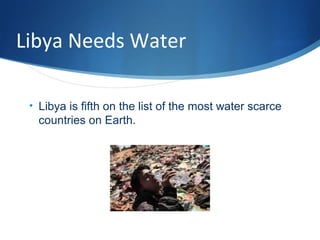
Libya Needs Water
• Libya is fifth on the list of the most water scarce
countries on Earth.
Where do they get their water?
• Nearly all of Libya’s water is fossil
water, or groundwater that has
remained sealed in an aquifer for a
long period of time.
Why is it called Fossil Water?
• Fossil Water rests underground in
"fossil aquifers" for thousands or
even millions of years, just like a
fossil.
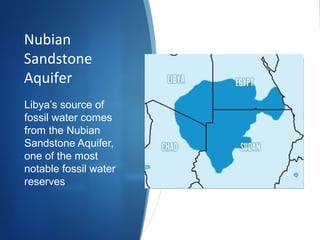
Nubian
Sandstone
Aquifer
Libya’s source of
fossil water comes
from the Nubian
Sandstone Aquifer,
one of the most
notable fossil water
reserves
Why doesn’t Libya have water?
• Libya has an increasing demand for fresh water,
while fossil groundwater supply is limited.
• This situation of water supply has become more
problematic with rapidly increasing population
and low rainfall.
Effects of Water Scarcity
• Only very certain areas of the country are
cultivable, approximately 1.2 percent, so
Libyans can only live in the areas on top of the
Nubian Sandstone Aquifer to farm and get their
water.
Solutions to Water Scarcity
• Libya can review agricultural water policies in
order to minimize some local deficits in water
resources and to avoid a deterioration in water
quality in the coastal areas.
Solutions Contd.
• Multiple desalination plants have been
constructed, however, restrictions have been
imposed by the high cost of energy and spare
parts and they are mainly used for industrial
purposes. If some of the plants are converted to
be for the common citizens of Libya, the scarcity
would be decreased some.
Sources
 http://www.springerlink.com/content/b1qv0273kt42p4l6/
 http://www.fao.org/nr/water/aquastat/countries_regions/libya/in
 http://growingblue.com/case-studies/the-nubian-sandstone-aquifer

Mauritania's Water Crisis
By:Maya McCrum
Problems in Mauritania
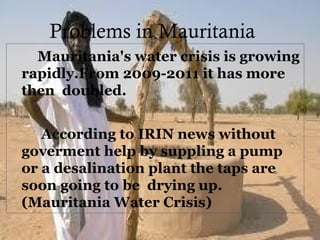
Mauritania's water crisis is growing
rapidly.From 2009-2011 it has more
then doubled.
According to IRIN news without
goverment help by suppling a pump
or a desalination plant the taps are
soon going to be drying up.
(Mauritania Water Crisis)
Problems in Mauritania
(Continued)
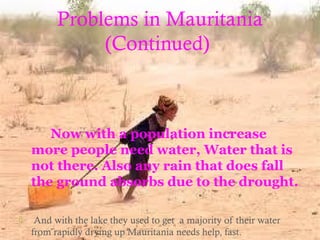
Now with a population increase
more people need water, Water that is
not there. Also any rain that does fall
the ground absorbs due to the drought.
 And with the lake they used to get a majority of their water
from rapidly drying up Mauritania needs help, fast.
Effects of Water Scarcity
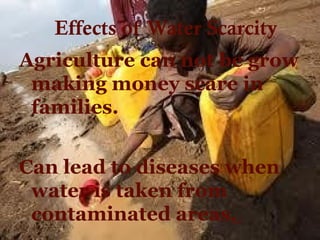
Agriculture can not be grow
making money scare in
families.
Can lead to diseases when
water is taken from
contaminated areas.
Effects of Water Scarcity
(Cont.)
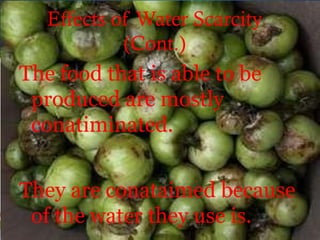
The food that is able to be
produced are mostly
conatiminated.
They are conataimed because
of the water they use is.
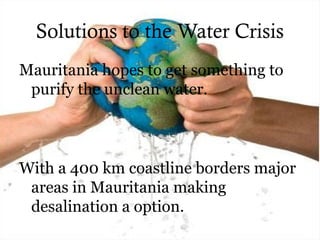
Solutions to the Water Crisis
Mauritania hopes to get something to
purify the unclean water.
With a 400 km coastline borders major
areas in Mauritania making
desalination a option.
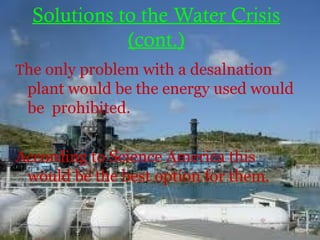
Solutions to the Water Crisis
(cont.)
The only problem with a desalnation
plant would be the energy used would
be prohibited.
According to Science America this
would be the best option for them.
Work Cited
scienceamerica.net
irinnew.net
www.thewaterproject.org
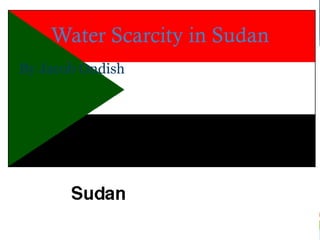
Water Scarcity in Sudan
By Jacob Ondish
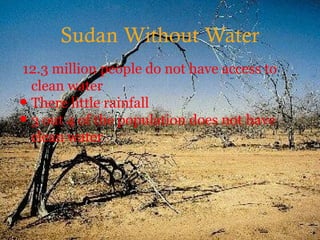
Sudan Without Water
12.3 million people do not have access to
clean water
• There little rainfall
• 3 out 4 of the population does not have
clean water
Causes of Water Scarcity
The causes of water scarcity in Sudan is little rainfall.
Though in the southwest of Sudan there is tropical
rainforests that rain frequently. But this region is not
habitable do to wild animals. The region of Sudan that is
mainly inhabited is the northern Darfur and Northern
states which is northwest on the map of Sudan. Since this
region holds most of the population moving them
towards a body of water cis out of the question, also is
desalination.
Effects of Water Scarcity
• In Sudan, 2% of the water they get can be
used for domestic use.
• Since there was no water, desertification is
a big problem.
Solution to water Scarcity in
Sudan
• Sudan's national solution to water scarcity is
irrigation and Rainwater Harvesting {RWH}.
• They have considered desalination but have
come to that they cannot afford it
• For the most part Sudan is a landlocked country
so their only main source of water is irrigation
• But the body of water they are connected to is
the red sea
What is Irrigation
Irrigation is the process by which any artificial way
of getting water is brought by that way.
For Example: Wells, Rivers, Lakes, and Reservoirs
The only way Sudan can use irrigation is to irrigate
wells and rivers. The main river that runs
through Sudan [and most of Africa] is the Nile
River.

Water scarcity-in-africa

  • 1.
     Water Scarcity inLibya Adam Niznik
  • 2.
    About Libya • About95 percent of the country is desert. • Only 1.2 percent of the total area of the country is cultivable. • About 93 percent of the land surface receives less than 100 mm of rain per year.
  • 3.
    Libya Needs Water •Libya is fifth on the list of the most water scarce countries on Earth.
  • 4.
    Where do theyget their water? • Nearly all of Libya’s water is fossil water, or groundwater that has remained sealed in an aquifer for a long period of time.
  • 5.
    Why is itcalled Fossil Water? • Fossil Water rests underground in "fossil aquifers" for thousands or even millions of years, just like a fossil.
  • 6.
    Nubian Sandstone Aquifer Libya’s source of fossilwater comes from the Nubian Sandstone Aquifer, one of the most notable fossil water reserves
  • 7.
    Why doesn’t Libyahave water? • Libya has an increasing demand for fresh water, while fossil groundwater supply is limited. • This situation of water supply has become more problematic with rapidly increasing population and low rainfall.
  • 8.
    Effects of WaterScarcity • Only very certain areas of the country are cultivable, approximately 1.2 percent, so Libyans can only live in the areas on top of the Nubian Sandstone Aquifer to farm and get their water.
  • 9.
    Solutions to WaterScarcity • Libya can review agricultural water policies in order to minimize some local deficits in water resources and to avoid a deterioration in water quality in the coastal areas.
  • 10.
    Solutions Contd. • Multipledesalination plants have been constructed, however, restrictions have been imposed by the high cost of energy and spare parts and they are mainly used for industrial purposes. If some of the plants are converted to be for the common citizens of Libya, the scarcity would be decreased some.
  • 11.
  • 12.
  • 13.
    Problems in Mauritania Mauritania'swater crisis is growing rapidly.From 2009-2011 it has more then doubled. According to IRIN news without goverment help by suppling a pump or a desalination plant the taps are soon going to be drying up. (Mauritania Water Crisis)
  • 14.
    Problems in Mauritania (Continued) Nowwith a population increase more people need water, Water that is not there. Also any rain that does fall the ground absorbs due to the drought.  And with the lake they used to get a majority of their water from rapidly drying up Mauritania needs help, fast.
  • 15.
    Effects of WaterScarcity Agriculture can not be grow making money scare in families. Can lead to diseases when water is taken from contaminated areas.
  • 16.
    Effects of WaterScarcity (Cont.) The food that is able to be produced are mostly conatiminated. They are conataimed because of the water they use is.
  • 17.
    Solutions to theWater Crisis Mauritania hopes to get something to purify the unclean water. With a 400 km coastline borders major areas in Mauritania making desalination a option.
  • 18.
    Solutions to theWater Crisis (cont.) The only problem with a desalnation plant would be the energy used would be prohibited. According to Science America this would be the best option for them.
  • 19.
  • 20.
    Water Scarcity inSudan By Jacob Ondish
  • 21.
    Sudan Without Water 12.3million people do not have access to clean water • There little rainfall • 3 out 4 of the population does not have clean water
  • 22.
    Causes of WaterScarcity The causes of water scarcity in Sudan is little rainfall. Though in the southwest of Sudan there is tropical rainforests that rain frequently. But this region is not habitable do to wild animals. The region of Sudan that is mainly inhabited is the northern Darfur and Northern states which is northwest on the map of Sudan. Since this region holds most of the population moving them towards a body of water cis out of the question, also is desalination.
  • 23.
    Effects of WaterScarcity • In Sudan, 2% of the water they get can be used for domestic use. • Since there was no water, desertification is a big problem.
  • 24.
    Solution to waterScarcity in Sudan • Sudan's national solution to water scarcity is irrigation and Rainwater Harvesting {RWH}. • They have considered desalination but have come to that they cannot afford it • For the most part Sudan is a landlocked country so their only main source of water is irrigation • But the body of water they are connected to is the red sea
  • 25.
    What is Irrigation Irrigationis the process by which any artificial way of getting water is brought by that way. For Example: Wells, Rivers, Lakes, and Reservoirs The only way Sudan can use irrigation is to irrigate wells and rivers. The main river that runs through Sudan [and most of Africa] is the Nile River.