Waste is a market – especially for poor!
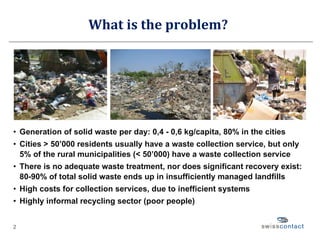
What is the problem? Generation of solid waste per day: 0,4 - 0,6 kg/capita, 80% in the cities Cities > 50’000 residents usually have a waste collection service, but only 5% of the rural municipalities (< 50’000) have a waste collection service There is no adequate waste treatment, nor does significant recovery exist: 80-90% of total solid waste ends up in insufficiently managed landfills High costs for collection services, due to inefficient systems Highly informal recycling sector (poor people)
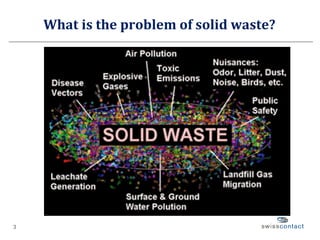
What is the problem of solid waste?
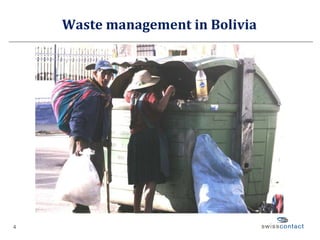
Waste management in Bolivia
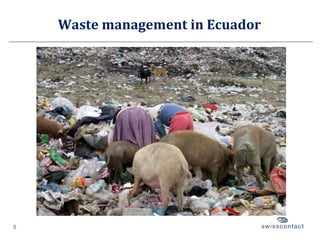
Waste management in Ecuador
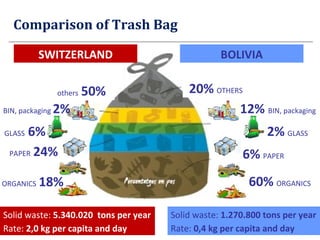
Comparison of Trash Bag 6%   PAPER 2%   GLASS 12%  BIN, packaging 60%   ORGANICS BIN, packaging  2% GLASS  6% PAPER   24% ORGANICS   18% 20%   OTHERS others   50% BOLIVIA SWITZERLAND Solid waste:  5.340.020  tons per year Rate:  2,0 kg per capita and day Solid waste:  1.270.800 tons per year Rate:  0,4 kg per capita and day
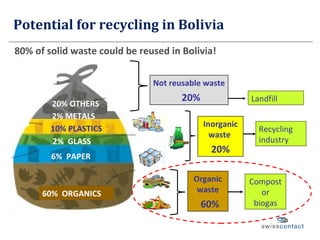
Potential for recycling in Bolivia Inorganic waste  20% Organic waste 60% Not reusable waste 20% Recycling industry Compost or biogas Landfill 80% of solid waste could be reused in Bolivia! 20% OTHERS 2% METALS 60%  ORGANICS 6%  PAPER 2%  GLASS 10% PLASTICS
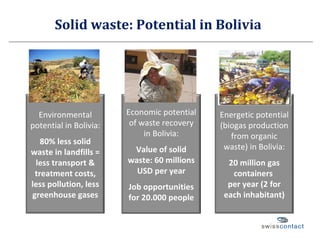
Solid waste: Potential in Bolivia Economic potential of waste recovery in Bolivia: Value of solid waste: 60 millions USD per year Job opportunities for 20.000 people Energetic potential (biogas production from organic waste) in Bolivia: 20 million gas containers  per year (2 for each inhabitant) Environmental potential in Bolivia: 80% less solid waste in landfills = less transport & treatment costs, less pollution, less greenhouse gases
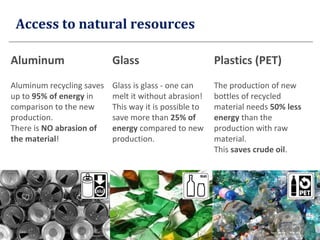
Access to natural resources Aluminum Glass Plastics (PET) Aluminum recycling saves up to  95% of energy  in comparison to the new production. There is  NO abrasion of the material !  Glass is glass - one can melt it without abrasion! This way it is possible to save more than  25% of energy  compared to new production. The production of new bottles of recycled material needs  50% less energy  than the production with raw material.  This  saves crude oil .
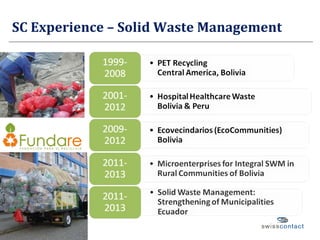
SC Experience – Solid Waste Management
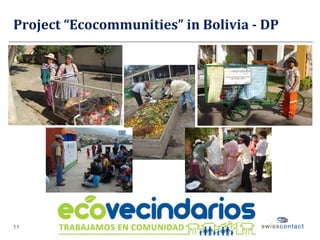
Project “Ecocommunities” in Bolivia - DP
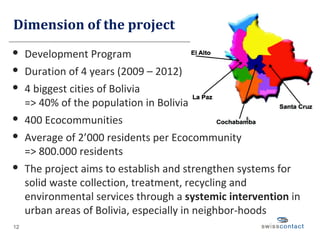
Dimension of the project Development Program Duration of 4 years (2009 – 2012) 4 biggest cities of Bolivia => 40% of the population in Bolivia 400 Ecocommunities  Average of 2’000 residents per Ecocommunity  => 800.000 residents The project aims to establish and strengthen systems for solid waste collection, treatment, recycling and environmental services through a  systemic intervention  in urban areas of Bolivia, especially in neighbor-hoods
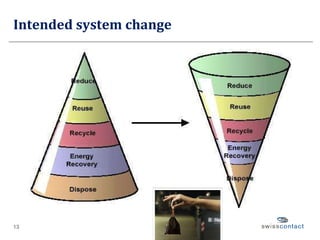
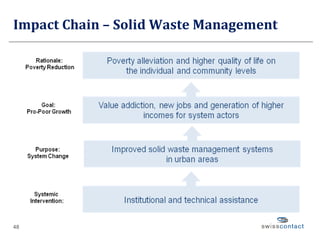
Intended system change
Rational & Goal Rational To contribute to poverty alleviation and higher life quality on individual and community level. Project Goal To contribute to value addition and creation of  new jobs  and generation of  higher incomes  for system actors: 1’200 new jobs with stable incomes above minimum salary  230 SME’s involved Market growth of at least 20%: sales/turnover in sector (recycling and green jobs) Women’s proportion in target groups at least 50%
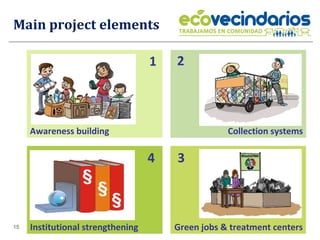
Main project elements Awareness building Collection systems Institutional strengthening Green jobs & treatment centers 1 2 3 4
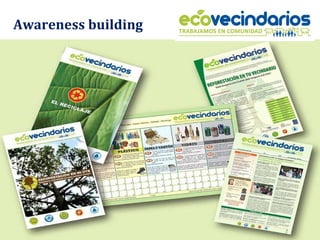
Awareness building
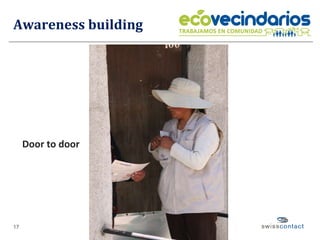
Awareness building Door to door
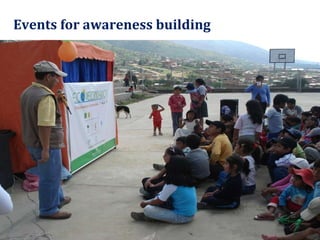
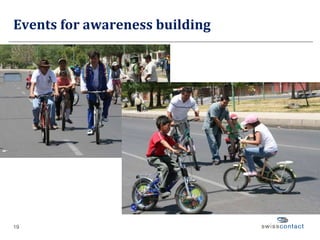
Events for awareness building
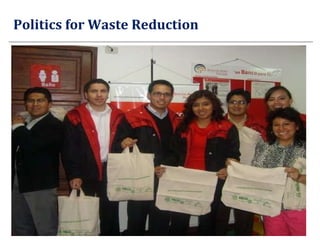
Politics for Waste Reduction
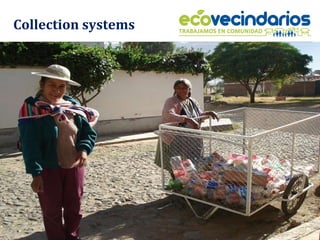
Collection systems
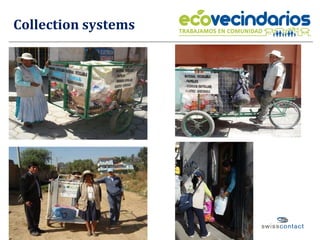
Collection systems
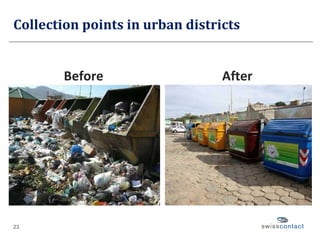
Collection points in urban districts Before After
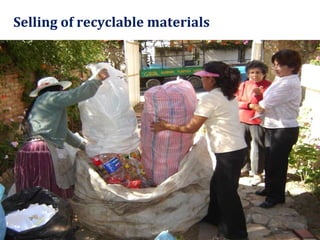
Selling of recyclable materials
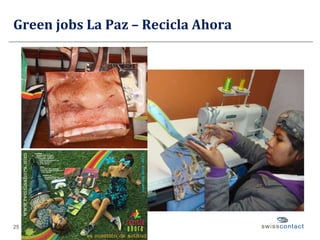
Green jobs La Paz – Recicla Ahora
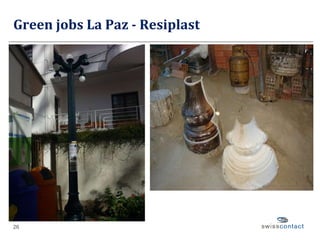
Green jobs La Paz - Resiplast
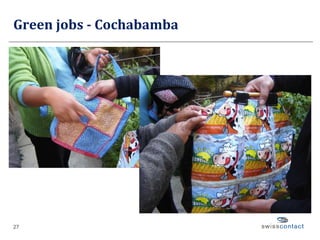
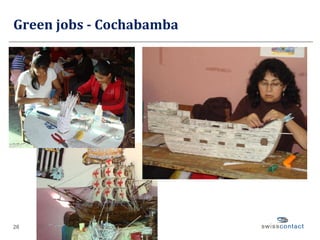
Green jobs - Cochabamba
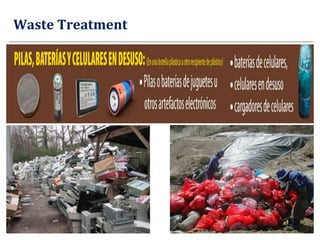
Waste Treatment
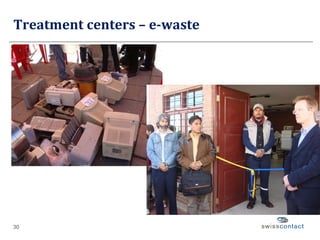
Treatment centers – e-waste
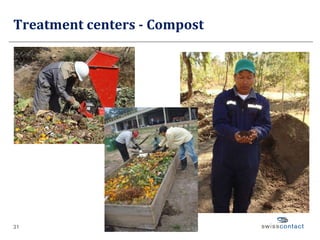
Treatment centers - Compost
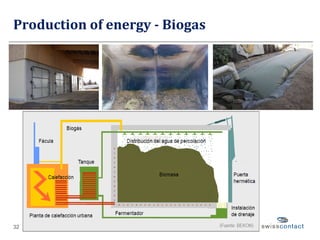
Production of energy - Biogas
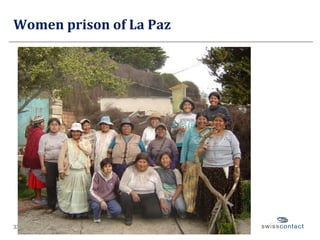
Women prison of La Paz
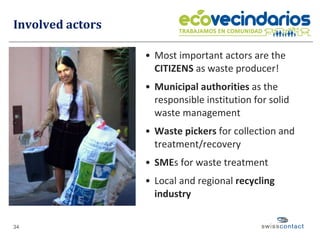
Involved actors Most important actors are the  CITIZENS  as waste producer! Municipal authorities  as the responsible institution for solid waste management Waste pickers  for collection and treatment/recovery SME s for waste treatment Local and regional  recycling industry
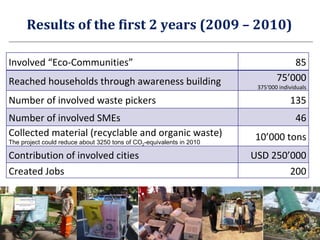
Results of the first 2 years (2009 – 2010) Involved “Eco-Communities” 85 Reached households through awareness building 75’000 375‘000 individuals Number of involved waste pickers 135 Number of involved SMEs 46 Collected material (recyclable and organic waste) The project could reduce about 3250 tons of CO 2 -equivalents in 2010 10’000 tons Contribution of involved cities USD 250’000 Created Jobs 200
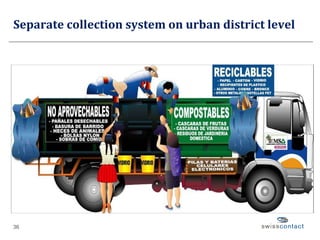
Separate collection system on urban district level
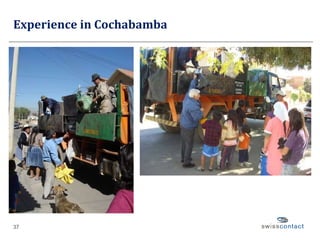
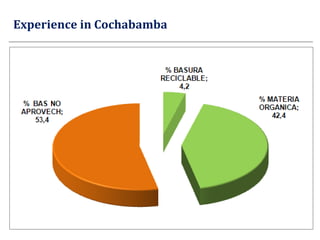
Experience in Cochabamba
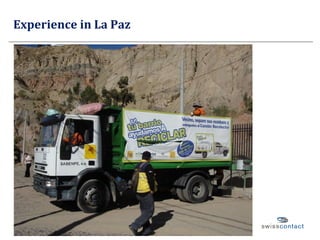
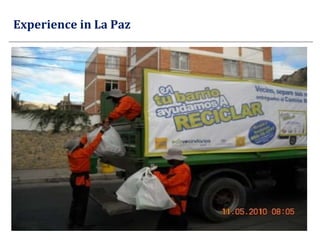
Experience in La Paz
Lessons learnt There is a huge political interest in the topic on all levels  (national, regional and local government) People are participating, if they have the option! Recovering and recycling processes can be managed strictly  on a private level  => Generation of new jobs and income Collection and treatment of organic waste is not a big business,  but it drastically reduces the waste volume entering to the landfill (costs). Therefore it should be managed by municipal services. Hazardous waste should be collected separately and treated adequately (controlled by authorities) The authorities share the important task to elaborate an adequate legal framework for an integral waste management system.
Impact on Acquisition & Fundraising Swisscontact is the leading institution in waste management in Bolivia All municipal authorities (biggest cities) want to implement ECOVECINDARIOS as a local policy with the technical cooperation of Swisscontact (they provide technical staff and money).  Swisscontact carried out a World Bank financed study to design an integral waste management system for 4 rural municipalities around Lake Titicaca. IDB has asked Swisscontact to develop and implement a waste management project for 20 rural municipalities (3 years, started 01.02.2011) New EU financed solid waste management in Ecuador started in February 2011, covering 5 municipalities
IDB – Waste Management Project, Bolivia  Microenterprises for the Integral Solid Waste Management in Rural Communities of Bolivia The project will develop 20 microenterprises with approximately 300 new jobs (in total) in 20 rural municipalities in Bolivia. The general objective of the project is to create jobs, linked to solid waste management, for inhabitants of rural areas in Bolivia. 3 years (2011 – 2013) USD 1.5 Mio (950.000 IDB – 550.000 SC)
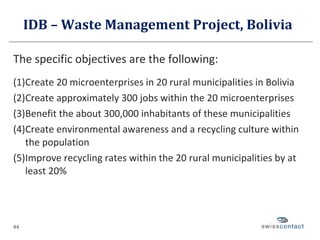
IDB – Waste Management Project, Bolivia  The specific objectives are the following: (1) Create 20 microenterprises in 20 rural municipalities in Bolivia (2) Create approximately 300 jobs within the 20 microenterprises (3) Benefit the about 300,000 inhabitants of these municipalities (4) Create environmental awareness and a recycling culture within the population (5) Improve recycling rates within the 20 rural municipalities by at least 20%
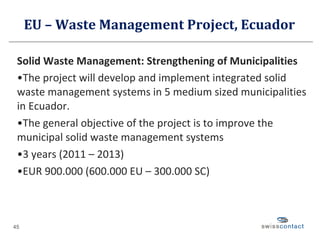
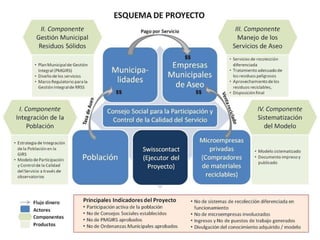
EU – Waste Management Project, Ecuador Solid Waste Management: Strengthening of Municipalities The project will develop and implement integrated solid waste management systems in 5 medium sized municipalities in Ecuador. The general objective of the project is to improve the municipal solid waste management systems 3 years (2011 – 2013) EUR 900.000 (600.000 EU – 300.000 SC)
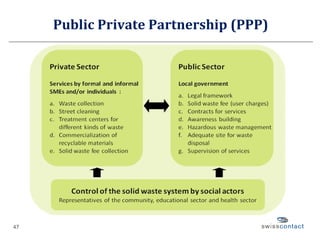
Public Private Partnership (PPP)
Impact Chain – Solid Waste Management
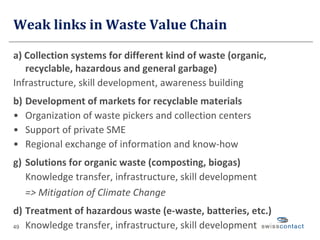
Weak links in Waste Value Chain a) Collection systems for different kind of waste (organic, recyclable, hazardous and general garbage) Infrastructure, skill development, awareness building b) Development of markets for recyclable materials Organization of waste pickers and collection centers Support of private SME Regional exchange of information and know-how Solutions for organic waste (composting, biogas) Knowledge transfer, infrastructure, skill development => Mitigation of Climate Change d) Treatment of hazardous waste (e-waste, batteries, etc.)  Knowledge transfer, infrastructure, skill development
Thank you for your attention !

Waste management solutions bolivia

  • 1.
    Waste is amarket – especially for poor!
  • 2.
    What is theproblem? Generation of solid waste per day: 0,4 - 0,6 kg/capita, 80% in the cities Cities > 50’000 residents usually have a waste collection service, but only 5% of the rural municipalities (< 50’000) have a waste collection service There is no adequate waste treatment, nor does significant recovery exist: 80-90% of total solid waste ends up in insufficiently managed landfills High costs for collection services, due to inefficient systems Highly informal recycling sector (poor people)
  • 3.
    What is theproblem of solid waste?
  • 4.
  • 5.
  • 6.
    Comparison of TrashBag 6% PAPER 2% GLASS 12% BIN, packaging 60% ORGANICS BIN, packaging 2% GLASS 6% PAPER 24% ORGANICS 18% 20% OTHERS others 50% BOLIVIA SWITZERLAND Solid waste: 5.340.020 tons per year Rate: 2,0 kg per capita and day Solid waste: 1.270.800 tons per year Rate: 0,4 kg per capita and day
  • 7.
    Potential for recyclingin Bolivia Inorganic waste 20% Organic waste 60% Not reusable waste 20% Recycling industry Compost or biogas Landfill 80% of solid waste could be reused in Bolivia! 20% OTHERS 2% METALS 60% ORGANICS 6% PAPER 2% GLASS 10% PLASTICS
  • 8.
    Solid waste: Potentialin Bolivia Economic potential of waste recovery in Bolivia: Value of solid waste: 60 millions USD per year Job opportunities for 20.000 people Energetic potential (biogas production from organic waste) in Bolivia: 20 million gas containers per year (2 for each inhabitant) Environmental potential in Bolivia: 80% less solid waste in landfills = less transport & treatment costs, less pollution, less greenhouse gases
  • 9.
    Access to naturalresources Aluminum Glass Plastics (PET) Aluminum recycling saves up to 95% of energy in comparison to the new production. There is NO abrasion of the material ! Glass is glass - one can melt it without abrasion! This way it is possible to save more than 25% of energy compared to new production. The production of new bottles of recycled material needs 50% less energy than the production with raw material. This saves crude oil .
  • 10.
    SC Experience –Solid Waste Management
  • 11.
  • 12.
    Dimension of theproject Development Program Duration of 4 years (2009 – 2012) 4 biggest cities of Bolivia => 40% of the population in Bolivia 400 Ecocommunities Average of 2’000 residents per Ecocommunity => 800.000 residents The project aims to establish and strengthen systems for solid waste collection, treatment, recycling and environmental services through a systemic intervention in urban areas of Bolivia, especially in neighbor-hoods
  • 13.
  • 14.
    Rational & GoalRational To contribute to poverty alleviation and higher life quality on individual and community level. Project Goal To contribute to value addition and creation of new jobs and generation of higher incomes for system actors: 1’200 new jobs with stable incomes above minimum salary 230 SME’s involved Market growth of at least 20%: sales/turnover in sector (recycling and green jobs) Women’s proportion in target groups at least 50%
  • 15.
    Main project elementsAwareness building Collection systems Institutional strengthening Green jobs & treatment centers 1 2 3 4
  • 16.
  • 17.
  • 18.
  • 19.
  • 20.
  • 21.
  • 22.
  • 23.
    Collection points inurban districts Before After
  • 24.
  • 25.
    Green jobs LaPaz – Recicla Ahora
  • 26.
    Green jobs LaPaz - Resiplast
  • 27.
    Green jobs -Cochabamba
  • 28.
    Green jobs -Cochabamba
  • 29.
  • 30.
  • 31.
  • 32.
  • 33.
  • 34.
    Involved actors Mostimportant actors are the CITIZENS as waste producer! Municipal authorities as the responsible institution for solid waste management Waste pickers for collection and treatment/recovery SME s for waste treatment Local and regional recycling industry
  • 35.
    Results of thefirst 2 years (2009 – 2010) Involved “Eco-Communities” 85 Reached households through awareness building 75’000 375‘000 individuals Number of involved waste pickers 135 Number of involved SMEs 46 Collected material (recyclable and organic waste) The project could reduce about 3250 tons of CO 2 -equivalents in 2010 10’000 tons Contribution of involved cities USD 250’000 Created Jobs 200
  • 36.
    Separate collection systemon urban district level
  • 37.
  • 38.
  • 39.
  • 40.
  • 41.
    Lessons learnt Thereis a huge political interest in the topic on all levels (national, regional and local government) People are participating, if they have the option! Recovering and recycling processes can be managed strictly on a private level => Generation of new jobs and income Collection and treatment of organic waste is not a big business, but it drastically reduces the waste volume entering to the landfill (costs). Therefore it should be managed by municipal services. Hazardous waste should be collected separately and treated adequately (controlled by authorities) The authorities share the important task to elaborate an adequate legal framework for an integral waste management system.
  • 42.
    Impact on Acquisition& Fundraising Swisscontact is the leading institution in waste management in Bolivia All municipal authorities (biggest cities) want to implement ECOVECINDARIOS as a local policy with the technical cooperation of Swisscontact (they provide technical staff and money). Swisscontact carried out a World Bank financed study to design an integral waste management system for 4 rural municipalities around Lake Titicaca. IDB has asked Swisscontact to develop and implement a waste management project for 20 rural municipalities (3 years, started 01.02.2011) New EU financed solid waste management in Ecuador started in February 2011, covering 5 municipalities
  • 43.
    IDB – WasteManagement Project, Bolivia Microenterprises for the Integral Solid Waste Management in Rural Communities of Bolivia The project will develop 20 microenterprises with approximately 300 new jobs (in total) in 20 rural municipalities in Bolivia. The general objective of the project is to create jobs, linked to solid waste management, for inhabitants of rural areas in Bolivia. 3 years (2011 – 2013) USD 1.5 Mio (950.000 IDB – 550.000 SC)
  • 44.
    IDB – WasteManagement Project, Bolivia The specific objectives are the following: (1) Create 20 microenterprises in 20 rural municipalities in Bolivia (2) Create approximately 300 jobs within the 20 microenterprises (3) Benefit the about 300,000 inhabitants of these municipalities (4) Create environmental awareness and a recycling culture within the population (5) Improve recycling rates within the 20 rural municipalities by at least 20%
  • 45.
    EU – WasteManagement Project, Ecuador Solid Waste Management: Strengthening of Municipalities The project will develop and implement integrated solid waste management systems in 5 medium sized municipalities in Ecuador. The general objective of the project is to improve the municipal solid waste management systems 3 years (2011 – 2013) EUR 900.000 (600.000 EU – 300.000 SC)
  • 47.
  • 48.
    Impact Chain –Solid Waste Management
  • 49.
    Weak links inWaste Value Chain a) Collection systems for different kind of waste (organic, recyclable, hazardous and general garbage) Infrastructure, skill development, awareness building b) Development of markets for recyclable materials Organization of waste pickers and collection centers Support of private SME Regional exchange of information and know-how Solutions for organic waste (composting, biogas) Knowledge transfer, infrastructure, skill development => Mitigation of Climate Change d) Treatment of hazardous waste (e-waste, batteries, etc.) Knowledge transfer, infrastructure, skill development
  • 50.
    Thank you foryour attention !