Download to read offline

![[Climate Change Program]City Paper Presentation : Guangzhou(China)](https://image.slidesharecdn.com/2-150421193716-conversion-gate02/85/Climate-Change-Program-City-Paper-Presentation-Guangzhou-China-11-320.jpg)

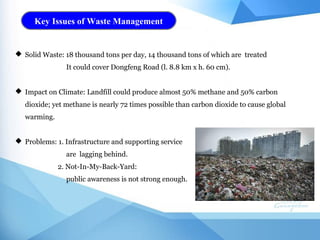
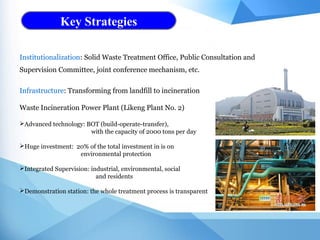
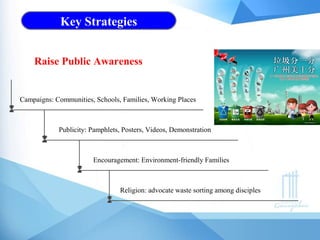
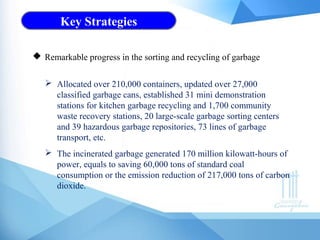
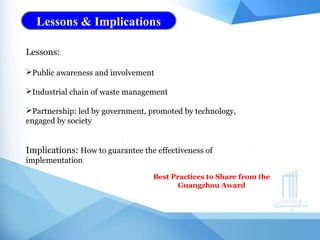
Guangzhou faces significant waste management challenges due to its large population and rapid growth. It generates over 18,000 tons of solid waste per day, which contributes to climate issues like methane emissions. However, Guangzhou is working to transform its waste management through strategies like building incineration plants, improving infrastructure, raising public awareness, and encouraging waste sorting. Notable achievements include allocating many waste containers and generating electricity from incinerated garbage. Lessons learned include the importance of public involvement, developing an industrial waste management chain, and partnership between government, technology, and society.
![[Climate Change Program]City Paper Presentation : Guangzhou(China)](https://cdn.slidesharecdn.com/ss_thumbnails/1-150421193732-conversion-gate02-thumbnail.jpg?width=640&height=640&fit=bounds)


![Public Administration Presentation Waste Reduction Programme[1]](https://cdn.slidesharecdn.com/ss_thumbnails/publicadministrationpresentation-wastereductionprogramme1-091117100353-phpapp02-thumbnail.jpg?width=640&height=640&fit=bounds)


![[Urban management policy training] ulaanbaatar city presentation](https://cdn.slidesharecdn.com/ss_thumbnails/urbanmanagementpolicytrainingulaanbaatarcitypresentation-160717120021-thumbnail.jpg?width=640&height=640&fit=bounds)
![[Urban management policy training] tegucigalpa city presentation](https://cdn.slidesharecdn.com/ss_thumbnails/urbanmanagementpolicytrainingtegucigalpacitypresentation-160717115701-thumbnail.jpg?width=640&height=640&fit=bounds)
![[Urban management policy training] macala city presentation](https://cdn.slidesharecdn.com/ss_thumbnails/urbanmanagementpolicytrainingmacalacitypresentation-160717115450-thumbnail.jpg?width=640&height=640&fit=bounds)
![[Urban management policy training] hanoi city presentation 2](https://cdn.slidesharecdn.com/ss_thumbnails/urbanmanagementpolicytraininghanoicitypresentation2-160717115311-thumbnail.jpg?width=640&height=640&fit=bounds)
![[Urban management policy training] hanoi city presentation](https://cdn.slidesharecdn.com/ss_thumbnails/urbanmanagementpolicytraininghanoicitypresentation-160717114925-thumbnail.jpg?width=640&height=640&fit=bounds)
![[Urban management policy training] Water Planning and Construction in Guangzhou](https://cdn.slidesharecdn.com/ss_thumbnails/urbanmanagementpolicytrainingguangzhoucitypresentation2-160717114604-thumbnail.jpg?width=640&height=640&fit=bounds)
![[Urban management policy training] guangzhou city presentation](https://cdn.slidesharecdn.com/ss_thumbnails/urbanmanagementpolicytrainingguangzhoucitypresentation-160717114316-thumbnail.jpg?width=640&height=640&fit=bounds)
![[Urban management policy training] beijing city presentation](https://cdn.slidesharecdn.com/ss_thumbnails/urbanmanagementpolicytrainingbeijingcitypresentation-160717090252-thumbnail.jpg?width=640&height=640&fit=bounds)
![[Urban management policy training] bangkok city presentation](https://cdn.slidesharecdn.com/ss_thumbnails/urbanmanagementpolicytrainingbangkokcitypresentation-160717090001-thumbnail.jpg?width=640&height=640&fit=bounds)
![[Urban management policy training] ambato city presentation](https://cdn.slidesharecdn.com/ss_thumbnails/urbanmanagementpolicytrainingambatocitypresentation-160717085029-thumbnail.jpg?width=640&height=640&fit=bounds)
![[E government policy training] shiraz city presentation](https://cdn.slidesharecdn.com/ss_thumbnails/e-governmentpolicytrainingshirazcitypresentation-160717080841-thumbnail.jpg?width=640&height=640&fit=bounds)
![[E government policy training] shanghai city presentation](https://cdn.slidesharecdn.com/ss_thumbnails/e-governmentpolicytrainingshanghaicitypresentation-160717080702-thumbnail.jpg?width=640&height=640&fit=bounds)
![[E government policy training] quito city presentation](https://cdn.slidesharecdn.com/ss_thumbnails/e-governmentpolicytrainingquitocitypresentation-160717080607-thumbnail.jpg?width=640&height=640&fit=bounds)
![[E government policy training] medellin city presentation](https://cdn.slidesharecdn.com/ss_thumbnails/e-governmentpolicytrainingmedellincitypresentation-160717080358-thumbnail.jpg?width=640&height=640&fit=bounds)
![[E government policy training] taipei city presentation](https://cdn.slidesharecdn.com/ss_thumbnails/e-governmentpolicytrainingtaipeicitypresentation-160717051309-thumbnail.jpg?width=640&height=640&fit=bounds)
![[E government policy training] jakarta city presentation](https://cdn.slidesharecdn.com/ss_thumbnails/e-governmentpolicytrainingjakartacitypresentation-160717051246-thumbnail.jpg?width=640&height=640&fit=bounds)
![[E government policy training] hanoi city presentation](https://cdn.slidesharecdn.com/ss_thumbnails/e-governmentpolicytraininghanoicitypresentation-160717045733-thumbnail.jpg?width=640&height=640&fit=bounds)
![[E government policy training] guangzhou city presentation](https://cdn.slidesharecdn.com/ss_thumbnails/e-governmentpolicytrainingguangzhoucitypresentation-160717045410-thumbnail.jpg?width=640&height=640&fit=bounds)
![[Seoul e government] seoul map geospatial information platform](https://cdn.slidesharecdn.com/ss_thumbnails/seoule-governmentseoulmapgeospatialinformationplatform-160613232015-thumbnail.jpg?width=640&height=640&fit=bounds)
![[Urban transportation policy program]action plan guzangzhou](https://cdn.slidesharecdn.com/ss_thumbnails/urbantransportationpolicyprogramactionplanguzangzhou-160407030814-thumbnail.jpg?width=640&height=640&fit=bounds)