WASTE MANAGEMENT
    IN SLUMS
WASTE COLLECTION IS
        EASIEST IN SLUMS
Slum dwellers are always the most
  neglected sector for waste collection.
They desire and understand the need for
 a clean environment and the costs of ill
 health.
They are the most willing to cooperate in
 improved waste management efforts.
                                            2
SLUM DWELLERS ARE THE MOST WILLING
   TO PAY FOR WASTE MANAGEMENT


 Despite having lower incomes
 than other areas, collection is
 most forthcoming and easiest
 to collect in slums.

                                     3
FIVE EASY PROVEN METHODS FOR
WASTE COLLECTION AND TREATMENT
1, Lorry at the slum entrance
2, Door-to-door collection in handcarts
3, Take-away bins in narrow lanes
4, Shared bio-bins
5, Community bio-bins

                                          4
LORRY AT SLUM ENTRANCE
Slum lanes are usually kept clean, but waste
  usually lies uncollected in large heaps just
  outside the slum entrance.
It takes a lorry 15-20 minutes to load this.
Instead, a lorry waits at slum entrance at a fixed
  time, while helper moves through slum with
  whistle to announce its arrival.
Slum-dwellers come to lorry with their waste.
Lorry pickup time and frequency unchanged.
So no extra payment is required.
                                                     5
DOOR-TO-DOOR COLLECTION
         IN HANDCARTS
This is done in Calcutta’s upgraded slums
 where lanes are paved and wide
 enough for movement.
Waste is collected in the usual way in
 hand-carts at a fixed time of day.
No payment is required as this replaces
 earlier lane-sweeping practices.
                                            6
TAKE-AWAY BINS IN NARROW LANES-1

In Mumbai, slum assns appoint youths for
cleaning work, before going to college or jobs.
First a mass clean-up drive is undertaken.
Then the new system is immediately started.
7-8am : narrow open drains are swept clean.
8am : 50-litre bins given by city are placed at
  path crossings, one per 25 homes or so.

                                                  7
TAKE-AWAY BINS IN NARROW LANES-2
8-10 am : waste is carried from each home to
  nearest bin at residents’ convenience.
10-11 am : All bins are removed and unloaded
  directly into waiting truck outside slum, and
  stacked till next day.
City’s cooperation in regular and punctual
presence of lorry at 10-11am is vital !!
Residents willingly pay Re 1 per head or Rs 5
 per family. More for shops outside the slum.

                                                  8
SHARED BIO-BINS : DHAKA MODEL
Waste Concern NGO provides 5-6 families a
 perforated barrel on a raised base, with
 compost layer at bottom as a starter bed.
Residents must fill only kitchen waste daily in
 layers not more than ~50mm, for mulch-
 composting in the barrel.
NGO buys the ready compost when barrel is full
 after 3 months or so.
Demand is good and cooperation too, as
 residents see their waste as valuable.

                                                  9
COMMUNITY BIO-BINS - 1
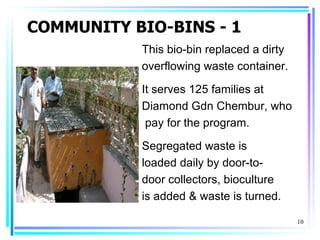
           This bio-bin replaced a dirty
           overflowing waste container.

           It serves 125 families at
           Diamond Gdn Chembur, who
            pay for the program.

           Segregated waste is
           loaded daily by door-to-
           door collectors, bioculture
           is added & waste is turned.

                                           10
COMMUNITY BIO-BINS - 2
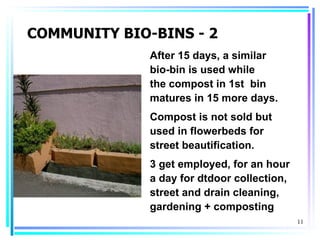
              After 15 days, a similar
              bio-bin is used while
              the compost in 1st bin
              matures in 15 more days.
              Compost is not sold but
              used in flowerbeds for
              street beautification.
              3 get employed, for an hour
              a day for dtdoor collection,
              street and drain cleaning,
              gardening + composting
                                             11
COMMUNITY BIO-BINS - 3
140 such bio-bins are in use at Kochi on
  Rupee-A-Day scheme, in good demand
  for cleanliness in middle-income areas.
Residents groups pay for installation of
 bio-bins. Kudumbashree womens’ self-
 help groups collect waste door-to-door,
 put kitchen waste in bio-bin, add culture
 and turn it. Sale of compost adds to
 their income. Being tried in slums now.

                                             12

Waste management in slums

  • 1.
  • 2.
    WASTE COLLECTION IS EASIEST IN SLUMS Slum dwellers are always the most neglected sector for waste collection. They desire and understand the need for a clean environment and the costs of ill health. They are the most willing to cooperate in improved waste management efforts. 2
  • 3.
    SLUM DWELLERS ARETHE MOST WILLING TO PAY FOR WASTE MANAGEMENT Despite having lower incomes than other areas, collection is most forthcoming and easiest to collect in slums. 3
  • 4.
    FIVE EASY PROVENMETHODS FOR WASTE COLLECTION AND TREATMENT 1, Lorry at the slum entrance 2, Door-to-door collection in handcarts 3, Take-away bins in narrow lanes 4, Shared bio-bins 5, Community bio-bins 4
  • 5.
    LORRY AT SLUMENTRANCE Slum lanes are usually kept clean, but waste usually lies uncollected in large heaps just outside the slum entrance. It takes a lorry 15-20 minutes to load this. Instead, a lorry waits at slum entrance at a fixed time, while helper moves through slum with whistle to announce its arrival. Slum-dwellers come to lorry with their waste. Lorry pickup time and frequency unchanged. So no extra payment is required. 5
  • 6.
    DOOR-TO-DOOR COLLECTION IN HANDCARTS This is done in Calcutta’s upgraded slums where lanes are paved and wide enough for movement. Waste is collected in the usual way in hand-carts at a fixed time of day. No payment is required as this replaces earlier lane-sweeping practices. 6
  • 7.
    TAKE-AWAY BINS INNARROW LANES-1 In Mumbai, slum assns appoint youths for cleaning work, before going to college or jobs. First a mass clean-up drive is undertaken. Then the new system is immediately started. 7-8am : narrow open drains are swept clean. 8am : 50-litre bins given by city are placed at path crossings, one per 25 homes or so. 7
  • 8.
    TAKE-AWAY BINS INNARROW LANES-2 8-10 am : waste is carried from each home to nearest bin at residents’ convenience. 10-11 am : All bins are removed and unloaded directly into waiting truck outside slum, and stacked till next day. City’s cooperation in regular and punctual presence of lorry at 10-11am is vital !! Residents willingly pay Re 1 per head or Rs 5 per family. More for shops outside the slum. 8
  • 9.
    SHARED BIO-BINS :DHAKA MODEL Waste Concern NGO provides 5-6 families a perforated barrel on a raised base, with compost layer at bottom as a starter bed. Residents must fill only kitchen waste daily in layers not more than ~50mm, for mulch- composting in the barrel. NGO buys the ready compost when barrel is full after 3 months or so. Demand is good and cooperation too, as residents see their waste as valuable. 9
  • 10.
    COMMUNITY BIO-BINS -1 This bio-bin replaced a dirty overflowing waste container. It serves 125 families at Diamond Gdn Chembur, who pay for the program. Segregated waste is loaded daily by door-to- door collectors, bioculture is added & waste is turned. 10
  • 11.
    COMMUNITY BIO-BINS -2 After 15 days, a similar bio-bin is used while the compost in 1st bin matures in 15 more days. Compost is not sold but used in flowerbeds for street beautification. 3 get employed, for an hour a day for dtdoor collection, street and drain cleaning, gardening + composting 11
  • 12.
    COMMUNITY BIO-BINS -3 140 such bio-bins are in use at Kochi on Rupee-A-Day scheme, in good demand for cleanliness in middle-income areas. Residents groups pay for installation of bio-bins. Kudumbashree womens’ self- help groups collect waste door-to-door, put kitchen waste in bio-bin, add culture and turn it. Sale of compost adds to their income. Being tried in slums now. 12