
A seminar presentation on
Amphibious house
Presented by:
Indrajit patra
Reg. no. 1201110048
Civil Engineering.
8th Semester.
GOVERNMENT COLLEGE OF ENGINEERING KALAHANDI,
BHAWANIPATNA
Contents
1. Introduction
2. Present flood scenario and protection in India
3. Amphibious house
4. Design of amphibious house
5. Successfully implemented amphibious house
6. Advantages
7. conclusion
8. References
Introduction
 In the recent year the floods is the biggest natural disaster the mankind
have ever experienced . Every year due to the riseing flood level the
conventional method of flood protection are proved futile which make
necessary for an alternative method .
 Amphibious architecture is a cost-effective, safe alternative to permanent
static elevation and can be achieved by the implementation of buoyant
foundations. It keep the house in flood prone area to remain on the
ground under normal condition. During a flood, the house is lifted by
rising waters to ensure it is always dry, and then returns to ground as the
flood waters recede.
Present flood scenario and protection in India
 India being a peninsular country and
surrounded by Arabian sea, Indian ocean
and Bay of Bengal is quite prone to flood.
As per the geological survey of India the
major flood prone areas cover 12.5% of
total area of the country. Every year, flood,
the most common disaster in India causes
immense losses to property and lives .
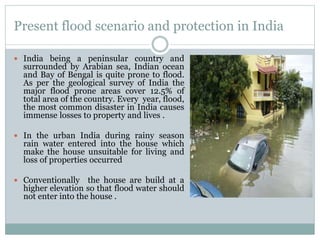
 In the urban India during rainy season
rain water entered into the house which
make the house unsuitable for living and
loss of properties occurred
 Conventionally the house are build at a
higher elevation so that flood water should
not enter into the house .
What is Amphibious house
 The term “amphibious” comes from the biological class amphibian which
are inhabitant to both land and water.
 The amphibious house is based on the principle of buoyant foundation.
 Amphibious house are essentially made up of hollow base strong enough
to hold the dead and live load .
 Amphibious house can work on both ground and water which provide
safety to the occupant during any flood hazard .
 Amphibious house are alternative to the existing safety precaution
provided to the houses in flood prone areas in an cost effective and
environmental friendly manner
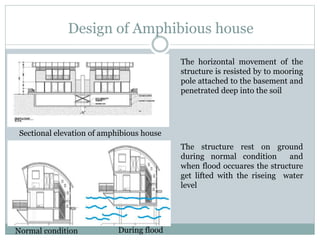
Design of Amphibious house
Normal condition During flood
Sectional elevation of amphibious house
The structure rest on ground
during normal condition and
when flood occuares the structure
get lifted with the riseing water
level
The horizontal movement of the
structure is resisted by to mooring
pole attached to the basement and
penetrated deep into the soil
 The amphibious house rest on a buoyant foundation which is essentially
a reinforced concrete foundation designed and located such that its
weight and superimposed permanent load is approximately equal to the
weight of displaced soil and/or ground water .
 Buoyant foundations are a solution to elevated housing, one that allows
homes to remain on ground under normal conditions but rise as much as
necessary when flooding occurs.
 The material used in the buoyant foundation are reinforced concrete ,
steel pontoon , plastic vessel , used plastic bottles etc.
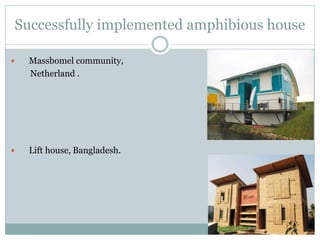
Successfully implemented amphibious house
 Massbomel community,
Netherland .
 Lift house, Bangladesh.
 The maasbommel community, Netherland .
• The first fully engineered amphibious structure was designed
and built by Factor Architecten and Dura Vermeer at
Maasbommel in Netherlands as a response to rising water level.
• The Maasbommel project consists of 34 amphibious houses
with every unit cost around 3-4 lakhs .
• Each house contain water tight hollow concrete basement
that becomes a buoyant when it floats on water. The houses can
reach a maximum height of 18 ft by sliding along two vertical
mooring poles that are permanently inserted into the ground
between each pair of houses. These poles restrict horizontal
movements to ensure the houses do not float away when the
water levels are high. PVC piping allows flexible connections for
plumbing, electrical, and natural gas during both positions of the
house whether floating or on the ground.
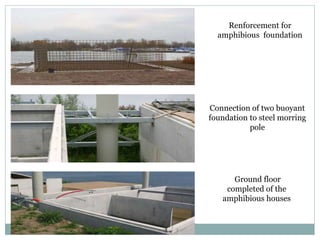
Renforcement for
amphibious foundation
Connection of two buoyant
foundation to steel morring
pole
Ground floor
completed of the
amphibious houses
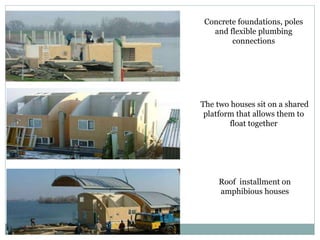
Concrete foundations, poles
and flexible plumbing
connections
The two houses sit on a shared
platform that allows them to
float together
Roof installment on
amphibious houses
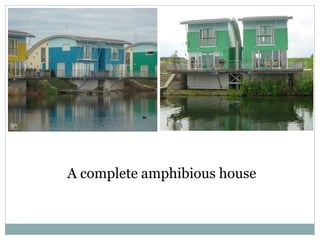
A complete amphibious house
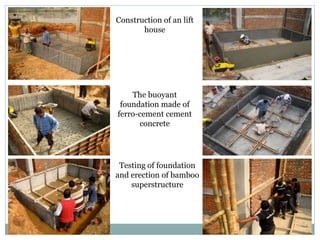
 Lift house, Bangladesh .
 Bangladesh, is a delta country that is one of the most vulnerable
locations for rising sea levels and is a hotspot in the flood map of the world .
 The lift (low income floating technology) house in bangladesh is
focused on the low income urban poor to provideing affordable house at low
price .
 Locally available bamboo make the cost of lift house affordable as
compaired to other construction material .
. .
Construction of an lift
house
The buoyant
foundation made of
ferro-cement cement
concrete
Testing of foundation
and erection of bamboo
superstructure
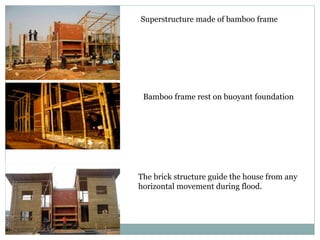
Superstructure made of bamboo frame
The brick structure guide the house from any
horizontal movement during flood.
Bamboo frame rest on buoyant foundation
1
1
5
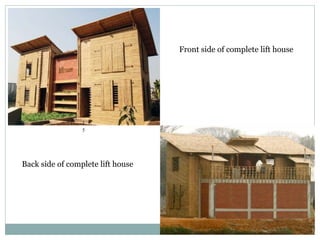
Front side of complete lift house
Back side of complete lift house
Advantages of amphibious house
 Amphibious house are low cost affordable structures that can be build
in flood prone areas.
 The land used for amphibious house have very low engineering
properties and proved costlier for conventional constructions.
 Amphibious house prove very useful in tidal region where normal
structures can not sustain.
 Countries where land for new construction are very less amphibious
house can be used to counter the higher demand for land by growing
population.
Conclusion
 India has islands, coastal areas and areas highly prone to floods.
Therefore, there is a need to construct floating houses and have
expertise in this type of construction.
 The sea level is said to have risen by 20 centimetres in the last century
and is expected to rise by three times that amount in the 21st century.
Therefore floating houses will not just be a fashionable lifestyle but a
necessity
 The amphibious house is not only a technique to safety against flood
but also it provide a solution for the growing demand of land for new
construction .
References
 Archimedes Principle. Encyclopedia Britannica, 2014. Web. 15 march,
2016. http://Britannica.com/
 BCDC Living with Water. San Francisco Bay Conservation and
Development Commission, Oct. 2011. Web. 21 march. 2016.
 English, Elizabeth. Amphibious Foundations and the Buoyant
Foundation Project : Innovative Strategies for Flood-Resilient
Housing. Ontario: University of Waterloo School of Architecture.
2010. Print.
 Floating Houses Ijburg , Architecten bureau Marlies Rohmer .
Web. 23 march. 2016. http://rohmer.nl/
 Pile Installation Demonstration Project. San Francisco-Oakland Bay
Bridge. East Span Seismic Safety Project. California Department
of Transportation, Jun. 1999. Web. 12 april. 2016.
http://dot.ca.gov/
 Prosun, Prithula. The LIFT House. Ontario: University of Waterloo,
2011. Print.
 Royal Institute of British Architects. Living With Water: Visions of a
Flooded Future. London: RIBA, 2007. Print.
 Van der Pol, Johan. Flood Proof Architecture. Climate of Coastal
Cooperation. Netherlands: Coastal and Marine Union, 2011.
Print.
Thank you
Dt.23/04/2016

Seminar on amphibious house ppt

  • 1.
    A seminar presentationon Amphibious house Presented by: Indrajit patra Reg. no. 1201110048 Civil Engineering. 8th Semester. GOVERNMENT COLLEGE OF ENGINEERING KALAHANDI, BHAWANIPATNA
  • 2.
    Contents 1. Introduction 2. Presentflood scenario and protection in India 3. Amphibious house 4. Design of amphibious house 5. Successfully implemented amphibious house 6. Advantages 7. conclusion 8. References
  • 3.
    Introduction  In therecent year the floods is the biggest natural disaster the mankind have ever experienced . Every year due to the riseing flood level the conventional method of flood protection are proved futile which make necessary for an alternative method .  Amphibious architecture is a cost-effective, safe alternative to permanent static elevation and can be achieved by the implementation of buoyant foundations. It keep the house in flood prone area to remain on the ground under normal condition. During a flood, the house is lifted by rising waters to ensure it is always dry, and then returns to ground as the flood waters recede.
  • 4.
    Present flood scenarioand protection in India  India being a peninsular country and surrounded by Arabian sea, Indian ocean and Bay of Bengal is quite prone to flood. As per the geological survey of India the major flood prone areas cover 12.5% of total area of the country. Every year, flood, the most common disaster in India causes immense losses to property and lives .  In the urban India during rainy season rain water entered into the house which make the house unsuitable for living and loss of properties occurred  Conventionally the house are build at a higher elevation so that flood water should not enter into the house .
  • 5.
    What is Amphibioushouse  The term “amphibious” comes from the biological class amphibian which are inhabitant to both land and water.  The amphibious house is based on the principle of buoyant foundation.  Amphibious house are essentially made up of hollow base strong enough to hold the dead and live load .  Amphibious house can work on both ground and water which provide safety to the occupant during any flood hazard .  Amphibious house are alternative to the existing safety precaution provided to the houses in flood prone areas in an cost effective and environmental friendly manner
  • 6.
    Design of Amphibioushouse Normal condition During flood Sectional elevation of amphibious house The structure rest on ground during normal condition and when flood occuares the structure get lifted with the riseing water level The horizontal movement of the structure is resisted by to mooring pole attached to the basement and penetrated deep into the soil
  • 7.
     The amphibioushouse rest on a buoyant foundation which is essentially a reinforced concrete foundation designed and located such that its weight and superimposed permanent load is approximately equal to the weight of displaced soil and/or ground water .  Buoyant foundations are a solution to elevated housing, one that allows homes to remain on ground under normal conditions but rise as much as necessary when flooding occurs.  The material used in the buoyant foundation are reinforced concrete , steel pontoon , plastic vessel , used plastic bottles etc.
  • 8.
    Successfully implemented amphibioushouse  Massbomel community, Netherland .  Lift house, Bangladesh.
  • 9.
     The maasbommelcommunity, Netherland . • The first fully engineered amphibious structure was designed and built by Factor Architecten and Dura Vermeer at Maasbommel in Netherlands as a response to rising water level. • The Maasbommel project consists of 34 amphibious houses with every unit cost around 3-4 lakhs . • Each house contain water tight hollow concrete basement that becomes a buoyant when it floats on water. The houses can reach a maximum height of 18 ft by sliding along two vertical mooring poles that are permanently inserted into the ground between each pair of houses. These poles restrict horizontal movements to ensure the houses do not float away when the water levels are high. PVC piping allows flexible connections for plumbing, electrical, and natural gas during both positions of the house whether floating or on the ground.
  • 10.
    Renforcement for amphibious foundation Connectionof two buoyant foundation to steel morring pole Ground floor completed of the amphibious houses
  • 11.
    Concrete foundations, poles andflexible plumbing connections The two houses sit on a shared platform that allows them to float together Roof installment on amphibious houses
  • 12.
  • 13.
     Lift house,Bangladesh .  Bangladesh, is a delta country that is one of the most vulnerable locations for rising sea levels and is a hotspot in the flood map of the world .  The lift (low income floating technology) house in bangladesh is focused on the low income urban poor to provideing affordable house at low price .  Locally available bamboo make the cost of lift house affordable as compaired to other construction material .
  • 14.
    . . Construction ofan lift house The buoyant foundation made of ferro-cement cement concrete Testing of foundation and erection of bamboo superstructure
  • 15.
    Superstructure made ofbamboo frame The brick structure guide the house from any horizontal movement during flood. Bamboo frame rest on buoyant foundation
  • 16.
    1 1 5 Front side ofcomplete lift house Back side of complete lift house
  • 17.
    Advantages of amphibioushouse  Amphibious house are low cost affordable structures that can be build in flood prone areas.  The land used for amphibious house have very low engineering properties and proved costlier for conventional constructions.  Amphibious house prove very useful in tidal region where normal structures can not sustain.  Countries where land for new construction are very less amphibious house can be used to counter the higher demand for land by growing population.
  • 18.
    Conclusion  India hasislands, coastal areas and areas highly prone to floods. Therefore, there is a need to construct floating houses and have expertise in this type of construction.  The sea level is said to have risen by 20 centimetres in the last century and is expected to rise by three times that amount in the 21st century. Therefore floating houses will not just be a fashionable lifestyle but a necessity  The amphibious house is not only a technique to safety against flood but also it provide a solution for the growing demand of land for new construction .
  • 19.
    References  Archimedes Principle.Encyclopedia Britannica, 2014. Web. 15 march, 2016. http://Britannica.com/  BCDC Living with Water. San Francisco Bay Conservation and Development Commission, Oct. 2011. Web. 21 march. 2016.  English, Elizabeth. Amphibious Foundations and the Buoyant Foundation Project : Innovative Strategies for Flood-Resilient Housing. Ontario: University of Waterloo School of Architecture. 2010. Print.  Floating Houses Ijburg , Architecten bureau Marlies Rohmer . Web. 23 march. 2016. http://rohmer.nl/  Pile Installation Demonstration Project. San Francisco-Oakland Bay Bridge. East Span Seismic Safety Project. California Department of Transportation, Jun. 1999. Web. 12 april. 2016. http://dot.ca.gov/
  • 20.
     Prosun, Prithula.The LIFT House. Ontario: University of Waterloo, 2011. Print.  Royal Institute of British Architects. Living With Water: Visions of a Flooded Future. London: RIBA, 2007. Print.  Van der Pol, Johan. Flood Proof Architecture. Climate of Coastal Cooperation. Netherlands: Coastal and Marine Union, 2011. Print.
  • 21.