Riaz Hussain Mirbahar
Program Manager WASH
ACF International Badin
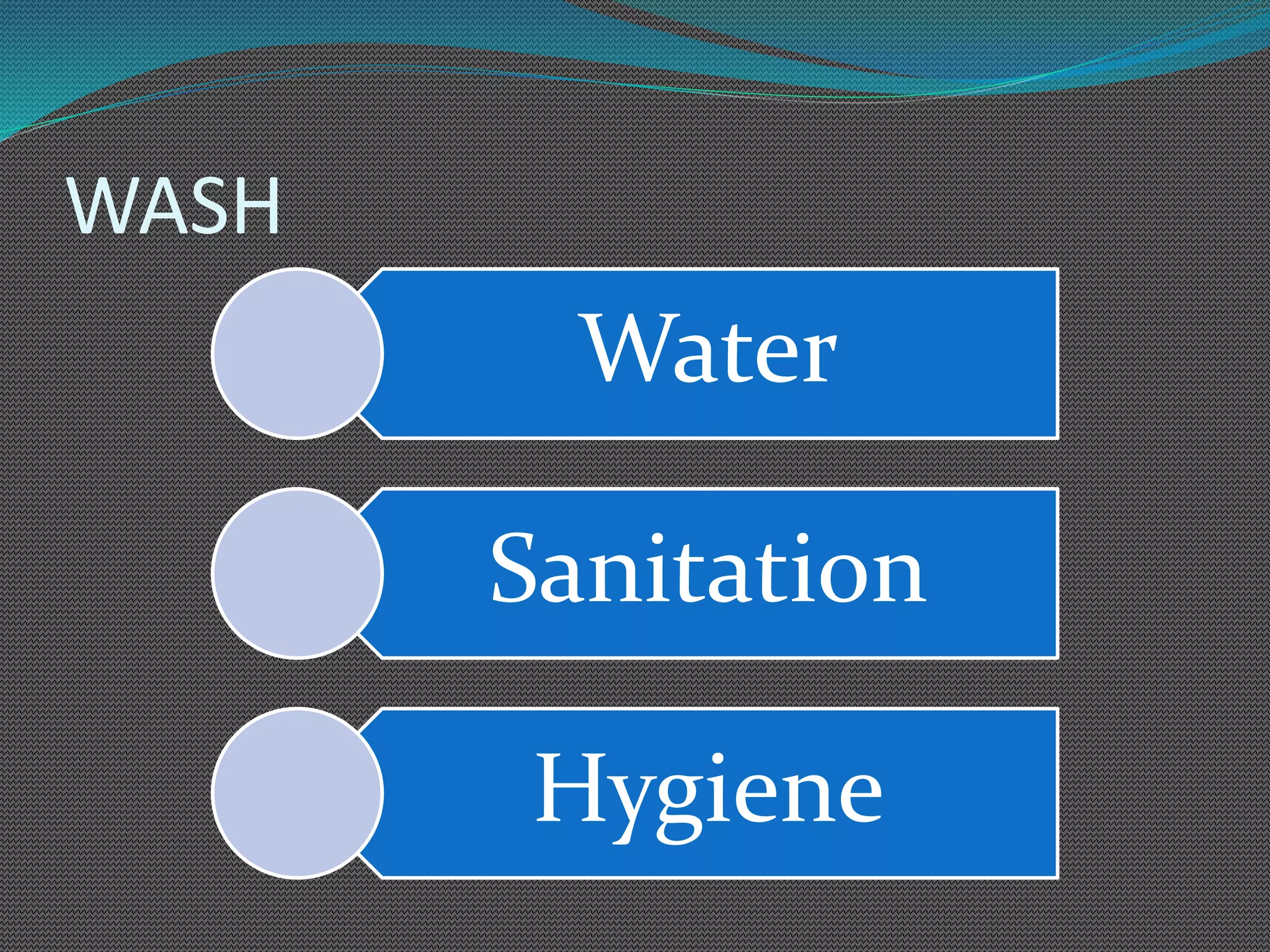
WASH
Water
Sanitation
Hygiene
WHY WASH
 According to a 2007 (WHO) report, 1.1 billion
people lack access to an improved drinking water
supply.
 1.8 million people die from diarrheal diseases each
year.
 The WHO estimates that 94 percent of these
diarrheal disease are preventable trough access to
safe water, adequate sanitation and proper hygiene.
WHY WASH
 Pakistan is facing worst water and sanitation problems in
rural, urban communities.
 Inadequate water and sanitation is a leading cause of about
60% of child mortality in Pakistan.
 Water related diseases occupy (20 to 40%) of hospitals
beds in Pakistan.
 Sindh is at the top having diarrheal alerts and outbreaks
which are higher than average in Pakistan.
WATER
Water is life
If it is potable/safe
Otherwise ????
WATER
H2O
Hydrogen + Oxygen
WATER
Access to clean water can be considered as
one of the basic needs and rights of a
human being
WATER CONTAMINATION
Water Contamination is any chemical,
physical or biological change in the quality
of water that has a harmful effect on any
living thing that drinks or uses this water.
SOURCES OF WATER CONTAMINATION
 Garbage/Wastage from cities/towns
disposed in Water canals, rivers, ponds.
 Wastage of factories/industries
 Wastage of hospitals.
 Use of chemical pesticides/fertilizers.
SOURCES OF WATER CONTAMINATION
WATER QUALITY PARAMETERS
Physical Parameters
Biological Parameters
Chemical Parameters
PHYSICAL PARAMETERS
 Turbidity
 Color
 Smell
 Taste
BIOLOGICAL PARAMETERS
Coliform Bacteria's
BIOLOGICAL PARAMETERS
Coliform Bacteria's
CHEMICAL PARAMETERS
SOURCES OF WATER
(Surface Water)
SOURCES OF WATER
(Hand Pumps)
ACTIVITIES FOR SAFE WATER
ACCESS
 Hand pumps Installation
 Hand pumps rehabilitation
 Water Reservoirs New/Rehab
 Water Quality Testing
 Water Filtration methods at household level
Basic Water Purification Methods
 Water Boiling
 Water Disinfection Tablets
 Alum (Phitkrhi)
 Chlorination
 Solar water disinfection
 Nadi Filter
SANITATION
World Health Organization (WHO) defines
sanitation as group of methods to collect human
excreta and urine as well as community waste
waters in a hygienic way, where human and
community health is not altered.
ACTIVITIES FOR ADEQUATE
SANITATION
 Installation of Latrines
 Drainage networks New/Rehab
 Solid Waste Management
 Hospital waste management (Incinerators)
HYGIENE PROMOTION
Hygiene promotion activities (HP) are done to
change “risk behaviors” within the population by
providing basic knowledge and resources.
A planned approach for preventing diarrheal
diseases through the widespread use of safe
hygiene practices is known as Hygiene
Promotion.
HYGIENE PROMOTION
 Transmission of diseases, understanding of risks and
solutions
 Proper use of facilities
 Proper water use: collection, transport, storage and
consumption
 Promotion of appropriate sanitation
 Basic personal hygiene
 Environmental hygiene
 Food hygiene
 Children hygiene
F-DIAGRAM
MOST COMMON WATER BORNE DISEASE
 Diarrhea
 Cholera (Infection: Acute Diarrhea)
 Typhoid Fever
 Skin Disease (Measles, Scabies)
 Hepatitis
 Salmonella (Infection: Severe Diarrhea)
 Dysentery (Bloody Diarrhea)
HAND WASHING STEPS
ANY QUESTION
?
?
WASH.pptx

WASH.pptx