Wanted: MOOC
Pedagogy
Case: Making Learning Personal
@somesanna
@akorhonen
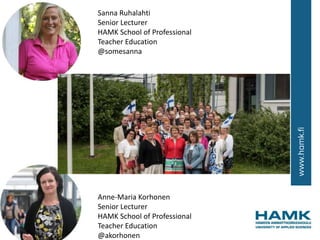
Sanna Ruhalahti
Senior Lecturer
HAMK School of Professional
Teacher Education
@somesanna
Anne-Maria Korhonen
Senior Lecturer
HAMK School of Professional
Teacher Education
@akorhonen
”MOOC pedagogy”
Courses are provided with ”a learning experience”:
• Video lectures (clips or cast interviews)
• Automated assesments (10-question quiz)
• Supporting messages
• Open resources (reading, links)
• Discussion forums (added some peer activities)
• What kind of learning this pedagogy supports?
• What´re learning outcomes?
• Where is pedagogy ?
• Why MOOC completion rate is less than 13 %?
Case: Making Learning
Personal
The course was designed for VET/FE educators who would
like to deepen their knowledge in individualization and
individual study plans.
One of the aims was to bring together VET/FE educators
from all over the world and recognize the best practices in
this field.
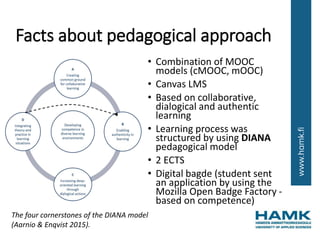
Facts about pedagogical approach
• Combination of MOOC
models (cMOOC, mOOC)
• Canvas LMS
• Based on collaborative,
dialogical and authentic
learning
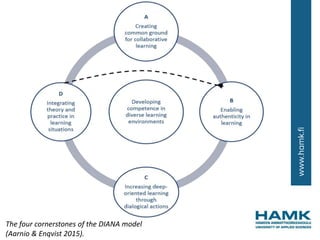
• Learning process was
structured by using DIANA
pedagogical model
• 2 ECTS
• Digital bagde (student sent
an application by using the
Mozilla Open Badge Factory -
based on competence)
The four cornerstones of the DIANA model
(Aarnio & Enqvist 2015).
The four cornerstones of the DIANA model
(Aarnio & Enqvist 2015).
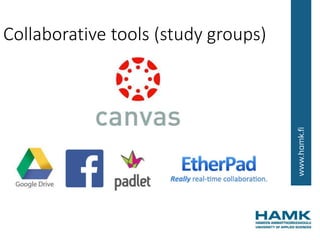
Collaborative tools (study groups)
Digital Badge (Making Learning Personal)
• Mozilla Open Badge Factory
• Criteria:
• The student is able to apply the legislation concerning individualisation and
instructions from national and institutional level to his/her practical work
and to developing the processes of his/her educational institute. The
student is able to provide his/her students with dialogical guidance during
the various stages of the personalisation process.
• How to show your competence:
• In your application, include a synthesis of the ISP model (link) that you have
created with your study group - Add an explanation for using the model in
practice - You can present the explanation in your learning environment as
long as you include an appropriate link in the application form. - Briefly
describe your dialogic participation and knowledge creation in your study
group.
Figures
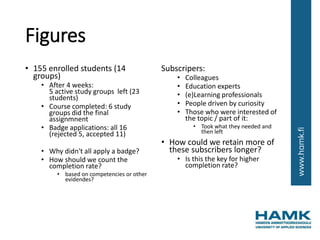
• 155 enrolled students (14
groups)
• After 4 weeks:
5 active study groups left (23
students)
• Course completed: 6 study
groups did the final
assignmnent
• Badge applications: all 16
(rejected 5, accepted 11)
• Why didn't all apply a badge?
• How should we count the
completion rate?
• based on competencies or other
evidendes?
Subscripers:
• Colleagues
• Education experts
• (e)Learning professionals
• People driven by curiosity
• Those who were interested of
the topic / part of it:
• Took what they needed and
then left
• How could we retain more of
these subscribers longer?
• Is this the key for higher
completion rate?
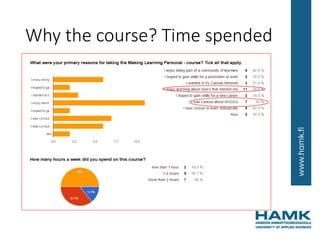
Why the course? Time spended
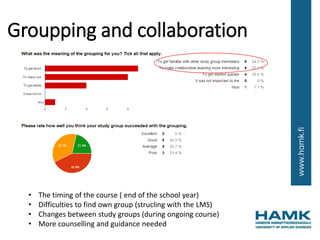
Groupping and collaboration
• The timing of the course ( end of the school year)
• Difficulties to find own group (strucling with the LMS)
• Changes between study groups (during ongoing course)
• More counselling and guidance needed
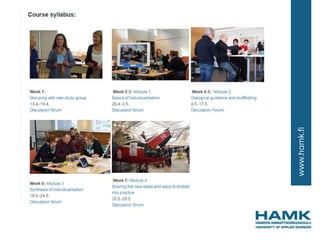
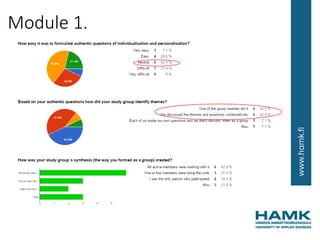
Module 1.
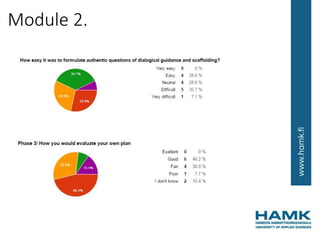
Module 2.
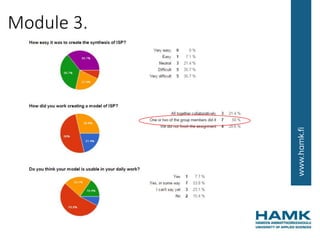
Module 3.
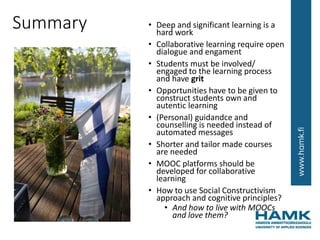
Summary • Deep and significant learning is a
hard work
• Collaborative learning require open
dialogue and engament
• Students must be involved/
engaged to the learning process
and have grit
• Opportunities have to be given to
construct students own and
autentic learning
• (Personal) guidandce and
counselling is needed instead of
automated messages
• Shorter and tailor made courses
are needed
• MOOC platforms should be
developed for collaborative
learning
• How to use Social Constructivism
approach and cognitive principles?
• And how to live with MOOCs
and love them?

Wanted: MOOC Pedagogy

  • 1.
    Wanted: MOOC Pedagogy Case: MakingLearning Personal @somesanna @akorhonen
  • 2.
    Sanna Ruhalahti Senior Lecturer HAMKSchool of Professional Teacher Education @somesanna Anne-Maria Korhonen Senior Lecturer HAMK School of Professional Teacher Education @akorhonen
  • 3.
    ”MOOC pedagogy” Courses areprovided with ”a learning experience”: • Video lectures (clips or cast interviews) • Automated assesments (10-question quiz) • Supporting messages • Open resources (reading, links) • Discussion forums (added some peer activities) • What kind of learning this pedagogy supports? • What´re learning outcomes? • Where is pedagogy ? • Why MOOC completion rate is less than 13 %?
  • 4.
    Case: Making Learning Personal Thecourse was designed for VET/FE educators who would like to deepen their knowledge in individualization and individual study plans. One of the aims was to bring together VET/FE educators from all over the world and recognize the best practices in this field.
  • 5.
    Facts about pedagogicalapproach • Combination of MOOC models (cMOOC, mOOC) • Canvas LMS • Based on collaborative, dialogical and authentic learning • Learning process was structured by using DIANA pedagogical model • 2 ECTS • Digital bagde (student sent an application by using the Mozilla Open Badge Factory - based on competence) The four cornerstones of the DIANA model (Aarnio & Enqvist 2015).
  • 6.
    The four cornerstonesof the DIANA model (Aarnio & Enqvist 2015).
  • 8.
  • 9.
    Digital Badge (MakingLearning Personal) • Mozilla Open Badge Factory • Criteria: • The student is able to apply the legislation concerning individualisation and instructions from national and institutional level to his/her practical work and to developing the processes of his/her educational institute. The student is able to provide his/her students with dialogical guidance during the various stages of the personalisation process. • How to show your competence: • In your application, include a synthesis of the ISP model (link) that you have created with your study group - Add an explanation for using the model in practice - You can present the explanation in your learning environment as long as you include an appropriate link in the application form. - Briefly describe your dialogic participation and knowledge creation in your study group.
  • 10.
    Figures • 155 enrolledstudents (14 groups) • After 4 weeks: 5 active study groups left (23 students) • Course completed: 6 study groups did the final assignmnent • Badge applications: all 16 (rejected 5, accepted 11) • Why didn't all apply a badge? • How should we count the completion rate? • based on competencies or other evidendes? Subscripers: • Colleagues • Education experts • (e)Learning professionals • People driven by curiosity • Those who were interested of the topic / part of it: • Took what they needed and then left • How could we retain more of these subscribers longer? • Is this the key for higher completion rate?
  • 11.
    Why the course?Time spended
  • 12.
    Groupping and collaboration •The timing of the course ( end of the school year) • Difficulties to find own group (strucling with the LMS) • Changes between study groups (during ongoing course) • More counselling and guidance needed
  • 13.
  • 14.
  • 15.
  • 16.
    Summary • Deepand significant learning is a hard work • Collaborative learning require open dialogue and engament • Students must be involved/ engaged to the learning process and have grit • Opportunities have to be given to construct students own and autentic learning • (Personal) guidandce and counselling is needed instead of automated messages • Shorter and tailor made courses are needed • MOOC platforms should be developed for collaborative learning • How to use Social Constructivism approach and cognitive principles? • And how to live with MOOCs and love them?