BY
ROHAN P. DUSANE (A4- 51)
"People think we got big by putting big
stores in small towns. Really, we got big
by replacing inventory with
information."
-Sam Walton, Founder of
Wal-Mart
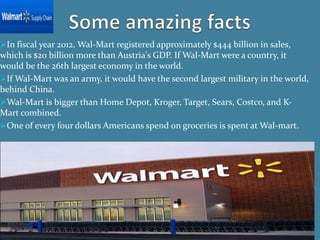
In fiscal year 2012, Wal-Mart registered approximately $444 billion in sales,
which is $20 billion more than Austria's GDP. If Wal-Mart were a country, it
would be the 26th largest economy in the world.
If Wal-Mart was an army, it would have the second largest military in the world,
behind China.
Wal-Mart is bigger than Home Depot, Kroger, Target, Sears, Costco, and K-
Mart combined.
One of every four dollars Americans spend on groceries is spent at Wal-mart.
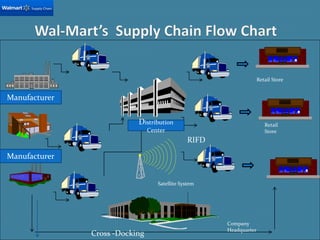
Manufacturer
Manufacturer
Distribution
Center
Company
Headquarter
Satellite System
Retail Store
Retail
Store
RIFD
Cross -Docking
competitor.
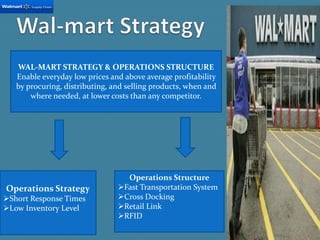
WAL-MART STRATEGY & OPERATIONS STRUCTURE
Enable everyday low prices and above average profitability
by procuring, distributing, and selling products, when and
where needed, at lower costs than any competitor.
Operations Strategy
Short Response Times
Low Inventory Level
Operations Structure
Fast Transportation System
Cross Docking
Retail Link
RFID
Wal-Mart’s Procurement
 Emphasized the need to reduce purchasing costs and offer
the best price to the customer.
 The company directly procured from manufacturers, by
passing all intermediaries.
 Finalizes a purchase deal only when fully confident that the
products being bought is not available else where at a
lower price.
 Spends a significant amount of time meeting vendors and
understanding their cost structure.
 Making the process transparent, the retailer can be certain
that the manufacturers are doing their best to cut down
costs.
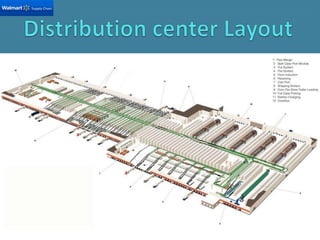
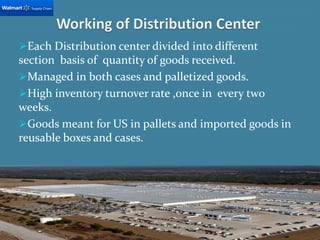
Each Distribution center divided into different
section basis of quantity of goods received.
Managed in both cases and palletized goods.
High inventory turnover rate ,once in every two
weeks.
Goods meant for US in pallets and imported goods in
reusable boxes and cases.
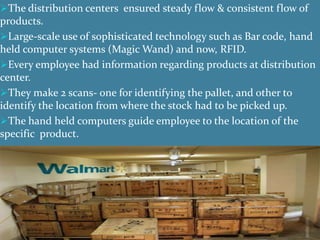
The distribution centers ensured steady flow &
consistent flow of products.
85% of goods passed distribution centers.
The distribution centers ensured steady flow & consistent flow of
products.
Large-scale use of sophisticated technology such as Bar code, hand
held computer systems (Magic Wand) and now, RFID.
Every employee had information regarding products at distribution
center.
They make 2 scans- one for identifying the pallet, and other to
identify the location from where the stock had to be picked up.
The hand held computers guide employee to the location of the
specific product.
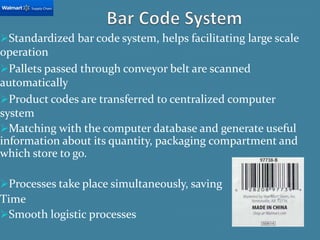
Standardized bar code system, helps facilitating large scale
operation
Pallets passed through conveyor belt are scanned
automatically
Product codes are transferred to centralized computer
system
Matching with the computer database and generate useful
information about its quantity, packaging compartment and
which store to go.
Processes take place simultaneously, saving
Time
Smooth logistic processes
Radio Frequency Identification System
Use radio waves to identify objects
Tags with microchip and antenna built in
Store data (type, quantity, manufacturer, expired date…)
Generate HF signal to transfer data
Allow Wal-mart to keep track of pallets at various stages
Locate where the pallet is and the condition of it i.e.
temperature and humidity
Automatic sensor – avoid scanning codes one by one
Important feature of Wal-marts logistics infrastructure was its fast
and responsive transportation system
Company hired experienced drivers having more than 300,000
accident free miles with no major traffic violation.
Each driver averages around 100,000 miles annually
Drivers follow the most efficient routes to their destinations, and
work to minimize the number of “empty miles” they drive.
The distribution centers were serviced by more than 3500 company
owned trucks.
Finished goods are directly picked up from the manufacturing site
of supplier, sorted out and directly supplied to the customers.
Because of “cross-docking” the system shifted from “supply chain”
to “demand chain” which meant, instead of retailers ‘pushing’ the
products into the system, the customers could ‘pull’ the products,
when & where they required.
 This reduces handling and storage of finished products.
Adopted to minimize costs and total lead time
 Wal-Mart invested heavily in IT and communication systems to
effectively track sales and merchandise inventories.
Wal-Mart made full use of its IT capabilities to make more inventories
available in the case of items that customers wanted most, while reducing
the overall inventory levels.
The order management and store replenishment of goods were entirely
executed with the help of computers through the Point-of-Sales (POS)
system , it was possible to monitor and track the sales and merchandise
stock levels on the store shelves.
In 1998, Wal-Mart installed a voice-based order filling (VOF) system in all
its grocery distribution centers.
They were guided by the voice to item locations in the distribution
centers.
Invested approximately $4 billion to build a retail link system.
More than 10,000 Wal-Mart retail suppliers used the retail link system to
monitor the sales of their goods at stores and replenish inventories.
Details of daily transactions were processed through this system.
Wal-Mart owned the largest and most sophisticated computer system in
the private sector.
Massively Parallel Processor (MPP) computer system to track the
movement of goods and stock levels
All information related to sales and inventories was passed on through an
advanced satellite communication system
Retail Link had emerged into an Internet-enabled SCM system whose functions
were not confined to inventory management alone, but also covered collaborative
planning, forecasting and replenishment (CPFR)
In CPFR, Wal-Mart worked together with its key suppliers on a real-time basis by
using the Internet to jointly determine product-wise demand forecast.
CPFR is defined as a business practice for business partners to share forecasts
and results data through the Internet, in order to reduce inventory costs while at
the same time, enhancing product availability across the supply chain
Aimed at a mutually beneficial collaboration between Wal-Mart and its suppliers,
its actual implementation required huge investments in time and money.
A few suppliers with whom Wal-Mart tried to implement CPFR complained that
a significant amount of time had to be spent on developing forecasts and analyzing
sales data.
Thank You

Walmart supply chain management

  • 1.
    BY ROHAN P. DUSANE(A4- 51) "People think we got big by putting big stores in small towns. Really, we got big by replacing inventory with information." -Sam Walton, Founder of Wal-Mart
  • 3.
    In fiscal year2012, Wal-Mart registered approximately $444 billion in sales, which is $20 billion more than Austria's GDP. If Wal-Mart were a country, it would be the 26th largest economy in the world. If Wal-Mart was an army, it would have the second largest military in the world, behind China. Wal-Mart is bigger than Home Depot, Kroger, Target, Sears, Costco, and K- Mart combined. One of every four dollars Americans spend on groceries is spent at Wal-mart.
  • 4.
  • 5.
    competitor. WAL-MART STRATEGY &OPERATIONS STRUCTURE Enable everyday low prices and above average profitability by procuring, distributing, and selling products, when and where needed, at lower costs than any competitor. Operations Strategy Short Response Times Low Inventory Level Operations Structure Fast Transportation System Cross Docking Retail Link RFID
  • 7.
    Wal-Mart’s Procurement  Emphasizedthe need to reduce purchasing costs and offer the best price to the customer.  The company directly procured from manufacturers, by passing all intermediaries.  Finalizes a purchase deal only when fully confident that the products being bought is not available else where at a lower price.  Spends a significant amount of time meeting vendors and understanding their cost structure.  Making the process transparent, the retailer can be certain that the manufacturers are doing their best to cut down costs.
  • 9.
    Each Distribution centerdivided into different section basis of quantity of goods received. Managed in both cases and palletized goods. High inventory turnover rate ,once in every two weeks. Goods meant for US in pallets and imported goods in reusable boxes and cases. The distribution centers ensured steady flow & consistent flow of products. 85% of goods passed distribution centers.
  • 10.
    The distribution centersensured steady flow & consistent flow of products. Large-scale use of sophisticated technology such as Bar code, hand held computer systems (Magic Wand) and now, RFID. Every employee had information regarding products at distribution center. They make 2 scans- one for identifying the pallet, and other to identify the location from where the stock had to be picked up. The hand held computers guide employee to the location of the specific product.
  • 11.
    Standardized bar codesystem, helps facilitating large scale operation Pallets passed through conveyor belt are scanned automatically Product codes are transferred to centralized computer system Matching with the computer database and generate useful information about its quantity, packaging compartment and which store to go. Processes take place simultaneously, saving Time Smooth logistic processes
  • 12.
    Radio Frequency IdentificationSystem Use radio waves to identify objects Tags with microchip and antenna built in Store data (type, quantity, manufacturer, expired date…) Generate HF signal to transfer data Allow Wal-mart to keep track of pallets at various stages Locate where the pallet is and the condition of it i.e. temperature and humidity Automatic sensor – avoid scanning codes one by one
  • 13.
    Important feature ofWal-marts logistics infrastructure was its fast and responsive transportation system Company hired experienced drivers having more than 300,000 accident free miles with no major traffic violation. Each driver averages around 100,000 miles annually Drivers follow the most efficient routes to their destinations, and work to minimize the number of “empty miles” they drive. The distribution centers were serviced by more than 3500 company owned trucks.
  • 14.
    Finished goods aredirectly picked up from the manufacturing site of supplier, sorted out and directly supplied to the customers. Because of “cross-docking” the system shifted from “supply chain” to “demand chain” which meant, instead of retailers ‘pushing’ the products into the system, the customers could ‘pull’ the products, when & where they required.  This reduces handling and storage of finished products. Adopted to minimize costs and total lead time
  • 15.
     Wal-Mart investedheavily in IT and communication systems to effectively track sales and merchandise inventories. Wal-Mart made full use of its IT capabilities to make more inventories available in the case of items that customers wanted most, while reducing the overall inventory levels. The order management and store replenishment of goods were entirely executed with the help of computers through the Point-of-Sales (POS) system , it was possible to monitor and track the sales and merchandise stock levels on the store shelves. In 1998, Wal-Mart installed a voice-based order filling (VOF) system in all its grocery distribution centers. They were guided by the voice to item locations in the distribution centers.
  • 16.
    Invested approximately $4billion to build a retail link system. More than 10,000 Wal-Mart retail suppliers used the retail link system to monitor the sales of their goods at stores and replenish inventories. Details of daily transactions were processed through this system. Wal-Mart owned the largest and most sophisticated computer system in the private sector. Massively Parallel Processor (MPP) computer system to track the movement of goods and stock levels All information related to sales and inventories was passed on through an advanced satellite communication system
  • 17.
    Retail Link hademerged into an Internet-enabled SCM system whose functions were not confined to inventory management alone, but also covered collaborative planning, forecasting and replenishment (CPFR) In CPFR, Wal-Mart worked together with its key suppliers on a real-time basis by using the Internet to jointly determine product-wise demand forecast. CPFR is defined as a business practice for business partners to share forecasts and results data through the Internet, in order to reduce inventory costs while at the same time, enhancing product availability across the supply chain Aimed at a mutually beneficial collaboration between Wal-Mart and its suppliers, its actual implementation required huge investments in time and money. A few suppliers with whom Wal-Mart tried to implement CPFR complained that a significant amount of time had to be spent on developing forecasts and analyzing sales data.
  • 18.