1
2
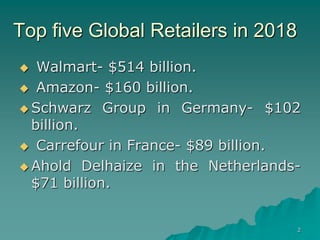
Top five Global Retailers in 2018
 Walmart- $514 billion.
 Amazon- $160 billion.
 Schwarz Group in Germany- $102
billion.
 Carrefour in France- $89 billion.
 Ahold Delhaize in the Netherlands-
$71 billion.
3
4
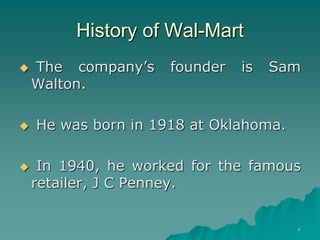
History of Wal-Mart
 The company’s founder is Sam
Walton.
 He was born in 1918 at Oklahoma.
 In 1940, he worked for the famous
retailer, J C Penney.
5
History of Wal-Mart…
 Walton gave up the job and decided
to set up his own retail store.
 He purchased a store franchise in
Arkansas.
 Offering significant discounts on
prices, he became successful and
acquired a second store in 3 years.
6
History of Wal-Mart…
 By 1969, Walton had established 18 Wal-
Mart stores.
 By late 1970s, the retail chain had
established a pharmacy and an auto service
center.
 In 1980s, Wal-Mart continued to grow due
to huge customer demands in small towns.
7
History of Wal-Mart…
 Wal-Mart was offering low prices,
customer satisfaction guaranteed,
and hours that were realistic for the
way people wanted to shop.
– Open all night, for university students
 By 1984, there were 640 Wal-Mart
stores in U.S.
8
Wal-Mart- Current
 Net Income from Continuing Operations-
$7.3 billion.
 Sales-$514 billion.
 Number of Global associates- 2.2 million.
 Conducted business in 27 countries.
 Served 275 million customers each week
through 11,300 stores and numerous e-
commerce websites that operated under 58
banners.
 In US alone it has 1.5 million associates and
5,362 stores/warehouse clubs.
9
Wal-Mart…Growth
This phenomenal growth of Wal-Mart
can be attributed to its continued focus
on customer needs and reducing cost
through efficient supply chain
management practices.
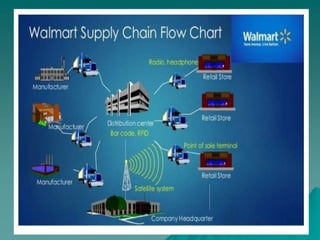
It was one of the first firms to relay on
data for Operational Decisions, use
barcodes, share sales data with
suppliers, control its own logistics and
transportation activities and install
POS that provided item level data in
real time.
10
11
Competitors
 Within US, it faced competition from
Target, Home Depot, Ikea, Costco,
Kroger, Aldi, Walgreens and CVS.
 Within Online Retail- Stiff Competition
from Amazon.
12
Competitors
As there was a stiff competition from online
and offline competitors.
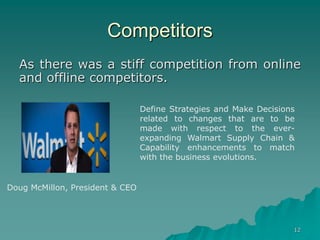
Doug McMillon, President & CEO
Define Strategies and Make Decisions
related to changes that are to be
made with respect to the ever-
expanding Walmart Supply Chain &
Capability enhancements to match
with the business evolutions.
13
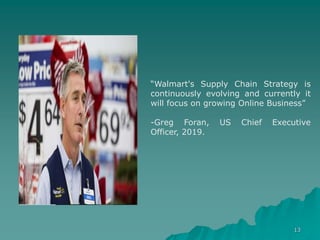
“Walmart's Supply Chain Strategy is
continuously evolving and currently it
will focus on growing Online Business”
-Greg Foran, US Chief Executive
Officer, 2019.
14
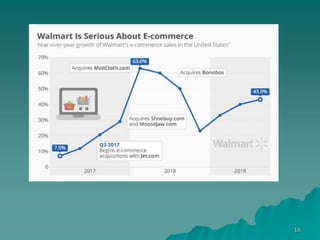
Online Programs
 Walmart.com (An online platform that sells an
assortment of goods similar to the ones
available at stores)-Launched in 2000.
 Walmart Market Place (Third part e-
commerce platform)-Launched in 2009.
 Jet.com (Online stores aimed at targeting
higher income Urban Shoppers)- (Purchased
in 2016).
Three programs together resulted in an on-line
revenue growth of 40 % ($15.7 billion) by Jan
2019.
15
Online Programs
Doug McMillon, President & CEO – wanted to
save both time and money for Customers.
 It Purchased Bonobos (An on-line designer
and seller of higher-end Men's clothing).
 It Purchased Moosejaw (An on-line outdoor
products retailer).
 It Purchased Hayneedle (An on-line Furniture
and Home-Décor Shop).
 It Purchased Shoe buy (An on-line Shoe
Retailer).
 In 2018, it Purchased 77% of India’s Flipkart
an e-commerce retailer.
16
17
Wal-Mart’s Procurement
 Wal-Mart emphasized the need to
reduce purchasing costs and offer
the best price to the customer.
 The company directly procured from
manufacturers, by passing all
intermediaries.
18
Wal-Mart’s Procurement…
 Wal-Mart finalizes a purchase deal
only when it is fully confident that
the products being bought is not
available else where at a lower
price.
19
Wal-Mart’s Procurement…
 Wal-Mart spends a significant
amount of time meeting vendors and
understanding their cost structure.
 By making the process transparent,
the retailer can be certain that the
manufacturers are doing their best to
cut down costs.
20
Using EDI for Procurement
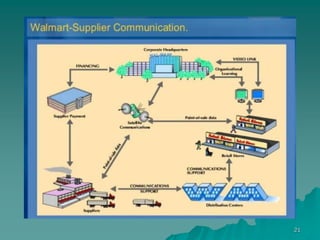
 The computer systems of Wal-Mart were
connected to those of its suppliers.
 EDI enabled the suppliers to download
purchase orders along with store-to-store
sales information relating to their products
sold.
 On receiving information about the sales
of various products, the suppliers shipped
the required goods to Wal-Mart’s
distribution centers.
21
22
Wal-Mart’s Procurement…
 Wal-Mart expanded its global
sourcing in the mid 1980’s by
establishing International Purchasing
Offices in China & other countries.
 Walmart's strategy was to procure
branded items in volumes and sell
them at lower prices.
23
Wal-Mart’s Procurement…
 Globally Wal-Mart had 60,000
suppliers of which around 200
(Nestle, P&G, Unilever Kraft- were
key global suppliers as their sales to
Walmart represented a major % of
their annual revenues).
 Initially, it did not allow suppliers to
advertise at it stores or within on-
line portals but later in 2019-it
allowed its key suppliers to advertise
to boost sales.
24
Wal-Mart’s Procurement…
 Walmart realized that incomplete
deliveries resulted in stock outs – so
it increased the requirements from
suppliers for on-time delivery
performance and also included
penalties on suppliers up to 3% of
invoice value.
 It has also requested some food
suppliers to use Block Chain
Technologies to enhance traceability.
25
Wal-Mart’s Distribution
 In the early 1970s, Wal-Mart became one
of the first retailing companies in the
world to centralize its distribution system,
pioneering the retail hub-and-spoke
system.
 Under the system, goods were centrally
ordered, assembled at a massive
warehouse, known as ‘distribution center’
(hub), from where they were dispatched
to the individual stores (spoke).
26
Hub and Spoke System…
 The hub and spoke system enabled
Wal-Mart to achieve significant cost
advantages by the centralized
purchasing of goods in huge
quantities..
– and distributing them through its own
logistics infrastructure to the retail
stores spread across the U.S.
27
Cross-docking
 To make its distribution process more
efficient, Wal-Mart also made use of a
logistics technique called “cross-docking.”
 In this system, the finished goods were
directly picked up from the manufacturing
plant, sorted out and then directly
supplied to the customers.
28
Cross-docking
 The system reduced the handling and
storage of finished goods, virtually
eliminating the role of the distribution
centers and stores.
 The manufacturer directly forwarded the
goods to a place called the “staging area.”
 The goods were packed here according to
the orders received from different stores
and then directly sent to the respective
customers.
29
30
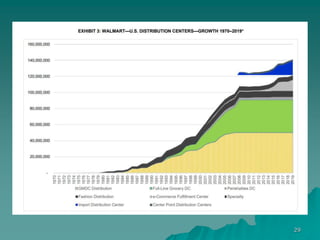
Wal-Mart’s Distribution-2019
 173 DC’s in US with 125.8 million square
feet of space.
 77% of store merchandize was shipped
through DC’s and the reminder was
shipped Direct to Store (DSD) by
Suppliers.
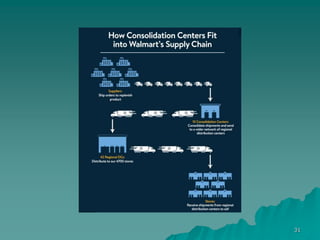
 It added a Consolidation Center (340,000
square foot high-tech distribution center-
to receive products from suppliers) and
was planning to add 10 more to enhance
the Supply Chain Efficiency.
31
32
Logistics Management
 An important feature of Wal-Mart’s
logistics infrastructure was its fast
and responsive transportation
system.
 The company employed around 8000
Truck Drivers in US, who logged
nearly 740 million miles per year.
 Walmart’s truck fleet included 6,000
tractors, 53,500 trailers and 5,600
refrigerated trailers.
33
Logistics Management…
 Wal-Mart believed that it needed
drivers who were committed and
dedicated to customer service.
 The company hired only experienced
drivers who had driven more than
300,000 accident-free miles, with no
major traffic violation.
34
Inventory Management
Wal-Mart categorized its Inventory into 4
types-
 FG Inventory-Received from Suppliers-
that was directly received into stores.
 Transit Inventory- Goods that are being
transported using the Walmart’s global
supply chain to warehouses.
 Buffer Inventory- Extra stock held in
stores to meet unexpected changes in
demand.
 Anticipatory Inventory- Extra Stock held
to meet specific periods of high demand.
35
Information Systems
 Wal-Mart invested heavily in IT and
communication systems to effectively track sales
and merchandise inventories in stores across the
country.
 Wal-Mart set up its own satellite communication
system in 1983.
 Employees at the stores had the “Magic Wand,” a
hand-held computer which was linked to in-
store terminals through a radio frequency
network.
 These helped them to keep track of the inventory
in stores, deliveries, and backup merchandise in
stock at the distribution centers.
36
Information Systems
 The order management and store
replenishment of goods were entirely
executed with the help of computers
through the Point-of-Sales (POS) system.
 Through this system, it was possible to
monitor and track the sales and
merchandise stock levels on the store
shelves.
37
Information Systems
(Retail link system- 1991)
 Retail Link connected Wal-Mart’s EDI
network with an extranet, accessible
to Wal-Mart’s thousands of suppliers.
 The suppliers could find out how
their product was performing vis-a-
vis competitors’ products in a
particular product category.
38
RFID Technology
(Radio Frequency Identification)
 It uses RFID tags for its products to
enhance the movement of its goods
through its supply chain.
 It is estimated that it also saves around
$500 million a year as it reduces stock
outs.
39
Walmart Pickup Tower
https://www.yo
utube.com/wat
ch?v=RYelFY1
8hoI
AI-Walmart
40
41

Wal-Mart-Supply-Chain.pptx

  • 1.
  • 2.
    2 Top five GlobalRetailers in 2018  Walmart- $514 billion.  Amazon- $160 billion.  Schwarz Group in Germany- $102 billion.  Carrefour in France- $89 billion.  Ahold Delhaize in the Netherlands- $71 billion.
  • 3.
  • 4.
    4 History of Wal-Mart The company’s founder is Sam Walton.  He was born in 1918 at Oklahoma.  In 1940, he worked for the famous retailer, J C Penney.
  • 5.
    5 History of Wal-Mart… Walton gave up the job and decided to set up his own retail store.  He purchased a store franchise in Arkansas.  Offering significant discounts on prices, he became successful and acquired a second store in 3 years.
  • 6.
    6 History of Wal-Mart… By 1969, Walton had established 18 Wal- Mart stores.  By late 1970s, the retail chain had established a pharmacy and an auto service center.  In 1980s, Wal-Mart continued to grow due to huge customer demands in small towns.
  • 7.
    7 History of Wal-Mart… Wal-Mart was offering low prices, customer satisfaction guaranteed, and hours that were realistic for the way people wanted to shop. – Open all night, for university students  By 1984, there were 640 Wal-Mart stores in U.S.
  • 8.
    8 Wal-Mart- Current  NetIncome from Continuing Operations- $7.3 billion.  Sales-$514 billion.  Number of Global associates- 2.2 million.  Conducted business in 27 countries.  Served 275 million customers each week through 11,300 stores and numerous e- commerce websites that operated under 58 banners.  In US alone it has 1.5 million associates and 5,362 stores/warehouse clubs.
  • 9.
    9 Wal-Mart…Growth This phenomenal growthof Wal-Mart can be attributed to its continued focus on customer needs and reducing cost through efficient supply chain management practices. It was one of the first firms to relay on data for Operational Decisions, use barcodes, share sales data with suppliers, control its own logistics and transportation activities and install POS that provided item level data in real time.
  • 10.
  • 11.
    11 Competitors  Within US,it faced competition from Target, Home Depot, Ikea, Costco, Kroger, Aldi, Walgreens and CVS.  Within Online Retail- Stiff Competition from Amazon.
  • 12.
    12 Competitors As there wasa stiff competition from online and offline competitors. Doug McMillon, President & CEO Define Strategies and Make Decisions related to changes that are to be made with respect to the ever- expanding Walmart Supply Chain & Capability enhancements to match with the business evolutions.
  • 13.
    13 “Walmart's Supply ChainStrategy is continuously evolving and currently it will focus on growing Online Business” -Greg Foran, US Chief Executive Officer, 2019.
  • 14.
    14 Online Programs  Walmart.com(An online platform that sells an assortment of goods similar to the ones available at stores)-Launched in 2000.  Walmart Market Place (Third part e- commerce platform)-Launched in 2009.  Jet.com (Online stores aimed at targeting higher income Urban Shoppers)- (Purchased in 2016). Three programs together resulted in an on-line revenue growth of 40 % ($15.7 billion) by Jan 2019.
  • 15.
    15 Online Programs Doug McMillon,President & CEO – wanted to save both time and money for Customers.  It Purchased Bonobos (An on-line designer and seller of higher-end Men's clothing).  It Purchased Moosejaw (An on-line outdoor products retailer).  It Purchased Hayneedle (An on-line Furniture and Home-Décor Shop).  It Purchased Shoe buy (An on-line Shoe Retailer).  In 2018, it Purchased 77% of India’s Flipkart an e-commerce retailer.
  • 16.
  • 17.
    17 Wal-Mart’s Procurement  Wal-Martemphasized the need to reduce purchasing costs and offer the best price to the customer.  The company directly procured from manufacturers, by passing all intermediaries.
  • 18.
    18 Wal-Mart’s Procurement…  Wal-Martfinalizes a purchase deal only when it is fully confident that the products being bought is not available else where at a lower price.
  • 19.
    19 Wal-Mart’s Procurement…  Wal-Martspends a significant amount of time meeting vendors and understanding their cost structure.  By making the process transparent, the retailer can be certain that the manufacturers are doing their best to cut down costs.
  • 20.
    20 Using EDI forProcurement  The computer systems of Wal-Mart were connected to those of its suppliers.  EDI enabled the suppliers to download purchase orders along with store-to-store sales information relating to their products sold.  On receiving information about the sales of various products, the suppliers shipped the required goods to Wal-Mart’s distribution centers.
  • 21.
  • 22.
    22 Wal-Mart’s Procurement…  Wal-Martexpanded its global sourcing in the mid 1980’s by establishing International Purchasing Offices in China & other countries.  Walmart's strategy was to procure branded items in volumes and sell them at lower prices.
  • 23.
    23 Wal-Mart’s Procurement…  GloballyWal-Mart had 60,000 suppliers of which around 200 (Nestle, P&G, Unilever Kraft- were key global suppliers as their sales to Walmart represented a major % of their annual revenues).  Initially, it did not allow suppliers to advertise at it stores or within on- line portals but later in 2019-it allowed its key suppliers to advertise to boost sales.
  • 24.
    24 Wal-Mart’s Procurement…  Walmartrealized that incomplete deliveries resulted in stock outs – so it increased the requirements from suppliers for on-time delivery performance and also included penalties on suppliers up to 3% of invoice value.  It has also requested some food suppliers to use Block Chain Technologies to enhance traceability.
  • 25.
    25 Wal-Mart’s Distribution  Inthe early 1970s, Wal-Mart became one of the first retailing companies in the world to centralize its distribution system, pioneering the retail hub-and-spoke system.  Under the system, goods were centrally ordered, assembled at a massive warehouse, known as ‘distribution center’ (hub), from where they were dispatched to the individual stores (spoke).
  • 26.
    26 Hub and SpokeSystem…  The hub and spoke system enabled Wal-Mart to achieve significant cost advantages by the centralized purchasing of goods in huge quantities.. – and distributing them through its own logistics infrastructure to the retail stores spread across the U.S.
  • 27.
    27 Cross-docking  To makeits distribution process more efficient, Wal-Mart also made use of a logistics technique called “cross-docking.”  In this system, the finished goods were directly picked up from the manufacturing plant, sorted out and then directly supplied to the customers.
  • 28.
    28 Cross-docking  The systemreduced the handling and storage of finished goods, virtually eliminating the role of the distribution centers and stores.  The manufacturer directly forwarded the goods to a place called the “staging area.”  The goods were packed here according to the orders received from different stores and then directly sent to the respective customers.
  • 29.
  • 30.
    30 Wal-Mart’s Distribution-2019  173DC’s in US with 125.8 million square feet of space.  77% of store merchandize was shipped through DC’s and the reminder was shipped Direct to Store (DSD) by Suppliers.  It added a Consolidation Center (340,000 square foot high-tech distribution center- to receive products from suppliers) and was planning to add 10 more to enhance the Supply Chain Efficiency.
  • 31.
  • 32.
    32 Logistics Management  Animportant feature of Wal-Mart’s logistics infrastructure was its fast and responsive transportation system.  The company employed around 8000 Truck Drivers in US, who logged nearly 740 million miles per year.  Walmart’s truck fleet included 6,000 tractors, 53,500 trailers and 5,600 refrigerated trailers.
  • 33.
    33 Logistics Management…  Wal-Martbelieved that it needed drivers who were committed and dedicated to customer service.  The company hired only experienced drivers who had driven more than 300,000 accident-free miles, with no major traffic violation.
  • 34.
    34 Inventory Management Wal-Mart categorizedits Inventory into 4 types-  FG Inventory-Received from Suppliers- that was directly received into stores.  Transit Inventory- Goods that are being transported using the Walmart’s global supply chain to warehouses.  Buffer Inventory- Extra stock held in stores to meet unexpected changes in demand.  Anticipatory Inventory- Extra Stock held to meet specific periods of high demand.
  • 35.
    35 Information Systems  Wal-Martinvested heavily in IT and communication systems to effectively track sales and merchandise inventories in stores across the country.  Wal-Mart set up its own satellite communication system in 1983.  Employees at the stores had the “Magic Wand,” a hand-held computer which was linked to in- store terminals through a radio frequency network.  These helped them to keep track of the inventory in stores, deliveries, and backup merchandise in stock at the distribution centers.
  • 36.
    36 Information Systems  Theorder management and store replenishment of goods were entirely executed with the help of computers through the Point-of-Sales (POS) system.  Through this system, it was possible to monitor and track the sales and merchandise stock levels on the store shelves.
  • 37.
    37 Information Systems (Retail linksystem- 1991)  Retail Link connected Wal-Mart’s EDI network with an extranet, accessible to Wal-Mart’s thousands of suppliers.  The suppliers could find out how their product was performing vis-a- vis competitors’ products in a particular product category.
  • 38.
    38 RFID Technology (Radio FrequencyIdentification)  It uses RFID tags for its products to enhance the movement of its goods through its supply chain.  It is estimated that it also saves around $500 million a year as it reduces stock outs.
  • 39.
  • 40.
  • 41.