Grupo Bimbo
INDUSTRY COMPETITION - Highly fragmented  and competitive industry structure,  with different players in different countries DEMAND PATTERNS - Consumption habits heavily influenced by cultural legacy, demographics, tastes, fashion (e.g. low-carb diets in the US), and price sensitivityDISTRIBUTION NETWORK S -  Retailers bargaining power and location, country geography , transportation  infrastructure, as well as labor relations affect distribution chain and costsADMINISTRATION - Regulatory frameworks vary widely among countries for labor relations, new business registration, bankruptcy filingBimboโ€™s globalization challenges
Mistakes in BRAZILโ€ฆ.Grupo Bimbo entered the Brazilian market wrongfully assuming it was similar to the Mexican one:Overall  bread consumption is much lower in Brazil than in Mexico; more specifically, industrial bread consumption in Brazil is three times less than in Mexico  (2.5 kg per capita in Brazil v. 7.5  in Mexico, in 2006, data from Exhibit 4) European immigrants in South America have maintained  a tradition of artisanal fresh bread โ€“ ยซย Artisanal bread is kingย ยป (A. Diaz, Head of Grupo Bimbo , Central and South America Division)Taste for sweet goods  differs from Mexico: Brazilians prefer pound cakes, cereal bars and products with milk cream, whereas Mexicans like strawberry jelly fillingIntense competition and relatively low demand push prices down: industrial bread can be sold at only $ 1.50 per Kg in Brazil v.  $1.90 in Mexico Unsuitable distribution strategy, targeting small shops, whereas 70% of sales happens in hypermarkets.Mexican brand names are not meaningful to Brazilians; subtle language barriers exist among Latin American countries.
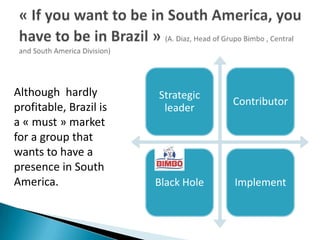
ยซย If youwant to be in South America, you have to be in Brazilย ยป(A. Diaz, Head of GrupoBimbo , Central and South America Division)Although  hardly profitable, Brazil is a ยซย mustย ยป market for a group that wants to have a presence in South America.
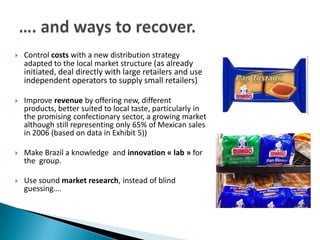
โ€ฆ. and ways to recover.Control costs with a new distribution strategy  adapted to the local market structure (as already initiated, deal directly with large retailers and use independent operators to supply small retailers)Improve revenue by offering new, different products, better suited to local taste, particularly in the promising confectionary sector, a growing market although still representing only 65% of Mexican sales in 2006 (based on data in Exhibit 5))Make Brazil a knowledge  and innovation ยซย labย ยป for the  group.Use sound market research, instead of blind guessingโ€ฆ.
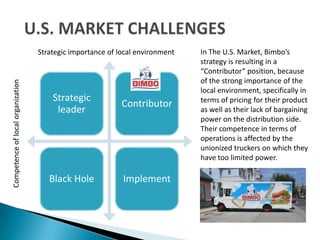
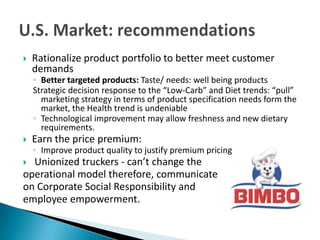
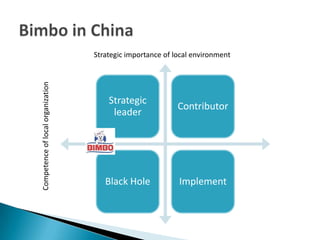
U.S. MARKET CHALLENGESStrategic importance of local environmentIn The U.S. Market, Bimboโ€™s strategy is resulting in a โ€œContributorโ€ position, because of the strong importance of the local environment, specifically in terms of pricing for their product as well as their lack of bargaining power on the distribution side.Their competence in terms of operations is affected by the unionized truckers on which they have too limited power.Competence of local organization
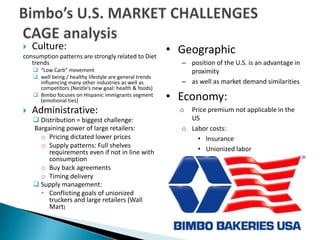
Bimboโ€™s U.S. MARKET CHALLENGES CAGE analysisCulture: consumption patterns are strongly related to Diet trendsโ€œLow Carbโ€ movement
well being / healthy lifestyle are general trends influencing many other industries as well as competitors (Nestleโ€™s new goal: health & foods)
Bimbo focuses on Hispanic immigrants segment (emotional ties)Administrative: Distribution = biggest challenge: Bargaining power of large retailers: Pricing dictated lower prices
Supply patterns: Full shelves requirements even if not in line with consumption
Buy back agreements
Timing delivery
Supply management:Conflicting goals of unionized truckers and large retailers (Wall Mart)Geographic
position of the U.S. is an advantage in proximity

Bimbo Case Study

  • 1.
  • 2.
    INDUSTRY COMPETITION -Highly fragmented and competitive industry structure, with different players in different countries DEMAND PATTERNS - Consumption habits heavily influenced by cultural legacy, demographics, tastes, fashion (e.g. low-carb diets in the US), and price sensitivityDISTRIBUTION NETWORK S - Retailers bargaining power and location, country geography , transportation infrastructure, as well as labor relations affect distribution chain and costsADMINISTRATION - Regulatory frameworks vary widely among countries for labor relations, new business registration, bankruptcy filingBimboโ€™s globalization challenges
  • 3.
    Mistakes in BRAZILโ€ฆ.GrupoBimbo entered the Brazilian market wrongfully assuming it was similar to the Mexican one:Overall bread consumption is much lower in Brazil than in Mexico; more specifically, industrial bread consumption in Brazil is three times less than in Mexico (2.5 kg per capita in Brazil v. 7.5 in Mexico, in 2006, data from Exhibit 4) European immigrants in South America have maintained a tradition of artisanal fresh bread โ€“ ยซย Artisanal bread is kingย ยป (A. Diaz, Head of Grupo Bimbo , Central and South America Division)Taste for sweet goods differs from Mexico: Brazilians prefer pound cakes, cereal bars and products with milk cream, whereas Mexicans like strawberry jelly fillingIntense competition and relatively low demand push prices down: industrial bread can be sold at only $ 1.50 per Kg in Brazil v. $1.90 in Mexico Unsuitable distribution strategy, targeting small shops, whereas 70% of sales happens in hypermarkets.Mexican brand names are not meaningful to Brazilians; subtle language barriers exist among Latin American countries.
  • 4.
    ยซย If youwant tobe in South America, you have to be in Brazilย ยป(A. Diaz, Head of GrupoBimbo , Central and South America Division)Although hardly profitable, Brazil is a ยซย mustย ยป market for a group that wants to have a presence in South America.
  • 5.
    โ€ฆ. and waysto recover.Control costs with a new distribution strategy adapted to the local market structure (as already initiated, deal directly with large retailers and use independent operators to supply small retailers)Improve revenue by offering new, different products, better suited to local taste, particularly in the promising confectionary sector, a growing market although still representing only 65% of Mexican sales in 2006 (based on data in Exhibit 5))Make Brazil a knowledge and innovation ยซย labย ยป for the group.Use sound market research, instead of blind guessingโ€ฆ.
  • 6.
    U.S. MARKET CHALLENGESStrategicimportance of local environmentIn The U.S. Market, Bimboโ€™s strategy is resulting in a โ€œContributorโ€ position, because of the strong importance of the local environment, specifically in terms of pricing for their product as well as their lack of bargaining power on the distribution side.Their competence in terms of operations is affected by the unionized truckers on which they have too limited power.Competence of local organization
  • 7.
    Bimboโ€™s U.S. MARKETCHALLENGES CAGE analysisCulture: consumption patterns are strongly related to Diet trendsโ€œLow Carbโ€ movement
  • 8.
    well being /healthy lifestyle are general trends influencing many other industries as well as competitors (Nestleโ€™s new goal: health & foods)
  • 9.
    Bimbo focuses onHispanic immigrants segment (emotional ties)Administrative: Distribution = biggest challenge: Bargaining power of large retailers: Pricing dictated lower prices
  • 10.
    Supply patterns: Fullshelves requirements even if not in line with consumption
  • 11.
  • 12.
  • 13.
    Supply management:Conflicting goalsof unionized truckers and large retailers (Wall Mart)Geographic
  • 14.
    position of theU.S. is an advantage in proximity