Rahul Todur
ABOUT THE COMPANY 
• Founded by Henri Nestlé 
• World’s biggest Food and Beverage Company 
• Developed first milk product in 1867 
• Merger with the Anglo-Swiss Condensed Milk 
Company.
ABOUT THE COMPANY 
• Nestlé's first expansion into chocolate 
activity 
• Introduction of Nescafe, a staple drink 
of US Military 
• In 1947 came the merger with Maggi 
seasonings and soups. 
• Acquisition of American Food Giant and 
Dreyer’s
PRINCIPLES AND OBJECTIVES 
• To create value 
• Nestle does not favor short term profit 
• Create trust among the customer 
• Ensures that the highest standards are met throughout the 
organization. 
• Recruitment of the right people & on going training & development 
• Continue to maintain its commitment
BUSINESS LEVEL STRATEGY 
• Wide range of products (over 20 categories: coffee, milk, 
mineral water, pet foods, cereals…) 
• Nestlé Nutrition- 
→ Strengthening their leadership in this market is the key element of their 
corporate strategy. 
→ Deliver superior business performance by offering consumers trusted, 
science based nutrition products and services. 
→ Strives to closely align Nestlé’s scientific and R&D expertise with consumer 
benefits. 
→ Addressing current customer concerns as well as anticipating future 
consumer trends.
PROBLEM IDENTIFICATION 
• 2,30,000 employees and 500 facilities in 80 countries 
• to support the decentralized strategy it has 80 different information technology units that’s runs nearly 
900 ibm as/400 mid range computers ,15 main frames , and 200 Unix system 
• despite its size the company has had no corporate computer center 
• local difference created inefficiencies and extra costs that could prevent the company from competing 
effectively in electronic commerce. 
• the lack of standard business processes prevented it from obtaining lower prices for its raw material. 
• at first project decide not to use sap’s supply chain software because that module was brand new and 
appeared to be risky 
• the staff that would be directly affected by the changes were not included in the key stake holder team. 
• the lower level worker did not understand how to use the new system and also did not understand the 
changes ,nobody was prepared for the new ways of doing things. 
• Turnover among the employees who were to use the Manugistics software to forecast product demand 
reached 77 percent. Those who remained found it easier to use their familiar spreadsheets. 
• the simultaneous installation of the y2k changes also caused some trouble.
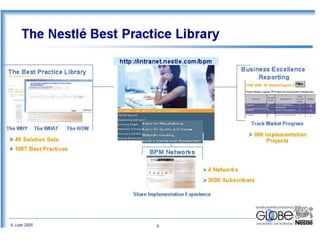
GLOBE SYSTEMS & NESTLE 
GLOBE (Global Business Excellence) 
• Its objective is to improve the efficiency of performance of the businesses 
on a global scale 
• The GLOBE programme is based on three main principles: 
→ Good Practice. 
→ Standardisation of Data and Management. 
→ Information Systems and Common Technologies. 
• facilitate better cross functional communication and knowledge 
management and help in standardizing products.
WHATS AN ERP? 
• Enterprise Resource Planning (ERP) systems seem to be 
the silver bullet for every company’s problems. 
• Enterprise Resource Planning is MIS that integrate and 
automate many of the business practices 
• Attempts to integrate all departments and functions into 
one computer system 
• A system that standardize and coordinate Information 
systems
ERP AT NESTLE 
• In 2000 Nestle SA signed a $200 million contract with SAP to 
roll out an ERP system. 
• Nestle SA also committed to an additional $80 million to be 
spent on consulting, maintenance, and upgrades. 
• Keeps track of customer orders 
• reduce overstocking 
• Enables group buying of materials 
• data sharing among subsidiaries
MANAGEMENT PROBLEMS 
• Employees thought it to be a software project rather than a business 
process re-organization. 
• Failure on the part of stakeholders to realize the feasibility of the 
project. 
• Inability to understand the usage of the new system by the workers. 
• Failure to integrate various modules. 
• Delay in the project due to employees’ resistance to change - 
inefficiency on the part of project co-leader to handle situations.
IMPLEMENTATION STRATEGY 
• Involvement of right individuals from the beginning. 
• Avoid heavy customization. 
• Defining the business goals of the project and then create a 
timeline. 
• Time should be spent evaluating the business process 
re-engineering that will be done in conjunction with an ERP 
implementation. 
• Provide training to employees throughout the project
RESULTS 
• All of Nestlé USA are using the same software and data. 
• Producing better sales forecasts 
• Costs were cut down and had already saved $325 million by 
spring 2002. 
• Nestlé SA has learned from that project and expects to have 
an easier success with its project. 
• By the end of 2004, about 10% of Nestlé’s global food and 
beverage business was operating with standard processes, 
datas and systems.
STRATEGIC BUSINESS DECSIONS AND MIS 
Load Control Center(LCC):- 
• Was introduced to streamline and standardize processes, reduce costs 
and gain control over transportation operations 
• By centralizing control, they could manage transportation and logistics 
costs, live up to carrier expectations about freight volumes and improve 
customer service. 
• Improvement in on-time delivery, maintain stable costs while business 
increased, better manage carrier activity, and reduce the number of 
carriers used to a small fraction of the original number. 
• Load planning, carrier selection, scheduling and real-time 
communication of that information is virtually automatic in the LCC. 
• Red Prairie's DLx[R] Transportation TMS software-Modules of the 
software in use include Load Builder, Matcher, Asset Manager, Assign, 
Offer, Rate and Pay, Routing Manager and Status
MARKETING AT NESTLE 
• Marketing strategy 
• Setting of objectives 
• Production 
• Communications 
• Supply chain and information systems 
• Sales administration 
• Trade marketing 
• Key account management 
• Regional Sales
Marketing information systems 
• Divided into four subsystems:- 
1. Internal accounting systems- Order shipping-billing 
2. Marketing intelligence systems- A user oriented 
system 
3. Marketing research systems- improving 
timeliness of sales reports 
4. Analytical systems- Horizontal Marketing 
Ex. Collaboration of Coke and Nestle
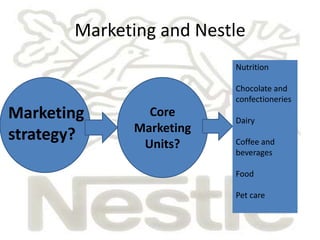
Marketing and Nestle 
Marketing 
strategy? 
Core 
Marketing 
Units? 
Nutrition 
Chocolate and 
confectioneries 
Dairy 
Coffee and 
beverages 
Food 
Pet care
Marketing and Nestle 
• Nestle uses the World Wide 
Web/Intranet/Extranet 
• Nestle – E-commerce- Increased Effieciency 
• Nestle- Interactive Marketing 
• Nestle- EIS 
• Nestle implemented six -SAP modules-purchasing, 
financial, sales and distribution, 
accounts payable, accounts receivable and 
advanced planning and optimization.
Integrating Internet Strategy 
• Looks after buying of raw materials such as cocoa to 
producing, marketing and selling products such as Kit Kat 
chocolate biscuits and instant coffee, every business process 
of the organisation has seen change. 
• Since July 2000, store owners in the US order Nestle chocolate 
and other products at NestleEZOrder.com 
-Helps slash order processing costs and cut inventories. 
Example:- Sainsbury and Tesco
Integrating Internet Strategy 
• Within 2 years, 20 %of annual advertising budget will be 
spent on the Web. 
- It will be used to fund sites such as VeryBestbaby.com, which 
offers articles about parenting and baby nutrition, as well as 
banners advertising baby foods. 
• Nestle also has a site for coffee lovers, and a Club Buitoni site, 
for lovers of Italian food. 
- These sites will help Nestle discover more about their 
consumers, a practice which may further help to kick start 
innovation when it comes to marketing.
Nestle on . Net Enterprise Servers 
• Nestlé now is using the Internet to collect and leverage 
information about consumers and drive new marketing 
initiatives. 
• The flexibility of the Microsoft platform allowed Nestlé to 
develop component-based Web architecture—the 
Nestlé Internet Resource Framework (NIRF). 
• Standardization of the platform is allowing Nestlé to 
gather consumer information 
-Enables nestle to know about common trends for 
marketing initiatives.
Benefits:- 
• Increased productivity - Helps eliminate tedious and repetitive 
tasks associated with campaign planning and execution 
• Reduced costs - Has given companies insight into campaign 
effectiveness, so they can abandon unsuccessful initiatives before 
they drain financial resources. 
• Enhanced flexibility - Has made marketing teams more agile;react 
instantly to changing marketplace conditions and shifting 
communication strategies. 
• Advanced intelligence - It provides timely, valuable information 
that can be analyzed to determine what works, what doesn't, and 
most importantly, why. 
• Improved personalization - marketing teams have the tools they 
need to launch initiatives based on the specific needs and wants of 
a target audience, so content is more targeted and more relevant.
CONCLUSION 
• first deal with organizational issues, including having the 
right people in the right places. 
• Second, look at the processes and then choose and 
implement the right technology to achieve objectives 
• executive level sponsorship and ongoing support is 
critical. 
• Processes and people's mindsets must be changed first, 
supported by technology

Nestle

  • 1.
  • 2.
    ABOUT THE COMPANY • Founded by Henri Nestlé • World’s biggest Food and Beverage Company • Developed first milk product in 1867 • Merger with the Anglo-Swiss Condensed Milk Company.
  • 3.
    ABOUT THE COMPANY • Nestlé's first expansion into chocolate activity • Introduction of Nescafe, a staple drink of US Military • In 1947 came the merger with Maggi seasonings and soups. • Acquisition of American Food Giant and Dreyer’s
  • 4.
    PRINCIPLES AND OBJECTIVES • To create value • Nestle does not favor short term profit • Create trust among the customer • Ensures that the highest standards are met throughout the organization. • Recruitment of the right people & on going training & development • Continue to maintain its commitment
  • 5.
    BUSINESS LEVEL STRATEGY • Wide range of products (over 20 categories: coffee, milk, mineral water, pet foods, cereals…) • Nestlé Nutrition- → Strengthening their leadership in this market is the key element of their corporate strategy. → Deliver superior business performance by offering consumers trusted, science based nutrition products and services. → Strives to closely align Nestlé’s scientific and R&D expertise with consumer benefits. → Addressing current customer concerns as well as anticipating future consumer trends.
  • 6.
    PROBLEM IDENTIFICATION •2,30,000 employees and 500 facilities in 80 countries • to support the decentralized strategy it has 80 different information technology units that’s runs nearly 900 ibm as/400 mid range computers ,15 main frames , and 200 Unix system • despite its size the company has had no corporate computer center • local difference created inefficiencies and extra costs that could prevent the company from competing effectively in electronic commerce. • the lack of standard business processes prevented it from obtaining lower prices for its raw material. • at first project decide not to use sap’s supply chain software because that module was brand new and appeared to be risky • the staff that would be directly affected by the changes were not included in the key stake holder team. • the lower level worker did not understand how to use the new system and also did not understand the changes ,nobody was prepared for the new ways of doing things. • Turnover among the employees who were to use the Manugistics software to forecast product demand reached 77 percent. Those who remained found it easier to use their familiar spreadsheets. • the simultaneous installation of the y2k changes also caused some trouble.
  • 7.
    GLOBE SYSTEMS &NESTLE GLOBE (Global Business Excellence) • Its objective is to improve the efficiency of performance of the businesses on a global scale • The GLOBE programme is based on three main principles: → Good Practice. → Standardisation of Data and Management. → Information Systems and Common Technologies. • facilitate better cross functional communication and knowledge management and help in standardizing products.
  • 8.
    WHATS AN ERP? • Enterprise Resource Planning (ERP) systems seem to be the silver bullet for every company’s problems. • Enterprise Resource Planning is MIS that integrate and automate many of the business practices • Attempts to integrate all departments and functions into one computer system • A system that standardize and coordinate Information systems
  • 9.
    ERP AT NESTLE • In 2000 Nestle SA signed a $200 million contract with SAP to roll out an ERP system. • Nestle SA also committed to an additional $80 million to be spent on consulting, maintenance, and upgrades. • Keeps track of customer orders • reduce overstocking • Enables group buying of materials • data sharing among subsidiaries
  • 10.
    MANAGEMENT PROBLEMS •Employees thought it to be a software project rather than a business process re-organization. • Failure on the part of stakeholders to realize the feasibility of the project. • Inability to understand the usage of the new system by the workers. • Failure to integrate various modules. • Delay in the project due to employees’ resistance to change - inefficiency on the part of project co-leader to handle situations.
  • 11.
    IMPLEMENTATION STRATEGY •Involvement of right individuals from the beginning. • Avoid heavy customization. • Defining the business goals of the project and then create a timeline. • Time should be spent evaluating the business process re-engineering that will be done in conjunction with an ERP implementation. • Provide training to employees throughout the project
  • 12.
    RESULTS • Allof Nestlé USA are using the same software and data. • Producing better sales forecasts • Costs were cut down and had already saved $325 million by spring 2002. • Nestlé SA has learned from that project and expects to have an easier success with its project. • By the end of 2004, about 10% of Nestlé’s global food and beverage business was operating with standard processes, datas and systems.
  • 13.
    STRATEGIC BUSINESS DECSIONSAND MIS Load Control Center(LCC):- • Was introduced to streamline and standardize processes, reduce costs and gain control over transportation operations • By centralizing control, they could manage transportation and logistics costs, live up to carrier expectations about freight volumes and improve customer service. • Improvement in on-time delivery, maintain stable costs while business increased, better manage carrier activity, and reduce the number of carriers used to a small fraction of the original number. • Load planning, carrier selection, scheduling and real-time communication of that information is virtually automatic in the LCC. • Red Prairie's DLx[R] Transportation TMS software-Modules of the software in use include Load Builder, Matcher, Asset Manager, Assign, Offer, Rate and Pay, Routing Manager and Status
  • 14.
    MARKETING AT NESTLE • Marketing strategy • Setting of objectives • Production • Communications • Supply chain and information systems • Sales administration • Trade marketing • Key account management • Regional Sales
  • 15.
    Marketing information systems • Divided into four subsystems:- 1. Internal accounting systems- Order shipping-billing 2. Marketing intelligence systems- A user oriented system 3. Marketing research systems- improving timeliness of sales reports 4. Analytical systems- Horizontal Marketing Ex. Collaboration of Coke and Nestle
  • 16.
    Marketing and Nestle Marketing strategy? Core Marketing Units? Nutrition Chocolate and confectioneries Dairy Coffee and beverages Food Pet care
  • 17.
    Marketing and Nestle • Nestle uses the World Wide Web/Intranet/Extranet • Nestle – E-commerce- Increased Effieciency • Nestle- Interactive Marketing • Nestle- EIS • Nestle implemented six -SAP modules-purchasing, financial, sales and distribution, accounts payable, accounts receivable and advanced planning and optimization.
  • 19.
    Integrating Internet Strategy • Looks after buying of raw materials such as cocoa to producing, marketing and selling products such as Kit Kat chocolate biscuits and instant coffee, every business process of the organisation has seen change. • Since July 2000, store owners in the US order Nestle chocolate and other products at NestleEZOrder.com -Helps slash order processing costs and cut inventories. Example:- Sainsbury and Tesco
  • 20.
    Integrating Internet Strategy • Within 2 years, 20 %of annual advertising budget will be spent on the Web. - It will be used to fund sites such as VeryBestbaby.com, which offers articles about parenting and baby nutrition, as well as banners advertising baby foods. • Nestle also has a site for coffee lovers, and a Club Buitoni site, for lovers of Italian food. - These sites will help Nestle discover more about their consumers, a practice which may further help to kick start innovation when it comes to marketing.
  • 21.
    Nestle on .Net Enterprise Servers • Nestlé now is using the Internet to collect and leverage information about consumers and drive new marketing initiatives. • The flexibility of the Microsoft platform allowed Nestlé to develop component-based Web architecture—the Nestlé Internet Resource Framework (NIRF). • Standardization of the platform is allowing Nestlé to gather consumer information -Enables nestle to know about common trends for marketing initiatives.
  • 22.
    Benefits:- • Increasedproductivity - Helps eliminate tedious and repetitive tasks associated with campaign planning and execution • Reduced costs - Has given companies insight into campaign effectiveness, so they can abandon unsuccessful initiatives before they drain financial resources. • Enhanced flexibility - Has made marketing teams more agile;react instantly to changing marketplace conditions and shifting communication strategies. • Advanced intelligence - It provides timely, valuable information that can be analyzed to determine what works, what doesn't, and most importantly, why. • Improved personalization - marketing teams have the tools they need to launch initiatives based on the specific needs and wants of a target audience, so content is more targeted and more relevant.
  • 23.
    CONCLUSION • firstdeal with organizational issues, including having the right people in the right places. • Second, look at the processes and then choose and implement the right technology to achieve objectives • executive level sponsorship and ongoing support is critical. • Processes and people's mindsets must be changed first, supported by technology