Walmart Analysis
Financial Management- MGMT649
Monica Estopinan
Carlos Albizu University
Executive Summary
Wal-Mart is the largest retailer in the world. Being the largest retailer in the world is
considered a huge strength because most competitors will never achieve their level of success.
This strength makes it easy to negotiate prices with suppliers. Being the number one customer
gives Wal-Mart an advantage. However there is more to consider when you look at finances. For
finances determines the over success of a company. Furthermore, one will have a better
understanding when financial statements are considered. Below is a financial analysis of
Wal-Mart. As result you will be able to determine the suitability for investment. Typically,
financial analysis is used to analyze whether an entity is stable, or profitable enough to be
invested in. When looking at a specific company, the financial analyst will often focus on the
income statement, balance sheet, and cash flow statement. In addition, one key area of financial
analysis involves extrapolating the company's past performance into an estimate of the
company's future performance.
Introduction
Wal-Mart was founded by Sam Walton in 1962, incorporated on October 31, 1969, and
publicly traded on the New York Exchange in 1972. In 2009, it generated 51 percent of $258
billion sales in the U.S. from grocery business. It also owns and operates the Sam’s Club retail
warehouse in North America. Wal-Mart was the most profitable retailer in the US, and by
November 1990, it outsold K-mart. By 1991 it outsold Sears in retail, making it America's
largest retailer and a distinction it still holds. Wal-Mart has 8,500 stores in 15 countries, under 55
different names.
Currently Wal-Mart operates over 4,150 retail facilities globally. Also, the company is
the dominant retail store in Canada, Mexico, and the United Kingdom. Wal-Mart holds the
number one spot, ranked by its total sales. The company is ranked as the second most admired
company in the world by Fortune. Wal-Mart provides general merchandise such as family
apparel, health, beauty aids, household needs, electronics, toys, fabrics, crafts, lawn and garden,
jewelry and shoes. Also, the company runs a pharmacy department, Tire & Lube Express, and
photo processing center as well. Company's mission is to save people money so they can live
better. Their main core value is to respect every individual and provide exceptional customer
service. These values have helped Wal-Mart to compete globally and to gain leadership in the
market since customers are more conscientious these days. (Wal-Mart Stores, Inc., 2013)
Financial Analysis
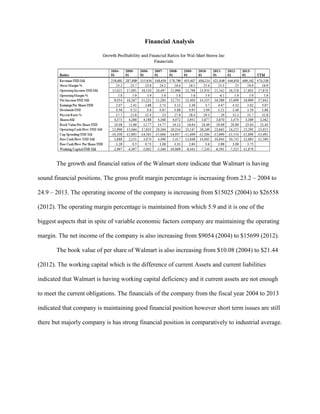
The growth and financial ratios of the Walmart store indicate that Walmart is having
sound financial positions. The gross profit margin percentage is increasing from 23.2 – 2004 to
24.9 – 2013. The operating income of the company is increasing from $15025 (2004) to $26558
(2012). The operating margin percentage is maintained from which 5.9 and it is one of the
biggest aspects that in spite of variable economic factors company are maintaining the operating
margin. The net income of the company is also increasing from $9054 (2004) to $15699 (2012).
The book value of per share of Walmart is also increasing from $10.08 (2004) to $21.44
(2012). The working capital which is the difference of current Assets and current liabilities
indicated that Walmart is having working capital deficiency and it current assets are not enough
to meet the current obligations. The financials of the company from the fiscal year 2004 to 2013
indicated that company is maintaining good financial position however short term issues are still
there but majorly company is has strong financial position in comparatively to industrial average.
The financial leverage of the company is 2.41 (2004) to 2.71 (2012) which indicates that
the riskiness of company is maintained and the company is utilizing the borrowed funds (either
from financial institutions or from banks) and maintaining good financial structure. The debt and
Equity financing of the company is balanced and company is looking to go for equity financing
more rather than debt financing.
The operating cash flow is increasing. Years over years are frequently used by investors
to assess the financial health of the organization and from 2004 to 2013 Walmart is progressing
by exceptional volume. The free cash flows to sales percentage ratio is 2.71 in the year of 2013
which indicates that company is making progress and the cash flow is generating by every single
unit sale which adding more financial value to the company.
Liquidity Position of Walmart
The liquidity position of Walmart indicates that company has not enough cash to meet its
current obligations and current liabilities are more than current assets, The current ratio trend of
the company is indicating that the liquidity position of the company is getting weaker which may
become severe in future. The quick ratio of the company is indicating that the quick assets of the
company are not enough to meet the current obligations of the company. Therefore, Walmart
essentially focuses on the capacity building and should consider the liquidity position by adding
more current assets. Walmart is fundamentally a retail store which must have to deal in inventory
therefore it is recommended that Walmart must have enough inventories to maintain its liquidity
position plus stock levels. The debt to equity ratio of the company is stable and it is in increasing
trend which means that Walmart is having enough equity to meet its overall liabilities and it is
the positive sign for the company as this is indicating that Walmart is not merely based on debt
financing but also equity based financing as well. The total worth of the company is more than
the obligations which proves its sustainability and credibility.
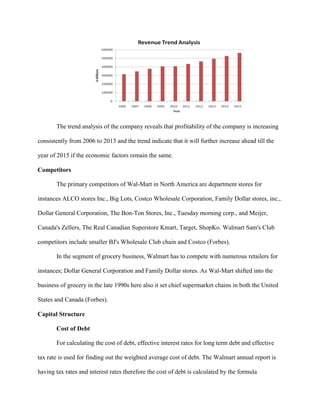
The trend analysis of the company reveals that profitability of the company is increasing
consistently from 2006 to 2013 and the trend indicate that it will further increase ahead till the
year of 2015 if the economic factors remain the same.
Competitors
The primary competitors of Wal-Mart in North America are department stores for
instances ALCO stores Inc., Big Lots, Costco Wholesale Corporation, Family Dollar stores, inc.,
Dollar General Corporation, The Bon-Ton Stores, Inc., Tuesday morning corp., and Meijer,
Canada's Zellers, The Real Canadian Superstore Kmart, Target, ShopKo. Walmart Sam's Club
competitors include smaller BJ's Wholesale Club chain and Costco (Forbes).
In the segment of grocery business, Walmart has to compete with numerous retailers for
instances; Dollar General Corporation and Family Dollar stores. As Wal-Mart shifted into the
business of grocery in the late 1990s here also it set chief supermarket chains in both the United
States and Canada (Forbes).
Capital Structure
Cost of Debt
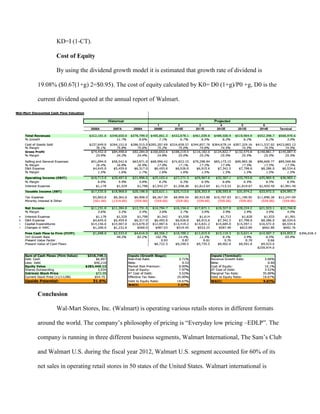
For calculating the cost of debt, effective interest rates for long term debt and effective
tax rate is used for finding out the weighted average cost of debt. The Walmart annual report is
having tax rates and interest rates therefore the cost of debt is calculated by the formula
KD=I (1-CT).
Cost of Equity
By using the dividend growth model it is estimated that growth rate of dividend is
19.08% ($0.67(1+g) 2=$0.95). The cost of equity calculated by K0= D0 (1+g)/P0 +g, D0 is the
current dividend quoted at the annual report of Walmart.
Conclusion
Wal-Mart Stores, Inc. (Walmart) is operating various retails stores in different formats
around the world. The company’s philosophy of pricing is “Everyday low pricing –EDLP”. The
company is running in three different business segments, Walmart International, The Sam’s Club
and Walmart U.S. during the fiscal year 2012, Walmart U.S. segment accounted for 60% of its
net sales in operating retail stores in 50 states of the United States. Walmart international is
mainly generating income from 26 countries. Sam’s club segment is consisting of warehouse
membership clubs operating in 47 states in the United States and Puerto Rico. Online retailing
operations have also contributed for approximately 12% of its net sales.
Walmart is having an excellent financial structure and the cost of debt is 7.27% and the
cost of equity is 9.07%. The stock intrinsic value is $95.56 and its current market value is
$73.51. I think that if one wants to invest in this company, it is highly recommended to invest
into the company as the trends are demonstrating that Walmart will be making exceptional
progress ahead.
References
Forbes Financial (2013), Forbes.com LLC 2014 Web. May 25, retrieved from
http://finapps.forbes.com/finapps/jsp/finance/compinfo/CIAtAGlance.jsp?tkr=wmt&tab=searcht
abquotesdark
Investopedia, Investopedia ULC 2014, Web Source
http://www.investopedia.com/terms/w/wide-economic-moat.asp
Reuters, Thomson Reuters, 2014, retrieved from
http://www.reuters.com/sectors/industries/rankings?view=size&industryCode=101
The Wall Street Journal, Dow Jones & Company, Inc 2014,
http://online.wsj.com/public/quotes/main.html?symbol=WMT&type=usstock%20usfund&mod=
DNH_S
Wal-Mart Annual Report, 2013, Walmart Web source.
(http://cdn.walmartstores.com/sites/AnnualReport/2013/PDF/WMT_2013AR_FINAL.pdf)
Wal-Mart Corporate, 2014, Wal-Mart Incorporation; retrieved from
(http://walmartstores.com/AboutUs/)
Yahoo! Finance, Yahoo! News Network 2014 Web,
http://finance.yahoo.com/q/pr?s=WMT+Profile

Walmart comprehensive analysis 2014

  • 1.
    Walmart Analysis Financial Management-MGMT649 Monica Estopinan Carlos Albizu University
  • 2.
    Executive Summary Wal-Mart isthe largest retailer in the world. Being the largest retailer in the world is considered a huge strength because most competitors will never achieve their level of success. This strength makes it easy to negotiate prices with suppliers. Being the number one customer gives Wal-Mart an advantage. However there is more to consider when you look at finances. For finances determines the over success of a company. Furthermore, one will have a better understanding when financial statements are considered. Below is a financial analysis of Wal-Mart. As result you will be able to determine the suitability for investment. Typically, financial analysis is used to analyze whether an entity is stable, or profitable enough to be invested in. When looking at a specific company, the financial analyst will often focus on the income statement, balance sheet, and cash flow statement. In addition, one key area of financial analysis involves extrapolating the company's past performance into an estimate of the company's future performance.
  • 3.
    Introduction Wal-Mart was foundedby Sam Walton in 1962, incorporated on October 31, 1969, and publicly traded on the New York Exchange in 1972. In 2009, it generated 51 percent of $258 billion sales in the U.S. from grocery business. It also owns and operates the Sam’s Club retail warehouse in North America. Wal-Mart was the most profitable retailer in the US, and by November 1990, it outsold K-mart. By 1991 it outsold Sears in retail, making it America's largest retailer and a distinction it still holds. Wal-Mart has 8,500 stores in 15 countries, under 55 different names. Currently Wal-Mart operates over 4,150 retail facilities globally. Also, the company is the dominant retail store in Canada, Mexico, and the United Kingdom. Wal-Mart holds the number one spot, ranked by its total sales. The company is ranked as the second most admired company in the world by Fortune. Wal-Mart provides general merchandise such as family apparel, health, beauty aids, household needs, electronics, toys, fabrics, crafts, lawn and garden, jewelry and shoes. Also, the company runs a pharmacy department, Tire & Lube Express, and photo processing center as well. Company's mission is to save people money so they can live better. Their main core value is to respect every individual and provide exceptional customer service. These values have helped Wal-Mart to compete globally and to gain leadership in the market since customers are more conscientious these days. (Wal-Mart Stores, Inc., 2013)
  • 4.
    Financial Analysis The growthand financial ratios of the Walmart store indicate that Walmart is having sound financial positions. The gross profit margin percentage is increasing from 23.2 – 2004 to 24.9 – 2013. The operating income of the company is increasing from $15025 (2004) to $26558 (2012). The operating margin percentage is maintained from which 5.9 and it is one of the biggest aspects that in spite of variable economic factors company are maintaining the operating margin. The net income of the company is also increasing from $9054 (2004) to $15699 (2012). The book value of per share of Walmart is also increasing from $10.08 (2004) to $21.44 (2012). The working capital which is the difference of current Assets and current liabilities indicated that Walmart is having working capital deficiency and it current assets are not enough to meet the current obligations. The financials of the company from the fiscal year 2004 to 2013 indicated that company is maintaining good financial position however short term issues are still there but majorly company is has strong financial position in comparatively to industrial average.
  • 5.
    The financial leverageof the company is 2.41 (2004) to 2.71 (2012) which indicates that the riskiness of company is maintained and the company is utilizing the borrowed funds (either from financial institutions or from banks) and maintaining good financial structure. The debt and Equity financing of the company is balanced and company is looking to go for equity financing more rather than debt financing. The operating cash flow is increasing. Years over years are frequently used by investors to assess the financial health of the organization and from 2004 to 2013 Walmart is progressing by exceptional volume. The free cash flows to sales percentage ratio is 2.71 in the year of 2013 which indicates that company is making progress and the cash flow is generating by every single unit sale which adding more financial value to the company.
  • 6.
    Liquidity Position ofWalmart The liquidity position of Walmart indicates that company has not enough cash to meet its current obligations and current liabilities are more than current assets, The current ratio trend of the company is indicating that the liquidity position of the company is getting weaker which may become severe in future. The quick ratio of the company is indicating that the quick assets of the company are not enough to meet the current obligations of the company. Therefore, Walmart essentially focuses on the capacity building and should consider the liquidity position by adding more current assets. Walmart is fundamentally a retail store which must have to deal in inventory therefore it is recommended that Walmart must have enough inventories to maintain its liquidity position plus stock levels. The debt to equity ratio of the company is stable and it is in increasing trend which means that Walmart is having enough equity to meet its overall liabilities and it is the positive sign for the company as this is indicating that Walmart is not merely based on debt financing but also equity based financing as well. The total worth of the company is more than the obligations which proves its sustainability and credibility.
  • 7.
    The trend analysisof the company reveals that profitability of the company is increasing consistently from 2006 to 2013 and the trend indicate that it will further increase ahead till the year of 2015 if the economic factors remain the same. Competitors The primary competitors of Wal-Mart in North America are department stores for instances ALCO stores Inc., Big Lots, Costco Wholesale Corporation, Family Dollar stores, inc., Dollar General Corporation, The Bon-Ton Stores, Inc., Tuesday morning corp., and Meijer, Canada's Zellers, The Real Canadian Superstore Kmart, Target, ShopKo. Walmart Sam's Club competitors include smaller BJ's Wholesale Club chain and Costco (Forbes). In the segment of grocery business, Walmart has to compete with numerous retailers for instances; Dollar General Corporation and Family Dollar stores. As Wal-Mart shifted into the business of grocery in the late 1990s here also it set chief supermarket chains in both the United States and Canada (Forbes). Capital Structure Cost of Debt For calculating the cost of debt, effective interest rates for long term debt and effective tax rate is used for finding out the weighted average cost of debt. The Walmart annual report is having tax rates and interest rates therefore the cost of debt is calculated by the formula
  • 8.
    KD=I (1-CT). Cost ofEquity By using the dividend growth model it is estimated that growth rate of dividend is 19.08% ($0.67(1+g) 2=$0.95). The cost of equity calculated by K0= D0 (1+g)/P0 +g, D0 is the current dividend quoted at the annual report of Walmart. Conclusion Wal-Mart Stores, Inc. (Walmart) is operating various retails stores in different formats around the world. The company’s philosophy of pricing is “Everyday low pricing –EDLP”. The company is running in three different business segments, Walmart International, The Sam’s Club and Walmart U.S. during the fiscal year 2012, Walmart U.S. segment accounted for 60% of its net sales in operating retail stores in 50 states of the United States. Walmart international is
  • 9.
    mainly generating incomefrom 26 countries. Sam’s club segment is consisting of warehouse membership clubs operating in 47 states in the United States and Puerto Rico. Online retailing operations have also contributed for approximately 12% of its net sales. Walmart is having an excellent financial structure and the cost of debt is 7.27% and the cost of equity is 9.07%. The stock intrinsic value is $95.56 and its current market value is $73.51. I think that if one wants to invest in this company, it is highly recommended to invest into the company as the trends are demonstrating that Walmart will be making exceptional progress ahead.
  • 10.
    References Forbes Financial (2013),Forbes.com LLC 2014 Web. May 25, retrieved from http://finapps.forbes.com/finapps/jsp/finance/compinfo/CIAtAGlance.jsp?tkr=wmt&tab=searcht abquotesdark Investopedia, Investopedia ULC 2014, Web Source http://www.investopedia.com/terms/w/wide-economic-moat.asp Reuters, Thomson Reuters, 2014, retrieved from http://www.reuters.com/sectors/industries/rankings?view=size&industryCode=101 The Wall Street Journal, Dow Jones & Company, Inc 2014, http://online.wsj.com/public/quotes/main.html?symbol=WMT&type=usstock%20usfund&mod= DNH_S Wal-Mart Annual Report, 2013, Walmart Web source. (http://cdn.walmartstores.com/sites/AnnualReport/2013/PDF/WMT_2013AR_FINAL.pdf) Wal-Mart Corporate, 2014, Wal-Mart Incorporation; retrieved from (http://walmartstores.com/AboutUs/) Yahoo! Finance, Yahoo! News Network 2014 Web, http://finance.yahoo.com/q/pr?s=WMT+Profile