TALLER DE PRÁCTICA DOCENTE
ALUMNO RESIDENTE: Mariela Isabel Waldovino
Período de Práctica: Nivel Inicial
Nivel Inicial Institución Educativa: Jardín Ositos Cariñosos – Colegio Horizonte
Dirección: Coronel López 1105
Sala / Grado / Año - sección: Sala de 5 años – Turno Tarde
Cantidad de alumnos: 9
Nivel lingüístico del curso: Principiantes
Tipo de Planificación: clase
Unidad Temática: Colors
Clase Nº: 4
Fecha: 08/6/2017
Hora: 16:00 – 16:30
Duración de la clase: 30’
Fecha de primera entrega: 11/05/2014 •
Teaching points: Colours yellow, red, orange
• Aims : During this lesson, learners will be able to…
Use the introductory structure I´m
Learn color vocabulary
Recognize and identify them
Language Focus
Lexis Function Structure Pronunciation
Revision Hello!
Welcome!
I´m…
Greetings
Introducing
themselves
I´m…
What colour is
it?
/æm/
New Color
Blue, purple,
Green, pink
Carterpillar
Head, tail
Recognize four
different colors Who´s there?
What is it?
A ball
/'gri:n/
Teaching approach: the lesson is based on the Natural Approach, and organized through the
PPP procedure.
Materials and resources: coloured cutouts, cardboard rings, styrofoam balls, paper bags, glue
Seating Arrangement: children will be sitting in a circle on the floor in order to facilitate visual
contact and interaction within the group. For the main activity they will be sitting at the table.
Cooperative work: during the lesson they help.
Possible problems / difficulties and their possible solutions during the class: kids could not
understand the warm-up activity. I will elicit the activity repeating two times before put it into
practice.
Another possible difficulty may be that their teacher doesn´t speak English to them, only the
very basic, so they may not understand me. I will use gestures, miming and when it is possible,
images.
Potential problems students may have with the language: they may not understand the
commands or instructions in English. They may not respond to the command of the warm up
activity.
Assessment: what will be assessed and how: will be assessed the knowledge of colours during
the lesson but especially at the end.
Routine: 5’ Purpose: establish rapport
I´ll be waiting for the kids outside the classroomand Welcome them.
I´ll ask children to sit on the floor and I will use the Welcome song.
Hello, hello,
we say hello to you
hello, hello, how are you today?
Welcome friends,
welcome friends,
It`s nice to see you again.
Welcome friends, welcome friends,
It`s nice to see you again.
Warm-up/Presentation 5’ : Purpose: to prepare kids for the main activity
Kids will enter into the classroom and I will say
T: Hello kids! Ready to start? Let´s sit in a circle
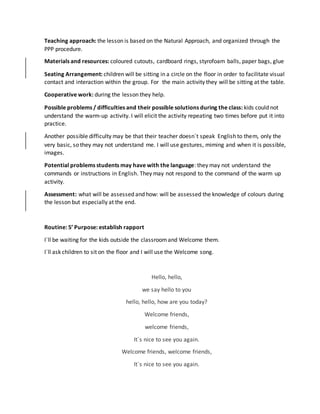
I will hide on my back first the cutouts and then I will show them each color and say the name
of the colour
T: Now kids, look! This colour is pink, pinkkk, pinkkk (I will elicit three times)
T: What colour is it?
And I will do the same with the other colours a few times.
Practice 10´: this activity is aimed at fostering contextualized practice of the teaching points
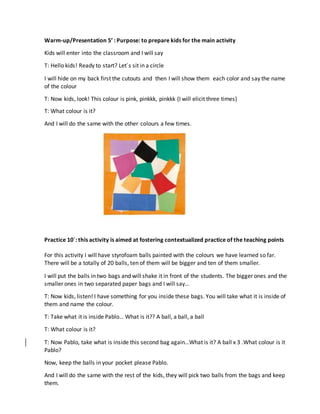
For this activity I will have styrofoam balls painted with the colours we have learned so far.
There will be a totally of 20 balls, ten of them will be bigger and ten of them smaller.
I will put the balls in two bags and will shake it in front of the students. The bigger ones and the
smaller ones in two separated paper bags and I will say…
T: Now kids, listen! I have something for you inside these bags. You will take what it is inside of
them and name the colour.
T: Take what it is inside Pablo… What is it?? A ball, a ball, a ball
T: What colour is it?
T: Now Pablo, take what is inside this second bag again…What is it? A ball x 3 .What colour is it
Pablo?
Now, keep the balls in your pocket please Pablo.
And I will do the same with the rest of the kids, they will pick two balls from the bags and keep
them.
Production 10’ : to make kids work
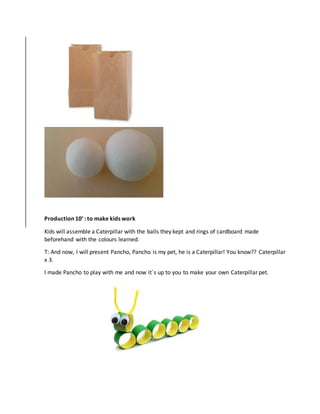
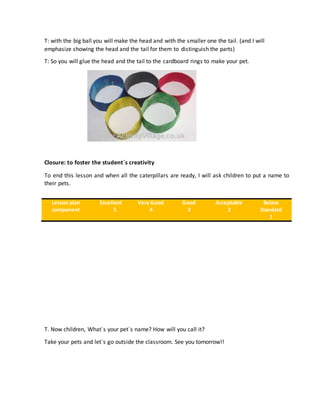
Kids will assemble a Caterpillar with the balls they kept and rings of cardboard made
beforehand with the colours learned.
T: And now, I will present Pancho, Pancho is my pet, he is a Caterpillar! You know?? Caterpillar
x 3.
I made Pancho to play with me and now it´s up to you to make your own Caterpillar pet.
T: with the big ball you will make the head and with the smaller one the tail. (and I will
emphasize showing the head and the tail for them to distinguish the parts)
T: So you will glue the head and the tail to the cardboard rings to make your pet.
Closure: to foster the student´s creativity
To end this lesson and when all the caterpillars are ready, I will ask children to put a name to
their pets.
T. Now children, What´s your pet´s name? How will you call it?
Take your pets and let´s go outside the classroom. See you tomorrow!!
Lesson plan
component
Excellent
5
Very Good
4
Good
3
Acceptable
2
Below
Standard
1
Visual
organization
x
Coherence and
sequencing
x
Variety of
resources –
Learning styles
x
Stages and
activities
x
Teaching
strategies
x
Language
accuracy
x
Observations
You are soresourceful! Well done!
Are you planningtotell themthe storyof the veryhungrycaterpillar?Ithinkit
wouldbe great.Anyway,toconnectthislessonwiththe previousone,youmaytell
themyourcaterpillarloveseatingfruit,andelicitsome vocabularyusingflashcards
or realia.
Have a lovelylesson!
Aure

Waldovino lesson plan4- passed

  • 1.
    TALLER DE PRÁCTICADOCENTE ALUMNO RESIDENTE: Mariela Isabel Waldovino Período de Práctica: Nivel Inicial Nivel Inicial Institución Educativa: Jardín Ositos Cariñosos – Colegio Horizonte Dirección: Coronel López 1105 Sala / Grado / Año - sección: Sala de 5 años – Turno Tarde Cantidad de alumnos: 9 Nivel lingüístico del curso: Principiantes Tipo de Planificación: clase Unidad Temática: Colors Clase Nº: 4 Fecha: 08/6/2017 Hora: 16:00 – 16:30 Duración de la clase: 30’ Fecha de primera entrega: 11/05/2014 • Teaching points: Colours yellow, red, orange • Aims : During this lesson, learners will be able to… Use the introductory structure I´m Learn color vocabulary Recognize and identify them Language Focus Lexis Function Structure Pronunciation Revision Hello! Welcome! I´m… Greetings Introducing themselves I´m… What colour is it? /æm/ New Color Blue, purple, Green, pink Carterpillar Head, tail Recognize four different colors Who´s there? What is it? A ball /'gri:n/
  • 2.
    Teaching approach: thelesson is based on the Natural Approach, and organized through the PPP procedure. Materials and resources: coloured cutouts, cardboard rings, styrofoam balls, paper bags, glue Seating Arrangement: children will be sitting in a circle on the floor in order to facilitate visual contact and interaction within the group. For the main activity they will be sitting at the table. Cooperative work: during the lesson they help. Possible problems / difficulties and their possible solutions during the class: kids could not understand the warm-up activity. I will elicit the activity repeating two times before put it into practice. Another possible difficulty may be that their teacher doesn´t speak English to them, only the very basic, so they may not understand me. I will use gestures, miming and when it is possible, images. Potential problems students may have with the language: they may not understand the commands or instructions in English. They may not respond to the command of the warm up activity. Assessment: what will be assessed and how: will be assessed the knowledge of colours during the lesson but especially at the end. Routine: 5’ Purpose: establish rapport I´ll be waiting for the kids outside the classroomand Welcome them. I´ll ask children to sit on the floor and I will use the Welcome song. Hello, hello, we say hello to you hello, hello, how are you today? Welcome friends, welcome friends, It`s nice to see you again. Welcome friends, welcome friends, It`s nice to see you again.
  • 3.
    Warm-up/Presentation 5’ :Purpose: to prepare kids for the main activity Kids will enter into the classroom and I will say T: Hello kids! Ready to start? Let´s sit in a circle I will hide on my back first the cutouts and then I will show them each color and say the name of the colour T: Now kids, look! This colour is pink, pinkkk, pinkkk (I will elicit three times) T: What colour is it? And I will do the same with the other colours a few times. Practice 10´: this activity is aimed at fostering contextualized practice of the teaching points For this activity I will have styrofoam balls painted with the colours we have learned so far. There will be a totally of 20 balls, ten of them will be bigger and ten of them smaller. I will put the balls in two bags and will shake it in front of the students. The bigger ones and the smaller ones in two separated paper bags and I will say… T: Now kids, listen! I have something for you inside these bags. You will take what it is inside of them and name the colour. T: Take what it is inside Pablo… What is it?? A ball, a ball, a ball T: What colour is it? T: Now Pablo, take what is inside this second bag again…What is it? A ball x 3 .What colour is it Pablo? Now, keep the balls in your pocket please Pablo. And I will do the same with the rest of the kids, they will pick two balls from the bags and keep them.
  • 4.
    Production 10’ :to make kids work Kids will assemble a Caterpillar with the balls they kept and rings of cardboard made beforehand with the colours learned. T: And now, I will present Pancho, Pancho is my pet, he is a Caterpillar! You know?? Caterpillar x 3. I made Pancho to play with me and now it´s up to you to make your own Caterpillar pet.
  • 5.
    T: with thebig ball you will make the head and with the smaller one the tail. (and I will emphasize showing the head and the tail for them to distinguish the parts) T: So you will glue the head and the tail to the cardboard rings to make your pet. Closure: to foster the student´s creativity To end this lesson and when all the caterpillars are ready, I will ask children to put a name to their pets. T. Now children, What´s your pet´s name? How will you call it? Take your pets and let´s go outside the classroom. See you tomorrow!! Lesson plan component Excellent 5 Very Good 4 Good 3 Acceptable 2 Below Standard 1
  • 6.
    Visual organization x Coherence and sequencing x Variety of resources– Learning styles x Stages and activities x Teaching strategies x Language accuracy x Observations You are soresourceful! Well done! Are you planningtotell themthe storyof the veryhungrycaterpillar?Ithinkit wouldbe great.Anyway,toconnectthislessonwiththe previousone,youmaytell themyourcaterpillarloveseatingfruit,andelicitsome vocabularyusingflashcards or realia. Have a lovelylesson! Aure