USS Arizona Pearl Harbor
World War II Facts
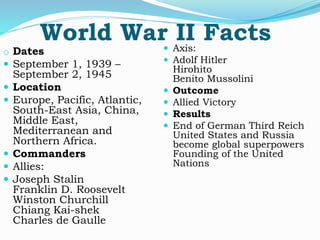
o Dates
 September 1, 1939 –
September 2, 1945
 Location
 Europe, Pacific, Atlantic,
South-East Asia, China,
Middle East,
Mediterranean and
Northern Africa.
 Commanders
 Allies:
 Joseph Stalin
Franklin D. Roosevelt
Winston Churchill
Chiang Kai-shek
Charles de Gaulle
 Axis:
 Adolf Hitler
Hirohito
Benito Mussolini
 Outcome
 Allied Victory
 Results
 End of German Third Reich
United States and Russia
become global superpowers
Founding of the United
Nations
World War II
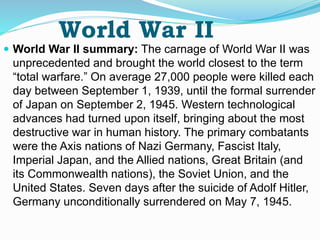
 World War II summary: The carnage of World War II was
unprecedented and brought the world closest to the term
“total warfare.” On average 27,000 people were killed each
day between September 1, 1939, until the formal surrender
of Japan on September 2, 1945. Western technological
advances had turned upon itself, bringing about the most
destructive war in human history. The primary combatants
were the Axis nations of Nazi Germany, Fascist Italy,
Imperial Japan, and the Allied nations, Great Britain (and
its Commonwealth nations), the Soviet Union, and the
United States. Seven days after the suicide of Adolf Hitler,
Germany unconditionally surrendered on May 7, 1945.
World War II
 The Japanese would go on to fight for nearly four more
months until their surrender on September 2, which was
brought on by the U.S. dropping atomic bombs on the
Japanese towns of Nagasaki and Hiroshima. Despite
winning the war, Britain largely lost much of its empire,
which was outlined in the basis of the Atlantic Charter.
 The war precipitated the revival of the U.S. economy, and
by the war’s end, the nation would have a gross national
product that was nearly greater than all the Allied and Axis
powers combined. The USA and USSR emerged from
World War II as global superpowers. The fundamentally
disparate, one-time allies became engaged in what was to
be called the Cold War, which dominated world politics for
Casualties in World War II
 The most destructive war in all of history, its exact cost in
human lives is unknown, but casualties in World War II
may have totaled over 60 million service personnel and
civilians killed. Nations suffering the highest losses, military
and civilian, in descending order, are:
 USSR: 42,000,000
 Germany: 9,000,000
 China: 4,000,000
 Japan: 3,000,000
When did World War II begin?
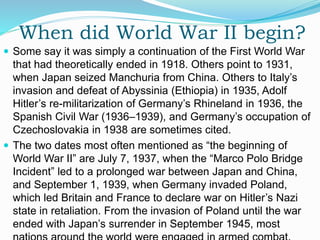
 Some say it was simply a continuation of the First World War
that had theoretically ended in 1918. Others point to 1931,
when Japan seized Manchuria from China. Others to Italy’s
invasion and defeat of Abyssinia (Ethiopia) in 1935, Adolf
Hitler’s re-militarization of Germany’s Rhineland in 1936, the
Spanish Civil War (1936–1939), and Germany’s occupation of
Czechoslovakia in 1938 are sometimes cited.
 The two dates most often mentioned as “the beginning of
World War II” are July 7, 1937, when the “Marco Polo Bridge
Incident” led to a prolonged war between Japan and China,
and September 1, 1939, when Germany invaded Poland,
which led Britain and France to declare war on Hitler’s Nazi
state in retaliation. From the invasion of Poland until the war
ended with Japan’s surrender in September 1945, most
Origins of World War II
 No one historic event can be said to have been the origin
of World War II. Japan’s unexpected victory over czarist
Russia in the Russo-Japanese War (1904-05) left open the
door for Japanese expansion in Asia and the Pacific. The
United States U.S. Navy first developed plans in
preparation for a naval war with Japan in 1890. War Plan
Orange, as it was called, would be updated continually as
technology advanced and greatly aided the U.S. during
World War II.
 The years between the first and second world wars were a
time of instability. The Great Depression that began on
Black Tuesday, 1929 plunged the worldwide recession.
Coming to power in 1933, Hitler capitalized on this
economic decline and the deep German resentment due to
the emasculating Treaty of Versailles, signed following the
Origins of World War II
 Declaring that Germany needed Lebensraum or “living
space,” Hitler began to test the Western powers and their
willingness to monitor the treaty’s provision. By 1935
Hitler had established the Luftwaffe, a direct violation of
the 1919 treaty. Remilitarizing the Rhineland in 1936
violated Versailles and the Locarno Treaties (which
defined the borders of Europe) once again.
 The Anschluss of Austria and the annexation of the
rump of Czechoslovakia was a further extension of
Hitler’s desire for Lebensraum. Italy’s desire to create the
Third Rome pushed the nation to closer ties with Nazi
Germany. Likewise, Japan, angered by their exclusion in
Paris in 1919, sought to create a Pan-Asian sphere with
Japan in order to create a self-sufficient state.
Origins of World War II
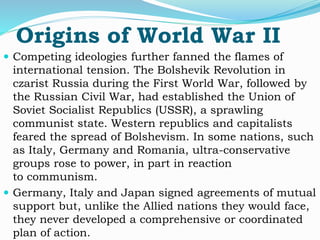
 Competing ideologies further fanned the flames of
international tension. The Bolshevik Revolution in
czarist Russia during the First World War, followed by
the Russian Civil War, had established the Union of
Soviet Socialist Republics (USSR), a sprawling
communist state. Western republics and capitalists
feared the spread of Bolshevism. In some nations, such
as Italy, Germany and Romania, ultra-conservative
groups rose to power, in part in reaction
to communism.
 Germany, Italy and Japan signed agreements of mutual
support but, unlike the Allied nations they would face,
they never developed a comprehensive or coordinated
plan of action.

The World War II.pptx

  • 3.
  • 4.
    World War IIFacts o Dates  September 1, 1939 – September 2, 1945  Location  Europe, Pacific, Atlantic, South-East Asia, China, Middle East, Mediterranean and Northern Africa.  Commanders  Allies:  Joseph Stalin Franklin D. Roosevelt Winston Churchill Chiang Kai-shek Charles de Gaulle  Axis:  Adolf Hitler Hirohito Benito Mussolini  Outcome  Allied Victory  Results  End of German Third Reich United States and Russia become global superpowers Founding of the United Nations
  • 5.
    World War II World War II summary: The carnage of World War II was unprecedented and brought the world closest to the term “total warfare.” On average 27,000 people were killed each day between September 1, 1939, until the formal surrender of Japan on September 2, 1945. Western technological advances had turned upon itself, bringing about the most destructive war in human history. The primary combatants were the Axis nations of Nazi Germany, Fascist Italy, Imperial Japan, and the Allied nations, Great Britain (and its Commonwealth nations), the Soviet Union, and the United States. Seven days after the suicide of Adolf Hitler, Germany unconditionally surrendered on May 7, 1945.
  • 6.
    World War II The Japanese would go on to fight for nearly four more months until their surrender on September 2, which was brought on by the U.S. dropping atomic bombs on the Japanese towns of Nagasaki and Hiroshima. Despite winning the war, Britain largely lost much of its empire, which was outlined in the basis of the Atlantic Charter.  The war precipitated the revival of the U.S. economy, and by the war’s end, the nation would have a gross national product that was nearly greater than all the Allied and Axis powers combined. The USA and USSR emerged from World War II as global superpowers. The fundamentally disparate, one-time allies became engaged in what was to be called the Cold War, which dominated world politics for
  • 7.
    Casualties in WorldWar II  The most destructive war in all of history, its exact cost in human lives is unknown, but casualties in World War II may have totaled over 60 million service personnel and civilians killed. Nations suffering the highest losses, military and civilian, in descending order, are:  USSR: 42,000,000  Germany: 9,000,000  China: 4,000,000  Japan: 3,000,000
  • 8.
    When did WorldWar II begin?  Some say it was simply a continuation of the First World War that had theoretically ended in 1918. Others point to 1931, when Japan seized Manchuria from China. Others to Italy’s invasion and defeat of Abyssinia (Ethiopia) in 1935, Adolf Hitler’s re-militarization of Germany’s Rhineland in 1936, the Spanish Civil War (1936–1939), and Germany’s occupation of Czechoslovakia in 1938 are sometimes cited.  The two dates most often mentioned as “the beginning of World War II” are July 7, 1937, when the “Marco Polo Bridge Incident” led to a prolonged war between Japan and China, and September 1, 1939, when Germany invaded Poland, which led Britain and France to declare war on Hitler’s Nazi state in retaliation. From the invasion of Poland until the war ended with Japan’s surrender in September 1945, most
  • 9.
    Origins of WorldWar II  No one historic event can be said to have been the origin of World War II. Japan’s unexpected victory over czarist Russia in the Russo-Japanese War (1904-05) left open the door for Japanese expansion in Asia and the Pacific. The United States U.S. Navy first developed plans in preparation for a naval war with Japan in 1890. War Plan Orange, as it was called, would be updated continually as technology advanced and greatly aided the U.S. during World War II.  The years between the first and second world wars were a time of instability. The Great Depression that began on Black Tuesday, 1929 plunged the worldwide recession. Coming to power in 1933, Hitler capitalized on this economic decline and the deep German resentment due to the emasculating Treaty of Versailles, signed following the
  • 10.
    Origins of WorldWar II  Declaring that Germany needed Lebensraum or “living space,” Hitler began to test the Western powers and their willingness to monitor the treaty’s provision. By 1935 Hitler had established the Luftwaffe, a direct violation of the 1919 treaty. Remilitarizing the Rhineland in 1936 violated Versailles and the Locarno Treaties (which defined the borders of Europe) once again.  The Anschluss of Austria and the annexation of the rump of Czechoslovakia was a further extension of Hitler’s desire for Lebensraum. Italy’s desire to create the Third Rome pushed the nation to closer ties with Nazi Germany. Likewise, Japan, angered by their exclusion in Paris in 1919, sought to create a Pan-Asian sphere with Japan in order to create a self-sufficient state.
  • 11.
    Origins of WorldWar II  Competing ideologies further fanned the flames of international tension. The Bolshevik Revolution in czarist Russia during the First World War, followed by the Russian Civil War, had established the Union of Soviet Socialist Republics (USSR), a sprawling communist state. Western republics and capitalists feared the spread of Bolshevism. In some nations, such as Italy, Germany and Romania, ultra-conservative groups rose to power, in part in reaction to communism.  Germany, Italy and Japan signed agreements of mutual support but, unlike the Allied nations they would face, they never developed a comprehensive or coordinated plan of action.