Vulnerability Assessments, Physical 
Security, and Nuclear Safeguards 
Roger G. Johnston, Ph.D., CPP 
Vulnerability Assessment Team 
Argonne National Laboratory 
630-252-6168 rogerj@anl.gov 
http://www.ne.anl.gov/capabilities/vat
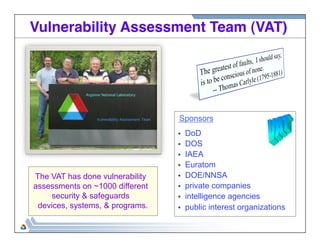
Vulnerability Assessment Team (VAT)! 
Sponsors 
• DoD 
• DOS 
• IAEA 
• Euratom 
• DOE/NNSA 
• private companies 
• intelligence agencies 
• public interest organizations 
The VAT has done vulnerability 
assessments on ~1000 different 
security & safeguards 
devices, systems, & programs.
Domestic Nuclear Safeguards 
• is MPC&A 
• is a traditional security application: 
ü the “good guys” own the assets & facilities 
ü the (unknown) adversaries are a small number of 
individuals with limited resources 
ü secrecy is allowed 
ü the attacks must often be quick 
ü the “good guys” can use the facility infrastructure, 
personnel, & training to counter the adversary
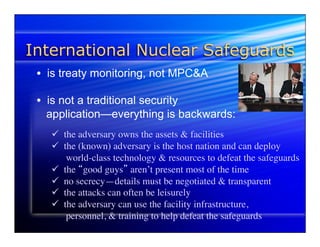
International Nuclear Safeguards 
• is treaty monitoring, not MPC&A 
• is not a traditional security 
application—everything is backwards: 
ü the adversary owns the assets & facilities 
ü the (known) adversary is the host nation and can deploy 
world-class technology & resources to defeat the safeguards 
ü the “good guys” aren’t present most of the time 
ü no secrecy—details must be negotiated & transparent 
ü the attacks can often be leisurely 
ü the adversary can use the facility infrastructure, 
personnel, & training to help defeat the safeguards
Domestic vs. International 
Nuclear Safeguards 
The differences are so extreme, we must be suspicious 
when similar hardware, strategies, expertise, and 
personnel are used. 
These differences are widely recognized 
in theory…but not in practice.
Other International Safeguards Problems 
Ø Cooperative Nuclear Safeguards gets confused with 
International Nuclear Safeguards 
Ø Denial & cognitive dissonance 
Ø Vulnerability assessments that are weak, non-existent, 
or done too late to make changes 
Ø Hijacking of the term & concept of “Transparency” 
Ø Lots of bureaucrats & engineers who don’t understand 
physical security
Other International Safeguards Problems 
Ø Technologists push their pet technology rather than 
solving the problem 
Ø Diplomats want simple solutions 
Ø Safeguards programs tend to have a life of their own 
beyond true needs 
Ø Details of inspections & safeguards can become bones 
of geopolitical contention 
Ø Disparate national and security cultures
Other International Safeguards Problems 
Ø Poor tamper/intrusion detection in general 
Ø Thinking a mechanical tamper switch provides effective 
intrusion detection 
Ø Wishful thinking about information barriers 
Ø No background checks on IAEA inspectors!
Warning! 
You should always assume a security or safeguards 
device or system can be easily defeated, because it 
usually can. 
Effective security & safeguards are very difficult. 
We can only get good at them if we understand this. 
Be wary of silver bullets—they don’t exist!
Definition 
Security Theater: sham or ceremonial security; 
Measures that ostensibly protect people or assets but 
that actually do little or nothing to counter adversaries.
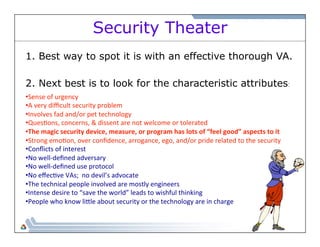
Security Theater 
1. Best way to spot it is with an effective thorough VA. 
2. Next best is to look for the characteristic attributes: 
• Sense 
of 
urgency 
• A 
very 
difficult 
security 
problem 
• Involves 
fad 
and/or 
pet 
technology 
• Ques=ons, 
concerns, 
& 
dissent 
are 
not 
welcome 
or 
tolerated 
• The 
magic 
security 
device, 
measure, 
or 
program 
has 
lots 
of 
“feel 
good” 
aspects 
to 
it 
• Strong 
emo=on, 
over 
confidence, 
arrogance, 
ego, 
and/or 
pride 
related 
to 
the 
security 
• Conflicts 
of 
interest 
• No 
well-­‐defined 
adversary 
• No 
well-­‐defined 
use 
protocol 
• No 
effec=ve 
VAs; 
no 
devil’s 
advocate 
• The 
technical 
people 
involved 
are 
mostly 
engineers 
• Intense 
desire 
to 
“save 
the 
world” 
leads 
to 
wishful 
thinking 
• People 
who 
know 
liOle 
about 
security 
or 
the 
technology 
are 
in 
charge
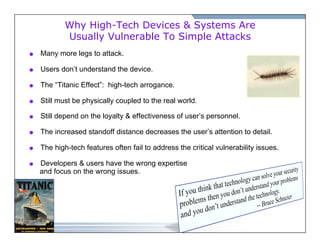
Why High-Tech Devices & Systems Are 
Usually Vulnerable To Simple Attacks 
 Many more legs to attack. 
 Users don’t understand the device. 
 The “Titanic Effect”: high-tech arrogance. 
 Still must be physically coupled to the real world. 
 Still depend on the loyalty & effectiveness of user’s personnel. 
 The increased standoff distance decreases the user’s attention to detail. 
 The high-tech features often fail to address the critical vulnerability issues. 
 Developers & users have the wrong expertise 
and focus on the wrong issues.
Blunder: Thinking Engineers Understand Security" 
Engineers... 
• ...work in solution space, not problem space 
• …make things work but aren't trained or mentally inclined to figure out how to make 
things break 
• ...view Nature or economics as the adversary, not the bad guys 
• …tend to think technologies fail randomly, not by deliberate, intelligent, malicious 
intent 
• …are not typically predisposed to think like bad guys 
• …focus on user friendliness—not making things difficult for the bad guys 
• ...like to add lots of extra features that open up new attack vectors 
• …want products to be simple to maintain, repair, and 
diagnose, which can make them easy to attack
Blunder: Wrong Assumptions about Counterfeiting 
Ø Usually much easier than developers, vendors, 
& manufacturers claim. 
Ø Often overlooked: The bad guys usually only needed to 
mimic only the superficial appearance of the original 
and (maybe) some of the apparent performance.
Data Encryption/Authentication 
At least currently, data encryption/authentication should have 
only a marginal role to play in international safeguards because: 
• not conducive to transparency & international cooperation 
• of minimal use given our poor physical security & tamper/intrusion detection 
• the data remanence problem hasn’t been solved 
• pointless if you can’t believe the sensors, the raw data, & the data analysis 
in the first place 
• the adversary may have access to the plaintext so he can go beyond 
ciphertext-only crytoanalysis 
• it’s easy to eavesdrop on keys and passwords
Warning: Multiple Layers of Security 
(“Security in Depth”) 
Ø Increases complexity. 
Ø Multiple layers of bad security do not equal good security. 
Ø It’s unlikely the adversary has to defeat all the layers. 
Ø Often mindlessly applied: the layers are not automatically backups for 
each other. They may have common failure modes, or even interfere 
with each other. 
Ø Leads to complacency. 
Ø Tends to be a cop-out to avoid improving security 
Ø Often a knee-jerk response when security hasn’t been thought through. 
Ø How many sieves do you have to stack up 
before the water won’t leak through?
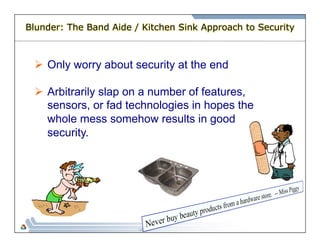
Blunder: The Band Aide / Kitchen Sink Approach to Security 
Ø Only worry about security at the end 
Ø Arbitrarily slap on a number of features, 
sensors, or fad technologies in hopes the 
whole mess somehow results in good 
security.
Confusing Inventory & Security 
Inventory 
§ Counting and locating stuff 
§ No nefarious adversary 
§ May detect innocent errors by insiders, but not 
surreptitious attacks by insiders or outsiders. 
Security 
§ Meant to counter nefarious adversaries (insiders and 
outsiders) 
§ Watch out for mission creep: inventory systems 
that come to be viewed as security systems!
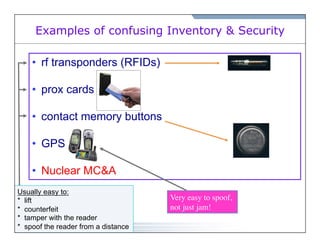
Examples of confusing Inventory & Security 
• rf transponders (RFIDs) 
• prox cards 
• contact memory buttons 
• GPS 
• Nuclear MC&A 
Usually easy to: 
* lift 
* counterfeit 
* tamper with the reader 
* spoof the reader from a distance 
Very easy to spoof, 
not just jam!
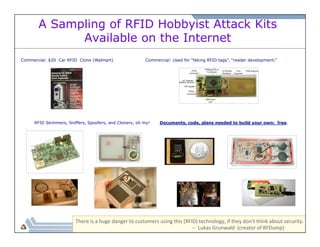
A Sampling of RFID Hobbyist Attack Kits 
Available on the Internet 
Commercial: Used for “faking RFID tags”, Commercial: $20 Car RFID Clone (Walmart) “reader development.” 
RFID Skimmers, Sniffers, Spoofers, and Cloners; oh my! Documents, code, plans needed to build your own: free. 
There 
is 
a 
huge 
danger 
to 
customers 
using 
this 
(RFID) 
technology, 
if 
they 
don't 
think 
about 
security. 
-­‐-­‐ 
Lukas 
Grunwald 
(creator 
of 
RFDump)
(Incidentally, Prox Cards are RFIDs!) 
[But then most (all?) access control and biometric devices are easy to defeat.]
GPS: Not a Security Technology 
Ø The private sector, foreigners, and 90+% of the 
federal government must use the civilian GPS 
satellite signals. 
Ø These are unencrypted and unauthenticated. 
Ø They were never meant for critical or security 
applications, yet GPS is being used that way! 
Ø GPS signals can be: Blocked, Jammed, or 
Spoofed
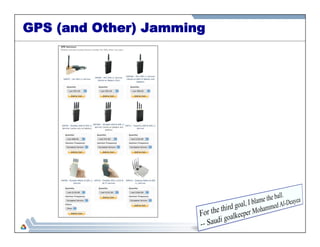
GPS (and Other) Jamming
Spoofing Civilian GPS Receivers 
• Easy to do with widely available GPS satellite 
simulators. 
• These can be purchased, rented, or stolen. 
• Not export controlled. 
• Many are surprisingly user friendly. Little 
expertise is needed in electronics, computers, 
or GPS to use them. 
• Spoofing can be detected for ~$15 
of parts retail (but there’s no interest).
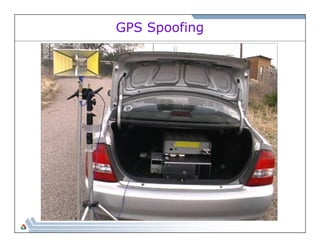
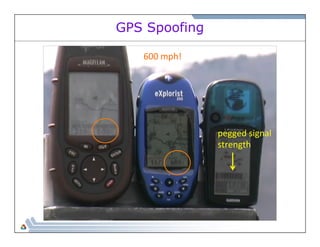
GPS Spoofing
GPS Spoofing 
600 
mph! 
pegged 
signal 
strength
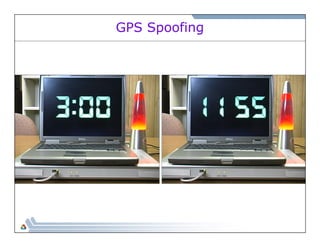
GPS Spoofing
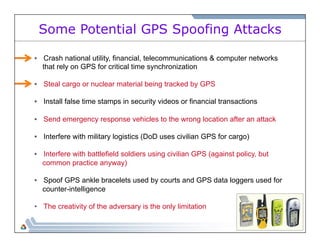
Some Potential GPS Spoofing Attacks 
• Crash national utility, financial, telecommunications & computer networks 
that rely on GPS for critical time synchronization 
• Steal cargo or nuclear material being tracked by GPS 
• Install false time stamps in security videos or financial transactions 
• Send emergency response vehicles to the wrong location after an attack 
• Interfere with military logistics (DoD uses civilian GPS for cargo) 
• Interfere with battlefield soldiers using civilian GPS (against policy, but 
common practice anyway) 
• Spoof GPS ankle bracelets used by courts and GPS data loggers used for 
counter-intelligence 
• The creativity of the adversary is the only limitation
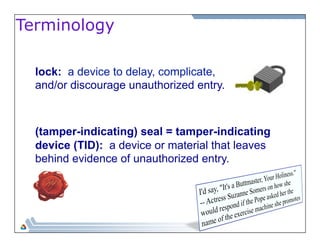
Terminology 
lock: a device to delay, complicate, 
and/or discourage unauthorized entry. 
(tamper-indicating) seal = tamper-indicating 
device (TID): a device or material that leaves 
behind evidence of unauthorized entry.
Terminology 
defeating a seal: opening a seal, then resealing 
(using the original seal or a counterfeit) without 
being detected. 
attacking a seal: undertaking a sequence 
of actions designed to defeat it.
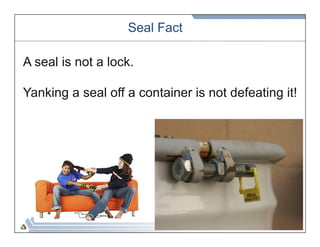
A seal is not a lock. 
Yanking a seal off a container is not defeating it! 
35 
Seal Fact
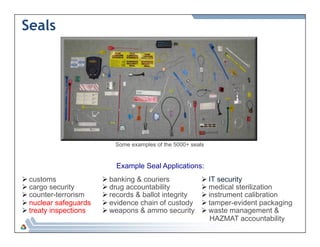
Seals 
Some examples of the 5000+ seals 
Ø customs 
Ø cargo security 
Ø counter-terrorism 
Ø nuclear safeguards 
Ø treaty inspections 
Example Seal Applications: 
Ø banking & couriers 
Ø drug accountability 
Ø records & ballot integrity 
Ø evidence chain of custody 
Ø weapons & ammo security 
Ø IT security 
Ø medical sterilization 
Ø instrument calibration 
Ø tamper-evident packaging 
Ø waste management & 
HAZMAT accountability
Seal Use Protocol 
A seal is no better than its formal and informal 
“use protocol”... 
...how the seal is: 
• manufactured 
• procured 
• shipped 
• stored 
• checked out 
• installed 
• inspected 
• removed 
• destroyed after use 
• And how the seal data and reader are stored & protected and 
• How the seal installers/inspectors are trained.
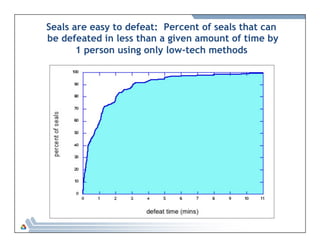
Seals are easy to defeat: Percent of seals that can 
be defeated in less than a given amount of time by 
1 person using only low-tech methods
The Good News: Countermeasures 
• Most of the seal attacks have simple 
and inexpensive countermeasures, 
but the seal installers & inspectors 
must understand the seal vulnerabilities, 
look for likely attacks, & have extensive 
hands-on training. 
• Also: better seals are possible!
40 
Conventional Seal: Stores the evidence of 
tampering until the seal can be inspected. But 
this ‘alarm condition’ is easy to erase or hide (or 
a fresh seal can be counterfeited). 
Anti-Evidence Seal: When the seal is first 
installed, we store secret information that 
tampering hasn’t been detected. This is 
deleted when the seal is opened. There’s 
nothing to erase, hide, or counterfeit.
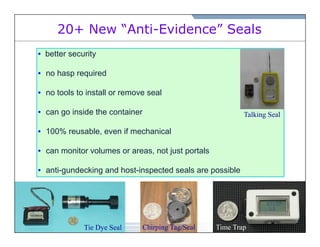
20+ New “Anti-Evidence” Seals 
• better security 
• no hasp required 
• no tools to install or remove seal 
• can go inside the container 
• 100% reusable, even if mechanical 
• can monitor volumes or areas, not just portals 
• anti-gundecking and host-inspected seals are possible 
Talking Seal 
Tie Dye Seal Chirping Tag/Seal Time Trap
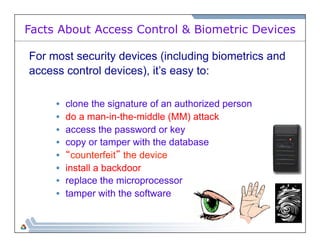
Facts About Access Control & Biometric Devices 
For most security devices (including biometrics and 
access control devices), it’s easy to: 
• clone the signature of an authorized person 
• do a man-in-the-middle (MM) attack 
• access the password or key 
• copy or tamper with the database 
• “counterfeit” the device 
• install a backdoor 
• replace the microprocessor 
• tamper with the software
Backdoor, Counterfeit, and MM Attacks 
The importance of a cradle-to-grave, secure chain of 
custody: 
As with most security devices, AC devices can usually be 
compromised in 15 seconds (at the factory or vendor, on the 
loading dock, in transit, in the receiving department, or after 
being installed). 
Most “security” and safeguards devices have little built-in 
security or ability to detect intrusion/tampering.
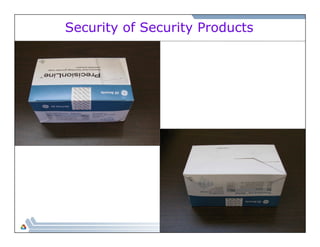
Security of Security Products
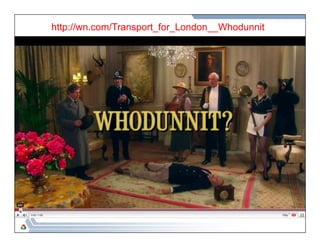
http://wn.com/Transport_for_London__Whodunnit
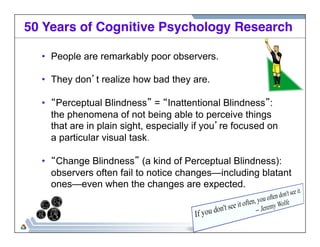
50 Years of Cognitive Psychology Research! 
• People are remarkably poor observers. 
• They don’t realize how bad they are. 
• “Perceptual Blindness” = “Inattentional Blindness”: 
the phenomena of not being able to perceive things 
that are in plain sight, especially if you’re focused on 
a particular visual task. 
• “Change Blindness” (a kind of Perceptual Blindness): 
observers often fail to notice changes—including blatant 
ones—even when the changes are expected.
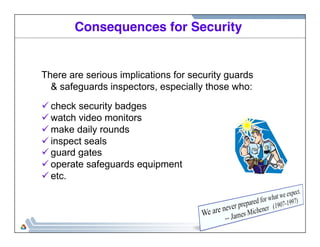
Consequences for Security! 
There are serious implications for security guards 
& safeguards inspectors, especially those who: 
ü check security badges 
ü watch video monitors 
ü make daily rounds 
ü inspect seals 
ü guard gates 
ü operate safeguards equipment 
ü etc.
Largely Unstudied Human Factors in Security 
Ø Two-Person Rule 
Ø Security Culture & Security Climate 
Ø Correlations between employee attitudes 
& the rate of security incidents 
Ø Reducing security guard turnover 
Ø The psychology of seal inspection 
Ø Countermeasures to perceptual blindness 
Ø Human factors in nuclear safeguards inspections 
Ø Mitigating the Insider Threat
Transparent, Negotiable, Reliable 
Video Verification for Treaty Inspection 
Relatively low-tech ways to make faking live streaming 
video difficult in real-time. 
Live Verify: Show that the video signals are real-time, 
not pre-recorded. 
Local Verify: Show they originate within at least a few 
km of the monitored nuclear facility (based on time of flight). 
Time of flight of electronic signals down a wire: 20 cm per nsec 
Video bandwidth: 27-140 MHz 
(37 nsec à 7 meters to 7 nsec à 1.4 meter)
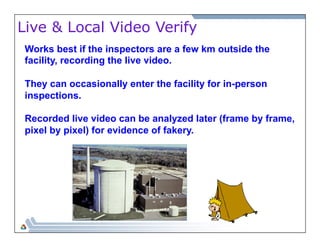
Live & Local Video Verify 
Works best if the inspectors are a few km outside the 
facility, recording the live video. 
They can occasionally enter the facility for in-person 
inspections. 
Recorded live video can be analyzed later (frame by frame, 
pixel by pixel) for evidence of fakery.
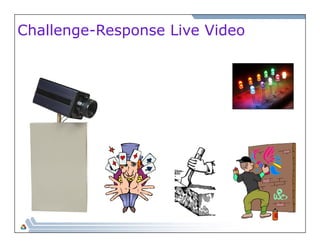
Challenge-Response Live Video
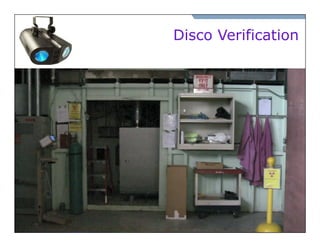
Disco Verification
For More Information... 
~250 related papers, reports, and 
presentations (including this one) 
are available from 
ROGERJ@ANL.GOV 
http://www.ne.anl.gov/capabilities/vat
supplemental material not part of the presentation…
Adversarial Vulnerability Assessments 
• Perform 
a 
mental 
coordinate 
transforma=on 
and 
pretend 
to 
be 
the 
bad 
guys. 
(This 
is 
much 
harder 
than 
you 
might 
think.) 
It is sometimes expedient to forget who 
we are. -- Publilius Syrus (~42 BC) 
• Be 
much 
more 
crea=ve 
than 
the 
adversaries. 
They 
need 
only 
stumble 
upon 
1 
vulnerability, 
the 
good 
guys 
have 
to 
worry 
about 
all 
of 
them. 
It’s really kinda cool to just be really creative and 
create something really cool. -- Britney Spears
Adversarial Vulnerability Assessments 
• Don’t 
let 
the 
good 
guys 
& 
the 
exis=ng 
security 
infrastructure 
and 
tac=cs 
define 
the 
problem. 
Evil will always triumph because good is dumb. 
-- Rick Moranis, as Dark Helmet in Spaceballs (1987) 
• Gleefully 
look 
for 
trouble, 
rather 
than 
seeking 
to 
reassure 
yourself 
that 
everything 
is 
fine. 
On a laser printer cartridge: “Warning. Do not eat toner.”
We need to be more like fault finders. They find 
problems because they want to find problems, and 
because t hey are skeptical: 
• bad guys 
• therapists 
• movie critics 
• computer hackers 
• scientific peer reviewers 
• mothers-in-law 
I told my psychiatrist that everyone hates 
me. He said I was being ridiculous-- 
everyone hasn’t met me yet. 
-- Rodney Dangerfield (1921-1997) 
“Two mothers-in-law.” 
-- Lord John Russell (1832-1900), on being asked what 
he would consider proper punishment for bigamy.
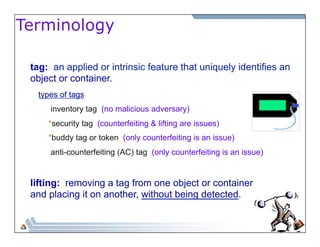
Terminology 
tag: an applied or intrinsic feature that uniquely identifies an 
object or container. 
types of tags 
inventory tag (no malicious adversary) 
*security tag (counterfeiting & lifting are issues) 
*buddy tag or token (only counterfeiting is an issue) 
anti-counterfeiting (AC) tag (only counterfeiting is an issue) 
lifting: removing a tag from one object or container 
and placing it on another, without being detected.
Polygraphs = Snake Oil 
National Academy of Sciences $860,000 study: 
“The Polygraph and Lie Detection” (October 2002) 
http://www.nap.edu/books/0309084369/html/ 
Some Conclusions: 
“Polygraph test accuracy may be degraded by countermeasures…” 
“…overconfidence in the polygraph—a belief in its accuracy that goes 
beyond what is justified by the evidence—…presents a danger to national 
security…” 
“Its accuracy in distinguishing actual or potential security violators from 
innocent test takers is insufficient to justify reliance on its use in employee 
security screening…”

Vulnerability Assessment, Physical Security, and Nuclear Safeguards

  • 1.
    Vulnerability Assessments, Physical Security, and Nuclear Safeguards Roger G. Johnston, Ph.D., CPP Vulnerability Assessment Team Argonne National Laboratory 630-252-6168 rogerj@anl.gov http://www.ne.anl.gov/capabilities/vat
  • 2.
    Vulnerability Assessment Team(VAT)! Sponsors • DoD • DOS • IAEA • Euratom • DOE/NNSA • private companies • intelligence agencies • public interest organizations The VAT has done vulnerability assessments on ~1000 different security & safeguards devices, systems, & programs.
  • 4.
    Domestic Nuclear Safeguards • is MPC&A • is a traditional security application: ü the “good guys” own the assets & facilities ü the (unknown) adversaries are a small number of individuals with limited resources ü secrecy is allowed ü the attacks must often be quick ü the “good guys” can use the facility infrastructure, personnel, & training to counter the adversary
  • 5.
    International Nuclear Safeguards • is treaty monitoring, not MPC&A • is not a traditional security application—everything is backwards: ü the adversary owns the assets & facilities ü the (known) adversary is the host nation and can deploy world-class technology & resources to defeat the safeguards ü the “good guys” aren’t present most of the time ü no secrecy—details must be negotiated & transparent ü the attacks can often be leisurely ü the adversary can use the facility infrastructure, personnel, & training to help defeat the safeguards
  • 6.
    Domestic vs. International Nuclear Safeguards The differences are so extreme, we must be suspicious when similar hardware, strategies, expertise, and personnel are used. These differences are widely recognized in theory…but not in practice.
  • 7.
    Other International SafeguardsProblems Ø Cooperative Nuclear Safeguards gets confused with International Nuclear Safeguards Ø Denial & cognitive dissonance Ø Vulnerability assessments that are weak, non-existent, or done too late to make changes Ø Hijacking of the term & concept of “Transparency” Ø Lots of bureaucrats & engineers who don’t understand physical security
  • 8.
    Other International SafeguardsProblems Ø Technologists push their pet technology rather than solving the problem Ø Diplomats want simple solutions Ø Safeguards programs tend to have a life of their own beyond true needs Ø Details of inspections & safeguards can become bones of geopolitical contention Ø Disparate national and security cultures
  • 9.
    Other International SafeguardsProblems Ø Poor tamper/intrusion detection in general Ø Thinking a mechanical tamper switch provides effective intrusion detection Ø Wishful thinking about information barriers Ø No background checks on IAEA inspectors!
  • 10.
    Warning! You shouldalways assume a security or safeguards device or system can be easily defeated, because it usually can. Effective security & safeguards are very difficult. We can only get good at them if we understand this. Be wary of silver bullets—they don’t exist!
  • 12.
    Definition Security Theater:sham or ceremonial security; Measures that ostensibly protect people or assets but that actually do little or nothing to counter adversaries.
  • 13.
    Security Theater 1.Best way to spot it is with an effective thorough VA. 2. Next best is to look for the characteristic attributes: • Sense of urgency • A very difficult security problem • Involves fad and/or pet technology • Ques=ons, concerns, & dissent are not welcome or tolerated • The magic security device, measure, or program has lots of “feel good” aspects to it • Strong emo=on, over confidence, arrogance, ego, and/or pride related to the security • Conflicts of interest • No well-­‐defined adversary • No well-­‐defined use protocol • No effec=ve VAs; no devil’s advocate • The technical people involved are mostly engineers • Intense desire to “save the world” leads to wishful thinking • People who know liOle about security or the technology are in charge
  • 15.
    Why High-Tech Devices& Systems Are Usually Vulnerable To Simple Attacks  Many more legs to attack.  Users don’t understand the device.  The “Titanic Effect”: high-tech arrogance.  Still must be physically coupled to the real world.  Still depend on the loyalty & effectiveness of user’s personnel.  The increased standoff distance decreases the user’s attention to detail.  The high-tech features often fail to address the critical vulnerability issues.  Developers & users have the wrong expertise and focus on the wrong issues.
  • 16.
    Blunder: Thinking EngineersUnderstand Security" Engineers... • ...work in solution space, not problem space • …make things work but aren't trained or mentally inclined to figure out how to make things break • ...view Nature or economics as the adversary, not the bad guys • …tend to think technologies fail randomly, not by deliberate, intelligent, malicious intent • …are not typically predisposed to think like bad guys • …focus on user friendliness—not making things difficult for the bad guys • ...like to add lots of extra features that open up new attack vectors • …want products to be simple to maintain, repair, and diagnose, which can make them easy to attack
  • 17.
    Blunder: Wrong Assumptionsabout Counterfeiting Ø Usually much easier than developers, vendors, & manufacturers claim. Ø Often overlooked: The bad guys usually only needed to mimic only the superficial appearance of the original and (maybe) some of the apparent performance.
  • 18.
    Data Encryption/Authentication Atleast currently, data encryption/authentication should have only a marginal role to play in international safeguards because: • not conducive to transparency & international cooperation • of minimal use given our poor physical security & tamper/intrusion detection • the data remanence problem hasn’t been solved • pointless if you can’t believe the sensors, the raw data, & the data analysis in the first place • the adversary may have access to the plaintext so he can go beyond ciphertext-only crytoanalysis • it’s easy to eavesdrop on keys and passwords
  • 19.
    Warning: Multiple Layersof Security (“Security in Depth”) Ø Increases complexity. Ø Multiple layers of bad security do not equal good security. Ø It’s unlikely the adversary has to defeat all the layers. Ø Often mindlessly applied: the layers are not automatically backups for each other. They may have common failure modes, or even interfere with each other. Ø Leads to complacency. Ø Tends to be a cop-out to avoid improving security Ø Often a knee-jerk response when security hasn’t been thought through. Ø How many sieves do you have to stack up before the water won’t leak through?
  • 20.
    Blunder: The BandAide / Kitchen Sink Approach to Security Ø Only worry about security at the end Ø Arbitrarily slap on a number of features, sensors, or fad technologies in hopes the whole mess somehow results in good security.
  • 21.
    Confusing Inventory &Security Inventory § Counting and locating stuff § No nefarious adversary § May detect innocent errors by insiders, but not surreptitious attacks by insiders or outsiders. Security § Meant to counter nefarious adversaries (insiders and outsiders) § Watch out for mission creep: inventory systems that come to be viewed as security systems!
  • 22.
    Examples of confusingInventory & Security • rf transponders (RFIDs) • prox cards • contact memory buttons • GPS • Nuclear MC&A Usually easy to: * lift * counterfeit * tamper with the reader * spoof the reader from a distance Very easy to spoof, not just jam!
  • 23.
    A Sampling ofRFID Hobbyist Attack Kits Available on the Internet Commercial: Used for “faking RFID tags”, Commercial: $20 Car RFID Clone (Walmart) “reader development.” RFID Skimmers, Sniffers, Spoofers, and Cloners; oh my! Documents, code, plans needed to build your own: free. There is a huge danger to customers using this (RFID) technology, if they don't think about security. -­‐-­‐ Lukas Grunwald (creator of RFDump)
  • 24.
    (Incidentally, Prox Cardsare RFIDs!) [But then most (all?) access control and biometric devices are easy to defeat.]
  • 25.
    GPS: Not aSecurity Technology Ø The private sector, foreigners, and 90+% of the federal government must use the civilian GPS satellite signals. Ø These are unencrypted and unauthenticated. Ø They were never meant for critical or security applications, yet GPS is being used that way! Ø GPS signals can be: Blocked, Jammed, or Spoofed
  • 26.
  • 27.
    Spoofing Civilian GPSReceivers • Easy to do with widely available GPS satellite simulators. • These can be purchased, rented, or stolen. • Not export controlled. • Many are surprisingly user friendly. Little expertise is needed in electronics, computers, or GPS to use them. • Spoofing can be detected for ~$15 of parts retail (but there’s no interest).
  • 28.
  • 29.
    GPS Spoofing 600 mph! pegged signal strength
  • 30.
  • 31.
    Some Potential GPSSpoofing Attacks • Crash national utility, financial, telecommunications & computer networks that rely on GPS for critical time synchronization • Steal cargo or nuclear material being tracked by GPS • Install false time stamps in security videos or financial transactions • Send emergency response vehicles to the wrong location after an attack • Interfere with military logistics (DoD uses civilian GPS for cargo) • Interfere with battlefield soldiers using civilian GPS (against policy, but common practice anyway) • Spoof GPS ankle bracelets used by courts and GPS data loggers used for counter-intelligence • The creativity of the adversary is the only limitation
  • 33.
    Terminology lock: adevice to delay, complicate, and/or discourage unauthorized entry. (tamper-indicating) seal = tamper-indicating device (TID): a device or material that leaves behind evidence of unauthorized entry.
  • 34.
    Terminology defeating aseal: opening a seal, then resealing (using the original seal or a counterfeit) without being detected. attacking a seal: undertaking a sequence of actions designed to defeat it.
  • 35.
    A seal isnot a lock. Yanking a seal off a container is not defeating it! 35 Seal Fact
  • 36.
    Seals Some examplesof the 5000+ seals Ø customs Ø cargo security Ø counter-terrorism Ø nuclear safeguards Ø treaty inspections Example Seal Applications: Ø banking & couriers Ø drug accountability Ø records & ballot integrity Ø evidence chain of custody Ø weapons & ammo security Ø IT security Ø medical sterilization Ø instrument calibration Ø tamper-evident packaging Ø waste management & HAZMAT accountability
  • 37.
    Seal Use Protocol A seal is no better than its formal and informal “use protocol”... ...how the seal is: • manufactured • procured • shipped • stored • checked out • installed • inspected • removed • destroyed after use • And how the seal data and reader are stored & protected and • How the seal installers/inspectors are trained.
  • 38.
    Seals are easyto defeat: Percent of seals that can be defeated in less than a given amount of time by 1 person using only low-tech methods
  • 39.
    The Good News:Countermeasures • Most of the seal attacks have simple and inexpensive countermeasures, but the seal installers & inspectors must understand the seal vulnerabilities, look for likely attacks, & have extensive hands-on training. • Also: better seals are possible!
  • 40.
    40 Conventional Seal:Stores the evidence of tampering until the seal can be inspected. But this ‘alarm condition’ is easy to erase or hide (or a fresh seal can be counterfeited). Anti-Evidence Seal: When the seal is first installed, we store secret information that tampering hasn’t been detected. This is deleted when the seal is opened. There’s nothing to erase, hide, or counterfeit.
  • 41.
    20+ New “Anti-Evidence”Seals • better security • no hasp required • no tools to install or remove seal • can go inside the container • 100% reusable, even if mechanical • can monitor volumes or areas, not just portals • anti-gundecking and host-inspected seals are possible Talking Seal Tie Dye Seal Chirping Tag/Seal Time Trap
  • 43.
    Facts About AccessControl & Biometric Devices For most security devices (including biometrics and access control devices), it’s easy to: • clone the signature of an authorized person • do a man-in-the-middle (MM) attack • access the password or key • copy or tamper with the database • “counterfeit” the device • install a backdoor • replace the microprocessor • tamper with the software
  • 44.
    Backdoor, Counterfeit, andMM Attacks The importance of a cradle-to-grave, secure chain of custody: As with most security devices, AC devices can usually be compromised in 15 seconds (at the factory or vendor, on the loading dock, in transit, in the receiving department, or after being installed). Most “security” and safeguards devices have little built-in security or ability to detect intrusion/tampering.
  • 45.
  • 47.
  • 48.
    50 Years ofCognitive Psychology Research! • People are remarkably poor observers. • They don’t realize how bad they are. • “Perceptual Blindness” = “Inattentional Blindness”: the phenomena of not being able to perceive things that are in plain sight, especially if you’re focused on a particular visual task. • “Change Blindness” (a kind of Perceptual Blindness): observers often fail to notice changes—including blatant ones—even when the changes are expected.
  • 49.
    Consequences for Security! There are serious implications for security guards & safeguards inspectors, especially those who: ü check security badges ü watch video monitors ü make daily rounds ü inspect seals ü guard gates ü operate safeguards equipment ü etc.
  • 50.
    Largely Unstudied HumanFactors in Security Ø Two-Person Rule Ø Security Culture & Security Climate Ø Correlations between employee attitudes & the rate of security incidents Ø Reducing security guard turnover Ø The psychology of seal inspection Ø Countermeasures to perceptual blindness Ø Human factors in nuclear safeguards inspections Ø Mitigating the Insider Threat
  • 52.
    Transparent, Negotiable, Reliable Video Verification for Treaty Inspection Relatively low-tech ways to make faking live streaming video difficult in real-time. Live Verify: Show that the video signals are real-time, not pre-recorded. Local Verify: Show they originate within at least a few km of the monitored nuclear facility (based on time of flight). Time of flight of electronic signals down a wire: 20 cm per nsec Video bandwidth: 27-140 MHz (37 nsec à 7 meters to 7 nsec à 1.4 meter)
  • 53.
    Live & LocalVideo Verify Works best if the inspectors are a few km outside the facility, recording the live video. They can occasionally enter the facility for in-person inspections. Recorded live video can be analyzed later (frame by frame, pixel by pixel) for evidence of fakery.
  • 54.
  • 55.
  • 56.
    For More Information... ~250 related papers, reports, and presentations (including this one) are available from ROGERJ@ANL.GOV http://www.ne.anl.gov/capabilities/vat
  • 57.
    supplemental material notpart of the presentation…
  • 58.
    Adversarial Vulnerability Assessments • Perform a mental coordinate transforma=on and pretend to be the bad guys. (This is much harder than you might think.) It is sometimes expedient to forget who we are. -- Publilius Syrus (~42 BC) • Be much more crea=ve than the adversaries. They need only stumble upon 1 vulnerability, the good guys have to worry about all of them. It’s really kinda cool to just be really creative and create something really cool. -- Britney Spears
  • 59.
    Adversarial Vulnerability Assessments • Don’t let the good guys & the exis=ng security infrastructure and tac=cs define the problem. Evil will always triumph because good is dumb. -- Rick Moranis, as Dark Helmet in Spaceballs (1987) • Gleefully look for trouble, rather than seeking to reassure yourself that everything is fine. On a laser printer cartridge: “Warning. Do not eat toner.”
  • 60.
    We need tobe more like fault finders. They find problems because they want to find problems, and because t hey are skeptical: • bad guys • therapists • movie critics • computer hackers • scientific peer reviewers • mothers-in-law I told my psychiatrist that everyone hates me. He said I was being ridiculous-- everyone hasn’t met me yet. -- Rodney Dangerfield (1921-1997) “Two mothers-in-law.” -- Lord John Russell (1832-1900), on being asked what he would consider proper punishment for bigamy.
  • 61.
    Terminology tag: anapplied or intrinsic feature that uniquely identifies an object or container. types of tags inventory tag (no malicious adversary) *security tag (counterfeiting & lifting are issues) *buddy tag or token (only counterfeiting is an issue) anti-counterfeiting (AC) tag (only counterfeiting is an issue) lifting: removing a tag from one object or container and placing it on another, without being detected.
  • 62.
    Polygraphs = SnakeOil National Academy of Sciences $860,000 study: “The Polygraph and Lie Detection” (October 2002) http://www.nap.edu/books/0309084369/html/ Some Conclusions: “Polygraph test accuracy may be degraded by countermeasures…” “…overconfidence in the polygraph—a belief in its accuracy that goes beyond what is justified by the evidence—…presents a danger to national security…” “Its accuracy in distinguishing actual or potential security violators from innocent test takers is insufficient to justify reliance on its use in employee security screening…”