OPSEC FOR SECURITY RESEARCHERS 
Vicente Díaz 
Principal Security Analyst
WHAT IS THIS TALK ABOUT 
“Operational security identifies critical information to 
determine if friendly actions can be observed by adversary 
intelligence systems” 
• How does this apply to our industry? 
• No counter-intel. 
• Not only identify – apply best practices for good opsec.
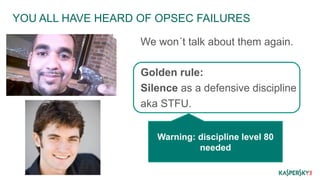
YOU ALL HAVE HEARD OF OPSEC FAILURES 
We won´t talk about them again. 
Golden rule: 
Silence as a defensive discipline 
aka STFU. 
Warning: discipline level 80 
needed
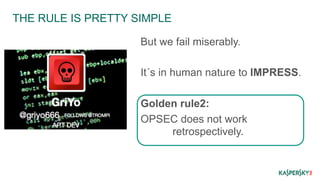
THE RULE IS PRETTY SIMPLE 
But we fail miserably. 
It´s in human nature to IMPRESS. 
Golden rule2: 
OPSEC does not work 
retrospectively.
I HAVE NO ENEMIES! 
Let´s put some context: 
_We work on cool stuff 
_We stumble upon “strange” things 
_The environment is sometimes poorly regulated 
_Hypocrisy vs red lines 
_Sense of invulnerability: we are the good guys, right? 
Not here to define the ethics of the industry!
BUT 
Could our work be interesting for someone else? 
Might it be perceived as dangerous for other´s interests? 
Are all our actions, as researchers, impeccable? 
We might be the weakest link, in terms of OPSEC, when 
collaborating with LE.
UNDER SCRUTINY 
We might be in a group of interest 
Objective: not become an individual of interest! 
Silence, but not complete. 
Avoid the escalation of surveillance: that means Game Over.
ADVERSARIES 
Broadly speaking: 
_Common cybercriminals 
_Non-common cybercriminals 
_Agencies 
_The future (or massive surveillance) 
Important: choose the OPSEC 
level you can adopt 
Otherwise – worse than 
not applying OPSEC at all.
Meet our adversaries 
MEET OUR ADVERSARIES
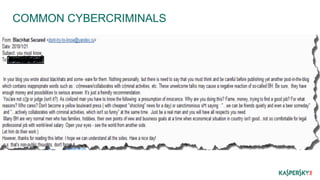
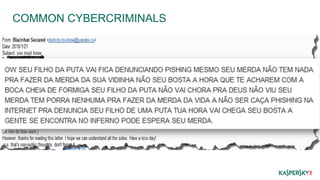
COMMON CYBERCRIMINALS
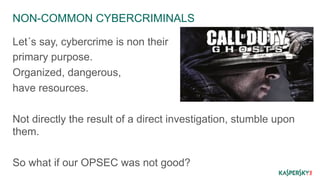
NON-COMMON CYBERCRIMINALS 
Let´s say, cybercrime is non their 
primary purpose. 
Organized, dangerous, 
have resources. 
Not directly the result of a direct investigation, stumble upon 
them. 
So what if our OPSEC was not good?
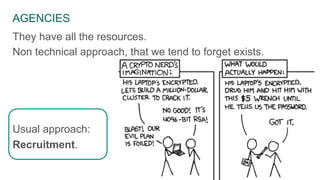
AGENCIES 
They have all the resources. 
Non technical approach, that we tend to forget exists. 
Usual approach: 
Recruitment.
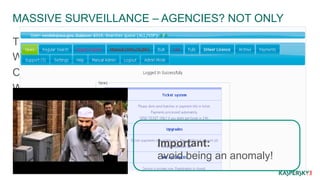
MASSIVE SURVEILLANCE – AGENCIES? NOT ONLY 
Trail of data and metadata – insane levels. 
What today looks secure, it might not be in the future. 
Companies getting huge amounts of data too. 
When leaks happen – fest.
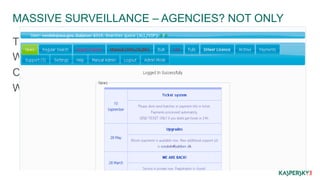
MASSIVE SURVEILLANCE – AGENCIES? NOT ONLY 
Trail of data and metadata – insane levels. 
What today looks secure, it might not be in the future. 
Companies getting huge amounts of data too. 
When leaks happen – fest.
MASSIVE SURVEILLANCE – AGENCIES? NOT ONLY 
Trail of data and metadata – insane levels. 
What today looks secure, it might not be in the future. 
Companies getting huge amounts of data too. 
When leaks happen – fest. 
Important: 
avoid being an anomaly!
IMPLEMENTATION 
Remember: be meticulous!
IMPLEMENTATION PROCESS - APPROACH 
Situational awareness 
Understand your position 
Threat actors (reduced) 
Threat environment 
Identify valuable data 
Unintentional metadata 
Analyze threats and vulnerabilities 
Asses risks 
Decide OPSEC measures to implement
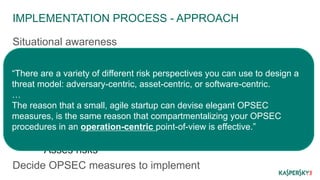
IMPLEMENTATION PROCESS - APPROACH 
Situational awareness 
Understand your position 
Threat actors (reduced) 
Threat environment 
Identify valuable data 
Unintentional metadata 
“There are a variety of different risk perspectives you can use to design a 
threat model: adversary-centric, asset-centric, or software-centric. 
… 
The reason that a small, agile startup can devise elegant OPSEC 
measures, is the same reason that compartmentalizing your OPSEC 
procedures in an operation-centric point-of-view is effective.” 
Analyze threats and vulnerabilities 
Asses risks 
Decide OPSEC measures to implement
HOW TO IMPLEMENT IN A GROUP 
As security, strongest as weakest link, somehow. 
Externally: 
who to trust, how to communicate with them 
command chain, protocols for events à Opsec officer ? 
Internally: 
ProTip: be careful with 
your language even internally. 
compartmentation 
training and shaming 
tag sensitiveness of information
HOW TO IMPLEMENT IN A GROUP 
As security, strongest as weakest link, somehow. 
Externally: 
who to trust, how to communicate with them 
command chain, protocols for events à Opsec officer ? 
Internally: 
ProTip: be careful with 
your language even internally. 
compartmentation 
training and shaming 


tag sensitiveness of information
IDENTITIES 
Usual Opsec recommendation. 
Necessary sometimes, but extremely difficult to do right. 
An error means an advantage for the adversaries. 
Advice: avoid if possible. 
But if you cannot, 
Golden rule: avoid 
cross-contamination
TOOLS – QUICK REVIEW
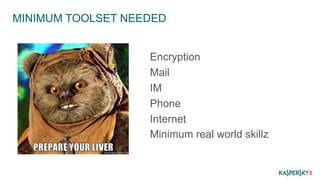
MINIMUM TOOLSET NEEDED 
Encryption 
Mail 
IM 
Phone 
Internet 
Minimum real world skillz
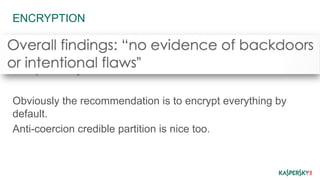
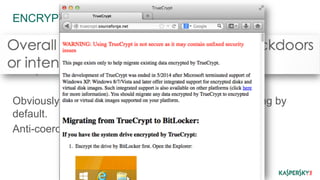
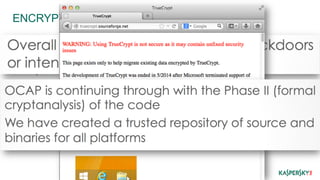
ENCRYPTION 
Inherent flaws – once broken all your past data is 
compromised. 
This possibility increases with time. 
Obviously the recommendation is to encrypt everything by 
default. 
Anti-coercion credible partition is nice too.
ENCRYPTION 
Inherent flaws – once broken all your past data is 
compromised. 
This possibility increases with time. 
Obviously the recommendation is to encrypt everything by 
default. 
Anti-coercion credible partition is nice too.
ENCRYPTION 
Inherent flaws – once broken all your past data is 
compromised. 
This possibility increases with time. 
Obviously the recommendation is to encrypt everything by 
default. 
Anti-coercion credible partition is nice too.
ENCRYPTION 
Inherent flaws – once broken all your past data is 
compromised. 
This possibility increases with time. 
Obviously the recommendation is to encrypt everything by 
default. 
Anti-coercion credible partition is nice too.
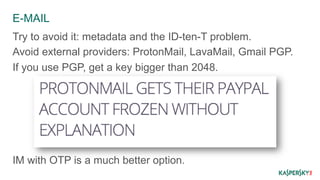
E-MAIL 
Try to avoid it: metadata and the ID-ten-T problem. 
Avoid external providers: ProtonMail, LavaMail, Gmail PGP. 
If you use PGP, get a key bigger than 2048. 
IM with OTP is a much better option.
IM 
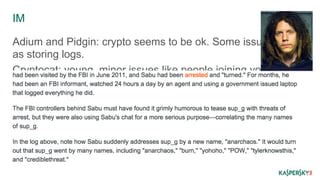
Adium and Pidgin: crypto seems to be ok. Some issues such 
as storing logs. 
Cryptocat: young, minor issues like people joining your chat if 
they know the name. 
Metadata, correlation and non-tech attacks still there!
IM 
Adium and Pidgin: crypto seems to be ok. Some issues such 
as storing logs. 
Cryptocat: young, minor issues like people joining your chat if 
they know the name. 
Metadata, correlation and non-tech attacks still there!
TOR 
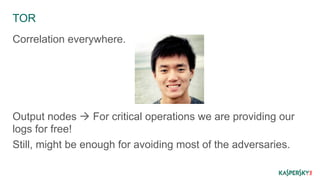
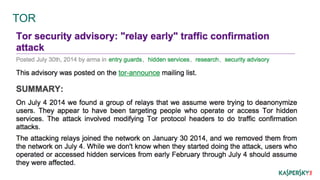
Correlation everywhere. 
Output nodes à For critical operations we are providing our 
logs for free! 
Still, might be enough for avoiding most of the adversaries.
TOR 
Correlation everywhere. 
Output nodes à For critical operations we are providing our 
logs for free! 
Still, might be enough for avoiding most of the adversaries.
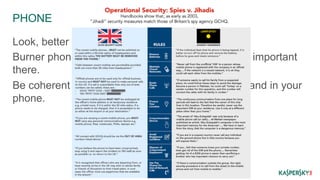
PHONE 
Look, better not to use it – but it´s a lost war. 
Burner phones, change often, don´t have anything important 
there. 
Be coherent with what you have in your computer and in your 
phone.
PHONE 
Look, better not to use it – but it´s a lost war. 
Burner phones, change often, don´t have anything important 
there. 
Be coherent with what you have in your computer and in your 
phone.
REAL WORLD 
Don´t try to impress people – don´t be impressed when 
approached by an stranger. 
What if we are required by LE? 
Have a travel laptop, travel phone, and lots of pennies in your 
pocket.
IN SUMMARY
CONCLUSIONS 
Opsec is hard – good news, no spy level is required. 
Let´s start educating ourselves and applying it by default. 
Over tools – meticulousness. 
Good Opsec is the one we can apply.
QUESTIONS? 
Vicente Díaz 
Principal Security Analyst 
vicente.diaz@kaspersky.com 
@trompi

Opsec for security researchers

  • 1.
    OPSEC FOR SECURITYRESEARCHERS Vicente Díaz Principal Security Analyst
  • 2.
    WHAT IS THISTALK ABOUT “Operational security identifies critical information to determine if friendly actions can be observed by adversary intelligence systems” • How does this apply to our industry? • No counter-intel. • Not only identify – apply best practices for good opsec.
  • 3.
    YOU ALL HAVEHEARD OF OPSEC FAILURES We won´t talk about them again. Golden rule: Silence as a defensive discipline aka STFU. Warning: discipline level 80 needed
  • 4.
    THE RULE ISPRETTY SIMPLE But we fail miserably. It´s in human nature to IMPRESS. Golden rule2: OPSEC does not work retrospectively.
  • 5.
    I HAVE NOENEMIES! Let´s put some context: _We work on cool stuff _We stumble upon “strange” things _The environment is sometimes poorly regulated _Hypocrisy vs red lines _Sense of invulnerability: we are the good guys, right? Not here to define the ethics of the industry!
  • 6.
    BUT Could ourwork be interesting for someone else? Might it be perceived as dangerous for other´s interests? Are all our actions, as researchers, impeccable? We might be the weakest link, in terms of OPSEC, when collaborating with LE.
  • 7.
    UNDER SCRUTINY Wemight be in a group of interest Objective: not become an individual of interest! Silence, but not complete. Avoid the escalation of surveillance: that means Game Over.
  • 8.
    ADVERSARIES Broadly speaking: _Common cybercriminals _Non-common cybercriminals _Agencies _The future (or massive surveillance) Important: choose the OPSEC level you can adopt Otherwise – worse than not applying OPSEC at all.
  • 9.
    Meet our adversaries MEET OUR ADVERSARIES
  • 10.
  • 11.
  • 12.
    NON-COMMON CYBERCRIMINALS Let´ssay, cybercrime is non their primary purpose. Organized, dangerous, have resources. Not directly the result of a direct investigation, stumble upon them. So what if our OPSEC was not good?
  • 13.
    AGENCIES They haveall the resources. Non technical approach, that we tend to forget exists. Usual approach: Recruitment.
  • 14.
    MASSIVE SURVEILLANCE –AGENCIES? NOT ONLY Trail of data and metadata – insane levels. What today looks secure, it might not be in the future. Companies getting huge amounts of data too. When leaks happen – fest.
  • 15.
    MASSIVE SURVEILLANCE –AGENCIES? NOT ONLY Trail of data and metadata – insane levels. What today looks secure, it might not be in the future. Companies getting huge amounts of data too. When leaks happen – fest.
  • 16.
    MASSIVE SURVEILLANCE –AGENCIES? NOT ONLY Trail of data and metadata – insane levels. What today looks secure, it might not be in the future. Companies getting huge amounts of data too. When leaks happen – fest. Important: avoid being an anomaly!
  • 17.
  • 18.
    IMPLEMENTATION PROCESS -APPROACH Situational awareness Understand your position Threat actors (reduced) Threat environment Identify valuable data Unintentional metadata Analyze threats and vulnerabilities Asses risks Decide OPSEC measures to implement
  • 19.
    IMPLEMENTATION PROCESS -APPROACH Situational awareness Understand your position Threat actors (reduced) Threat environment Identify valuable data Unintentional metadata “There are a variety of different risk perspectives you can use to design a threat model: adversary-centric, asset-centric, or software-centric. … The reason that a small, agile startup can devise elegant OPSEC measures, is the same reason that compartmentalizing your OPSEC procedures in an operation-centric point-of-view is effective.” Analyze threats and vulnerabilities Asses risks Decide OPSEC measures to implement
  • 20.
    HOW TO IMPLEMENTIN A GROUP As security, strongest as weakest link, somehow. Externally: who to trust, how to communicate with them command chain, protocols for events à Opsec officer ? Internally: ProTip: be careful with your language even internally. compartmentation training and shaming tag sensitiveness of information
  • 21.
    HOW TO IMPLEMENTIN A GROUP As security, strongest as weakest link, somehow. Externally: who to trust, how to communicate with them command chain, protocols for events à Opsec officer ? Internally: ProTip: be careful with your language even internally. compartmentation training and shaming tag sensitiveness of information
  • 22.
    IDENTITIES Usual Opsecrecommendation. Necessary sometimes, but extremely difficult to do right. An error means an advantage for the adversaries. Advice: avoid if possible. But if you cannot, Golden rule: avoid cross-contamination
  • 23.
  • 24.
    MINIMUM TOOLSET NEEDED Encryption Mail IM Phone Internet Minimum real world skillz
  • 25.
    ENCRYPTION Inherent flaws– once broken all your past data is compromised. This possibility increases with time. Obviously the recommendation is to encrypt everything by default. Anti-coercion credible partition is nice too.
  • 26.
    ENCRYPTION Inherent flaws– once broken all your past data is compromised. This possibility increases with time. Obviously the recommendation is to encrypt everything by default. Anti-coercion credible partition is nice too.
  • 27.
    ENCRYPTION Inherent flaws– once broken all your past data is compromised. This possibility increases with time. Obviously the recommendation is to encrypt everything by default. Anti-coercion credible partition is nice too.
  • 28.
    ENCRYPTION Inherent flaws– once broken all your past data is compromised. This possibility increases with time. Obviously the recommendation is to encrypt everything by default. Anti-coercion credible partition is nice too.
  • 29.
    E-MAIL Try toavoid it: metadata and the ID-ten-T problem. Avoid external providers: ProtonMail, LavaMail, Gmail PGP. If you use PGP, get a key bigger than 2048. IM with OTP is a much better option.
  • 30.
    IM Adium andPidgin: crypto seems to be ok. Some issues such as storing logs. Cryptocat: young, minor issues like people joining your chat if they know the name. Metadata, correlation and non-tech attacks still there!
  • 31.
    IM Adium andPidgin: crypto seems to be ok. Some issues such as storing logs. Cryptocat: young, minor issues like people joining your chat if they know the name. Metadata, correlation and non-tech attacks still there!
  • 32.
    TOR Correlation everywhere. Output nodes à For critical operations we are providing our logs for free! Still, might be enough for avoiding most of the adversaries.
  • 33.
    TOR Correlation everywhere. Output nodes à For critical operations we are providing our logs for free! Still, might be enough for avoiding most of the adversaries.
  • 34.
    PHONE Look, betternot to use it – but it´s a lost war. Burner phones, change often, don´t have anything important there. Be coherent with what you have in your computer and in your phone.
  • 35.
    PHONE Look, betternot to use it – but it´s a lost war. Burner phones, change often, don´t have anything important there. Be coherent with what you have in your computer and in your phone.
  • 36.
    REAL WORLD Don´ttry to impress people – don´t be impressed when approached by an stranger. What if we are required by LE? Have a travel laptop, travel phone, and lots of pennies in your pocket.
  • 37.
  • 38.
    CONCLUSIONS Opsec ishard – good news, no spy level is required. Let´s start educating ourselves and applying it by default. Over tools – meticulousness. Good Opsec is the one we can apply.
  • 39.
    QUESTIONS? Vicente Díaz Principal Security Analyst vicente.diaz@kaspersky.com @trompi