
1 
Talk for the 58th Annual ASIS Meeting 
Philadelphia, PA, September 10-13, 2012 
Under-Utilized Methods 
for Mitigating the Insider Threat 
Roger G. Johnston, Ph.D., CPP 
Vulnerability Assessment Team 
Argonne National Laboratory 
630-252-6168 rogerj@anl.gov 
http://www.ne.anl.gov/capabilities/vat 
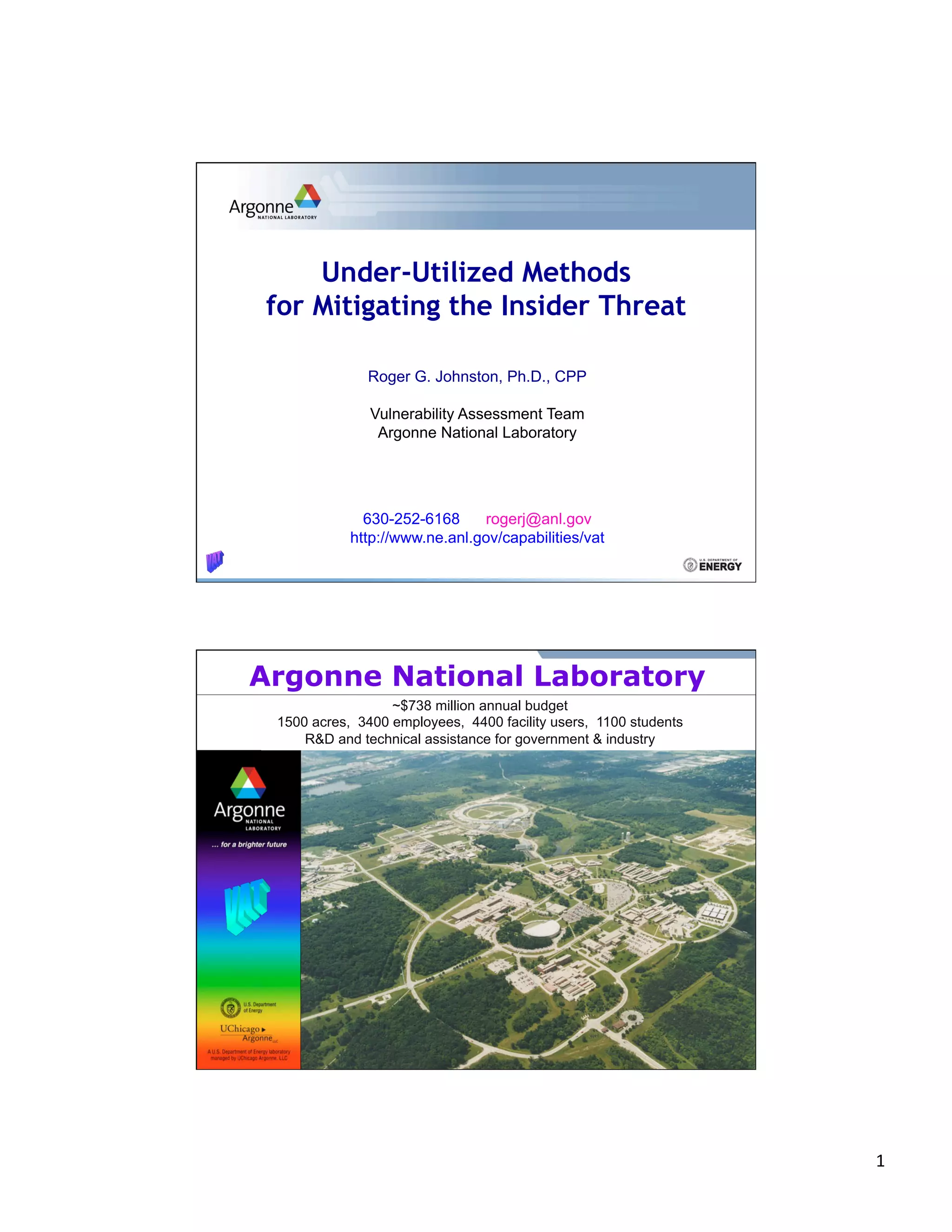
Argonne National Laboratory 
~$738 million annual budget 
1500 acres, 3400 employees, 4400 facility users, 1100 students 
R&D and technical assistance for government & industry
2 
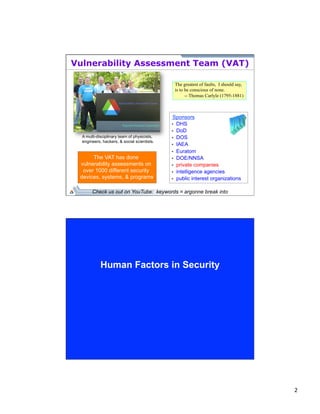
Vulnerability Assessment Team (VAT) 
Sponsors 
• DHS 
• DoD 
• DOS 
• IAEA 
• Euratom 
• DOE/NNSA 
• private companies 
• intelligence agencies 
• public interest organizations 
The VAT has done 
vulnerability assessments on 
over 1000 different security 
devices, systems, & programs. 
The greatest of faults, I should say, 
is to be conscious of none. 
-- Thomas Carlyle (1795-1881) 
A multi-disciplinary team of physicists, 
engineers, hackers, & social scientists. 
Check us out on YouTube: keywords = argonne break into 
Human Factors in Security
3 
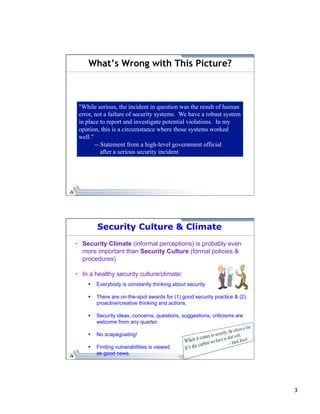
What’s Wrong with This Picture? 
"While serious, the incident in question was the result of human 
error, not a failure of security systems. We have a robust system 
in place to report and investigate potential violations. In my 
opinion, this is a circumstance where those systems worked 
well." 
-- Statement from a high-level government official 
after a serious security incident 
Security Culture & Climate 
• Security Climate (informal perceptions) is probably even 
more important than Security Culture (formal policies & 
procedures) 
• In a healthy security culture/climate: 
§ Everybody is constantly thinking about security. 
§ There are on-the-spot awards for (1) good security practice & (2) 
proactive/creative thinking and actions. 
§ Security ideas, concerns, questions, suggestions, criticisms are 
welcome from any quarter. 
§ No scapegoating! 
§ Finding vulnerabilities is viewed 
as good news.
4 
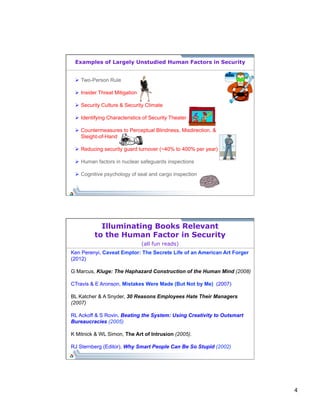
Examples of Largely Unstudied Human Factors in Security 
Ø Two-Person Rule 
Ø Insider Threat Mitigation 
Ø Security Culture & Security Climate 
Ø Identifying Characteristics of Security Theater 
Ø Countermeasures to Perceptual Blindness, Misdirection, & 
Sleight-of-Hand 
Ø Reducing security guard turnover (~40% to 400% per year) 
Ø Human factors in nuclear safeguards inspections 
Ø Cognitive psychology of seal and cargo inspection 
Illuminating Books Relevant 
to the Human Factor in Security 
(all fun reads) 
Ken Perenyi, Caveat Emptor: The Secrete Life of an American Art Forger 
(2012) 
G Marcus, Kluge: The Haphazard Construction of the Human Mind (2008) 
CTravis & E Aronson, Mistakes Were Made (But Not by Me) (2007) 
BL Katcher & A Snyder, 30 Reasons Employees Hate Their Managers 
(2007) 
RL Ackoff & S Rovin, Beating the System: Using Creativity to Outsmart 
Bureaucracies (2005) 
K Mitnick & WL Simon, The Art of Intrusion (2005). 
RJ Sternberg (Editor), Why Smart People Can Be So Stupid (2002)
5 
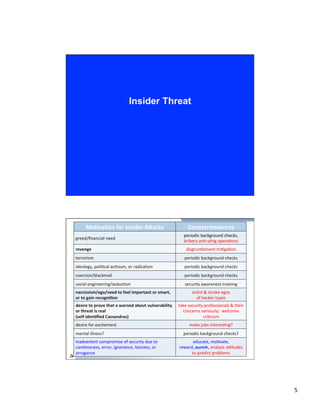
Insider Threat 
Mo#va#on 
for 
Insider 
A0acks 
Countermeasures 
greed/financial 
need 
periodic 
background 
checks, 
bribery 
an;-­‐s;ng 
opera;ons 
revenge 
disgruntlement 
mi;ga;on 
terrorism 
periodic 
background 
checks 
ideology, 
poli;cal 
ac;vism, 
or 
radicalism 
periodic 
background 
checks 
coercion/blackmail 
periodic 
background 
checks 
social 
engineering/seduc;on 
security 
awareness 
training 
narcissism/ego/need 
to 
feel 
important 
or 
smart, 
or 
to 
gain 
recogni#on 
enlist 
& 
stroke 
egos 
of 
hacker 
types 
desire 
to 
prove 
that 
a 
warned 
about 
vulnerability 
or 
threat 
is 
real 
(self-­‐iden#fied 
Cassandras) 
take 
security 
professionals 
& 
their 
concerns 
seriously; 
welcome 
cri;cism 
desire 
for 
excitement 
make 
jobs 
interes;ng? 
mental 
illness? 
periodic 
background 
checks? 
inadvertent 
compromise 
of 
security 
due 
to 
educate, 
mo;vate, 
carelessness, 
error, 
ignorance, 
laziness, 
or 
arrogance 
reward, 
punish, 
analyze 
aHtudes 
to 
predict 
problems
6 
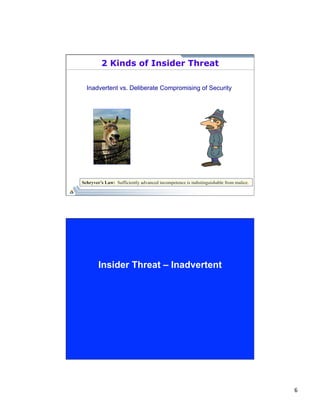
2 Kinds of Insider Threat 
Inadvertent vs. Deliberate Compromising of Security 
Schryver’s Law: Sufficiently advanced incompetence is indistinguishable from malice. 
Insider Threat – Inadvertent
7 
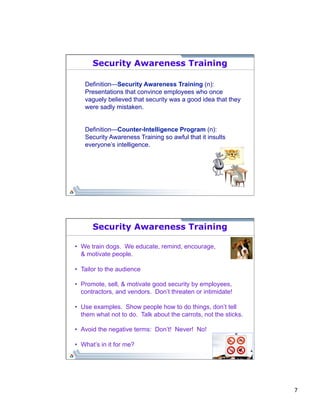
Security Awareness Training 
Definition—Security Awareness Training (n): 
Presentations that convince employees who once 
vaguely believed that security was a good idea that they 
were sadly mistaken. 
Definition—Counter-Intelligence Program (n): 
Security Awareness Training so awful that it insults 
everyone’s intelligence. 
Security Awareness Training 
• We train dogs. We educate, remind, encourage, 
& motivate people. 
• Tailor to the audience 
• Promote, sell, & motivate good security by employees, 
contractors, and vendors. Don’t threaten or intimidate! 
• Use examples. Show people how to do things, don’t tell 
them what not to do. Talk about the carrots, not the sticks. 
• Avoid the negative terms: Don’t! Never! No! 
• What’s in it for me?
8 
Security Awareness Training 
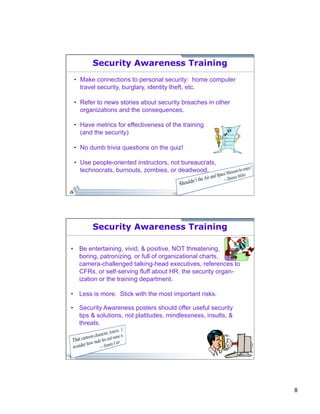
• Make connections to personal security: home computer 
travel security, burglary, identity theft, etc. 
• Refer to news stories about security breaches in other 
organizations and the consequences. 
• Have metrics for effectiveness of the training 
(and the security) 
• No dumb trivia questions on the quiz! 
• Use people-oriented instructors, not bureaucrats, 
technocrats, burnouts, zombies, or deadwood. 
Security Awareness Training 
• Be entertaining, vivid, & positive, NOT threatening, 
boring, patronizing, or full of organizational charts, 
camera-challenged talking-head executives, references to 
CFRs, or self-serving fluff about HR, the security organ-ization 
or the training department. 
• Less is more. Stick with the most important risks. 
• Security Awareness posters should offer useful security 
tips & solutions, not platitudes, mindlessness, insults, & 
threats.
9 
Security Awareness Training 
• Teach about social engineering and that adversaries 
often conduct espionage or intelligence via: 
- industry “surveys” 
- social networking sites 
- bogus headhunters & job interviews 
- phony trade journal interviews 
- hanging out at nearby restaurants/bars 
- public affairs & the graphics department 
- recruiting crafts people & custodians 
- impersonation 
- targeting based on ethnicity, religion, or foreign 
nationality 
Insider Threat – Deliberate
10 
Good Insider Threat Practice 
Ø Publicly prosecute insider offenders 
Ø Avoid the perp walk! 
Ø Pay attention to morale 
Ø Watch employees/contractors/vendors who think they may 
soon be gone 
Ø Treat retired, laid off, and fired personnel well 
Ø Consider using bribery anti-stings 
Countermeasure: Bribery Anti-Stings 
Ø Occasionally test if randomly chosen employees, 
contractors, vendors, consultants, etc. can be bribed. 
Ø Let the person keep the money if he/she rejects and reports the bribe. 
Then widely praise and publicize him/her as a hero. 
Ø Allow at least 2 days for the bribe to be rejected and reported. 
Ø There must be clear, frequently publicized rules about the need to report 
a bribe and exactly how to do it. 
Ø There are legal entrapment issues but the goal is not to fire or arrest 
a lot of people (as in a sting operation), but rather to undercut the 
effectiveness of future bribe attempts by making people think it might be a 
test.
11 
Good Insider Threat Practice 
Ø Periodic background 
checks 
Ø Periodically google & check insiders’ public social media 
Ø Use role-based access control & actively updating it 
Ø Identify/Recruit/Ego-Stroke hacker types and Cassandras 
within the organization 
Ø Watch out for poor drug testing security 
Poor Security for Urine Drug Tests 
It’s easy to tamper with urine test kits. 
Most urine testing programs (government, companies, 
athletes) have very poor security protocols. 
Emphasis has been on false negatives, but 
false positives are equally troubling. 
Serious implications for safety, courts, 
public welfare, national security, fairness, 
careers, livelihood, reputations, sports. 
Journal 
of 
Drug 
Issues 
39, 
1015-­‐1028 
(2009)
12 
Good Insider Threat Practice 
Ø Think about which employees/contractors/positions are 
most likely to be targeted by adversaries for compromise, 
or have the most potentially risky insider access. 
Ø Security professionals need to be the “friendly cop on the 
beat” & pick up scuttlebutt 
Ø Do thorough exit interviews, and interviews with people who 
turn down job offers 
Ø Avoid special treatment for VIPs 
Ø Avoid polygraphs 
Polygraphs = Snake Oil 
National Academy of Sciences $860,000 study: 
“The Polygraph and Lie Detection” (October 2002) 
http://www.nap.edu/books/0309084369/html/ 
Some Conclusions: 
“Polygraph test accuracy may be degraded by countermeasures…” 
“…overconfidence in the polygraph—a belief in its accuracy that goes 
beyond what is justified by the evidence—…presents a danger to national 
security…” 
“Its accuracy in distinguishing actual or potential security violators from 
innocent test takers is insufficient to justify reliance on its use in employee 
security screening…”
13 
Good Insider Threat Practice 
Ø Avoid: Witch Hunts, Spying, Secret Police, Invasions of 
Privacy, Violation of Civil Liberties. (Mind Nietzsche’s 
Admonition: In fighting monsters, be careful not to become 
one yourself!) 
Ø Do effective disgruntlement mitigation. 
Don’t assume managers or HR will automatically 
deal with it, or that it’s not a security issue. 
Disgruntlement Mitigation Blunders 
Employee perceptions are the only reality! 
Ø Phony or non-existent grievance, complaint, & 
conflict resolution processes (Note: if good, 
they’ll be used a lot) 
Ø Phony or non-existent anonymous whistle 
blower program & anonymous tip hot line 
Ø Non-existent, poor, or retaliatory employee 
assistance programs
14 
Disgruntlement Mitigation Blunders 
Ø No identification/constraints on bully bosses 
Ø No constraints on HR tyranny, evil, & 
charlatanism 
Ø Institutional arrogance, insincerity, 
indifference, denial regarding employees 
Ø Emphasis on being “fair” instead 
of treating everybody well 
Ø Not managing expectations (technical personnel 
often have very high expectations) 
The human-resources trade long ago proved itself, at best, a necessary evil—and 
at worst, a dark bureaucratic force that blindly enforces nonsensical rules, resists 
creativity, and impedes constructive change. -- Keith H. Hammonds 
Disgruntlement Mitigation Blunders 
Ø Not being prepared for domestic 
violence coming into the workplace 
Ø Not watching for the usual precursors to 
insider attacks due to disgruntlement, 
especially sudden changes in: 
• hygiene 
• performance 
• rule compliance 
• use of drugs or alcohol 
• signs of aggression or hostility 
• being late for work or a no show 
• not getting along with co-workers
15 
Disgruntlement Mitigation Blunders 
Ø Not recognizing that whatever an employee or 
contactor says is upsetting him/her probably 
isn’t the real issue. 
Ø Ignoring the 80% rule about the importance 
of listening, empathizing, validating, & 
permitting venting. (You don’t have to agree 
with the disgruntled individual.) 
Ø Not trying to fix the problem; not offering 
a consolation prize if you can’t. 
Countermeasures from Psychology
16 
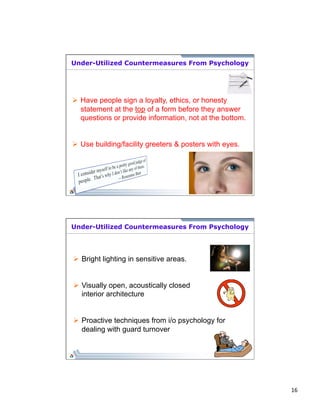
Under-Utilized Countermeasures From Psychology 
Ø Have people sign a loyalty, ethics, or honesty 
statement at the top of a form before they answer 
questions or provide information, not at the bottom. 
Ø Use building/facility greeters & posters with eyes. 
Under-Utilized Countermeasures From Psychology 
Ø Bright lighting in sensitive areas. 
Ø Visually open, acoustically closed 
interior architecture 
Ø Proactive techniques from i/o psychology for 
dealing with guard turnover
17 
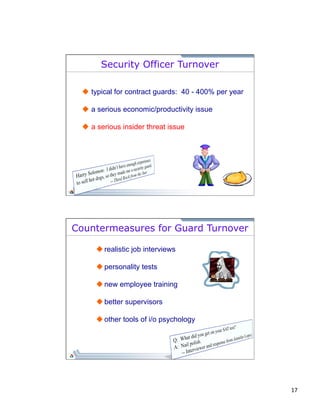
Security Officer Turnover 
u typical for contract guards: 40 - 400% per year 
u a serious economic/productivity issue 
u a serious insider threat issue 
Countermeasures for Guard Turnover 
u realistic job interviews 
u personality tests 
u new employee training 
u better supervisors 
u other tools of i/o psychology
18 
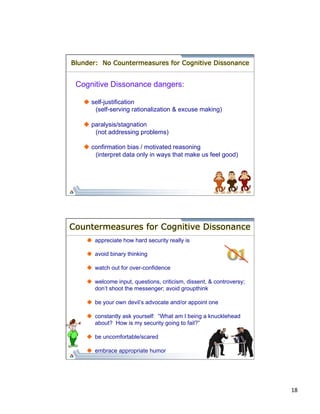
Blunder: No Countermeasures for Cognitive Dissonance 
Cognitive Dissonance dangers: 
u self-justification 
(self-serving rationalization & excuse making) 
u paralysis/stagnation 
(not addressing problems) 
u confirmation bias / motivated reasoning 
(interpret data only in ways that make us feel good) 
Countermeasures for Cognitive Dissonance 
u appreciate how hard security really is 
u avoid binary thinking 
u watch out for over-confidence 
u welcome input, questions, criticism, dissent, & controversy; 
don’t shoot the messenger; avoid groupthink 
u be your own devil’s advocate and/or appoint one 
u constantly ask yourself: “What am I being a knucklehead 
about? How is my security going to fail?” 
u be uncomfortable/scared 
u embrace appropriate humor
19 
Security Theater 
& 
Compliance-Based Security 
Definition 
Security Theater: sham or ceremonial security; 
Measures that ostensibly protect people or assets but 
that actually do little or nothing to counter adversaries.
20 
Security Theater 
1. Best way to spot it is with an effective thorough VA. 
2. Next best is to look for the characteristic attributes: 
• Sense 
of 
urgency 
• A 
very 
difficult 
security 
problem 
• Involves 
fad 
and/or 
pet 
technology 
• Ques;ons, 
concerns, 
& 
dissent 
are 
not 
welcome 
or 
tolerated 
• The 
magic 
security 
device, 
measure, 
or 
program 
has 
lots 
of 
“feel 
good” 
aspects 
to 
it 
• Strong 
emo;on, 
over 
confidence, 
arrogance, 
ego, 
and/or 
pride 
related 
to 
the 
security 
• Conflicts 
of 
interest 
• No 
well-­‐defined 
adversary 
• No 
well-­‐defined 
use 
protocol 
• No 
effec;ve 
VAs; 
no 
devil’s 
advocate 
• The 
technical 
people 
involved 
are 
mostly 
engineers 
• Intense 
desire 
to 
“save 
the 
world” 
leads 
to 
wishful 
thinking 
• People 
who 
know 
li`le 
about 
security 
or 
the 
technology 
are 
in 
charge 
Rule of Thumb 
30% Maxim: In any large organization, at least 30% of 
the security rules, policies, and procedures will be dumb 
or counter productive. 
This includes Security Theater, foolish “one-size-fits-all” 
policies, rules that only the good guys follow, punitive 
practices, and policies that make abstract sense to 
bureaucrats, committees, and higher-ups who lack 
knowledge of real-world issues.
21 
Examples of Compliance Harming Security 
41 
• All 
the 
paperwork, 
bureaucracy, 
data 
recording, 
& 
prepara;on 
for 
audits 
causes 
distrac;ons 
and 
wastes 
resources. 
• Creates 
wrong 
mindset: 
Security 
= 
Busy 
Work; 
Mindless 
rule-­‐following; 
the 
Brass 
are 
responsible 
for 
security 
strategies 
& 
tac;cs, 
not 
me... 
• An 
over-­‐emphasis 
on 
fences 
(4.5 
– 
15 
sec 
delay) 
and 
entry 
points 
leads 
to 
bad 
security. 
• Gran;ng 
access 
to 
numerous 
auditors, 
overseers, 
micro-­‐managers, 
and 
checkers 
of 
the 
checkers 
increases 
the 
insider 
threat. 
• Security 
clearances 
require 
self-­‐repor#ng 
of 
professional 
counseling, 
thus 
discouraging 
it. 
• The 
rules 
require 
overly 
predictable 
guard 
patrols 
& 
shii 
changes. 
• Li`le 
room 
for 
flexibility, 
individual 
ini;a;ve, 
hunches, 
resourcefulness, 
observa;onal 
skills, 
people 
skills. 
Some New Security Paradigms
22 
Compliance-Based Security 
Old Paradigm: 
• Compliance gets us good Security. 
New Paradigm: 
• Compliance—though it may be necessary and can be of value—often causes 
distractions, gets in the way of good Security, or can be incompatible with it. 
The Insider Threat 
Old Paradigm: 
• The insider threat is our employees, mostly the technical and high-level ones. 
New Paradigm: 
• Our insider threat comes from employees, but also contractors, vendors, 
customers, terminated employees, retirees, consultants, service providers, 
crafts people, graphic arts professionals, interns, and spouses/significant 
others. 
• Low-level personnel can be a major threat, too.
23 
Security Training 
Old Paradigm: 
• Security Awareness Training for general employees is for the purpose of 
threatening and intimidating them into compliance. 
New Paradigm: 
• Security Awareness Training seeks to motivate and educate general 
employees about security, and seek their help. 
Security Officer Training 
Old Paradigm: 
• Training for security personnel is mostly about their understanding security 
rules, policies, and procedures. 
• Performance for security personnel is measured by how well they adhere to 
security rules, policies, and procedures. 
New Paradigm: 
• Training for security personnel emphasizes creative “What if?” exercises 
(mental and field practice). 
• Performance for security personnel is measured by how resourcefully they deal 
with day-to-day real-world security issues, and with “What if?” exercises.
24 
Who Does Security 
Old Paradigm: 
• Trained security personnel provide security. 
• Security managers and security consultants are the main experts on Security. 
• Regular employees, contractors, & visitors are the enemies of good security. 
New Paradigm: 
• (The Insider Threat not withstanding) regular employees, contractors, visitors, 
local authorities, and neighbors provide security, with help from trained 
security personnel. 
• Frontline security personnel and regular employees are the main experts on 
local Security. 
Pain & Gain 
Old Paradigm: 
• Security is painful and must inconvenience and hassle employees, 
contractors, & visitors. 
• Hassling is a metric for security effectiveness. 
New Paradigm: 
• Security cannot interfere with productivity any more than necessary. 
• Once Security becomes the enemy of productivity and employees, all is lost 
and the bad guys have partially won. 
• Employee acceptance is one metric for effective Security.
25 
Process, Technology, & People 
Old Paradigm: 
• Process and Technology (in that order) are our main tools for providing 
security. 
New Paradigm: 
• People and Process (in that order) are our main tools (though Technology 
can help). 
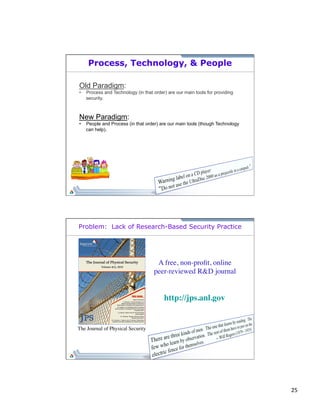
Problem: Lack of Research-Based Security Practice 
The Journal of Physical Security 
A free, non-profit, online 
peer-reviewed R&D journal 
http://jps.anl.gov
26 
Additional information is 
available from: 
rogerj@anl.gov 
and 
For More Information...! 
http://www.ne.anl.gov/capabilities/vat 
http://www.youtube.com/watch?v=frBBGJqkz9E

Insider Threat Mitigation

  • 1.
    1 Talk forthe 58th Annual ASIS Meeting Philadelphia, PA, September 10-13, 2012 Under-Utilized Methods for Mitigating the Insider Threat Roger G. Johnston, Ph.D., CPP Vulnerability Assessment Team Argonne National Laboratory 630-252-6168 rogerj@anl.gov http://www.ne.anl.gov/capabilities/vat Argonne National Laboratory ~$738 million annual budget 1500 acres, 3400 employees, 4400 facility users, 1100 students R&D and technical assistance for government & industry
  • 2.
    2 Vulnerability AssessmentTeam (VAT) Sponsors • DHS • DoD • DOS • IAEA • Euratom • DOE/NNSA • private companies • intelligence agencies • public interest organizations The VAT has done vulnerability assessments on over 1000 different security devices, systems, & programs. The greatest of faults, I should say, is to be conscious of none. -- Thomas Carlyle (1795-1881) A multi-disciplinary team of physicists, engineers, hackers, & social scientists. Check us out on YouTube: keywords = argonne break into Human Factors in Security
  • 3.
    3 What’s Wrongwith This Picture? "While serious, the incident in question was the result of human error, not a failure of security systems. We have a robust system in place to report and investigate potential violations. In my opinion, this is a circumstance where those systems worked well." -- Statement from a high-level government official after a serious security incident Security Culture & Climate • Security Climate (informal perceptions) is probably even more important than Security Culture (formal policies & procedures) • In a healthy security culture/climate: § Everybody is constantly thinking about security. § There are on-the-spot awards for (1) good security practice & (2) proactive/creative thinking and actions. § Security ideas, concerns, questions, suggestions, criticisms are welcome from any quarter. § No scapegoating! § Finding vulnerabilities is viewed as good news.
  • 4.
    4 Examples ofLargely Unstudied Human Factors in Security Ø Two-Person Rule Ø Insider Threat Mitigation Ø Security Culture & Security Climate Ø Identifying Characteristics of Security Theater Ø Countermeasures to Perceptual Blindness, Misdirection, & Sleight-of-Hand Ø Reducing security guard turnover (~40% to 400% per year) Ø Human factors in nuclear safeguards inspections Ø Cognitive psychology of seal and cargo inspection Illuminating Books Relevant to the Human Factor in Security (all fun reads) Ken Perenyi, Caveat Emptor: The Secrete Life of an American Art Forger (2012) G Marcus, Kluge: The Haphazard Construction of the Human Mind (2008) CTravis & E Aronson, Mistakes Were Made (But Not by Me) (2007) BL Katcher & A Snyder, 30 Reasons Employees Hate Their Managers (2007) RL Ackoff & S Rovin, Beating the System: Using Creativity to Outsmart Bureaucracies (2005) K Mitnick & WL Simon, The Art of Intrusion (2005). RJ Sternberg (Editor), Why Smart People Can Be So Stupid (2002)
  • 5.
    5 Insider Threat Mo#va#on for Insider A0acks Countermeasures greed/financial need periodic background checks, bribery an;-­‐s;ng opera;ons revenge disgruntlement mi;ga;on terrorism periodic background checks ideology, poli;cal ac;vism, or radicalism periodic background checks coercion/blackmail periodic background checks social engineering/seduc;on security awareness training narcissism/ego/need to feel important or smart, or to gain recogni#on enlist & stroke egos of hacker types desire to prove that a warned about vulnerability or threat is real (self-­‐iden#fied Cassandras) take security professionals & their concerns seriously; welcome cri;cism desire for excitement make jobs interes;ng? mental illness? periodic background checks? inadvertent compromise of security due to educate, mo;vate, carelessness, error, ignorance, laziness, or arrogance reward, punish, analyze aHtudes to predict problems
  • 6.
    6 2 Kindsof Insider Threat Inadvertent vs. Deliberate Compromising of Security Schryver’s Law: Sufficiently advanced incompetence is indistinguishable from malice. Insider Threat – Inadvertent
  • 7.
    7 Security AwarenessTraining Definition—Security Awareness Training (n): Presentations that convince employees who once vaguely believed that security was a good idea that they were sadly mistaken. Definition—Counter-Intelligence Program (n): Security Awareness Training so awful that it insults everyone’s intelligence. Security Awareness Training • We train dogs. We educate, remind, encourage, & motivate people. • Tailor to the audience • Promote, sell, & motivate good security by employees, contractors, and vendors. Don’t threaten or intimidate! • Use examples. Show people how to do things, don’t tell them what not to do. Talk about the carrots, not the sticks. • Avoid the negative terms: Don’t! Never! No! • What’s in it for me?
  • 8.
    8 Security AwarenessTraining • Make connections to personal security: home computer travel security, burglary, identity theft, etc. • Refer to news stories about security breaches in other organizations and the consequences. • Have metrics for effectiveness of the training (and the security) • No dumb trivia questions on the quiz! • Use people-oriented instructors, not bureaucrats, technocrats, burnouts, zombies, or deadwood. Security Awareness Training • Be entertaining, vivid, & positive, NOT threatening, boring, patronizing, or full of organizational charts, camera-challenged talking-head executives, references to CFRs, or self-serving fluff about HR, the security organ-ization or the training department. • Less is more. Stick with the most important risks. • Security Awareness posters should offer useful security tips & solutions, not platitudes, mindlessness, insults, & threats.
  • 9.
    9 Security AwarenessTraining • Teach about social engineering and that adversaries often conduct espionage or intelligence via: - industry “surveys” - social networking sites - bogus headhunters & job interviews - phony trade journal interviews - hanging out at nearby restaurants/bars - public affairs & the graphics department - recruiting crafts people & custodians - impersonation - targeting based on ethnicity, religion, or foreign nationality Insider Threat – Deliberate
  • 10.
    10 Good InsiderThreat Practice Ø Publicly prosecute insider offenders Ø Avoid the perp walk! Ø Pay attention to morale Ø Watch employees/contractors/vendors who think they may soon be gone Ø Treat retired, laid off, and fired personnel well Ø Consider using bribery anti-stings Countermeasure: Bribery Anti-Stings Ø Occasionally test if randomly chosen employees, contractors, vendors, consultants, etc. can be bribed. Ø Let the person keep the money if he/she rejects and reports the bribe. Then widely praise and publicize him/her as a hero. Ø Allow at least 2 days for the bribe to be rejected and reported. Ø There must be clear, frequently publicized rules about the need to report a bribe and exactly how to do it. Ø There are legal entrapment issues but the goal is not to fire or arrest a lot of people (as in a sting operation), but rather to undercut the effectiveness of future bribe attempts by making people think it might be a test.
  • 11.
    11 Good InsiderThreat Practice Ø Periodic background checks Ø Periodically google & check insiders’ public social media Ø Use role-based access control & actively updating it Ø Identify/Recruit/Ego-Stroke hacker types and Cassandras within the organization Ø Watch out for poor drug testing security Poor Security for Urine Drug Tests It’s easy to tamper with urine test kits. Most urine testing programs (government, companies, athletes) have very poor security protocols. Emphasis has been on false negatives, but false positives are equally troubling. Serious implications for safety, courts, public welfare, national security, fairness, careers, livelihood, reputations, sports. Journal of Drug Issues 39, 1015-­‐1028 (2009)
  • 12.
    12 Good InsiderThreat Practice Ø Think about which employees/contractors/positions are most likely to be targeted by adversaries for compromise, or have the most potentially risky insider access. Ø Security professionals need to be the “friendly cop on the beat” & pick up scuttlebutt Ø Do thorough exit interviews, and interviews with people who turn down job offers Ø Avoid special treatment for VIPs Ø Avoid polygraphs Polygraphs = Snake Oil National Academy of Sciences $860,000 study: “The Polygraph and Lie Detection” (October 2002) http://www.nap.edu/books/0309084369/html/ Some Conclusions: “Polygraph test accuracy may be degraded by countermeasures…” “…overconfidence in the polygraph—a belief in its accuracy that goes beyond what is justified by the evidence—…presents a danger to national security…” “Its accuracy in distinguishing actual or potential security violators from innocent test takers is insufficient to justify reliance on its use in employee security screening…”
  • 13.
    13 Good InsiderThreat Practice Ø Avoid: Witch Hunts, Spying, Secret Police, Invasions of Privacy, Violation of Civil Liberties. (Mind Nietzsche’s Admonition: In fighting monsters, be careful not to become one yourself!) Ø Do effective disgruntlement mitigation. Don’t assume managers or HR will automatically deal with it, or that it’s not a security issue. Disgruntlement Mitigation Blunders Employee perceptions are the only reality! Ø Phony or non-existent grievance, complaint, & conflict resolution processes (Note: if good, they’ll be used a lot) Ø Phony or non-existent anonymous whistle blower program & anonymous tip hot line Ø Non-existent, poor, or retaliatory employee assistance programs
  • 14.
    14 Disgruntlement MitigationBlunders Ø No identification/constraints on bully bosses Ø No constraints on HR tyranny, evil, & charlatanism Ø Institutional arrogance, insincerity, indifference, denial regarding employees Ø Emphasis on being “fair” instead of treating everybody well Ø Not managing expectations (technical personnel often have very high expectations) The human-resources trade long ago proved itself, at best, a necessary evil—and at worst, a dark bureaucratic force that blindly enforces nonsensical rules, resists creativity, and impedes constructive change. -- Keith H. Hammonds Disgruntlement Mitigation Blunders Ø Not being prepared for domestic violence coming into the workplace Ø Not watching for the usual precursors to insider attacks due to disgruntlement, especially sudden changes in: • hygiene • performance • rule compliance • use of drugs or alcohol • signs of aggression or hostility • being late for work or a no show • not getting along with co-workers
  • 15.
    15 Disgruntlement MitigationBlunders Ø Not recognizing that whatever an employee or contactor says is upsetting him/her probably isn’t the real issue. Ø Ignoring the 80% rule about the importance of listening, empathizing, validating, & permitting venting. (You don’t have to agree with the disgruntled individual.) Ø Not trying to fix the problem; not offering a consolation prize if you can’t. Countermeasures from Psychology
  • 16.
    16 Under-Utilized CountermeasuresFrom Psychology Ø Have people sign a loyalty, ethics, or honesty statement at the top of a form before they answer questions or provide information, not at the bottom. Ø Use building/facility greeters & posters with eyes. Under-Utilized Countermeasures From Psychology Ø Bright lighting in sensitive areas. Ø Visually open, acoustically closed interior architecture Ø Proactive techniques from i/o psychology for dealing with guard turnover
  • 17.
    17 Security OfficerTurnover u typical for contract guards: 40 - 400% per year u a serious economic/productivity issue u a serious insider threat issue Countermeasures for Guard Turnover u realistic job interviews u personality tests u new employee training u better supervisors u other tools of i/o psychology
  • 18.
    18 Blunder: NoCountermeasures for Cognitive Dissonance Cognitive Dissonance dangers: u self-justification (self-serving rationalization & excuse making) u paralysis/stagnation (not addressing problems) u confirmation bias / motivated reasoning (interpret data only in ways that make us feel good) Countermeasures for Cognitive Dissonance u appreciate how hard security really is u avoid binary thinking u watch out for over-confidence u welcome input, questions, criticism, dissent, & controversy; don’t shoot the messenger; avoid groupthink u be your own devil’s advocate and/or appoint one u constantly ask yourself: “What am I being a knucklehead about? How is my security going to fail?” u be uncomfortable/scared u embrace appropriate humor
  • 19.
    19 Security Theater & Compliance-Based Security Definition Security Theater: sham or ceremonial security; Measures that ostensibly protect people or assets but that actually do little or nothing to counter adversaries.
  • 20.
    20 Security Theater 1. Best way to spot it is with an effective thorough VA. 2. Next best is to look for the characteristic attributes: • Sense of urgency • A very difficult security problem • Involves fad and/or pet technology • Ques;ons, concerns, & dissent are not welcome or tolerated • The magic security device, measure, or program has lots of “feel good” aspects to it • Strong emo;on, over confidence, arrogance, ego, and/or pride related to the security • Conflicts of interest • No well-­‐defined adversary • No well-­‐defined use protocol • No effec;ve VAs; no devil’s advocate • The technical people involved are mostly engineers • Intense desire to “save the world” leads to wishful thinking • People who know li`le about security or the technology are in charge Rule of Thumb 30% Maxim: In any large organization, at least 30% of the security rules, policies, and procedures will be dumb or counter productive. This includes Security Theater, foolish “one-size-fits-all” policies, rules that only the good guys follow, punitive practices, and policies that make abstract sense to bureaucrats, committees, and higher-ups who lack knowledge of real-world issues.
  • 21.
    21 Examples ofCompliance Harming Security 41 • All the paperwork, bureaucracy, data recording, & prepara;on for audits causes distrac;ons and wastes resources. • Creates wrong mindset: Security = Busy Work; Mindless rule-­‐following; the Brass are responsible for security strategies & tac;cs, not me... • An over-­‐emphasis on fences (4.5 – 15 sec delay) and entry points leads to bad security. • Gran;ng access to numerous auditors, overseers, micro-­‐managers, and checkers of the checkers increases the insider threat. • Security clearances require self-­‐repor#ng of professional counseling, thus discouraging it. • The rules require overly predictable guard patrols & shii changes. • Li`le room for flexibility, individual ini;a;ve, hunches, resourcefulness, observa;onal skills, people skills. Some New Security Paradigms
  • 22.
    22 Compliance-Based Security Old Paradigm: • Compliance gets us good Security. New Paradigm: • Compliance—though it may be necessary and can be of value—often causes distractions, gets in the way of good Security, or can be incompatible with it. The Insider Threat Old Paradigm: • The insider threat is our employees, mostly the technical and high-level ones. New Paradigm: • Our insider threat comes from employees, but also contractors, vendors, customers, terminated employees, retirees, consultants, service providers, crafts people, graphic arts professionals, interns, and spouses/significant others. • Low-level personnel can be a major threat, too.
  • 23.
    23 Security Training Old Paradigm: • Security Awareness Training for general employees is for the purpose of threatening and intimidating them into compliance. New Paradigm: • Security Awareness Training seeks to motivate and educate general employees about security, and seek their help. Security Officer Training Old Paradigm: • Training for security personnel is mostly about their understanding security rules, policies, and procedures. • Performance for security personnel is measured by how well they adhere to security rules, policies, and procedures. New Paradigm: • Training for security personnel emphasizes creative “What if?” exercises (mental and field practice). • Performance for security personnel is measured by how resourcefully they deal with day-to-day real-world security issues, and with “What if?” exercises.
  • 24.
    24 Who DoesSecurity Old Paradigm: • Trained security personnel provide security. • Security managers and security consultants are the main experts on Security. • Regular employees, contractors, & visitors are the enemies of good security. New Paradigm: • (The Insider Threat not withstanding) regular employees, contractors, visitors, local authorities, and neighbors provide security, with help from trained security personnel. • Frontline security personnel and regular employees are the main experts on local Security. Pain & Gain Old Paradigm: • Security is painful and must inconvenience and hassle employees, contractors, & visitors. • Hassling is a metric for security effectiveness. New Paradigm: • Security cannot interfere with productivity any more than necessary. • Once Security becomes the enemy of productivity and employees, all is lost and the bad guys have partially won. • Employee acceptance is one metric for effective Security.
  • 25.
    25 Process, Technology,& People Old Paradigm: • Process and Technology (in that order) are our main tools for providing security. New Paradigm: • People and Process (in that order) are our main tools (though Technology can help). Problem: Lack of Research-Based Security Practice The Journal of Physical Security A free, non-profit, online peer-reviewed R&D journal http://jps.anl.gov
  • 26.
    26 Additional informationis available from: rogerj@anl.gov and For More Information...! http://www.ne.anl.gov/capabilities/vat http://www.youtube.com/watch?v=frBBGJqkz9E