MAGMA AND ITS COMPOSITION
Magma is the molten rock which lies underneath
volcanoes. It is formed at destructive plate
boundaries and is rich in silicate. These are
products of crustal rocks (which are richer in silica
than the rock of the mantle).
Crystal Content
Some magmas begin to crystallize as they reach the surface.
High temperature minerals are formed as magma slowly cools
down followed by low temperature minerals. Magma always
contains crystals of high temperature.
Viscosity
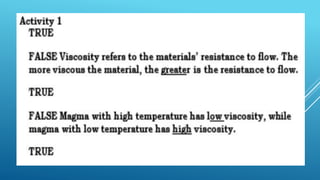
The magma’s silica content affects its viscosity, the resistance
of the fluid to flow. Low viscosity magma has low silica
content and is composed mostly of basalt. While magma with
rhyolite is viscous or high in viscosity due to its high silica
content. Temperature also affects the viscosity of the magma.
Magma with high temperatures have low viscosity while
magma with low temperatures have high viscosity.
Temperature
Temperature of magma reflects the melting points of their
mineral components. Magmas formed by partial melting of
mantle rocks are much hotter over 1200⁰C for some basalts.
Rhyolites that reached the surface have temperature of less
than 900⁰C, and have a much higher viscosity.
Volatile Content
Magma contains small amounts of dissolved gas (water
vapor, Carbon dioxide, etc.) which is released as pressure is
removed. Magmas formed by melting of mantle rocks have
generally low volatile contents, but those formed by partial
melting of crustal rocks are often volatile-rich.
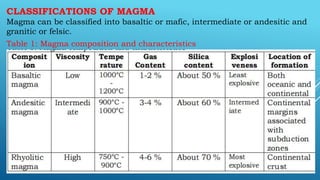
CLASSIFICATIONS OF MAGMA
Magma can be classified into basaltic or mafic, intermediate or andesitic and
granitic or felsic.
Table 1: Magma composition and characteristics
PROCESS OF VOLCANIC ERUPTION
High temperature inside the Earth melts the solid rocks in the mantle and
turns it into a thick molten mixture commonly known as magma. The
continuous melting of solid rocks and accumulation of additional magma
push it to the vent of a volcano, called magma chamber. Magma contains
dissolved gases mostly water vapor, carbon dioxide, and sulfur dioxide. As
dissolved gases are released from the magma, bubbles will begin to form
through the process called vesiculation. This can occur by decompression or
crystallization. In decompression, the confining pressure is lowered when
magma rises which promotes bubble formation. This process is similar to
bubble formation in soda bottles when opened. In the process of
crystallization of anhydrous minerals, the vapor pressure of the residual
liquid of the cooling magma increases leading to vesiculation. Bubbles frozen
in a porous or frothy volcanic rock are called vesicles. Both decompression
and crystallization can trigger an explosive eruption. As the magma reaches
the Earth’s surface it explodes due to the presence of dissolved gases. The
type of explosion of a volcano is dependent on the composition of magma.
VOLCANIC HAZARDS AND THEIR EFFECTS
Volcanic hazards are phenomena arising from volcanic activity that poses
potential threat to people and property. During major explosive eruptions,
large amounts of volcanic gas, aerosol droplets, and ash are injected into
the stratosphere. Tephra or fragmented volcanic debris are violently ejected
into the atmosphere and can extend to tens of kilometers above
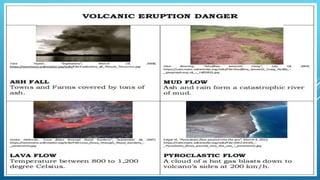
 Ash fall – pulverized rocks, sand, gritty and harsh glasses shoot out in
the air by volcano.
 Mud flow – mixture of water, molten rocks and debris flowing down from
the side of volcano to the ground. It is also called as Lahar.
 Lava flow – streams of molten rocks and other fragmented materials
emitted by erupting volcano.
 Pyroclastic flow – fast moving hot mixtures of gas, ash, and molten rocks
moving away from the volcano to the ground.
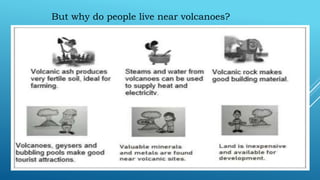
But why do people live near volcanoes?
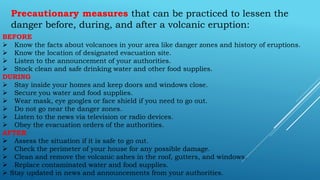
Precautionary measures that can be practiced to lessen the
danger before, during, and after a volcanic eruption:
BEFORE
 Know the facts about volcanoes in your area like danger zones and history of eruptions.
 Know the location of designated evacuation site.
 Listen to the announcement of your authorities.
 Stock clean and safe drinking water and other food supplies.
DURING
 Stay inside your homes and keep doors and windows close.
 Secure you water and food supplies.
 Wear mask, eye googles or face shield if you need to go out.
 Do not go near the danger zones.
 Listen to the news via television or radio devices.
 Obey the evacuation orders of the authorities.
AFTER
 Assess the situation if it is safe to go out.
 Check the perimeter of your house for any possible damage.
 Clean and remove the volcanic ashes in the roof, gutters, and windows.
 Replace contaminated water and food supplies.
 Stay updated in news and announcements from your authorities.
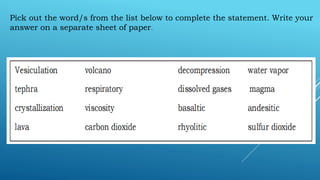
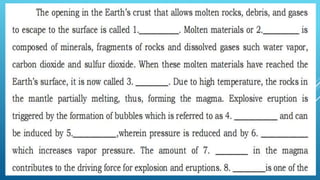
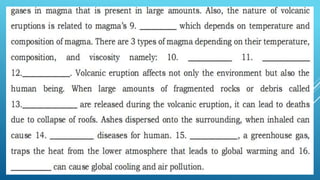
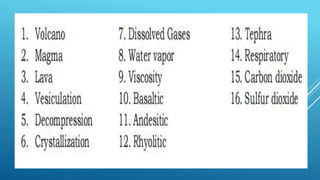
Pick out the word/s from the list below to complete the statement. Write your
answer on a separate sheet of paper.
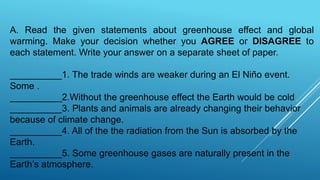
A. Read the given statements about greenhouse effect and global
warming. Make your decision whether you AGREE or DISAGREE to
each statement. Write your answer on a separate sheet of paper.
__________1. The trade winds are weaker during an El Niño event.
Some .
__________2.Without the greenhouse effect the Earth would be cold
__________3. Plants and animals are already changing their behavior
because of climate change.
__________4. All of the the radiation from the Sun is absorbed by the
Earth.
__________5. Some greenhouse gases are naturally present in the
Earth’s atmosphere.
Read each statement and classify whether it describes La Niña or El
Niño. Write LN for La Niña and EN for El Niño.
6. The episodes of ocean warming that affect the eastern tropical
Pacific.
7. A powerful climate change that occurs about every two to seven
years.
8. It can cause wild weather on the west coast and strong winds over
the Pacific Ocean, violent typhoons, rainstorms, and floods.
9. It occurs when the ocean waters are cooler than normal.
10. The episode when winds push from east to west resulting to
a wetter weather to the Pacific region.

MAGMA-AND-ITS-COMPOSITION for grade nine

  • 1.
    MAGMA AND ITSCOMPOSITION Magma is the molten rock which lies underneath volcanoes. It is formed at destructive plate boundaries and is rich in silicate. These are products of crustal rocks (which are richer in silica than the rock of the mantle).
  • 2.
    Crystal Content Some magmasbegin to crystallize as they reach the surface. High temperature minerals are formed as magma slowly cools down followed by low temperature minerals. Magma always contains crystals of high temperature. Viscosity The magma’s silica content affects its viscosity, the resistance of the fluid to flow. Low viscosity magma has low silica content and is composed mostly of basalt. While magma with rhyolite is viscous or high in viscosity due to its high silica content. Temperature also affects the viscosity of the magma. Magma with high temperatures have low viscosity while magma with low temperatures have high viscosity.
  • 3.
    Temperature Temperature of magmareflects the melting points of their mineral components. Magmas formed by partial melting of mantle rocks are much hotter over 1200⁰C for some basalts. Rhyolites that reached the surface have temperature of less than 900⁰C, and have a much higher viscosity. Volatile Content Magma contains small amounts of dissolved gas (water vapor, Carbon dioxide, etc.) which is released as pressure is removed. Magmas formed by melting of mantle rocks have generally low volatile contents, but those formed by partial melting of crustal rocks are often volatile-rich.
  • 4.
    CLASSIFICATIONS OF MAGMA Magmacan be classified into basaltic or mafic, intermediate or andesitic and granitic or felsic. Table 1: Magma composition and characteristics
  • 5.
    PROCESS OF VOLCANICERUPTION High temperature inside the Earth melts the solid rocks in the mantle and turns it into a thick molten mixture commonly known as magma. The continuous melting of solid rocks and accumulation of additional magma push it to the vent of a volcano, called magma chamber. Magma contains dissolved gases mostly water vapor, carbon dioxide, and sulfur dioxide. As dissolved gases are released from the magma, bubbles will begin to form through the process called vesiculation. This can occur by decompression or crystallization. In decompression, the confining pressure is lowered when magma rises which promotes bubble formation. This process is similar to bubble formation in soda bottles when opened. In the process of crystallization of anhydrous minerals, the vapor pressure of the residual liquid of the cooling magma increases leading to vesiculation. Bubbles frozen in a porous or frothy volcanic rock are called vesicles. Both decompression and crystallization can trigger an explosive eruption. As the magma reaches the Earth’s surface it explodes due to the presence of dissolved gases. The type of explosion of a volcano is dependent on the composition of magma.
  • 6.
    VOLCANIC HAZARDS ANDTHEIR EFFECTS Volcanic hazards are phenomena arising from volcanic activity that poses potential threat to people and property. During major explosive eruptions, large amounts of volcanic gas, aerosol droplets, and ash are injected into the stratosphere. Tephra or fragmented volcanic debris are violently ejected into the atmosphere and can extend to tens of kilometers above  Ash fall – pulverized rocks, sand, gritty and harsh glasses shoot out in the air by volcano.  Mud flow – mixture of water, molten rocks and debris flowing down from the side of volcano to the ground. It is also called as Lahar.  Lava flow – streams of molten rocks and other fragmented materials emitted by erupting volcano.  Pyroclastic flow – fast moving hot mixtures of gas, ash, and molten rocks moving away from the volcano to the ground.
  • 8.
    But why dopeople live near volcanoes?
  • 9.
    Precautionary measures thatcan be practiced to lessen the danger before, during, and after a volcanic eruption: BEFORE  Know the facts about volcanoes in your area like danger zones and history of eruptions.  Know the location of designated evacuation site.  Listen to the announcement of your authorities.  Stock clean and safe drinking water and other food supplies. DURING  Stay inside your homes and keep doors and windows close.  Secure you water and food supplies.  Wear mask, eye googles or face shield if you need to go out.  Do not go near the danger zones.  Listen to the news via television or radio devices.  Obey the evacuation orders of the authorities. AFTER  Assess the situation if it is safe to go out.  Check the perimeter of your house for any possible damage.  Clean and remove the volcanic ashes in the roof, gutters, and windows.  Replace contaminated water and food supplies.  Stay updated in news and announcements from your authorities.
  • 11.
    Pick out theword/s from the list below to complete the statement. Write your answer on a separate sheet of paper.
  • 16.
    A. Read thegiven statements about greenhouse effect and global warming. Make your decision whether you AGREE or DISAGREE to each statement. Write your answer on a separate sheet of paper. __________1. The trade winds are weaker during an El Niño event. Some . __________2.Without the greenhouse effect the Earth would be cold __________3. Plants and animals are already changing their behavior because of climate change. __________4. All of the the radiation from the Sun is absorbed by the Earth. __________5. Some greenhouse gases are naturally present in the Earth’s atmosphere.
  • 17.
    Read each statementand classify whether it describes La Niña or El Niño. Write LN for La Niña and EN for El Niño. 6. The episodes of ocean warming that affect the eastern tropical Pacific. 7. A powerful climate change that occurs about every two to seven years. 8. It can cause wild weather on the west coast and strong winds over the Pacific Ocean, violent typhoons, rainstorms, and floods. 9. It occurs when the ocean waters are cooler than normal. 10. The episode when winds push from east to west resulting to a wetter weather to the Pacific region.