A  PRESENTATION  ON
CONTENTS :
INTRODUCTION :
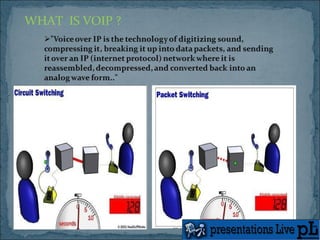
WHAT  IS VOIP ?
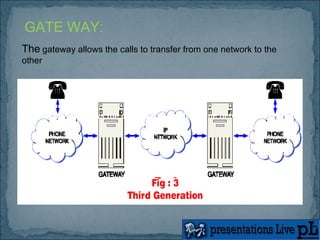
GATE WAY: The gateway allows the calls to transfer from one network to the other The gateway allows the calls to transfer from one network to the other The gateway allows the calls to transfer from one network to the other The gateway allows the calls to transfer from one network to the other The gateway allows the calls to transfer from one network to the other The   gateway allows the calls to transfer from one network to the other
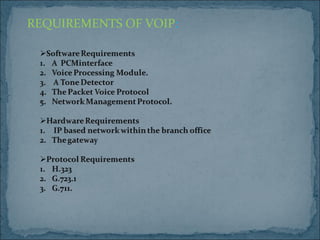
REQUIREMENTS OF VOIP :
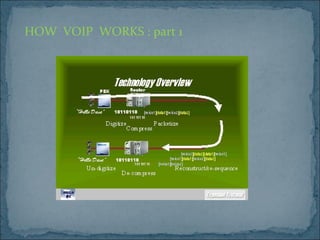
HOW  VOIP  WORKS : part 1
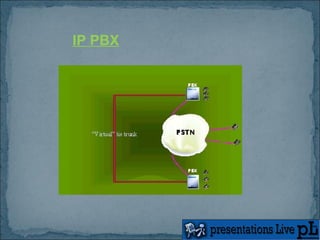
IP PBX
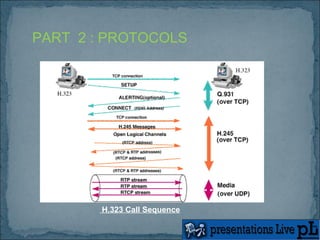
PART  2 : PROTOCOLS H.323 Call Sequence
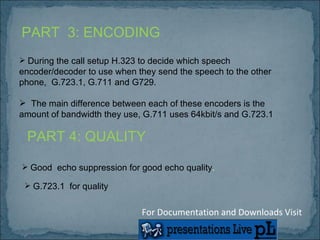
PART  3: ENCODING During the call setup H.323 to decide which speech encoder/decoder to use when they send the speech to the other phone,  G.723.1, G.711 and G729.  The main difference between each of these encoders is the amount of bandwidth they use, G.711 uses 64kbit/s and G.723.1 PART 4: QUALITY Good  echo suppression for good echo quality . G.723.1  for quality For Documentation and Downloads Visit
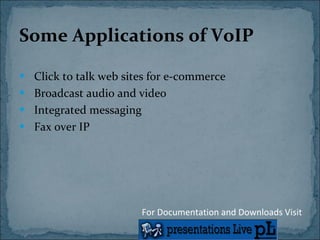
Some Applications of VoIP Click to talk web sites for e-commerce Broadcast audio and video Integrated messaging Fax over IP For Documentation and Downloads Visit
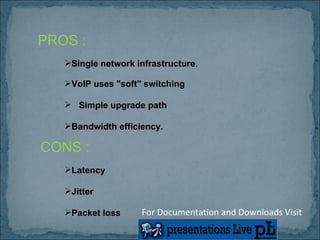
PROS : Single network infrastructure . VoIP uses "soft" switching   Simple upgrade path Bandwidth efficiency.   CONS : Latency  Jitter Packet loss  For Documentation and Downloads Visit
Without a doubt, the data revolution will only gain momentum in the coming years, with more and more voice traffic moving onto data networks. Vendors of voice equipment will continue to develop integrated voice and data devices based on packetized technology. Users with ubiquitous voice and data service integrated over one universal infrastructure will benefit from true, seamless, transparent interworking between voice and all types of data.  CONCLUSION : For Documentation and Downloads Visit
REFRENCES: Computer Networks by Andrew S.Tanenbaum Internetworking with TCP/IP by Douglas E.comer www.iec.org.com www.telogy.com www.rad.com www.mailto:blazer@gslis.utexas.edu For Documentation and Downloads Visit
THANK YOU For Documentation and Downloads Visit
ANY QUERIES

VOIP

  • 1.
  • 2.
  • 3.
  • 4.
    WHAT ISVOIP ?
  • 5.
    GATE WAY: Thegateway allows the calls to transfer from one network to the other The gateway allows the calls to transfer from one network to the other The gateway allows the calls to transfer from one network to the other The gateway allows the calls to transfer from one network to the other The gateway allows the calls to transfer from one network to the other The gateway allows the calls to transfer from one network to the other
  • 6.
  • 7.
    HOW VOIP WORKS : part 1
  • 8.
  • 9.
    PART 2: PROTOCOLS H.323 Call Sequence
  • 10.
    PART 3:ENCODING During the call setup H.323 to decide which speech encoder/decoder to use when they send the speech to the other phone, G.723.1, G.711 and G729. The main difference between each of these encoders is the amount of bandwidth they use, G.711 uses 64kbit/s and G.723.1 PART 4: QUALITY Good echo suppression for good echo quality . G.723.1 for quality For Documentation and Downloads Visit
  • 11.
    Some Applications ofVoIP Click to talk web sites for e-commerce Broadcast audio and video Integrated messaging Fax over IP For Documentation and Downloads Visit
  • 12.
    PROS : Singlenetwork infrastructure . VoIP uses "soft" switching Simple upgrade path Bandwidth efficiency. CONS : Latency Jitter Packet loss For Documentation and Downloads Visit
  • 13.
    Without a doubt,the data revolution will only gain momentum in the coming years, with more and more voice traffic moving onto data networks. Vendors of voice equipment will continue to develop integrated voice and data devices based on packetized technology. Users with ubiquitous voice and data service integrated over one universal infrastructure will benefit from true, seamless, transparent interworking between voice and all types of data. CONCLUSION : For Documentation and Downloads Visit
  • 14.
    REFRENCES: Computer Networksby Andrew S.Tanenbaum Internetworking with TCP/IP by Douglas E.comer www.iec.org.com www.telogy.com www.rad.com www.mailto:blazer@gslis.utexas.edu For Documentation and Downloads Visit
  • 15.
    THANK YOU ForDocumentation and Downloads Visit
  • 16.