International Research Journal of Engineering and Technology (IRJET) e-ISSN: 2395 -0056
Volume: 04 Issue: 02 | Feb -2017 www.irjet.net p-ISSN: 2395-0072
© 2017, IRJET | Impact Factor value: 5.181 | ISO 9001:2008 Certified Journal | Page 1671
Voice Recognition Eye Test
Madhavi Priya
1Student, Dept. of Electronics & Communication Engineering, Dronacharya group of institution, India
---------------------------------------------------------------------***---------------------------------------------------------------------
Abstract - In this paper, an attempt has been made to
review on design of voice recognition eyetestthatiscapableof
performing the entire eye test on its own. This project
attempted to design and implementavoicerecognitionsystem
that would identify different users based on previously stored
voice samples. Each user inputs audio samples withakeyword
of his or her choice. This input was gathered but successful
processing to extract meaningful spectral coefficients wasnot
achieved. These coefficients were tobestoredinadatabase for
later comparison with future audio inputs. Afterwards, the
system had to capture an input from any user and match its
spectral coefficients to all previously stored coefficientsonthe
database, in order to identify the unknown speaker.
Key Words: Recognition, Eye, Design, Database,
Processing
1. INTRODUCTION
It starts by displaying large letters and waits on the
user to guess which letter has beendisplayed.Theuser
speaks his/her guess into the microphone. The speech
recognition portion uses energy threshold to make
sure background noise does not interfere with the
user's guess. The system will then determine the next
step based on whether the user guessed the displayed
letter correctly or not. If the user guesses enough
correctly, the text size will continue getting smaller
until the user either reaches the minimum text size
(corresponding to 20/20) or starts guessing enough
incorrectly. If the user guesses too many letters
incorrectly, the system will display the result
corresponding to the current textsize(e.g.20/30).The
thresholds for amount guessed and amount guessed
correctly are set in the code. Our eye test uses a
dictionary containing the letters "A", "E", "I", "R", and
"L" with the same 6 possible text sizes for each ofthese
letters.
1.1 High Level Design
Rationale
The idea is that we want to bring the common Snellen
eye test to the household. Thetestisverysimpleinthat
it requires the user to stand a distance away from a
chart and readletterstoestimateone'svisualacuity.So
we thought, why not bring the test from the eye
doctor's office to the household? In this way, people
can take the initiative in taking care of their health in a
way that does not requirehavingtodriveoverandwait
until it is their turn to complete the test which, in the
end, takes a fraction of the time spent driving and
waiting. Also, this can reduce the time it takes to
receive a proper diagnosis for one's eyesightwhenone
visits the doctor after having taking the household
exam. Also, our eye test could be used in the doctor's
office to streamline the process of determining a
person's visual acuity since so many of these tests are
performed each day
1.2 BPF Design
The range of spoken frequencies is 300 Hz to 3400 Hz.
This means we onlyneedtoworryaboutfrequenciesin
that range, so we can filter out the rest. We set up our
band-pass filter and determined the resistance and
capacitance values according to the cutoff frequency
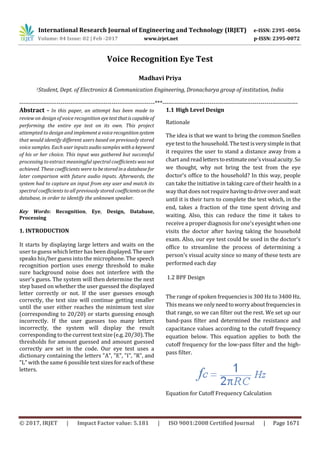
equation below. This equation applies to both the
cutoff frequency for the low-pass filter and the high-
pass filter.
Equation for Cutoff Frequency Calculation
International Research Journal of Engineering and Technology (IRJET) e-ISSN: 2395 -0056
Volume: 04 Issue: 02 | Feb -2017 www.irjet.net p-ISSN: 2395-0072
© 2017, IRJET | Impact Factor value: 5.181 | ISO 9001:2008 Certified Journal | Page 1672
In the above equation, we chose R1 = 5.1kΩ and C1 =
96.2nF for the low-pass filter, while R2 = 326Ω and C2
= 169.6nF for the high-pass filter. Under this setup, the
actual cutoff frequencies are 324Hz and 3058Hz
respectively.
We also set up our band-pass filter amplifier to have a
proper gain and DC bias. This is because the output of
our microphone circuit is inputted into the ADC of the
PIC32, which expects an input in the range of 0 to 3.3V
so that the ADC can gain more accuracy. We spoke into
the microphone and determined its output alone to be
in the range of ±13mV. The equation for the gain
calculation is simply: Gain = Rg/R2. As a result, we set
Rg = 437kΩ to obtain a gain of 1340 so thatthecircuit's
output could be in the proper range for the ADC. Some
graphs of our band-pass filters output can be found in
the appendix. We have a voltage divider applied to the
microphone signal to provide a Vdd/2 DC bias before
serving as input to the band-pass filter.
Fig.1. Band-Pass Filter Circuit
2. LOGICAL STRUCTURE
The overall structure of how our speech recognition eyetest
is implemented is shown in the below figure. Our lab starts
by displaying a large letter. Then, the user speaks into the
microphone system(microphone,filtersandamplifiers).The
output of the microphone system is inputted into the PIC32
and sampled at a rate of 8 kHz. The PIC32 stores thefirstand
last 256 samples in two separate arrays. These arrays are
then passed into an FFT to switch from thetime-domain into
the frequency domain. Then, a Mel transform is applied to
the FFT results to average the frequencies into 10 bins.
These bins are then sorted, along with their corresponding
indices. The indices are then compared to the dictionary to
see which letter in the dictionarymostcloselymatchesto the
spoken letter. Once the spoken letterhasbeendetermined,it
is inputted into the FSM used for our vision test. The FSM
will then determine if it is ready to print the results to the
TFT for the user to see or if it needs to display a new letter
and repeat the process in order to get more information
from the user.
Fig -2: Logical Structure Of Voice Recognition Eye Test
Our eye test works using the standard approach of
determining how accurate someone's vision is 20 ft away
from the display compared to what the average person can
see at 20 ft away. We refer to the Snellen eye chart to help
determine the formula for a person's eyesight. We also had
to choose text sizes on the PIC32 that closely line up to the
proper proportions for the Eye chart.
Using our project, a person could perform the Snellen eye
test without the need to leave their house. The results could
then be stored and even printed to a computer. If a doctor is
familiar with the project, he could then use the data to
conduct further eyesight testing instead of spending time
needing to measure the person's eyesight. Of course, the
Snellen eye test should only serve as a guiding tool for one's
eye care and one should always consult with the eye doctor
for further concerns.
2.1. Integration Of Hardware And Software
A majority of our code was software based, which meant
integrating the hardware and software together did not
require much since there was very little hardware. We
simply needed to connect the TFT to the PIC32 and the
output of the microphone circuit to the ADC of the PIC32.
3. CONCLUSIONS
The results show reasonably good success in
recognizing continuous speech from various speakers,
for a large vocabulary. The different modules were
analyzed in their respective domains and were
successfully verified for different speech input files.
The obtained results can be improved by fine tuning
the system with larger training databases. The next
International Research Journal of Engineering and Technology (IRJET) e-ISSN: 2395 -0056
Volume: 04 Issue: 02 | Feb -2017 www.irjet.net p-ISSN: 2395-0072
© 2017, IRJET | Impact Factor value: 5.181 | ISO 9001:2008 Certified Journal | Page 1673
step would be to recognize live speech, which would
require more resources including larger speech
databases, acoustic models and exhaustive
vocabularies to produce good recognition results
REFERENCES
[1] Geoffrey Z, Picheny M (2004) Advances in large
vocabulary continuous speech recognition.AdvComput
60:249–291
[2] Carlson R (2002) Dialogue system. Slide presentation,
speech technology, GSLT,Göteborg,23Oct2002. http://
www.speech.kth.se/~rolf/gslt/GSLT021023_dialogue.
pdf
[3] Rolf C, Granström B (1997) Speech synthesis. In:
Hardcastle WJ, Laver J (eds) The handbook of phonetic
sciences. Blackwell Publishers Ltd, Oxford.
[4] He X, Deng L, Wu C (2008) Discriminative learning in
sequential pattern recognition. IEEE Signal ProcessMag
25(5):14–36

Voice Recognition Eye Test

  • 1.
    International Research Journalof Engineering and Technology (IRJET) e-ISSN: 2395 -0056 Volume: 04 Issue: 02 | Feb -2017 www.irjet.net p-ISSN: 2395-0072 © 2017, IRJET | Impact Factor value: 5.181 | ISO 9001:2008 Certified Journal | Page 1671 Voice Recognition Eye Test Madhavi Priya 1Student, Dept. of Electronics & Communication Engineering, Dronacharya group of institution, India ---------------------------------------------------------------------***--------------------------------------------------------------------- Abstract - In this paper, an attempt has been made to review on design of voice recognition eyetestthatiscapableof performing the entire eye test on its own. This project attempted to design and implementavoicerecognitionsystem that would identify different users based on previously stored voice samples. Each user inputs audio samples withakeyword of his or her choice. This input was gathered but successful processing to extract meaningful spectral coefficients wasnot achieved. These coefficients were tobestoredinadatabase for later comparison with future audio inputs. Afterwards, the system had to capture an input from any user and match its spectral coefficients to all previously stored coefficientsonthe database, in order to identify the unknown speaker. Key Words: Recognition, Eye, Design, Database, Processing 1. INTRODUCTION It starts by displaying large letters and waits on the user to guess which letter has beendisplayed.Theuser speaks his/her guess into the microphone. The speech recognition portion uses energy threshold to make sure background noise does not interfere with the user's guess. The system will then determine the next step based on whether the user guessed the displayed letter correctly or not. If the user guesses enough correctly, the text size will continue getting smaller until the user either reaches the minimum text size (corresponding to 20/20) or starts guessing enough incorrectly. If the user guesses too many letters incorrectly, the system will display the result corresponding to the current textsize(e.g.20/30).The thresholds for amount guessed and amount guessed correctly are set in the code. Our eye test uses a dictionary containing the letters "A", "E", "I", "R", and "L" with the same 6 possible text sizes for each ofthese letters. 1.1 High Level Design Rationale The idea is that we want to bring the common Snellen eye test to the household. Thetestisverysimpleinthat it requires the user to stand a distance away from a chart and readletterstoestimateone'svisualacuity.So we thought, why not bring the test from the eye doctor's office to the household? In this way, people can take the initiative in taking care of their health in a way that does not requirehavingtodriveoverandwait until it is their turn to complete the test which, in the end, takes a fraction of the time spent driving and waiting. Also, this can reduce the time it takes to receive a proper diagnosis for one's eyesightwhenone visits the doctor after having taking the household exam. Also, our eye test could be used in the doctor's office to streamline the process of determining a person's visual acuity since so many of these tests are performed each day 1.2 BPF Design The range of spoken frequencies is 300 Hz to 3400 Hz. This means we onlyneedtoworryaboutfrequenciesin that range, so we can filter out the rest. We set up our band-pass filter and determined the resistance and capacitance values according to the cutoff frequency equation below. This equation applies to both the cutoff frequency for the low-pass filter and the high- pass filter. Equation for Cutoff Frequency Calculation
  • 2.
    International Research Journalof Engineering and Technology (IRJET) e-ISSN: 2395 -0056 Volume: 04 Issue: 02 | Feb -2017 www.irjet.net p-ISSN: 2395-0072 © 2017, IRJET | Impact Factor value: 5.181 | ISO 9001:2008 Certified Journal | Page 1672 In the above equation, we chose R1 = 5.1kΩ and C1 = 96.2nF for the low-pass filter, while R2 = 326Ω and C2 = 169.6nF for the high-pass filter. Under this setup, the actual cutoff frequencies are 324Hz and 3058Hz respectively. We also set up our band-pass filter amplifier to have a proper gain and DC bias. This is because the output of our microphone circuit is inputted into the ADC of the PIC32, which expects an input in the range of 0 to 3.3V so that the ADC can gain more accuracy. We spoke into the microphone and determined its output alone to be in the range of ±13mV. The equation for the gain calculation is simply: Gain = Rg/R2. As a result, we set Rg = 437kΩ to obtain a gain of 1340 so thatthecircuit's output could be in the proper range for the ADC. Some graphs of our band-pass filters output can be found in the appendix. We have a voltage divider applied to the microphone signal to provide a Vdd/2 DC bias before serving as input to the band-pass filter. Fig.1. Band-Pass Filter Circuit 2. LOGICAL STRUCTURE The overall structure of how our speech recognition eyetest is implemented is shown in the below figure. Our lab starts by displaying a large letter. Then, the user speaks into the microphone system(microphone,filtersandamplifiers).The output of the microphone system is inputted into the PIC32 and sampled at a rate of 8 kHz. The PIC32 stores thefirstand last 256 samples in two separate arrays. These arrays are then passed into an FFT to switch from thetime-domain into the frequency domain. Then, a Mel transform is applied to the FFT results to average the frequencies into 10 bins. These bins are then sorted, along with their corresponding indices. The indices are then compared to the dictionary to see which letter in the dictionarymostcloselymatchesto the spoken letter. Once the spoken letterhasbeendetermined,it is inputted into the FSM used for our vision test. The FSM will then determine if it is ready to print the results to the TFT for the user to see or if it needs to display a new letter and repeat the process in order to get more information from the user. Fig -2: Logical Structure Of Voice Recognition Eye Test Our eye test works using the standard approach of determining how accurate someone's vision is 20 ft away from the display compared to what the average person can see at 20 ft away. We refer to the Snellen eye chart to help determine the formula for a person's eyesight. We also had to choose text sizes on the PIC32 that closely line up to the proper proportions for the Eye chart. Using our project, a person could perform the Snellen eye test without the need to leave their house. The results could then be stored and even printed to a computer. If a doctor is familiar with the project, he could then use the data to conduct further eyesight testing instead of spending time needing to measure the person's eyesight. Of course, the Snellen eye test should only serve as a guiding tool for one's eye care and one should always consult with the eye doctor for further concerns. 2.1. Integration Of Hardware And Software A majority of our code was software based, which meant integrating the hardware and software together did not require much since there was very little hardware. We simply needed to connect the TFT to the PIC32 and the output of the microphone circuit to the ADC of the PIC32. 3. CONCLUSIONS The results show reasonably good success in recognizing continuous speech from various speakers, for a large vocabulary. The different modules were analyzed in their respective domains and were successfully verified for different speech input files. The obtained results can be improved by fine tuning the system with larger training databases. The next
  • 3.
    International Research Journalof Engineering and Technology (IRJET) e-ISSN: 2395 -0056 Volume: 04 Issue: 02 | Feb -2017 www.irjet.net p-ISSN: 2395-0072 © 2017, IRJET | Impact Factor value: 5.181 | ISO 9001:2008 Certified Journal | Page 1673 step would be to recognize live speech, which would require more resources including larger speech databases, acoustic models and exhaustive vocabularies to produce good recognition results REFERENCES [1] Geoffrey Z, Picheny M (2004) Advances in large vocabulary continuous speech recognition.AdvComput 60:249–291 [2] Carlson R (2002) Dialogue system. Slide presentation, speech technology, GSLT,Göteborg,23Oct2002. http:// www.speech.kth.se/~rolf/gslt/GSLT021023_dialogue. pdf [3] Rolf C, Granström B (1997) Speech synthesis. In: Hardcastle WJ, Laver J (eds) The handbook of phonetic sciences. Blackwell Publishers Ltd, Oxford. [4] He X, Deng L, Wu C (2008) Discriminative learning in sequential pattern recognition. IEEE Signal ProcessMag 25(5):14–36